6 Golden Rules for Number System


Introduction: Number System (GMAT)
The Number System forms the backbone of GMAT Quant questions. Understanding types of numbers, their properties, and relationships is key to solving problems on divisibility, remainders, HCF/LCM, factorials, cyclicity, and base conversions. Mastering core rules and patterns allows you to solve questions quickly and accurately. The 6 Golden Rules below summarize the essentials for fast and effective problem-solving.
1. Classification of Numbers & Sets
Rule: Know the hierarchy and properties of all number sets.
Details:
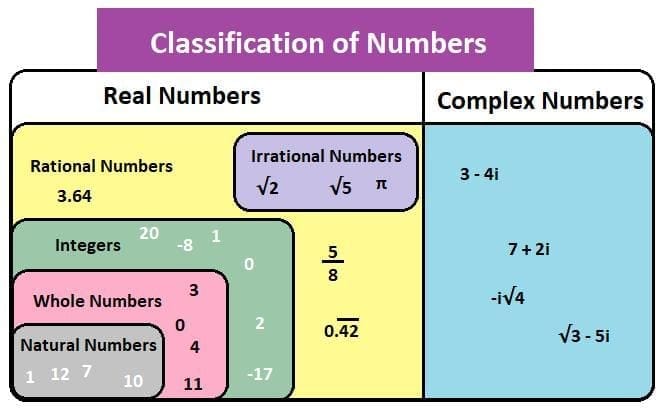
Natural Numbers (N): Counting numbers starting from 1 → {1,2,3,...}
Whole Numbers (W): Natural numbers + 0 → {0,1,2,...}
Integers (Z): Whole numbers + negatives → {...,-2,-1,0,1,2,...}
Rational Numbers (Q): Numbers that can be expressed as p/q where p and q are integers, q ≠ 0. Example: 1/2, -7/3, 0.75
Irrational Numbers: Cannot be expressed as p/q. Decimal is non-terminating and non-repeating. Example: √2, π
Real Numbers (R): Rational ∪ Irrational
Important GMAT Notes:
1 is neither prime nor composite.
Prime numbers have exactly 2 factors; composites have more than 2.
Even/Odd: Even divisible by 2; odd not divisible by 2.
Mini Example:
Which set does -3.5 belong to? → Rational Numbers
2. Divisibility & Remainders
Rule: Quickly test divisibility and calculate remainders without full division.
Divisibility Rules:
2 → last digit even
3 → sum of digits divisible by 3
4 → last 2 digits divisible by 4
5 → last digit 0 or 5
6 → divisible by 2 & 3
9 → sum of digits divisible by 9
10 → last digit 0
Remainder Formula:
Dividend=(Divisor×Quotient)+Remainder,0≤R<Divisor
Mini Example:
Find remainder when 234 is divided by 9: sum of digits = 2+3+4=9 → divisible → remainder = 0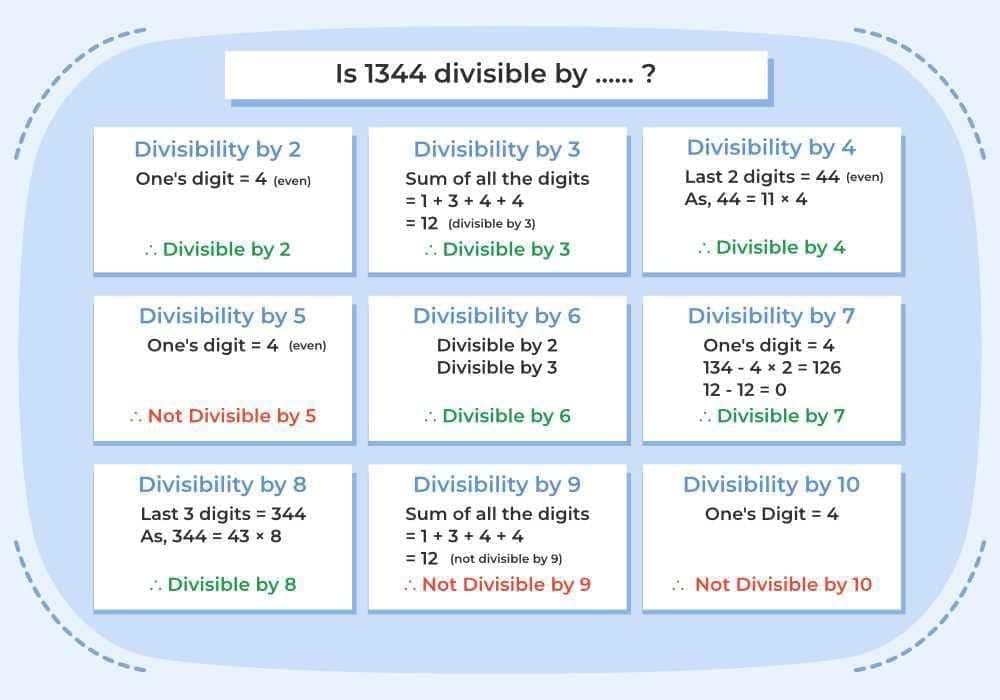
3. HCF (GCD) & LCM
Rule: Use prime factorisation and the formula for fast calculation.
HCF (GCD): Multiply all common prime factors with smallest powers
LCM: Multiply all prime factors with highest powers
Relationship:
a×b=HCF(a,b)×LCM(a,b)
Co-prime: HCF(a,b) = 1; if numbers are co-prime and divisible by some x, then divisible by their product × x.
Mini Example:
HCF of 12 & 18 → 12=2²×3¹, 18=2¹×3² → HCF = 2¹×3¹ = 6
LCM = 2²×3² = 36
4. Cyclicity & Unit Digit Patterns
Rule: The last digit of powers of numbers follows a repeatable pattern.
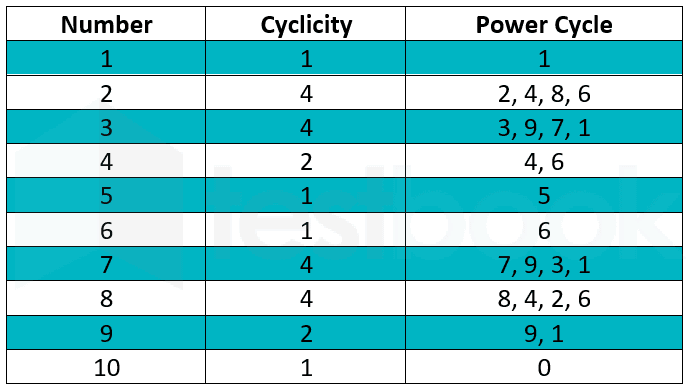
Unit-digit cycles:
0,1,5,6 → cycle 1 (last digit same)
4,9 → cycle 2
2,3,7,8 → cycle 4
Use this for finding last digits of large powers or remainders modulo 10.
Mini Example:
Last digit of 7⁴: Cycle of 7 → 7,9,3,1 → 7⁴ last digit = 1
Last digit of 2¹⁰⁰: 2,4,8,6 cycle → 100 mod 4 = 0 → last digit = 6
5. Factorials & Trailing Zeroes
Rule: Trailing zeroes come from factors of 10 (2×5).
Formula to count trailing zeroes in n!
Number of zeroes=⌊5n⌋+⌊25n⌋+⌊125n⌋+...
Only count multiples of 5 (2s are always more).
Mini Example:
Trailing zeroes in 100! = ⌊100/5⌋ + ⌊100/25⌋ = 20 + 4 = 24
6. Base Systems & Number Line
Rule: Be comfortable with base conversions and number line properties.
Base Conversion:
Number=∑(Digit×BasePosition)
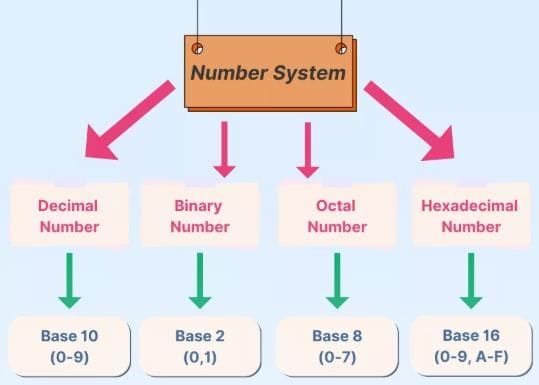
Common bases: Binary (2), Octal (8), Decimal (10), Hexadecimal (16)
Number Line: Distance between a & b → |a-b|
Absolute value: |a| = a if a ≥ 0, = -a if a < 0
Perfect Numbers: Sum of proper divisors = number (6, 28...)
Mini Example:
Convert 1011₂ to decimal → 1×2³ + 0×2² + 1×2¹ +1×2⁰ = 8+0+2+1=11
FAQs on 6 Golden Rules for Number System
| 1. What are the different classifications of numbers in the number system? |  |
| 2. How do divisibility rules help in solving number system problems? | |
| 3. What is the significance of HCF (GCD) and LCM in mathematics? | |
| 4. What is cyclicity and how does it relate to unit digit patterns? | |
| 5. How do trailing zeroes in factorials get calculated? | |