6 Golden Rules for Two Part Analysis


Introduction
Two-Part Analysis questions appear in both Quantitative and Verbal Reasoning sections. They assess your ability to evaluate two interrelated parts simultaneously and select the correct combination that satisfies all conditions.
Unlike standard multiple-choice questions, each part has multiple answer choices, and your solution requires picking the correct pair - one choice for each part. Success depends on reading carefully, analyzing constraints, and systematic elimination.
1. Read Carefully & Identify Both Parts
Begin by reading the question thoroughly. Identify what each part is asking.
Determine whether the two parts are dependent (one influences the other) or independent (solved separately).
Highlight explicit constraints and any hidden relationships that link the two parts.
Underline key phrases such as "must be divisible by," "cannot exceed," or "exactly one of."
Example:
Part A: Identify the even number.
Part B: Identify the number divisible by 3.
→ Each number must satisfy both criteria to form a valid pair.
2. Analyze Constraints First
List all restrictions, conditions, and rules clearly.
Identify mandatory criteria that a valid combination must satisfy.
Use constraints to eliminate impossible options early, which reduces cognitive load.
Pay attention to both numerical constraints (divisibility, sum, difference) and logical constraints (exclusions, dependencies).
Example:
If Part A must be a multiple of 4 and Part B must be a prime number, any combination where Part B is not prime can be immediately discarded.
3. Consider All Combinations Systematically
List all possible choices for Part A and Part B in a structured format, such as a table or matrix.
Evaluate each combination against the constraints and mark whether it is valid or invalid.
Focus only on combinations that satisfy all conditions; discard those that violate any rule.
This approach ensures you systematically cover all possibilities without missing the correct pair.
Example: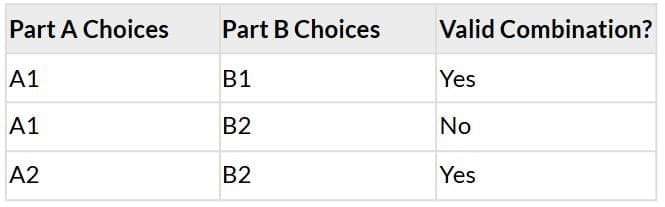
4. Use Logical Deduction, Not Guesswork
Instead of testing randomly, use reasoning to narrow options.
Ask yourself: "If this is Part A, what must Part B be?" or "Which choice violates a rule?"
Apply elimination based on constraints first, then confirm the remaining pair.
Avoid relying solely on computation; often the GMAT tests conceptual reasoning over arithmetic.
Example:
If a number must be even (Part A) and a multiple of 3 (Part B), you can eliminate all odd numbers immediately without further calculation.
5. Look for Patterns & Relationships
Quantitative Two-Part Analysis often involves numbers, ratios, sequences, divisibility, or probability.
Spot recurring patterns, shortcuts, or relationships to reduce computation.
Mental math or divisibility rules can save time.
For logic-based questions, map relationships visually (diagrams or charts).
Example:
Part A: 2-digit numbers divisible by 4
Part B: Numbers where the sum of digits is divisible by 3
→ Only numbers meeting both criteria form valid pairs. Recognizing divisibility patterns allows rapid elimination.
6. Confirm the Unique Pair
GMAT Two-Part Analysis generally has one correct combination.
After identifying a potential valid pair, check all other possibilities to ensure no alternative satisfies all conditions.
Avoid partial matches where only one part meets the criteria - both must satisfy all constraints simultaneously.
Double-check for hidden dependencies between the parts.
Example:
After selecting Part A = 12 and Part B = 9 as a valid pair, verify that no other pair (e.g., 8 & 9 or 12 & 6) meets all the given rules.
Tips for GMAT Two-Part Analysis
Begin with the most restrictive condition to narrow options quickly.
Use elimination tables for multiple-choice combinations.
Double-check pairs to ensure both parts satisfy every condition.
Practice a variety of question types: numbers, probability, logic puzzles, geometry, ratios.
Keep track of constraints and cross-check systematically for accuracy.
FAQs on 6 Golden Rules for Two Part Analysis
| 1. What is the purpose of the Two-Part Analysis in the GMAT? |  |
| 2. How should one approach the constraints in a Two-Part Analysis question? | |
| 3. What techniques can be used to identify patterns in Two-Part Analysis questions? | |
| 4. Why is logical deduction preferred over guesswork in solving Two-Part Analysis questions? | |
| 5. What steps should be taken to confirm the unique pair in a Two-Part Analysis question? | |