CBSE Class 9 > Class 9 Notes > Science > Cheat Sheet: Force and Laws of Motion
Cheat Sheet: Force and Laws of Motion


Introduction
Force: Push/pull that changes motion state, speed, direction, or shape.
Not visible, but effects are (e.g., ball moves when kicked).
Balanced and Unbalanced Forces
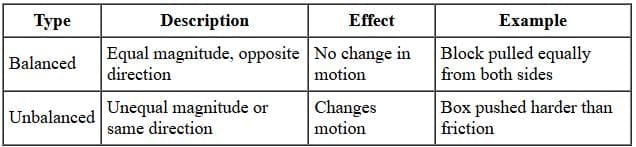
Friction: Opposes motion (e.g., bicycle slows when not pedaling).
Galileo's Observation
- Objects move forever on frictionless surface if no unbalanced force.
- Rest not natural; uniform motion is (if no net force).
Newton's Laws of Motion
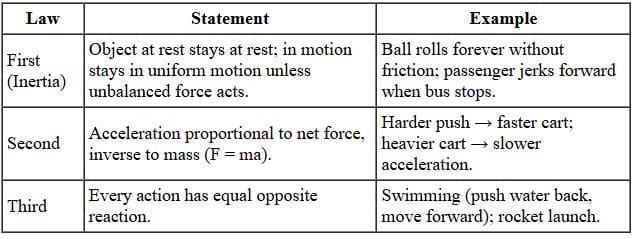
Inertia
Resistance to motion change.
Types: Rest (stationary), Motion (moving), Direction.
Mass measures inertia (more mass → more inertia).
Momentum
p = m × v (vector). Second law: F = Δp / Δt = m(v - u)/t = ma.
Unit: kg m/s. Larger mass/velocity → larger momentum.
Conservation of Momentum
Total momentum before = after (isolated system, no external force).
Example: Gun recoil - Bullet forward momentum = Gun backward momentum.
Formula: m₁u₁ + m₂u₂ = m₁v₁ + m₂v₂
The document Cheat Sheet: Force and Laws of Motion is a part of the Class 9 Course Science Class 9.
All you need of Class 9 at this link: Class 9
FAQs on Cheat Sheet: Force and Laws of Motion
| 1. What are balanced and unbalanced forces? |  |
Ans. Balanced forces are two or more forces acting on an object that are equal in size but opposite in direction, resulting in no change in the object's motion. Unbalanced forces occur when the forces acting on an object are not equal, causing the object to accelerate in the direction of the net force.
| 2. How did Galileo's observations contribute to our understanding of motion? | |
Ans. Galileo's observations revealed that objects in motion tend to stay in motion unless acted upon by an external force. He demonstrated that the motion of falling objects is independent of their mass, challenging the prevailing beliefs of his time that heavier objects fall faster.
| 3. What are Newton's Laws of Motion? | |
Ans. Newton's Laws of Motion are three fundamental principles that describe the relationship between the motion of an object and the forces acting on it. The first law states that an object at rest stays at rest and an object in motion stays in motion unless acted upon by a net external force (law of inertia). The second law states that the acceleration of an object is directly proportional to the net force acting on it and inversely proportional to its mass. The third law states that for every action, there is an equal and opposite reaction.
| 4. What is inertia and how does it relate to motion? | |
Ans. Inertia is the property of an object to resist changes in its state of motion. An object at rest will remain at rest, and an object in motion will continue moving in a straight line at a constant speed unless acted upon by an external force. Inertia is directly related to the mass of the object; the greater the mass, the greater the inertia.
| 5. What is momentum and how is it conserved in a closed system? | |
Ans. Momentum is the product of an object's mass and its velocity, represented mathematically as p = mv. In a closed system, where no external forces act, the total momentum before an event (such as a collision) is equal to the total momentum after the event. This principle is known as the conservation of momentum, indicating that momentum cannot be created or destroyed, only transferred between objects.
About this Document

4.90/5 Rating

Apr 18, 2026 Last updated
Document Description: Cheat Sheet: Force and Laws of Motion for Class 9 2026 is part of Science Class 9 preparation. The notes and questions for Cheat Sheet: Force and Laws of Motion have been prepared according to the Class 9 exam syllabus. Information about Cheat Sheet: Force and Laws of Motion covers topics like and Cheat Sheet: Force and Laws of Motion Example, for Class 9 2026 Exam. Find important definitions, questions, notes, meanings, examples, exercises and tests below for Cheat Sheet: Force and Laws of Motion.
Introduction of Cheat Sheet: Force and Laws of Motion in English is available as part of our Science Class 9 for Class 9 & Cheat Sheet: Force and Laws of Motion in Hindi for Science Class 9 course. Download more important topics related with notes, lectures and mock test series for Class 9 Exam by signing up for free. Class 9: Cheat Sheet: Force and Laws of Motion
Description
Cheat Sheet: Force & Laws of Motion of Science Class 9 to help you remember important concepts with short tricks. Start learning for Class 9 exam & improve retention with EduRev.
Information about Cheat Sheet: Force and Laws of Motion
In this doc you can find the meaning of Cheat Sheet: Force and Laws of Motion defined & explained in the simplest way possible. Besides explaining types of Cheat Sheet: Force and Laws of Motion theory, EduRev gives you an ample number of questions to practice Cheat Sheet: Force and Laws of Motion tests, examples and also practice Class 9 tests



Related Searches
MCQs, Cheat Sheet: Force and Laws of Motion, shortcuts and tricks, Previous Year Questions with Solutions, Cheat Sheet: Force and Laws of Motion, mock tests for examination, Important questions, Sample Paper, past year papers, pdf , Free, Exam, Semester Notes, Viva Questions, ppt, Objective type Questions, Cheat Sheet: Force and Laws of Motion, study material, Summary, Extra Questions, video lectures, practice quizzes;