Research, Research Questions and Objectives Types of Research


Introductiuon
Research is a careful, systematic and planned investigation undertaken to increase the stock of knowledge and to use this knowledge to solve problems. The word research can be seen as Re + search - a journey from the known to the unknown. It uses scientific methods to collect and analyse data objectively, to verify theories, to discover new facts, and to expand the limits of understanding in any branch of knowledge.
Definitions
- Encyclopaedia of Social Sciences: Research is the manipulation of things, concepts or symbols for the purpose of generalisation to extend, correct or verify knowledge whether that knowledge aids in the construction of a theory or in the practice of an art.
- Best & Kahn (Research in Education): Research is the systematic and objective analysis and recording of controlled observations that may lead to the development of generalisations, principles or theories, resulting in prediction and possibly ultimate control of events.
- Busha (Research Methods in Librarianship): Research is a systematic quest for knowledge that is characterised by disciplined enquiry; an efficient and effective approach to expanding knowledge is the conduct of special, planned and structured investigations.
- Goode & Hatt: Research is a systematic method of discovering new facts and verifying old ones with their sequence, interrelationship and causal explanation.
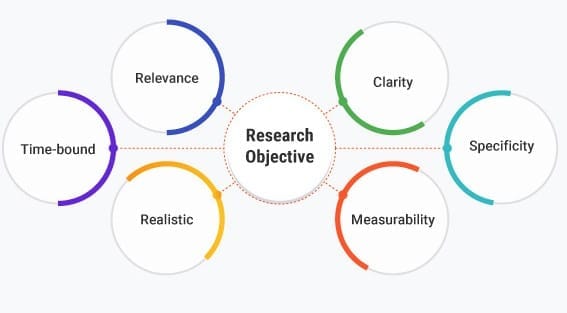
Objectives of Research
- Generate new knowledge - expand theoretical understanding and practical information.
- Solve problems - offer solutions to practical or social problems through investigation.
- Test hypotheses - examine causal relationships between variables.
- Verify and validate - confirm the acceptability of theories or findings.
- Describe phenomena - portray accurately the characteristics of persons, situations or groups.
- Diagnose - determine the frequency or association of events or conditions.
- Develop procedures and instruments - construct new methods, tools or measures.
- Inform policy and practice - provide evidence for decision-making, planning and evaluation.
Characteristics of Good Research
- Objectivity: Results are not influenced by the researcher's personal feelings or bias; the process and interpretation are impartial.
- Systematic: Research follows a planned and orderly procedure from problem formulation to conclusion.
- Logical: Conclusions are based on sound reasoning and consistent with the data.
- Empirical: Research is grounded in observable and verifiable evidence from real-life experience or experiment.
- Reliability: The degree to which a measure produces consistent results on repeated trials.
- Validity: The extent to which the research measures what it intends to measure and is free from systematic error.
- Accuracy: Choice of appropriate tools and procedures that yield precise and correct measurements.
- Generalizability: The extent to which findings from a sample can be applied to the wider population.
- Replicability: The study can be repeated by other researchers and yield similar results when conducted under similar conditions.
- Ethical: Research protects the rights, dignity and welfare of participants and adheres to accepted ethical standards.
Types of Validity
- Internal validity: The extent to which observed effects in a study are due to the manipulated variables and not to other factors; it is often referred to as credibility and is central to experiments.
- External validity: The degree to which study results can be generalised to other settings, people, times and measures; also called generalisability.
- Content validity: A qualitative judgement about how well a measure covers all facets of a construct or domain.
- Construct validity: How well a test or instrument measures the theoretical construct it claims to measure.
- Face validity: A superficial assessment of whether a measure appears to measure what it intends to; also called logical validity.
- Criterion validity: How well one measure predicts an outcome based on another established measure; it includes concurrent validity and predictive validity.
- Concurrent validity: Correlation of a new measure with an established measure taken at the same time.
- Predictive validity: The ability of a measure to predict future outcomes or behaviour.
Types of Reliability
- Test-retest reliability: Stability of a measure over time.
- Internal consistency: Degree to which items within a test measure the same construct (for example, Cronbach's alpha).
- Inter-rater reliability: Agreement between different observers or raters.
Research Questions
A research question is a clear, focused and researchable query that the study seeks to answer. It guides the choice of methods, data collection and analysis. A well-formulated research question narrows the topic to a specific issue and specifies the population, variables and context where appropriate.
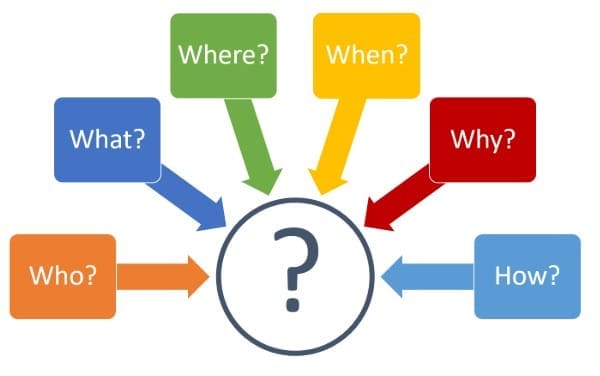
Features of a Good Research Question
- Clear - easy to understand and unambiguous.
- Focused - narrow enough to be answerable within the study's scope.
- Researchable - possible to investigate with available methods and resources.
- Specific - identifies variables, population and context where needed.
- Feasible - achievable within time, budget and ethical constraints.
- Significant - contributes to knowledge or practice.
Research questions differ by approach:
- Qualitative questions often begin with "how" or "why" and seek to explore meanings or processes (for example, "How do first-generation college students experience academic support services?").
- Quantitative questions are usually structured to test relationships or differences (for example, "Does training improve teachers' classroom management scores?").
- Mixed-methods combine both exploratory and confirmatory elements (for example, "What are teachers' perceptions of the training, and does their performance data improve after training?").
Research Objectives
Research objectives state the purpose of the study and specify what the researcher intends to achieve. Objectives are closely linked to research questions and guide the methodology and analysis.

Types and Formulation of Objectives
- General (primary) objective: Gives the overall aim of the research in broad terms.
- Specific (secondary) objectives: Break the general objective into precise, measurable sub-goals that can be addressed through data collection and analysis.
- Exploratory objectives: Aim to gain familiarity or new insights about a relatively unknown phenomenon.
- Descriptive objectives: Aim to portray characteristics of a population, situation or phenomenon accurately.
- Diagnostic objectives: Aim to determine frequency, association or distribution of variables.
- Explanatory or causal objectives: Aim to test hypotheses about cause-effect relationships between variables.
- Evaluative objectives: Aim to assess the effectiveness of programmes, policies or interventions.
- SMART objectives: Specific, Measurable, Achievable, Relevant and Time-bound - a useful guideline when writing objectives.
Example linking research question and objectives:
- Research question: "Does participation in a remedial reading programme improve reading scores of Class 5 students?"
- General objective: To evaluate the effect of the remedial reading programme on reading achievement of Class 5 students.
- Specific objectives: To compare pre- and post-programme reading scores; to examine whether effects differ by baseline ability; to document teachers' implementation fidelity.
Types of Research
Research can be classified in several ways depending on purpose, method, time frame and setting. The classification below summarises commonly used types with brief explanations and examples.
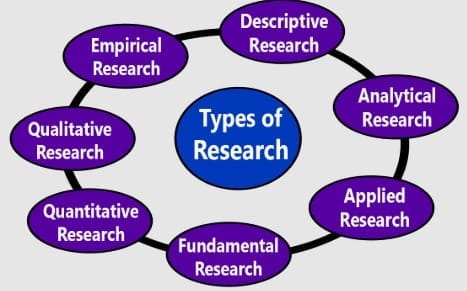
By Purpose
- Basic (fundamental, pure) research: Seeks to advance theoretical knowledge without immediate practical application. Example: studying cognitive processes underlying memory.
- Applied research: Aims to solve specific, practical problems. Example: developing a cost-effective irrigation method.
- Action research: Conducted by practitioners to improve their own practice through iterative cycles of planning, action and reflection. Example: a teacher testing classroom strategies to improve student engagement.
- Evaluation research: Systematic assessment of programmes, policies or products to judge their effectiveness. Example: impact evaluation of a school nutrition programme.
By Method or Approach
- Qualitative research: Emphasises understanding meanings, experiences and processes using methods such as interviews, focus groups, participant observation, case studies and thematic analysis. Example: ethnography of a community group.
- Quantitative research: Emphasises measurement and numerical analysis using surveys, experiments and statistical tests to test hypotheses and estimate relationships. Example: a randomised controlled trial measuring intervention effects.
- Mixed-methods research: Combines qualitative and quantitative approaches to provide a broader understanding. Example: a survey measuring prevalence combined with interviews to explore reasons behind responses.
By Research Design
- Experimental research: Researcher manipulates an independent variable and observes the effect on a dependent variable under controlled conditions. Example: laboratory experiments or field experiments.
- Quasi-experimental research: Similar to experiments but lacks random assignment; used when randomisation is not feasible.
- Correlational research: Examines relationships between variables without implying causation.
- Survey research: Uses questionnaires or interviews to collect data from a large population sample; common in descriptive and analytical studies.
- Case study: In-depth study of a single case (an individual, group, organisation or event) to explore complex issues in real-life context.
- Ethnography: Detailed study of cultures or communities through prolonged observation and participation.
- Grounded theory: Method for generating theory from systematically gathered qualitative data.
- Content and document analysis: Systematic analysis of text, media, or documents to identify patterns and meanings.
By Time Dimension
- Cross-sectional research: Data are collected at a single point in time from different subjects.
- Longitudinal research: The same subjects are studied repeatedly over a period to observe change or development (panel studies, cohort studies).
By Setting
- Laboratory research: Conducted in controlled settings where extraneous variables can be minimised.
- Field research: Conducted in natural settings where behaviours occur organically.
Choosing the Appropriate Type of Research
Match the type of research with the research question and objectives. Consider these factors when choosing a design:
- The nature of the question (exploratory, descriptive, causal or evaluative).
- Available resources (time, budget, personnel).
- Ethical constraints and feasibility.
- Type of data required (numerical vs textual), and the level of control needed to establish causality.
- Required generalisability and the population to which you wish to apply the findings.
Link between Research Question, Objectives and Methods
A clear research question leads to precise objectives, which in turn determine the methods. For example, to test a causal hypothesis you will usually need an experimental or quasi-experimental design with appropriate control of confounders and a reliable measurement strategy. To explore experiences or meanings you will use qualitative methods such as interviews or observation.
Summary
Research is a systematic, objective and disciplined process for generating and validating knowledge. Well-formulated research questions and SMART objectives guide the choice of appropriate research types and methods. Understanding validity, reliability and other characteristics of good research helps ensure sound conclusions that can inform theory, policy and practice.
FAQs on Research, Research Questions and Objectives Types of Research
| 1. What are the main objectives of research? |  |
| 2. What characteristics define good research? | |
| 3. How do research questions relate to research objectives? | |
| 4. What are the different types of research? | |
| 5. How can one choose the appropriate type of research? | |