Cheat Sheet: National Education Policy (NEP)


Introduction
The National Education Policy (NEP) aims to transform India's education system to make it holistic, flexible, multidisciplinary and aligned with 21st-century skills. It replaced the NEP 1986 and focuses on child-centered, inclusive, competency-based education.
Key Objectives of NEP
Universal access to education for all.
Focus on Foundational Literacy & Numeracy (FLN).
Reduce rote learning and promote critical thinking.
Flexible curriculum and multidisciplinary approach.
Use of mother tongue/regional language as medium of instruction.
Technology integration in education.
Promote inclusive and equitable education.
Focus on teacher training and professional development.
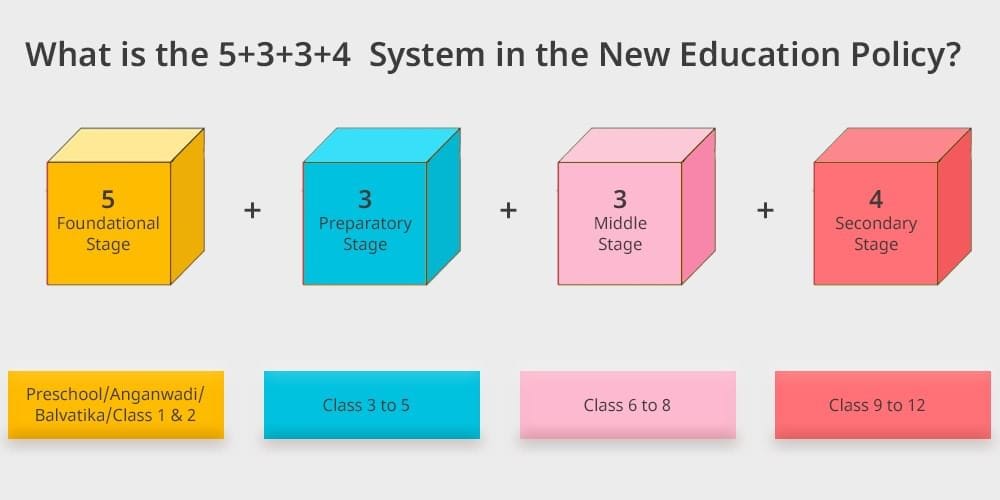
New School Structure (5+3+3+4)
Replaces the old 10+2 system.
Foundational Literacy and Numeracy (FLN)
Top priority of NEP.
FLN Mission: NIPUN Bharat.
Goal: Every child should achieve literacy and numeracy by Grade 3.
Language Policy
Mother tongue/regional language encouraged till Grade 5 (preferably till Grade 8).
Three-Language Formula continues.
Importance of Indian languages & culture.
Assessment Changes
Old system: Mainly rote-based
New system: Competency-based assessment
Focus on conceptual understanding.
Use of Formative Assessment over Summative Assessment.
Board Exams to be made easier with two attempts:
Objective type + descriptive
Can be taken twice a year
Progress Cards will include 360° Holistic Report: academics + skills + values + extracurricular activities.
Vocational Education
Introduced from Class 6 onwards.
Includes internships & practical training.
Students learn skills like carpentry, gardening, coding, etc.
Teacher Training & Development
Integrated B.Ed. - 4 years compulsory for teaching by 2030.
Focus on continuous professional development.
Teachers to be trained in pedagogy, technology & inclusive education.
Mentoring system for new teachers.
Inclusive Education
Focus on children with special needs.
Use of assistive technology & trained teachers.
Gender inclusion, socio-economic equity, and rural education.
Support for dropouts and migrant children.
Technology in Education
Digital learning platforms (e.g., DIKSHA, SWAYAM).
Smart classrooms, online training, AI-based tools.
Use of ICT for interactive learning.
Higher Education Reforms
Multidisciplinary institutions.
Multiple Entry-Exit system (certificate after 1 year, diploma after 2 years, degree after 3/4 years).
Focus on research & innovation.
Academic Bank of Credits (ABC) system to store credits digitally.
Regulatory Changes
Old Structure → Many regulatory bodies
New Structure → Single regulator:
Higher Education Commission of India (HECI)
Conclusion
NEP 2020 marks a major shift towards holistic, flexible, inclusive, skill-based, and learner-centered education. It focuses on critical thinking, creativity, vocational skills, technology, and teacher development to prepare students for the future.
FAQs on Cheat Sheet: National Education Policy (NEP)
| 1. What are the key objectives of the National Education Policy (NEP)? |  |
| 2. Can you explain the new school structure introduced by the NEP? | |
| 3. What is the emphasis on Foundational Literacy and Numeracy (FLN) in the NEP? | |
| 4. How does the NEP address vocational education? | |
| 5. What changes in assessment methods are proposed in the NEP? | |




