Cheat Sheet: National Curriculum Framework (NCF)


1. Introduction
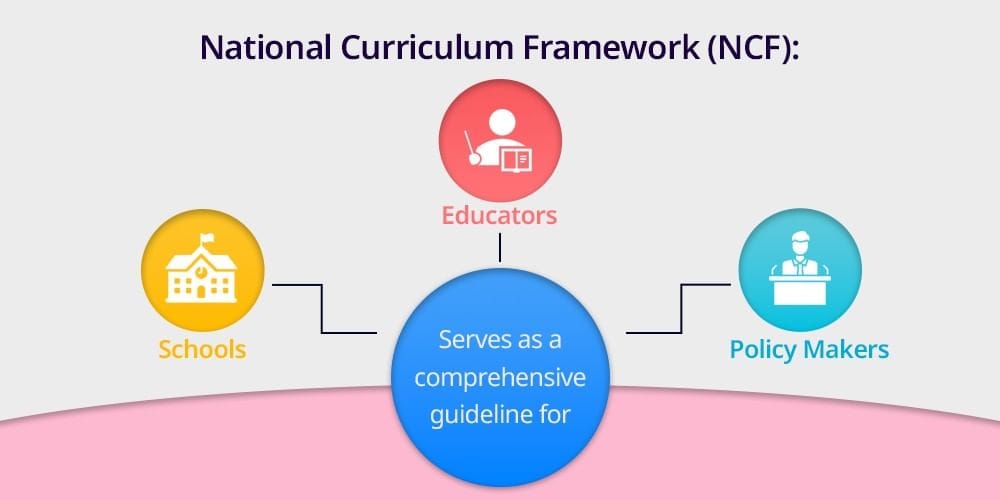
The National Curriculum Framework (NCF) 2023 is developed under the vision of NEP 2020. It provides a guideline for curriculum, teaching methods, assessments, textbooks, and overall educational structure from preschool to Class 12.
It aims to create:
Competency-based education
Holistic development of learners
Multidisciplinary & skill-based learning
Strong foundational learning
Indian values with global outlook
2. Purpose of NCF 2023
To implement NEP 2020 in schools.
Provide guidelines for textbooks, assessment, pedagogies, and learning outcomes.
Shift focus from rote learning to experiential and meaningful learning.
Make education more inclusive, flexible, and relevant to real life.
Promote critical thinking, creativity, problem-solving, collaboration, and values.
3. School Structure (Aligned with 5+3+3+4 Pattern)
| Stage | Classes | Age Group | Focus |
|---|---|---|---|
| Foundational | Balvatika & Classes 1-2 | 3-8 yrs | Play-based & discovery learning |
| Preparatory | Classes 3-5 | 8-11 yrs | Conceptual clarity & basic skills |
| Middle | Classes 6-8 | 11-14 yrs | Abstract thinking & exploration |
| Secondary | Classes 9-12 | 14-18 yrs | Critical thinking, career & life skills |
NCF 2023 ensures smooth transition between stages and focuses on appropriate pedagogy for each level.
4. Key Principles of NCF 2023
Child-Centered & Inclusive Education
Competency-Based Learning
Integration of Indian Knowledge Systems
Flexible & Multidisciplinary Curriculum
Play-based and activity-based learning at early stages
Reduced curriculum load - focus on core concepts
Focus on Skill Development & vocational education
Technology integration (ICT, AI tools, digital labs)
Holistic progress - not just academics
Mother tongue/regional language as medium of instruction in early years
5. Foundational Stage Reforms
Introduction of BALVATIKA (Pre-primary): 3 levels.
Focus on FLN - Foundational Literacy & Numeracy.
NIPUN Bharat mission implemented.
Emphasis on:
Play-based learning
Storytelling
Local culture and art
Physical & emotional development
6. Changes in Textbooks & Curriculum
Textbooks will be lighter, activity-based, and real-life linked.
Use of local context, Indian examples, stories, folk traditions.
Focus on learning outcomes, not just content.
Integration of life skills, values, and social responsibility.
7. Pedagogical Approaches Recommended
Activity-based learning
Inquiry & exploration-based
Collaborative group learning
Project-based learning
Experiential learning
Use of TLMs (Teaching-Learning Materials)
Assessment-integrated teaching (Learning-by-doing)
8. Assessment Reforms
Board exams will become easier & skill-based.
Use of Formative Assessment more than Summative Assessment.
Focus on application & understanding, not memorization.
360° Holistic Progress Card will include:
Academic performance
Skills & values
Physical activities
Art and cultural participation
Emotional well-being
Multiple choice + descriptive questions
Two board exam attempts per year
Focus on overall development, not marks only
9. Multilingualism in Education
Mother tongue/regional language preferred till Grade 5 (preferably Grade 8).
Three-Language Formula continues.
Development of bilingual textbooks.
Encourages love for Indian languages & classical literature.
10. Vocational & Skill Education
Starts from Class 6 onwards.
Every student must learn at least one vocational skill.
Internships will be encouraged.
Includes:
Coding
Handicrafts
Gardening
Local trades
Digital skills & entrepreneurship
FAQs on Cheat Sheet: National Curriculum Framework (NCF)
| 1. What is the purpose of the National Curriculum Framework (NCF)? |  |
| 2. How is the school structure aligned with the 5+3+3+4 pattern? | |
| 3. What are the key principles outlined in NCF 2023? | |
| 4. What reforms are suggested for the Foundational Stage in NCF 2023? | |
| 5. How does NCF 2023 address assessment reforms? | |




