Sure Shot Questions: Staffing

Introduction
Based on a detailed analysis of Previous Year Questions (PYQs) from CBSE Board exams over the last several years, we have compiled a list of questions that are most likely to appear again in the upcoming exam. These predictions aren't just guesses-they're derived from how frequently these questions have been repeated, the pattern in which CBSE frames them, and the core topics that are repeatedly tested year after year.
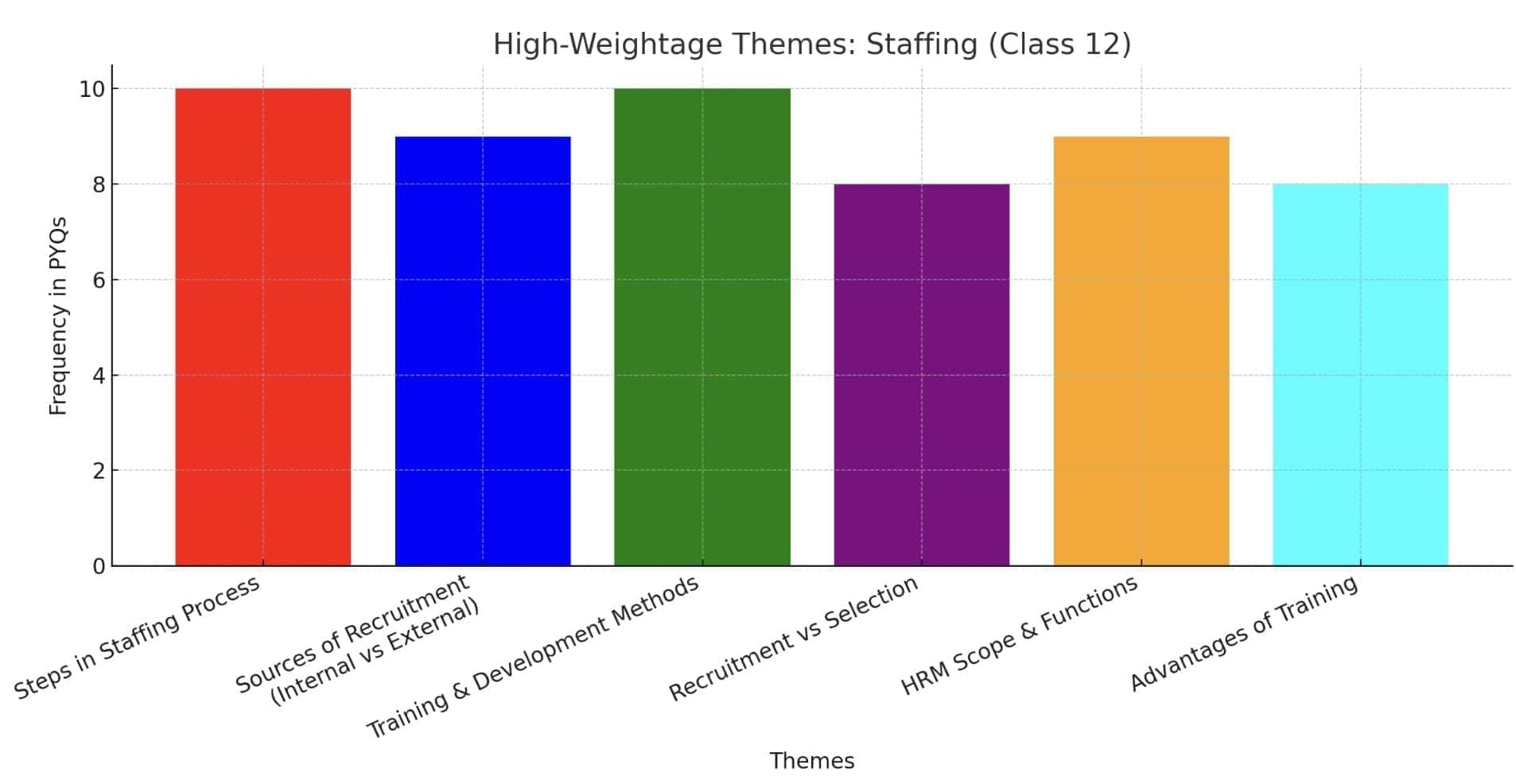
Key Questions
Q1: Why is an "employment interview" conducted in the selection process?
Ans: The employment interview is a crucial step in the selection process where the interviewer evaluates the candidate's suitability for the job by seeking detailed information about their qualifications, skills, experience, personality and career goals. It helps assess the candidate's communication abilities, problem-solving skills and cultural fit with the organisation. Additionally, it allows the interviewer to check the alignment between the person's expectations and the job requirements, ensuring a mutual match that reduces turnover and enhances performance. Through structured or unstructured questions, the interview provides insights beyond resumes, helping make informed hiring decisions.
Q2: What is the managerial function called that involves filling and maintaining positions in the organisation structure?
Ans: Staffing. It is the management function focused on acquiring, deploying, developing and retaining human resources to achieve organisational goals. Staffing ensures the right people with appropriate skills are placed in suitable positions at the right time, involving activities like manpower planning, recruitment, selection, training and performance appraisal. This function maintains a balance between the organisation's needs and employee capabilities, contributing to efficiency and productivity.
Q3: "Staffing makes for higher performance by putting the right person on the right job". Is this statement true or false? Justify.
Ans: True. Staffing ensures higher performance by matching employee skills, knowledge and abilities with job requirements through proper recruitment and selection. This leads to better job fit, increased motivation, reduced errors, higher productivity and lower turnover. When the right person is placed on the right job, it optimises resource utilisation, enhances job satisfaction and contributes to overall organisational efficiency and goal achievement.
Q4: Apha Enterprises has a functional structure with key functions in Production, Marketing, Finance and HR. To meet rising demand, what concept will help the HR Manager determine the number of people needed for each department?
Ans: Workload Analysis. This concept involves forecasting the volume and complexity of work in each department based on planned output, production schedules and efficiency standards. The HR Manager calculates the manpower requirement by dividing total work by standard time per unit, considering factors like absenteeism and overtime. This ensures accurate staffing levels, preventing overstaffing (waste of resources) or understaffing (delays in production), and aligns human resources with organisational growth needs.
Q5: Why is the "Aptitude Test" conducted in the process of selection?
Ans: The Aptitude Test is conducted to measure a candidate's innate potential and capacity to learn new skills, acquire knowledge and adapt to job demands. Unlike achievement tests that assess past learning, aptitude tests predict future performance by evaluating abilities like numerical reasoning, verbal comprehension and logical thinking. This helps identify candidates who can quickly master job-specific tasks, reducing training costs and time, and ensuring long-term success in dynamic roles.
Q6: "This involves recruiting, selecting, developing, utilising, compensating, and motivating an organisation's human resources." Name the concept.
Ans: Human Resource Management (HRM). HRM is the strategic and coherent approach to managing an organisation's most valued assets - its people. It encompasses all activities from manpower planning and recruitment to performance appraisal, training, compensation, employee relations and career development. HRM treats employees as assets to be invested in, aiming to enhance their contributions towards achieving organisational objectives while fulfilling individual career aspirations.
Q7: What is the next step after selection in the staffing process?
Ans: Placement and Orientation. Placement involves assigning the selected candidate to the specific job and work group, ensuring optimal utilisation of their skills. Orientation (induction) follows, introducing the new employee to the organisation's culture, policies, procedures, colleagues and facilities. This step reduces initial anxiety, accelerates adjustment and boosts early productivity by familiarising the employee with expectations and resources.
Q8: It seeks to attract suitable applicants to apply for available jobs. Give the term.
Ans: Recruitment. Recruitment is the positive process of identifying, attracting and encouraging qualified candidates to apply for job vacancies. It widens the pool of applicants through sources like advertisements, employment exchanges and campus placements, ensuring the organisation receives diverse talent to choose from during selection.
Q9: These are managed by the Government to hire individuals for both unskilled and skilled operational positions. What is being talked about?
Ans: Employment Exchanges. These are government-run agencies that register job seekers and match them with vacancies notified by employers. They provide a database for unskilled, semi-skilled and skilled workers, facilitating recruitment for operational roles while promoting fair employment practices and reducing unemployment.
Q10: Which type of personnel do management consultancy firms recruit?
Ans: Technical, professional and managerial personnel. Management consultancy firms specialise in sourcing high-level talent like engineers, consultants, executives and specialists for strategic roles, using their networks for headhunting and executive search to meet client needs for skilled leadership.
Q11: Why is induction not required in internal sources of recruitment?
Ans: Internal sources like promotions or transfers involve existing employees who are already familiar with the organisation's policies, culture, processes and colleagues. No formal induction is needed as they require minimal adjustment, allowing immediate contribution to the new role without orientation time.
Q12: State the meaning of placement as a staffing function.
Ans: Placement is the final step in staffing where the selected candidate is assigned to a specific job and introduced to the work environment. It involves matching the employee's skills with job demands to ensure optimal performance, reduce absenteeism and enhance job satisfaction by placing the right person in the right position.
Q13: It's a test employed in employee selection to gauge someone's ability to learn new skills. Name it and describe two other tests.
Ans: Aptitude Test - assesses potential to learn and adapt to new job skills through innate abilities like reasoning and problem-solving.
Other tests:
• Personality Test - evaluates traits, attitudes and behavioural patterns to predict job fit and team compatibility.
• Intelligence Test - measures general cognitive abilities like logical thinking and decision-making for complex roles.
Q14: Trainees are placed under supervision of experienced worker to gain advanced skills like plumbing. What training method is this?
Ans: Apprenticeship Programme. This on-the-job method involves trainees working under a master craftsman to learn specialised skills through hands-on experience, combining practical work with theoretical instruction, often with stipend (earn while learn).
Q15: Define Training. How is it different from Development?
Ans: Training is the systematic process of enhancing knowledge, skills and attitudes for a specific job role.
Difference: Training is short-term, job-oriented and focuses on current performance; Development is long-term, career-oriented and aims at overall personality and managerial growth.
Important Topics for Preparation
- Steps in Staffing Process (8 steps)
- Training Methods (On/Off-the-job - 4 each)
- Internal vs External Sources (merits, examples)
- Recruitment vs Selection
- Advantages of Training (to employee & organisation)
- HRM Scope & Functions
Tips for Preparation
- Visualise the staffing cycle: Create a flowchart for the 8 steps to recall effortlessly
- Tabulate sources: Prepare a comparison chart for internal/external recruitment with 3 merits/examples per side
- Case practice: Solve 5-10 scenarios identifying sources or methods to build analytical skills
- Differentiate key terms: Use mind maps for training/development vs recruitment/selection
- Review PYQs: Analyse last 8 years' papers, noting 75-85% recurrence in similar formats
FAQs on Sure Shot Questions: Staffing
| 1. What are the key components of staffing in commerce? |  |
| 2. How does recruitment differ from selection in the staffing process? | |
| 3. What are some effective strategies for employee retention? | |
| 4. Why is training and development important in staffing? | |
| 5. What role does performance appraisal play in staffing? | |