Sure Shot Questions: Organising

Introduction
After a comprehensive review of Previous Year Questions (PYQs) from CBSE Class 12 Board exams over the last several years and considering the consistent chapter weightage (usually 8-12 marks), we have curated this list of questions that are most likely to appear again. These are not random guesses - they are based on the exact frequency of repetition, question patterns used by CBSE, and the core topics that are tested year after year.
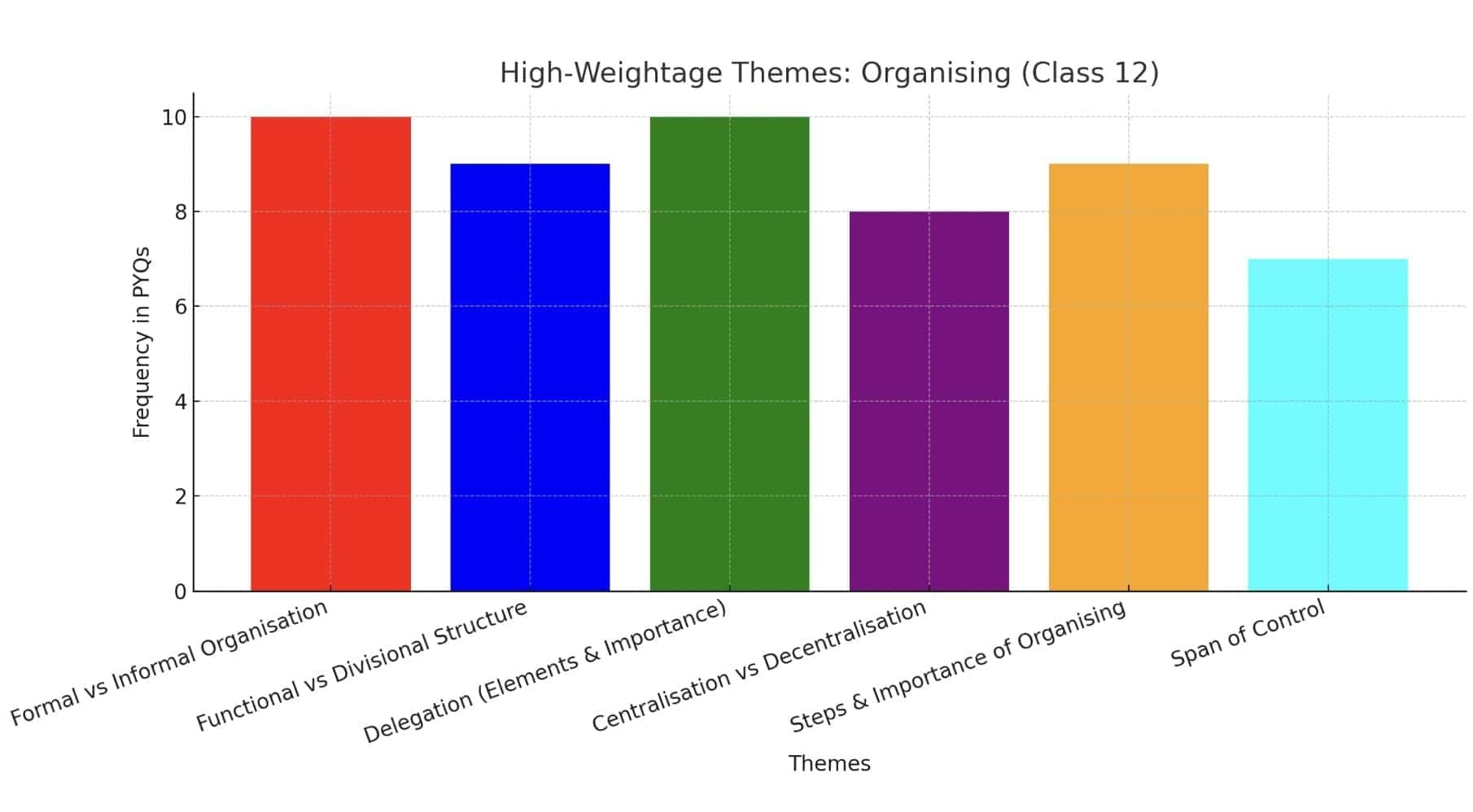
Key Questions
Q1: To make the annual function of the school successful, the principal divided all activities into task groups, each dealing with a specific area like rehearsals, decoration, stage management, refreshments, etc. Each group was placed under the overall supervision of a senior teacher. Identify the function of management performed by the Principal in doing so.
Ans: Organising. Organising is the process of identifying and grouping the work to be performed, assigning duties to job positions and establishing relationships to accomplish objectives. Here, the principal identified activities, formed groups, assigned specific tasks and placed them under supervision, creating a structured framework for the event's success.
Q2: Name the organisational structure which supports growing managerial and operational proficiency.
Ans: Functional structure. This structure groups activities by function (for example, production, marketing, finance), which encourages specialisation and improves managerial and operational proficiency. Employees focus on their specialised areas, leading to expertise development and efficiency.
Q3: What is meant by 'Decentralisation'?
Ans: Decentralisation is the systematic dispersal of decision-making authority from top management to middle and lower levels of management, enabling quicker decisions and better responsiveness to local conditions. It empowers subordinates, reduces top management's burden and fosters initiative.
Q4: Give the meaning of 'organising as a process'.
Ans: Organising as a process involves identifying and grouping the work to be performed, assigning duties to specific job positions and establishing authority and reporting relationships so that organisational objectives can be achieved efficiently. It creates a framework for coordination, resource allocation and control.
Q5: Name the type of organisational structure which promotes flexibility and initiative.
Ans: Divisional structure. It promotes flexibility and initiative because each division operates as a semi-autonomous unit, allowing managers to make decisions specific to their product, region or customer segment. This autonomy encourages innovation and quick adaptation.
Q6: Give the meaning of 'Delegation'.
Ans: Delegation is the process by which a manager assigns responsibility and transfers the necessary authority to a subordinate to carry out specific activities, while retaining accountability for the outcome. It enables division of work, employee development and efficient management.
Q7: Give the meaning of 'authority' as an element of delegation.
Ans: Authority is the right formally vested in a person to make decisions and to give orders necessary to carry out assigned responsibilities. When a manager delegates responsibility, he or she also delegates the authority required to perform the task. It flows from top to bottom.
Q8: Name the type of 'organisational structure' which promotes efficiency in the utilisation of manpower.
Ans: Functional structure. By grouping people according to specialised functions (for example, accounts, production, marketing), it promotes efficient utilisation of manpower and expertise. Specialisation leads to higher productivity and skill development.
Q9: Name the organisation which is deliberately created.
Ans: Formal organisation. It is deliberately designed with a defined structure of roles, responsibilities and authority to achieve organisational objectives. It follows planned hierarchy and rules.
Q10: Organising helps in the optimum utilisation of resources. Which type of resources does it refer to?
Ans: All types of resources - physical (raw materials, plant and equipment), financial (capital) and human resources (manpower, skills). Organising ensures efficient allocation and coordination.
Q11: Give any one importance of organising.
Ans: Organising provides clarity of roles and responsibilities, which helps avoid duplication of effort and enables efficient achievement of organisational objectives. It establishes who is accountable for what.
Q12: Divisional structure is more suitable for firms having several products, and each product has distinct features. Do you agree? Why?
Ans: Yes, I agree. Divisional structure is appropriate for firms with several distinct products, wide geographical coverage or varied customer segments. It organises the company into semi-autonomous divisions, each focusing on a product line or region, which improves flexibility, accountability and quicker decision-making tailored to each division's needs. This suits multi-product firms better than a functional structure.
Q13: Which term denotes "The number of subordinates that can be effectively managed by a superior"?
Ans: The Span of Management (or Span of Control). It refers to the number of subordinates a superior can manage effectively. It determines the width of the managerial layer and affects organisational height.
Q14: What are the elements of delegation of authority?
Ans: The elements of delegation are:
• Responsibility: Obligation to perform assigned tasks.
• Authority: Right to decide and command resources/subordinates.
• Accountability: Obligation to explain the use of authority and discharge of responsibility.
Q15: A company has its registered office in Delhi, manufacturing unit at Gurgaon & marketing & sales department at Faridabad. The company manufactures consumer products. Which type of organisational structure should it adopt to achieve its targets?
Ans: Functional organisational structure. This will allow the company to group activities by function (production, marketing, sales, finance) across its locations, promoting specialisation and efficient use of resources. It suits single-product consumer goods manufacturing with scattered units.
Important Topics for Preparation
- Formal vs Informal Organisation (differences, advantages)
- Functional vs Divisional Structure (suitability, advantages/disadvantages)
- Delegation (elements, importance)
- Centralisation vs Decentralisation (differences)
- Steps & Importance of Organising
- Span of Control
Tips for Preparation
- Memorise advantages/disadvantages of structures point-wise
- Practise case-based structure suggestion with reasons
- Learn delegation elements & centralisation-decentralisation difference in table
- Solve last 10 years papers - 80% questions repeat with similar cases
FAQs on Sure Shot Questions: Organising
| 1. What are the key components of organising commerce? |  |
| 2. How does strategic planning influence commerce? | |
| 3. What role does communication play in commerce organisation? | |
| 4. Why is resource management crucial for commercial success? | |
| 5. What are some common challenges faced in organising commerce? | |