Chapter Notes: Operations with Integers

Introduction
Mathematics is not only about counting forward - sometimes we also need to count backward! Think about moments in real life:
- A car moves 5 km forward and then 3 km backward
- The temperature rises in the morning but drops in the evening
- You score +4 marks for a correct answer and -2 marks for a wrong one
- A lift goes 10 metres up and then 15 metres down
All these situations involve positive and negative numbers, which together form integers.
To understand them better, this chapter takes you on a journey beyond ordinary whole numbers.
A Quick Recap of Integers
Integers are a set of numbers that include all whole numbers (0, 1, 2, 3, ...) and their negative counterparts (..., -3, -2, -1).
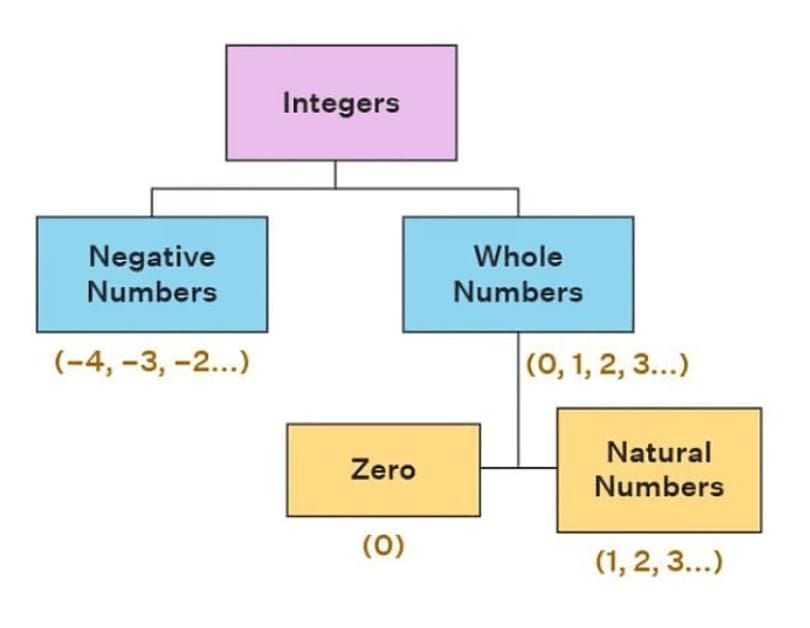
They are essential for representing quantities that have both magnitude and direction, such as movement on a number line, profit/loss, or temperature above/below zero.
Rakesh's Puzzle: A Number Game
This section introduces the idea of finding two numbers when their sum and difference are known.
Challenge:
"Rakesh has two numbers in mind. The sum of these two numbers is 25, and the difference between them is 11. Your task is to find out what the two numbers are."
Steps to Solve:
Think of possible pairs of numbers that could add up to 25. For example, if you start with the number 12, the other number would be 13 because 12 + 13 = 25.
Check the difference: You need to subtract the smaller number from the bigger one to see if the difference is 11. In this case, 13 - 12 = 1, which is not 11. So, 12 and 13 are not the correct numbers.
Keep guessing: Try another pair, like 15 and 10. When you add them, you get 15 + 10 = 25, which is correct.
Check the difference again: 15 - 10 = 5, but this is not 11 either. Keep trying different numbers.
Simple Strategy:
You just need to find a pair where:
- When you add the two numbers, you get 25.
- When you subtract one number from the other, you get 11.
Keep testing different pairs until you find the right one!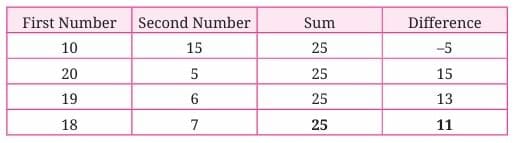
Example:
Let's try: Guess: 18 and 7.
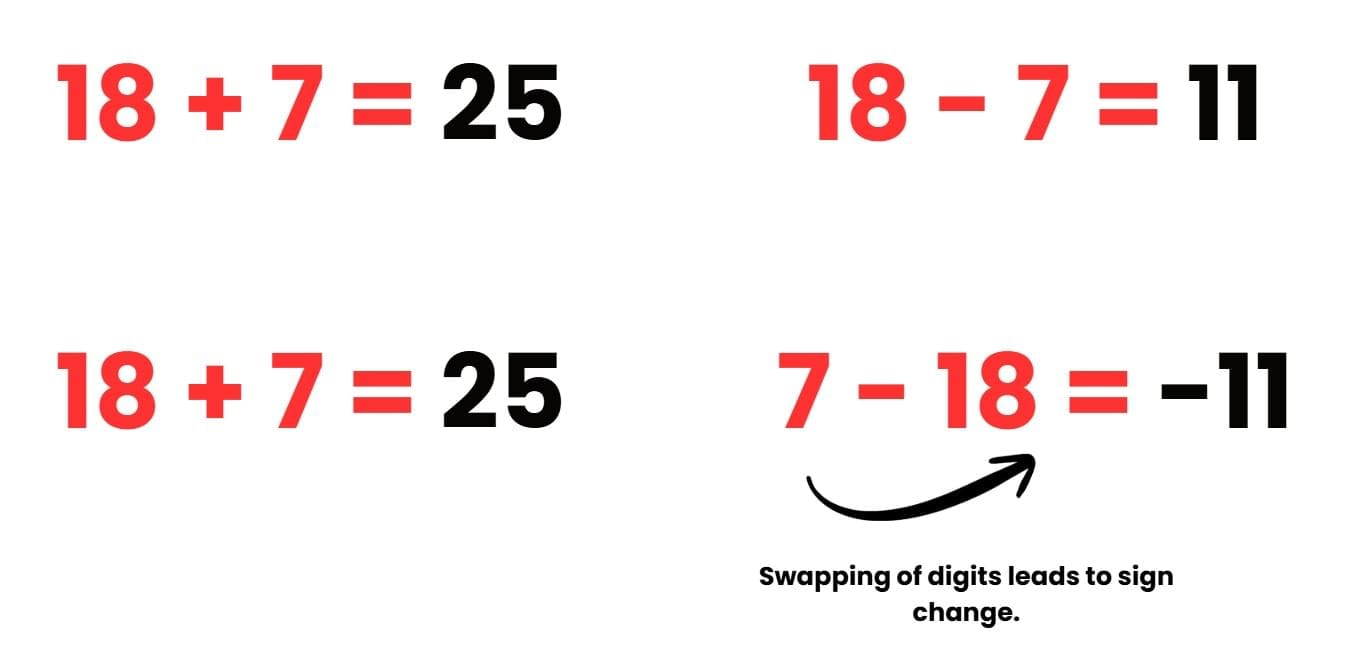
-Add them: 18 + 7 = 25 (Correct sum)
- Subtract them: 18 - 7 = 11 (Correct difference)
So, the two numbers are 18 and 7!
Conclusion: The two numbers Rakesh is thinking of are 18 and 7.
Now that we've found the correct pair, Rakesh gives you a second challenge:
"You need to find two numbers whose sum is 25, but their difference is -11. Remember that when the difference is negative, it means the second number is bigger than the first one."
Steps to Solve:
Start with pairs that add up to 25:
You can still think of pairs like you did before. For example, start with 18 and 7 (like in the first puzzle).
Check the sum:
18 + 7 = 25 (This is correct, as the sum is 25).
Check the difference:
18 - 7 = 11. But wait, the difference is 11, not -11. This means that the first number should be smaller, and the second number should be larger to get a negative difference.
Swap the numbers:
If you swap the numbers, you get 7 and 18. Now, check the difference:
- 7 + 18 = 25 (The sum is still 25, which is correct).
- 7 - 18 = -11 (This is the correct difference!).
Conclusion:
The two numbers for Rakesh's second challenge are 7 and 18. When you swap the numbers from the first puzzle, you get the correct answer for the second one!
So, the two numbers are 7 and 18, but the order is important:
- For the first puzzle, it was 18 and 7 (because the difference is 11).
- For the second puzzle, it is 7 and 18 (because the difference is -11).
To understand movements in positive and negative directions, we first recall the number line. A number line is like a straight track marked with numbers:
- Numbers to the right of 0 are positive (showing increase, gain, or movement forward)
- Numbers to the left of 0 are negative (showing decrease, loss, or movement backward)
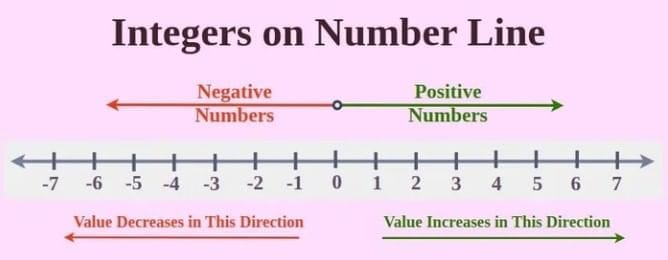
So, whenever a quantity increases, we move right, and whenever it decreases, we move left. The number line helps us visualize how even opposite directions or actions can be represented using integers.
Carrom Coin Integers
If the carrom coin is struck and moves in the right direction (positive side), we will represent that movement with a positive number.
Example: If the first strike moves the coin 4 units to the right, we write it as +4.
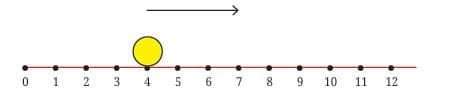
Q: To begin with, the coin is at point 0. If the coin is struck twice, with the first strike moving it by 4 units and the second strike moving it by 3 units, what will be the final position of the coin?
Ans: It is clear that the coin will be 4 + 3 = 7 units from 0.
Both strikes move the coin to the right:
Right means positive direction.
So if the first strike moves the coin a units to the right, and the second strike moves it b units to the right, the total movement becomes:
Final position P = a + b
Example: First strike +4, second strike +3 → P = 4 + 3 = 7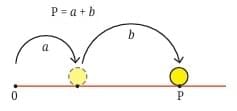
But what if the coin can move either right or left?
- Right movement → Positive number
- Left movement → Negative number
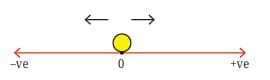
So instead of checking different cases one by one (both right / both left / first right & second left / first left & second right), we use a smarter idea:
Just use positive numbers for right and negative numbers for left.
Then add them like normal integers.
What is the final position of the coin?
When the carrom coin is struck twice, it moves two times on the number line.
To find where the coin finally stops, we just need to add both movements.
Example:
- First strike → +5 units (right side)
- Second strike → -7 units (left side)
So we calculate:
5 + (-7) = -2
This means the coin ends at -2 on the number line - that is 2 units to the left of 0.
Token Model for Addition and Subtraction
The token model helps visualize integer operations:
Green Token (+): Represents +1 (Positive).  Red Token (-): Represents -1 (Negative).
  Zero Pair: One green and one red token together make a zero pair (+ -), as they cancel each other out.
Subtraction using Tokens
To subtract a number, you must remove that many tokens. If you don't have enough, you add zero pairs until you can remove the required tokens.
Example: (+7) - (+18)
Ans: To find (+7) - (+18), think of the numbers as tokens.
Green tokens represent positive numbers, and red tokens represent negative numbers.
We start with +7, so we place 7 green tokens in the bag.

But we want to subtract +18, which means we need to remove 18 green tokens.
The problem is that we only have 7 green tokens, so we cannot remove 18 yet.
To fix this, we add zero pairs.
A zero pair means one green token (+1) and one red token (-1) together.
A zero pair does not change the value, because +1 and -1 cancel each other.
We need 11 more green tokens to reach 18 greens.
So we add 11 zero pairs.

This gives us enough green tokens to remove 18.

After removing 18 green tokens, only the 11 red tokens remain.
So the final value is -11.
Therefore:
7 - 18 = -11
This method helps us understand how subtraction with larger numbers works, even when the number we subtract is bigger than the number we start with.
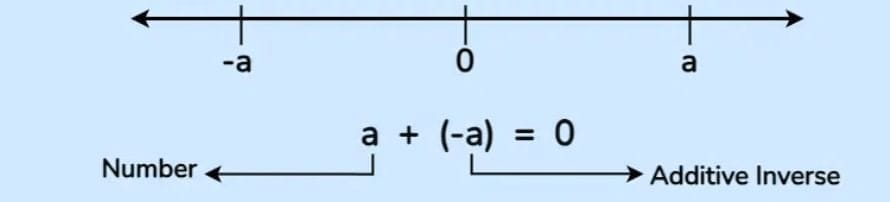
We had also seen that subtracting a number is the same as adding its additive inverse.
Additive Inverse
The additive inverse of an integer 'a' is the number that, when added to 'a', gives zero. It is represented as -a.
- Additive inverse of 18 is -18, because 18 + (-18) = 0.
- Additive inverse of -18 is 18, because -18 + 18 = 0.
Multiplication of Integers
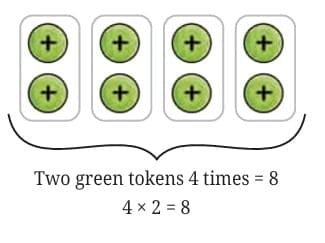
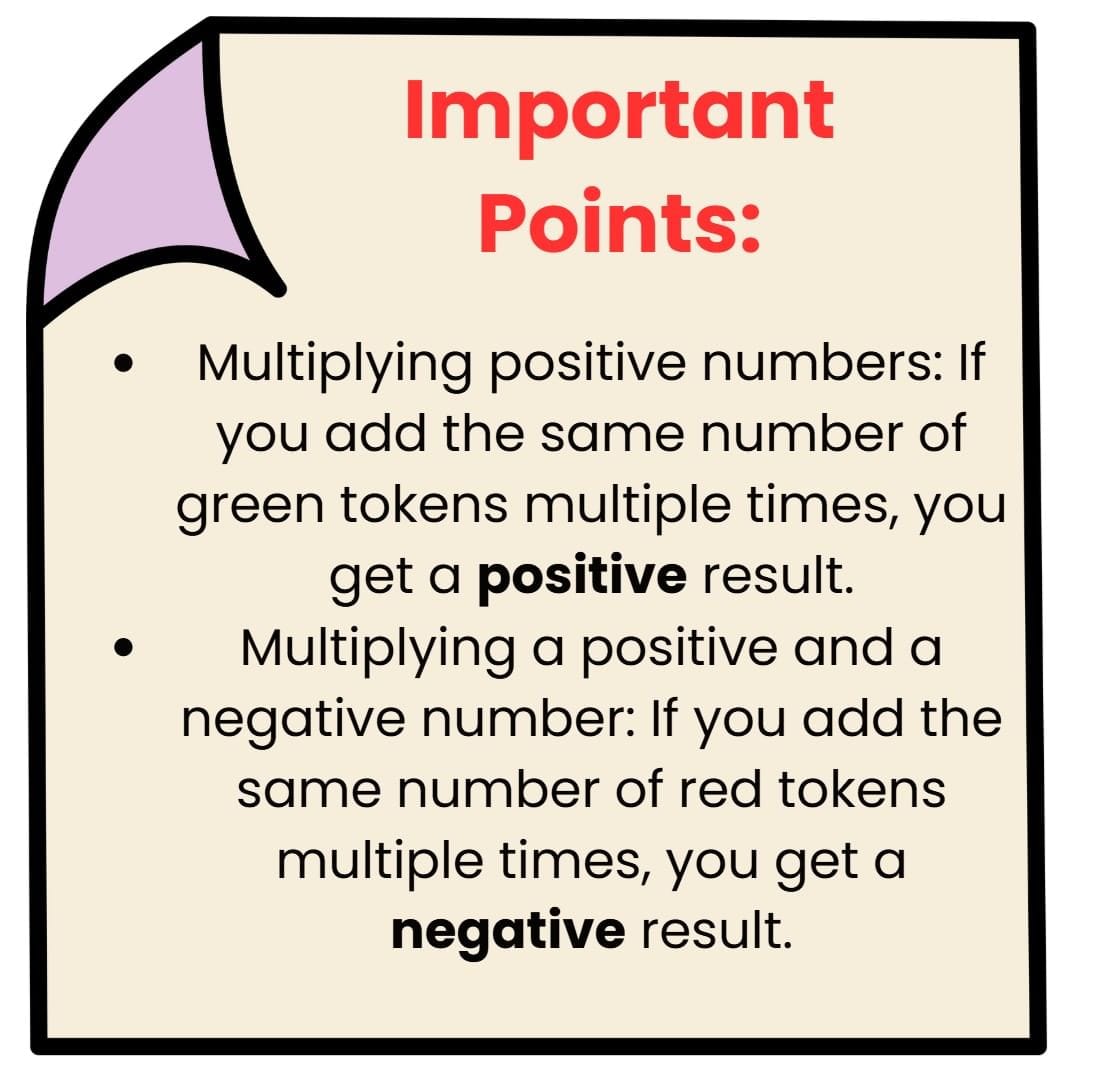
To understand multiplication with positive and negative numbers, imagine a simple bag. We use green tokens to show positive numbers and red tokens to show negative numbers.
1. Multiplying Positive Numbers (Example: 4 × 2)
- Suppose you add 2 green tokens (positives) to a bag.
- You do this 4 times.
So:
4 × 2 means adding 2, four times
→ 2 + 2 + 2 + 2 = 8 green token
Thus: 4 × 2 = 8
Now, what about multiplying a positive with a negative?
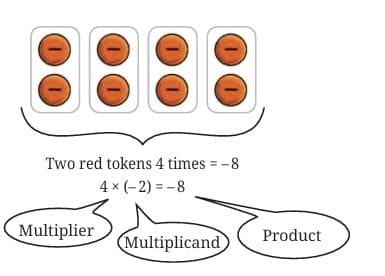
Example: 4 × (-2)
What does (-2) mean?
Negative numbers are shown using red tokens. So, -2 means 2 red (negative) tokens.
What does 4 × (-2) mean?
It means:
Put -2 (two red tokens) into the bag, 4 times.
So:
- First time → -2
- Second time → -2
- Third time → -2
- Fourth time → -2
Total = -2 + -2 + -2 + -2 = -8
Thus, 4 × (-2) = -8
Patterns in Integer Multiplication
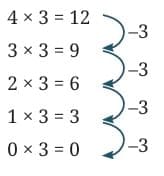
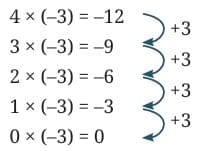
We have explored the multiplication of integers in cases where the multiplier is positive, when it is negative, when the multiplicand is positive and when it is negative. Using this understanding, let us construct a sequence of multiplications and observe the patterns.
Positive Multiplicand (a × 3): As the multiplier decreases by 1, the product decreases by the multiplicand (3).
Negative Multiplicand (a × (-3)): As the multiplier decreases by 1, the product increases by the magnitude of the multiplicand (3).
Rules for Multiplication of Integers
With this understanding of multiplication of integers, let us look at the times 3 tables when the multipliers and multiplicands are positive, and when they are negative.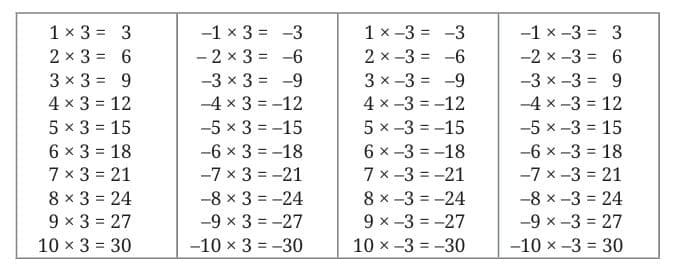
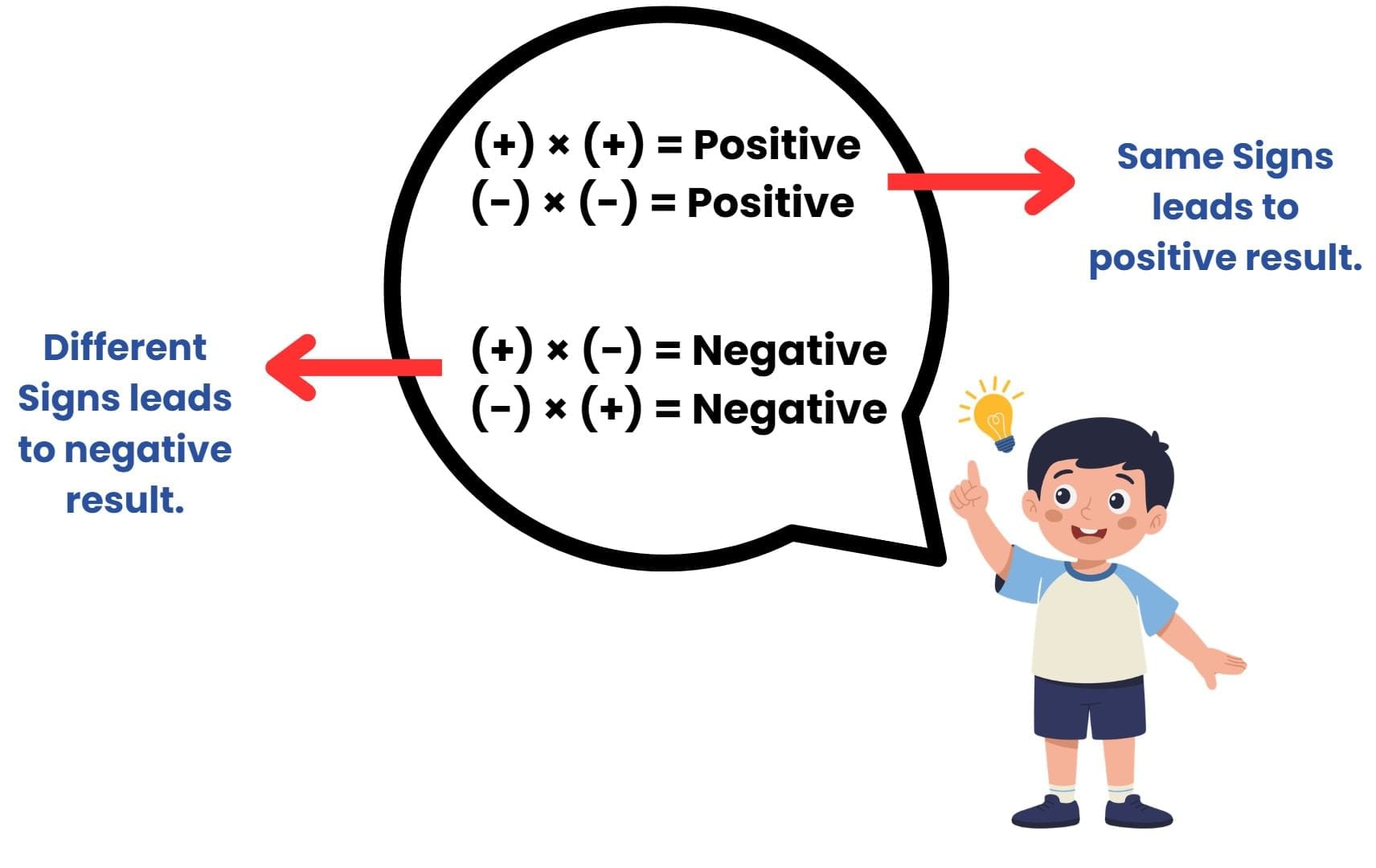
The patterns lead to the following simple rules:
- Product of two positives: Positive (e.g., 4 × 3 = 12).
- Product of two negatives: Positive (e.g., (-4) × (-3) = 12).
- Product of a positive and a negative: Negative (e.g., 4 × (-3) = -12 or (-4) × 3 = -12).
Commutativity of Multiplication
Multiplication of integers is commutative. This means that swapping the multiplier and the multiplicand does not change the product.
For any two integers a and b: a × b = b × a
Example:
3 × (-4) = (-4) × 3 = -12
Brahmagupta's Rules for Multiplication and Division of Positive and Negative Numbers
Around 1400 years ago, the great Indian mathematician Brahmagupta explained how to multiply and divide positive and negative numbers.
He used two simple ideas: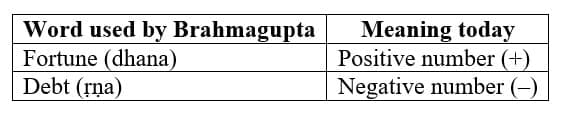
He explained the rules like this: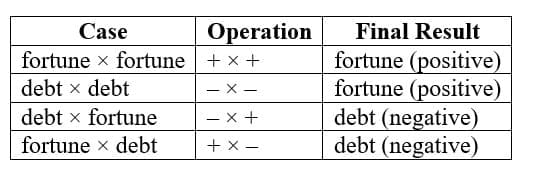
Exactly the same rules apply for division.
Example 1: An exam has 50 multiple choice questions. 5 marks are given for every correct answer and 2 negative marks for every wrong answer. What are Mala's total marks if she had 30 correct answers and 20 wrong answers?
Ans: We use positive and negative integers. The mark for each correct answer is a positive integer 5 and for each wrong answer is a negative integer - 2.
Marks for 30 correct answers = 30 × 5.
Marks for 20 wrong answers = 20 × (- 2).
Thus the arithmetic expression for 30 correct answers and 20 wrong answers is:
30 × 5 + 20 × (- 2)
= 150 + (- 40)
= 110.
Mala got 110 marks in the exam.
Q: What are the maximum possible marks in the exam? What are the minimum possible marks?
Ans: Maximum Possible Marks:
If a student gets all 50 questions correct,
Marks =
Minimum Possible Marks:
If a student gets all 50 questions wrong,
Marks =
Maximum possible marks = 250
Minimum possible marks = -100
Example 2: There is an elevator in a mining shaft that moves above and below the ground. The elevator's positions above the ground are represented as positive integers and positions below the ground are represented as negative integers.
(a) The elevator moves 3 metres per minute. If it descends into the shaft from the ground level (0), what will be its position after one hour?
(b) If it begins to descend from 15 m above the ground, what will be its position after 45 minutes?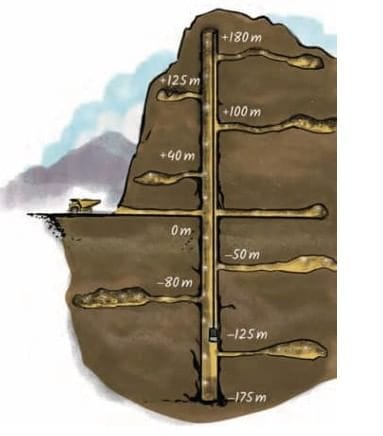
Solution: Solution to part (a) of the question:
Method 1:
We can think of the elevator's movement using subtraction.
The elevator goes 3 metres per minute.
In one hour, it moves:
metres
Since it begins at ground level (0 metres) and goes down, we subtract:
So the elevator reaches -180 metres, which means it is 180 metres below the ground.
Method 2:
We can show the elevator's speed and direction using an integer.
- Moving up → +3 metres per minute
- Moving down → -3 metres per minute
Since the elevator is going down, its speed is -3 m/min.
For 60 minutes, it travels:
So, after one hour, the elevator's position is -180 metres, which is 180 m below ground level.
Q: Find the solution to part (b) using Method 1 described above.
Solution to part (b) using Method 2:
Starting position = +15 m (because it is 15 metres above the ground)
The elevator moves down at 3 metres per minute for 45 minutes, so the total downward distance is:
Using this, the ending position becomes:
Ending Position = 15 + (45 × -3) = 15 + (-135) = -120
So, the elevator will be 120 metres below the ground.
A Magic Grid of Integers
You are given a grid filled with numbers-positive and negative.
Your job is to follow a fun set of steps until no numbers are left to choose.
This is how the game works: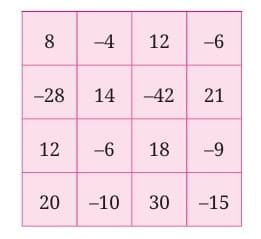
Step 1: Circle any one number you like.
You can start anywhere in the grid.
Just choose any number and circle it.
Step 2: Strike out (cut) the whole row and the whole column of that number.
For example, if you circled a number in Row 2 and Column 3:
- You will cut the entire Row 2
- And also cut entire Column 3
All numbers in that row and column are now "used" and cannot be chosen again.
Step 3: From the remaining unstruck numbers, circle another number.
Again, strike out the row and column of this newly circled number.
Repeat this step until there are no unstruck numbers left.
Step 4: Multiply all the circled numbers.
At the end, you will have 4 circled numbers (because the grid is 4×4).
Multiply those 4 numbers to get your final answer.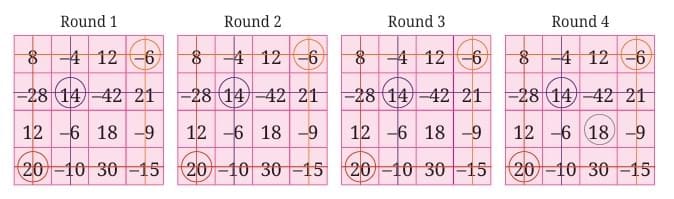
Try Again With Different Choices
What product did you get? Was it different from the first time? Try a few more times with different numbers! Play the same game with the grid below.
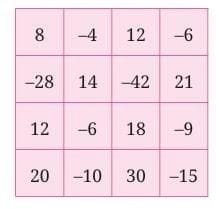
Repeat the steps: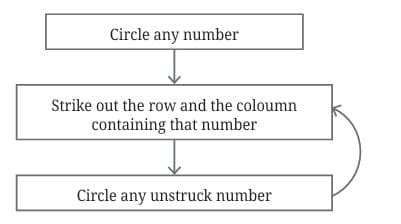
You will notice something magical:
The product of circled numbers will be the SAME every time-even if you choose different numbers!
What is so special about these grids? Is the magic in the numbers or the way they are arranged or both? Can you make more such grids?
Ans: No matter which set of numbers you circle, the final product always remains the same! This is called Magic Grid.
Division of Integers
To understand division of integers, we first remember an important idea:
Division can be rewritten as multiplication.
For example:
can be thought of as:
"What number should be multiplied with 25 to get -100?"
So we write:
25 × ___ = -100
Since 25 × (-4) = -100,
therefore,
Similarly,
(-100) ÷ (-4) means:
"What number should be multiplied with -4 to get -100?"
We write:
-4 × ___ = -100
Since -4 × 25 = -100,
therefore, (-100) ÷ (-4) = 25
Another example:
Since (-25) × (-2) = 50, reversing it gives:
50 ÷ (-25) = -2
What pattern do we notice?
From the examples above:
- Negative ÷ Positive = Negative
- Negative ÷ Negative = Positive
- Positive ÷ Negative = Negative
Final Rules for Division of Integers
Let a and b be positive integers (b ≠ 0):
- a ÷ (-b) = -(a ÷ b)
- (-a) ÷ b = -(a ÷ b)
- (-a) ÷ (-b) = a ÷ b
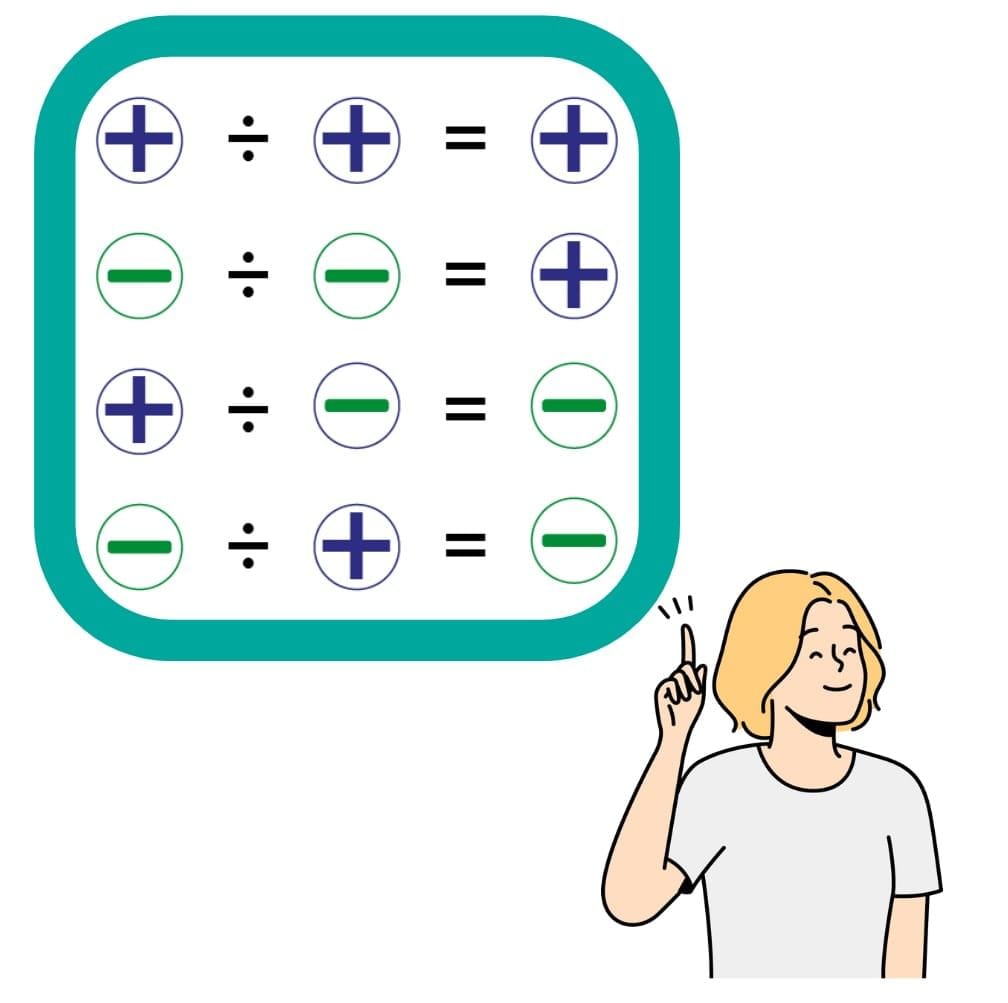 Division Rules of Integers
Expressions Using Integers
Q: What is the value of the expression 5 × - 3 × 4? Does it matter whether we multiply 5 × - 3 and then multiply the product with 4, or if we multiply - 3 × 4 first and then multiply the product with 5?
Ans: We want to check the value of this expression:
and 5 × (-3) × 4
Let's try multiplying in different orders.
Way 1: (5 × -3) × 4
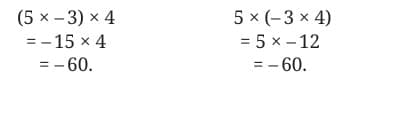
Way 2: 5 × (-3 × 4)
-3 × 4 = -12
5 × -12 = -60
Again, the answer is -60.
Checking the Associative Property of Multiplication
Let us take a few more examples to check whether the way we group three integers changes the final product or not.
Example 1: 2 × 3 × 4
Grouping 1:
(2 × 3) × 4 = 6 × 4 = 24Grouping 2:
2 × (3 × 4) = 2 × 12 = 24The product is the same.
Example 2: -5 × 2 × 3
Grouping 1:
(-5 × 2) × 3 = -10 × 3 = -30Grouping 2:
-5 × (2 × 3) = -5 × 6 = -30The product is the same.
Example 3: 4 × -2 × -3
Grouping 1:
(4 × -2) × -3 = -8 × -3 = 24Grouping 2:
4 × (-2 × -3) = 4 × 6 = 24The product is the same.
What do we observe?
In all these examples, the product remains the same no matter how the integers are grouped. This means that multiplication of integers is associative, just like addition.
In general, for any three integers a, b, and c:
a × (b × c) = (a × b) × c
Checking with the expression 5 × -3 × 4
Try grouping 5 and 4 first:
(5 × 4) × -3
5 × 4 = 20
20 × -3 = -60
This also gives the same product as before.
There are different orders in which 5 × -3 × 4 can be evaluated, but the product will always be the same. This shows that multiplication of integers is associative.
Multiplying 25 × -6 × 12 in Different Orders
Let us multiply the expression 25 × -6 × 12 in all possible orders and check if the product changes.
(25 × -6) × 12
= -150 × 12
= -1800
25 × (-6 × 12)
= 25 × -72
= -1800
(25 × 12) × -6
= 300 × -6
= -1800
In every case, the product is -1800.
This shows that the product remains the same no matter how we group the numbers.
When three or more integers are multiplied, the order of multiplication does not affect the final product.
Observing the Product of Several -1's
-1 × -1 = 1
-1 × -1 × -1 = -1
-1 × -1 × -1 × -1 = 1
-1 × -1 × -1 × -1 × -1 = -1
When -1 is multiplied an even number of times (2 or 4), the product is positive.
When -1 is multiplied an odd number of times (3 or 5), the product is negative.
This suggests a general rule:
If the number of negative integers in a product is even, the product is positive.
If the number of negative integers in a product is odd, the product is negative.This rule applies to any collection of integers.
Understanding the Distributive Property
Consider the expression: 5 × (4 + -2)
Check whether it equals: 5 × 4 + 5 × -2
Left side:
4 + -2 = 2
5 × 2 = 10
Right side:
5 × 4 = 20
5 × -2 = -10
20 + -10 = 10
Both sides give 10.
So, the distributive property holds.
Checking Another Example
Check whether: -2 × (4 + -3)
equals:
(-2 × 4) + (-2 × -3)
Left side:
4 + -3 = 1
-2 × 1 = -2
Right side:
-2 × 4 = -8
-2 × -3 = 6
-8 + 6 = -2
Both sides are equal, so the distributive property also holds here.
Final Observation
The distributive property works for integers just as it does for whole numbers. Whenever you multiply an integer with a sum of two integers, the property: a × (b + c) = (a × b) + (a × c) continues to hold.
This happens for all integers in all cases.
Understanding the Distributive Property Using Tokens
For positive integers, we used a rectangular arrangement of objects to understand why the distributive property works. We can use the same idea for integers by using two types of tokens:
• Green tokens for positive numbers
• Red tokens for negative numbers
Consider a rectangular arrangement made using these tokens. In this arrangement, you can think of one side of the rectangle as representing the number 4, and the other side as representing the expression (2 + -3).
This means the whole rectangle represents the expression: 4 × (2 + -3)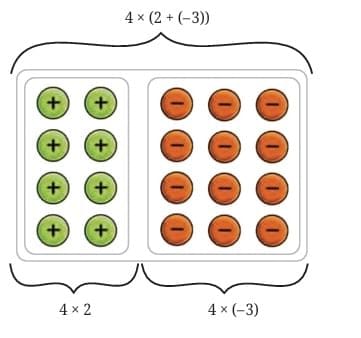
Inside the rectangle, we can separate the tokens into two groups:
A group representing 4 × 2
A group representing 4 × -3
When we look at the arrangement, it becomes clear that the entire rectangle is simply the combination of these two smaller groups. Therefore, the total number of tokens in the rectangle equals:
4 × 2 + 4 × -3
This shows that:
4 × (2 + -3) = (4 × 2) + (4 × -3)
So, even when we use both positive and negative integers, the distributive property still holds.
Pick the Pattern
Two pattern machines are given below. Each machine takes 3 numbers, does some operations and gives out the result.
Finding the Operation of Machine 1
Machine 1 takes three numbers from each row and produces the number shown on the right.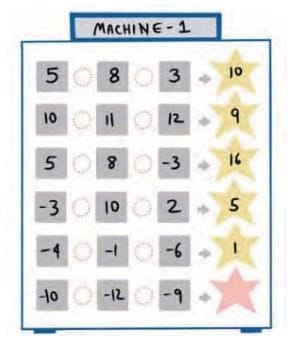 By checking the results, we see that Machine 1 performs the operation:
(first number) + (second number) - (third number)
In algebraic form, the operation is:
a + b - c
Examples:
5 + 8 - 3 = 10
-4 + -1 - (-6) = 1
So, for the last row:
(-10) + (-12) - (-9)
= -10 -12 + 9
= -13
The answer for Machine 1's last group is -13.
Q: Find the operations being done by Machine 2 and fill in the blank.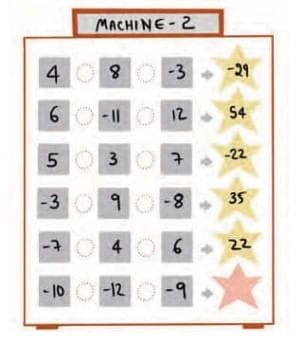
Now we look at Machine 2. We check a few rows and try to find a pattern.
Take the first row:
4, 8, -3 → result is -29
Try different operations:
4 × 8 = 32
32 × -3 = -96 (not correct)
4 + 8 - (-3) = 15 (not correct)
But:
4 × 8 = 32
32 - (-3 × 5)? (No pattern)
Let us test multiplication of the first two numbers and then adding the third multiplied by a fixed number.
Try:
(4 × 8) + (-3 × 5)
32 - 15 = 17 (not correct)
Instead, test:
(first number × second number) + (third number)
4 × 8 = 32
32 + (-3) = 29 → but result is -29
So machine seems to give the negative of it.
Check:
Result = -(a × b + c)
Test first row:
4 × 8 = 32
32 + (-3) = 29
Negative of 29 = -29 (correct)
Check another row:
6, -11, 12 → result is 54
Compute:
6 × -11 = -66
-66 + 12 = -54
Negative of -54 = 54 (correct)
Check one more:
-7, 4, 6 → result is 22
-7 × 4 = -28
-28 + 6 = -22
Negative of -22 = 22 (correct)
So Machine 2 performs the operation:
Result = -(a × b + c)
Or in words:
Take the product of the first two numbers, add the third number, and then change the sign of the final answer.
FAQs on Chapter Notes: Operations with Integers
| 1. What are integers? |  |
| 2. How do you multiply integers? | |
| 3. What is the process for dividing integers? | |
| 4. Can you give examples of expressions using integers? | |
| 5. What are some key notes to remember about operations with integers? | |