APPSC (Andhra Pradesh) Exam  >  APPSC (Andhra Pradesh) Notes  >  APPSC State Specific Preparation Course  >  Cheat Sheet: Modern History of Andhra Pradesh

Cheat Sheet: Modern History of Andhra Pradesh

The Modern History of Andhra Pradesh begins with the decline of the Vijayanagara Empire and extends up to the formation of Andhra State in 1953 and later the State of Andhra Pradesh in 1956. This period witnessed colonial expansion, freedom movements, socio-religious reforms, and the rise of Telugu identity.
Cheat Sheet: Modern History of Andhra Pradesh

Decline of Vijayanagara & Rise of Regional Powers

Decline of Vijayanagara & Rise of Regional Powers

Colonial Rule in Andhra

Nizam's Hyderabad & British Expansion

  • The Nizam of Hyderabad became a British ally (Subsidiary Alliance, 1798).
  • The Northern Circars and Ceded Districts (Rayalaseema region) came under British control.
  • Madras Presidency included most parts of Coastal Andhra and Rayalaseema.

Important British Administrative Changes

Important British Administrative Changes

Early Resistance Movements

Palnadu War (1178-1182) (Precursor to regional assertion): Though earlier, it symbolized the Andhra spirit of self-rule.

Rampa Rebellion (1879 & 1922-24)

  • Led by Alluri Sitarama Raju against British forest laws.
  • Known as the "Manyam Veerudu" (Hero of the Jungle).
  • Adopted guerrilla warfare tactics in Eastern Ghats.
  • Inspired by Gandhian ideals, though used armed resistance.

Quick Fact: Alluri Sitarama Raju's rebellion was contemporaneous with the Non-Cooperation Movement (1920-22).

Freedom Struggle in Andhra Pradesh

Participation in Indian National Movement

Participation in Indian National Movement

Prominent Freedom Fighters of Andhra Pradesh
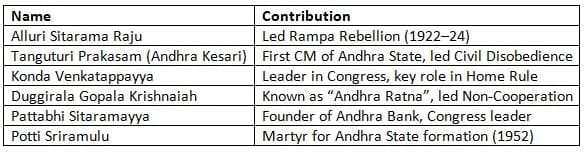
Prominent Freedom Fighters of Andhra Pradesh

Social and Reform Movements

Kandukuri Veeresalingam (1848-1919)

  • Known as "Father of Modern Andhra".
  • Pioneer of social reform and women's empowerment.
  • Started widow remarriage movement.
  • Published "Viveka Vardhini" journal.
  • Opened first girls' school in Rajahmundry (1874).

Gurajada Apparao (1862-1915)

  • Writer and reformer, author of "Kanyasulkam".
  • Advocated social reform and equality.
  • Promoted spoken Telugu over Sanskritized forms.

Viresalingam Movement Legacy

  • Encouraged education, widow remarriage, and scientific temper.
  • Influenced later Andhra reformers and freedom leaders.

Quick Fact: Kandukuri Veeresalingam established the "Hithakarini Samajam" (1906) to promote education and social reform.

Cultural Renaissance in Andhra
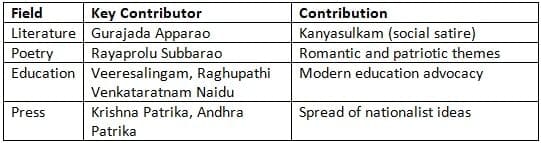
Cultural Renaissance in Andhra

Political Developments & Andhra State Formation

Demand for Separate Andhra

  • Due to linguistic, cultural and administrative neglect in Madras Presidency.
  • Leaders like T. Prakasam, N.G. Ranga, Pattabhi Sitaramayya championed the cause.

Role of Potti Sriramulu

  • Fasting for separate Andhra State (October-December 1952).
  • Death on 15 December 1952 led to widespread protests.

Formation of Andhra State (1953)
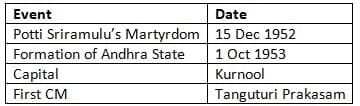
Formation of Andhra State (1953)

Formation of Andhra Pradesh (1956)

  • States Reorganisation Act, 1956
  • Andhra State + Telangana (Hyderabad State) → Andhra Pradesh
  • Hyderabad made the capital.

Quick Fact: Andhra Pradesh became the first linguistic state in independent India.

Important Dates & Events
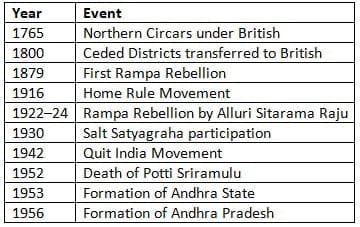
Important Dates & Events

Quick Facts

  • Father of Modern Andhra: Kandukuri Veeresalingam
  • Andhra Kesari: Tanguturi Prakasam
  • Manyam Veerudu: Alluri Sitarama Raju
  • Andhra Ratna: Duggirala Gopala Krishnaiah
  • First CM of Andhra State: T. Prakasam
  • First CM of Andhra Pradesh: Neelam Sanjeeva Reddy
The document Cheat Sheet: Modern History of Andhra Pradesh is a part of the APPSC (Andhra Pradesh) Course APPSC State Specific Preparation Course.
All you need of APPSC (Andhra Pradesh) at this link: APPSC (Andhra Pradesh)

FAQs on Cheat Sheet: Modern History of Andhra Pradesh

1. What were the factors contributing to the decline of the Vijayanagara Empire?
Ans. The decline of the Vijayanagara Empire was influenced by a combination of internal and external factors. Internally, administrative inefficiencies, economic difficulties, and succession disputes weakened the empire. Externally, the defeat in the Battle of Talikota against the Deccan Sultanates in 1565 marked a significant turning point, leading to the loss of territories and resources. Additionally, the increasing power of regional kingdoms further fragmented the empire's authority.
2. How did colonial rule impact Andhra Pradesh?
Ans. Colonial rule had a profound impact on Andhra Pradesh, affecting its socio-economic structures and administration. The British imposed new revenue systems that disrupted traditional agricultural practices, leading to widespread peasant distress. Educational reforms introduced Western education, which created a new socio-political consciousness among the populace. Furthermore, the introduction of railways and telecommunication facilitated trade but also enabled colonial exploitation, altering the region's economic landscape.
3. What were some early resistance movements in Andhra Pradesh against British rule?
Ans. Early resistance movements in Andhra Pradesh included the Paika Rebellion in the late 19th century and the Moplah Rebellion in 1921. The Paika Rebellion was a response to oppressive revenue policies and highlighted the agrarian discontent. The Moplah Rebellion was driven by the grievances of Muslim peasants against the British and local landlords, showcasing a significant uprising against colonial authority. These movements laid the groundwork for subsequent freedom struggles in the region.
4. Who were some prominent freedom fighters from Andhra Pradesh?
Ans. Prominent freedom fighters from Andhra Pradesh include figures like Alluri Sitarama Raju, who led the Rampa Rebellion against British rule, and Pingali Venkayya, who designed the Indian national flag. Other notable activists include Kandukuri Veeresalingam, who worked for social reform, and Sardar Vallabhbhai Patel, who played a crucial role in the integration of princely states post-independence. Their contributions were pivotal in mobilising the masses and advocating for independence.
5. What role did social and reform movements play in the cultural renaissance of Andhra Pradesh?
Ans. Social and reform movements played a crucial role in the cultural renaissance of Andhra Pradesh by addressing social injustices and promoting educational reforms. Leaders like Kandukuri Veeresalingam advocated for women's rights and the abolition of untouchability, fostering a sense of social equality. The promotion of Telugu literature and arts during this period also contributed to a renewed cultural identity, encouraging people to engage with their heritage and advocate for social change.
Explore Courses for APPSC (Andhra Pradesh) exam
Get EduRev Notes directly in your Google search
Related Searches
Important questions, Cheat Sheet: Modern History of Andhra Pradesh, Previous Year Questions with Solutions, shortcuts and tricks, MCQs, video lectures, study material, pdf , Semester Notes, Viva Questions, past year papers, Cheat Sheet: Modern History of Andhra Pradesh, Exam, Cheat Sheet: Modern History of Andhra Pradesh, ppt, Objective type Questions, mock tests for examination, Free, Sample Paper, practice quizzes, Summary, Extra Questions;