APPSC (Andhra Pradesh) Exam > APPSC (Andhra Pradesh) Notes > APPSC State Specific Preparation Course > Cheat Sheet: Geography of Andhra Pradesh
Cheat Sheet: Geography of Andhra Pradesh


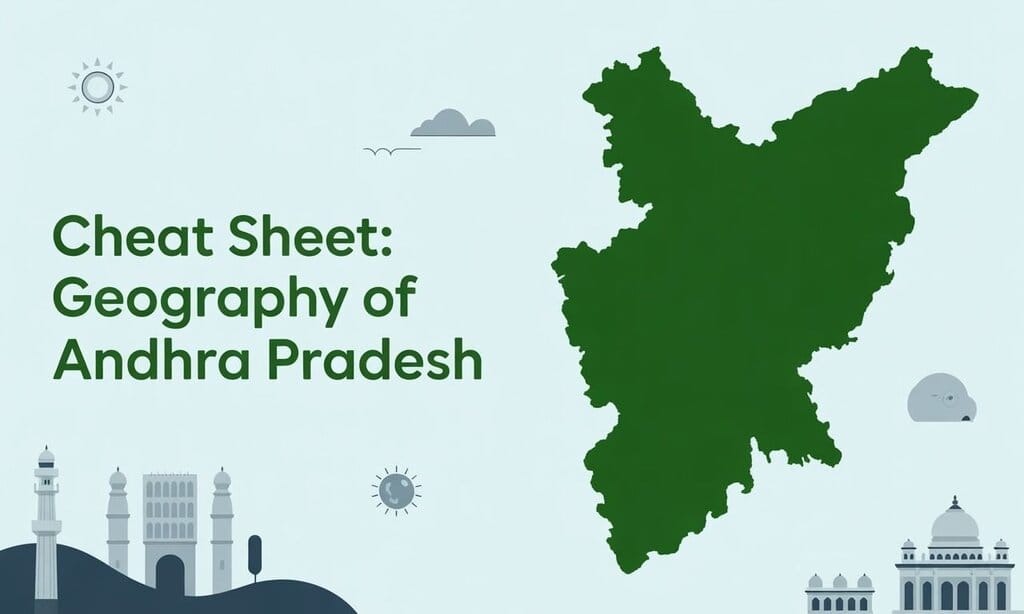
Andhra Pradesh, located on the southeastern coast of India, is known for its diverse geography, rich river systems, and long coastline along the Bay of Bengal. It is the 7th largest state in India by area and one of the most agriculturally productive due to its fertile deltas.
- Formation of the State: 1 November 1956 (from the merger of Andhra State & Telangana region of Hyderabad State)
- Reorganization: On 2 June 2014, Telangana was separated to form a new state.
- Capital (Present): Amaravati (Proposed)
- Administrative Capital: Visakhapatnam
- Judicial Capital: Kurnool
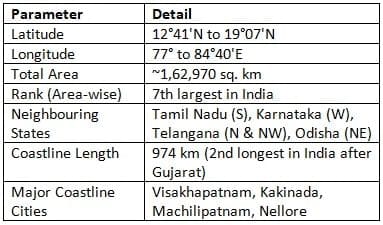
Location & Extent
Physiographic Divisions
Andhra Pradesh can be divided into three major physiographic regions: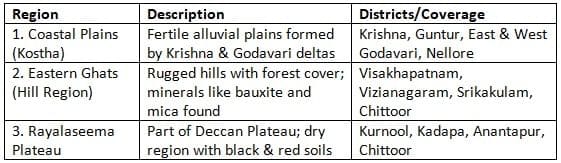
Quick Facts
- The Eastern Ghats run parallel to the coast and are discontinuous.
- Horsley Hills (Chittoor district) and Araku Valley (Visakhapatnam) are famous hill stations.
- The Deccan Plateau slopes eastward, aiding river flow toward the Bay of Bengal.
Rivers of Andhra Pradesh

Note: Almost all rivers in AP are east-flowing, draining into the Bay of Bengal.
Lakes and Water Bodies

Mountains and Hills

Quick Facts
- Red Sanders (Pterocarpus santalinus) grows only in Seshachalam Hills - a CITES-protected species.
- Borra Caves (Visakhapatnam) - limestone caves formed by the Gosthani River.
Soils of Andhra Pradesh

Climate
- Type: Tropical Monsoon Climate
- Seasons:
- Summer: March-June (Hot & Humid near coast)
- Southwest Monsoon: June-September (Major rainfall)
- Northeast Monsoon: October-December (Significant in Coastal Andhra)
- Average Annual Rainfall: ~940 mm
- Cyclones: Frequent in coastal districts (especially between October-December)
Cyclone-Prone Districts: Srikakulam, Visakhapatnam, East Godavari, Nellore
Natural Vegetation and Forests

- Forest Area: ~29,137 sq. km (~18% of total area)
- Protected Areas: 13 Wildlife Sanctuaries, 6 National Parks (e.g., Papikonda, Sri Venkateswara)
Mineral Resources
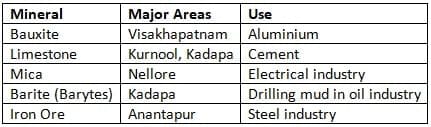
Quick Fact: Andhra Pradesh is the leading producer of barytes and mica in India.
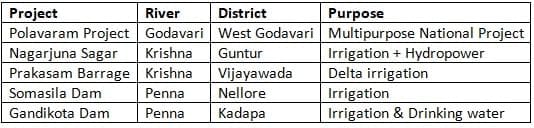
Irrigation and Power Projects
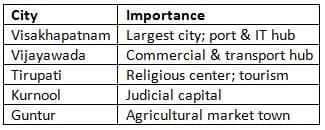
Urban Geography
Quick Facts for Andhra Pradesh
- 2nd longest coastline in India: 974 km
- Rice Bowl of India: Krishna-Godavari delta
- Largest freshwater lake: Kolleru Lake
- Leading in Barytes & Mica production
- Cyclone-prone coast due to Bay of Bengal depressions
- Red Sanders exclusive to Seshachalam Hills (Chittoor district)
- Highest Peak: Jindhagada (1690 m) in Eastern Ghats
- 3 Physical Divisions: Coastal Plains, Eastern Ghats, Rayalaseema Plateau
- 3 Major Rivers: Godavari, Krishna, Penna
- Climate: Tropical Monsoon
- Soils: Red > Black > Alluvial
- Vegetation: Deciduous & Mangrove
- Natural Hazards: Cyclones, Droughts (Rayalaseema)
The document Cheat Sheet: Geography of Andhra Pradesh is a part of the APPSC (Andhra Pradesh) Course APPSC State Specific Preparation Course.
All you need of APPSC (Andhra Pradesh) at this link: APPSC (Andhra Pradesh)
FAQs on Cheat Sheet: Geography of Andhra Pradesh
| 1. What are the main physiographic divisions of Andhra Pradesh? |  |
Ans. Andhra Pradesh has several physiographic divisions, including the Eastern Ghats, the Coastal Plains, and the Deccan Plateau. The Eastern Ghats are a series of low hills, while the Coastal Plains are characterized by fertile land and numerous rivers. The Deccan Plateau is a large elevated region that contributes to the diverse geography of the state.
| 2. Which rivers are significant to Andhra Pradesh, and what roles do they play? | |
Ans. Significant rivers in Andhra Pradesh include the Godavari, Krishna, and Penna. These rivers are crucial for irrigation, supporting agriculture in the region. They also provide water for domestic use and are vital for the state's hydropower generation.
| 3. How do the lakes and water bodies of Andhra Pradesh benefit the state? | |
Ans. The lakes and water bodies of Andhra Pradesh serve multiple purposes, including irrigation, fisheries, and recreation. They help maintain ecological balance and support local biodiversity. Additionally, they are important for groundwater recharge and serve as crucial sources of water for various human activities.
| 4. What types of soils are found in Andhra Pradesh, and what are their characteristics? | |
Ans. Andhra Pradesh has several soil types, including red soil, black soil, alluvial soil, and sandy soil. Red soil is known for its iron content and is suitable for crops like millets and pulses. Black soil is rich in calcium, ideal for cotton cultivation. Alluvial soil, found in river basins, is highly fertile, while sandy soil is more suitable for specific crops due to its drainage properties.
| 5. What is the climate like in Andhra Pradesh, and how does it affect agriculture? | |
Ans. Andhra Pradesh experiences a tropical climate with distinct wet and dry seasons. The southwest monsoon significantly impacts rainfall, which is essential for agriculture. The diverse climate allows for the cultivation of various crops, including rice, pulses, and oilseeds, although the state faces challenges such as drought and erratic rainfall patterns.
About this Document

4.82/5 Rating

Apr 21, 2026 Last updated
Related Exams
Document Description: Cheat Sheet: Geography of Andhra Pradesh for APPSC (Andhra Pradesh) 2026 is part of APPSC State Specific Preparation Course preparation. The notes and questions for Cheat Sheet: Geography of Andhra Pradesh have been prepared according to the APPSC (Andhra Pradesh) exam syllabus. Information about Cheat Sheet: Geography of Andhra Pradesh covers topics like and Cheat Sheet: Geography of Andhra Pradesh Example, for APPSC (Andhra Pradesh) 2026 Exam. Find important definitions, questions, notes, meanings, examples, exercises and tests below for Cheat Sheet: Geography of Andhra Pradesh.
Introduction of Cheat Sheet: Geography of Andhra Pradesh in English is available as part of our APPSC State Specific Preparation Course for APPSC (Andhra Pradesh) & Cheat Sheet: Geography of Andhra Pradesh in Hindi for APPSC State Specific Preparation Course course. Download more important topics related with notes, lectures and mock test series for APPSC (Andhra Pradesh) Exam by signing up for free. APPSC (Andhra Pradesh): Cheat Sheet: Geography of Andhra Pradesh
Description
Cheat Sheet: Geography of Andhra Pradesh of APPSC State Specific Preparation Course to help you remember important concepts with short tricks. Start learning for APPSC (Andhra Pradesh) exam & improve retention with EduRev.
Information about Cheat Sheet: Geography of Andhra Pradesh
In this doc you can find the meaning of Cheat Sheet: Geography of Andhra Pradesh defined & explained in the simplest way possible. Besides explaining types of Cheat Sheet: Geography of Andhra Pradesh theory, EduRev gives you an ample number of questions to practice Cheat Sheet: Geography of Andhra Pradesh tests, examples and also practice APPSC (Andhra Pradesh) tests



Related Searches
shortcuts and tricks, Semester Notes, Viva Questions, Summary, Previous Year Questions with Solutions, mock tests for examination, Exam, ppt, Free, Important questions, Extra Questions, video lectures, Cheat Sheet: Geography of Andhra Pradesh, past year papers, Sample Paper, study material, practice quizzes, MCQs, Objective type Questions, Cheat Sheet: Geography of Andhra Pradesh, pdf , Cheat Sheet: Geography of Andhra Pradesh;