Important Diagrams: Exploring Forces

Q1. a) After rubbing the two balloons with woollen cloth and releasing them, what is observed?
Ans: The balloons move away from each other because like charges repel.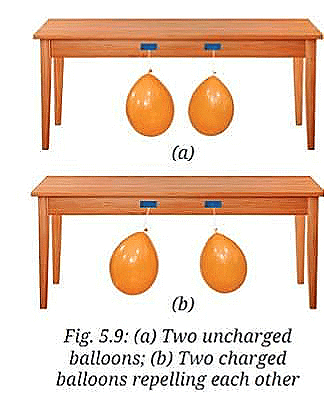
b) Why should we avoid touching the balloons after rubbing them?
Ans: Touching removes the electric charge, so the balloons will not show static electricity.
c) What happens when the same woollen cloth is brought close to one rubbed balloon?
Ans: The balloon moves towards the cloth, showing attraction of opposite charges.
d) What kind of force is responsible for the attraction and repulsion between the balloons?
Ans: Electrostatic force (static electricity).
e) Fill in the blanks: Like charges ________, but opposite charges ________.
Ans: Like charges repel, but opposite charges attract.
Q2. a) What type of force is shown on the left side of the image?
Ans: A pushing force is applied to the table.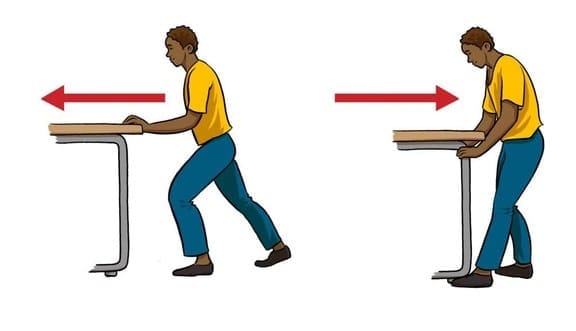
b) What type of force is shown on the right side of the image?
Ans: A pulling force is applied to the table.
c) In which direction is the force applied in both actions?
Ans: The force is applied horizontally.
d) Give any two effects of applying push or pull force.
Ans:
- It can move an object.
- It can change the speed or direction of an object.
e) Define force based on the actions shown in the image.
Ans: Force is a push or pull that can move or stop an object.
Q3. a) What is shown in the image?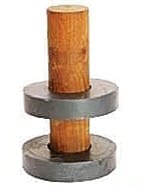
Ans: The image shows two ring magnets placed on a wooden rod, demonstrating the force between magnets.
b) Why do the two ring magnets not touch each other?
Ans: They do not touch because like poles repel each other, creating a repulsive magnetic force.
c) What type of force is acting between the two magnets?
Ans: A magnetic force is acting between the two magnets.
d) What can you conclude about the nature of magnetic poles from this activity?
Ans: Like poles repel, and unlike poles attract.
e) Name any two objects around you that contain magnets.
Ans:
- Speakers
- Refrigerator door (magnetic strip)
Q4 a) What action is shown in the first part of the image (opening drawer)?
Ans: The person is pulling the drawer, which is an example of pulling force.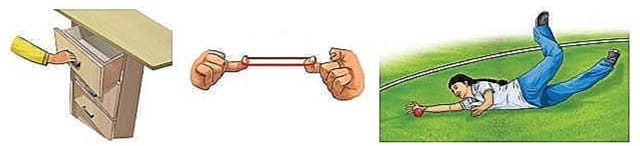 Applying force on object
b) What type of force is being applied in the middle image?
Ans: The person is stretching an elastic band, which shows force causing change in shape.
c) What effect of force is shown in the image of the girl catching the ball?
Ans: The force is used to stop a moving object (the ball).
d) Name any two effects of force seen in these images.
Ans:
- Force can change the shape of an object (stretching elastic).
- Force can move or stop objects (opening drawer or stopping the ball).
e) What is common in all the actions shown in the image?
Ans: In all actions, force is being applied to perform a task or change motion/shape.
FAQs on Important Diagrams: Exploring Forces
| 1. What are the different types of forces studied in Class 8? |  |
| 2. How does frictional force affect motion? | |
| 3. What is the role of gravitational force in our daily lives? | |
| 4. What is the significance of free body diagrams in understanding forces? | |
| 5. How can balanced and unbalanced forces be distinguished? | |




