CBSE Class 8 > Class 8 Notes > English Grammar > Mind Map: Tenses
Mind Map: Tenses

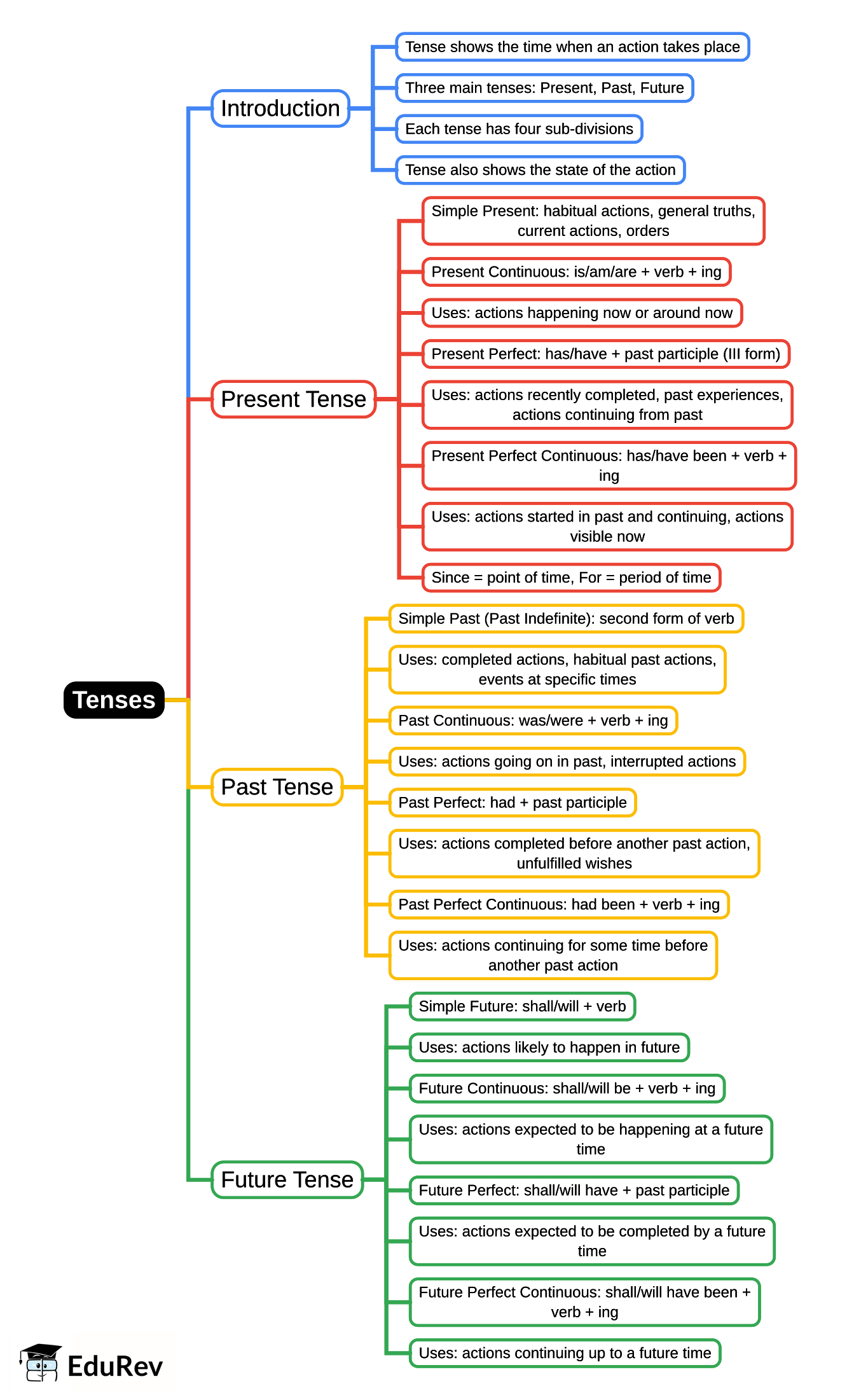
The document Mind Map: Tenses is a part of the Class 8 Course English Grammar Class 8.
All you need of Class 8 at this link: Class 8
FAQs on Mind Map: Tenses
| 1. What are the primary types of tenses in English? |  |
Ans. The primary types of tenses in English are the present tense, past tense, and future tense. Each of these can be further divided into simple, continuous (progressive), perfect, and perfect continuous forms, allowing for a range of expressions regarding time and aspect.
| 2. How are the simple tenses formed in English? | |
Ans. Simple tenses are formed using the base form of the verb. The simple present tense uses the base form for all subjects except the third person singular, which adds an -s or -es. The simple past tense typically adds -ed for regular verbs, while irregular verbs have unique forms. The simple future tense is formed using 'will' followed by the base form of the verb.
| 3. What is the difference between the present perfect tense and the past perfect tense? | |
Ans. The present perfect tense indicates an action that occurred at an unspecified time before now, often with relevance to the present, and is formed using 'have' or 'has' plus the past participle. The past perfect tense, on the other hand, describes an action that was completed before another past action and is formed using 'had' plus the past participle.
| 4. When should the future continuous tense be used? | |
Ans. The future continuous tense is used to describe an action that will be in progress at a specific time in the future. It is formed using 'will be' followed by the present participle of the verb (the -ing form). This tense is useful for indicating planned future activities or actions that will be ongoing.
| 5. Can you explain the concept of aspect in relation to tenses? | |
Ans. Aspect in relation to tenses refers to the way in which the time of an action is viewed with respect to its completion or duration. There are four aspects in English: simple, continuous, perfect, and perfect continuous. Each aspect provides additional information about the timing, duration, and completion of an action, allowing for more nuanced communication.
About this Document

4.82/5 Rating

Apr 19, 2026 Last updated
Document Description: Mind Map: Tenses for Class 8 2026 is part of English Grammar Class 8 preparation. The notes and questions for Mind Map: Tenses have been prepared according to the Class 8 exam syllabus. Information about Mind Map: Tenses covers topics like and Mind Map: Tenses Example, for Class 8 2026 Exam. Find important definitions, questions, notes, meanings, examples, exercises and tests below for Mind Map: Tenses.
Introduction of Mind Map: Tenses in English is available as part of our English Grammar Class 8 for Class 8 & Mind Map: Tenses in Hindi for English Grammar Class 8 course. Download more important topics related with notes, lectures and mock test series for Class 8 Exam by signing up for free. Class 8: Mind Map: Tenses
Description
Mind Map: Tenses of English Grammar Class 8 provides you one-page visual summary of the chapter covering all the important topics. Download the PDF from EduRev.
Information about Mind Map: Tenses
In this doc you can find the meaning of Mind Map: Tenses defined & explained in the simplest way possible. Besides explaining types of Mind Map: Tenses theory, EduRev gives you an ample number of questions to practice Mind Map: Tenses tests, examples and also practice Class 8 tests



Related Searches
past year papers, Objective type Questions, Free, Mind Map: Tenses, Extra Questions, Viva Questions, Summary, Sample Paper, Exam, shortcuts and tricks, MCQs, video lectures, Semester Notes, study material, mock tests for examination, ppt, pdf , Mind Map: Tenses, practice quizzes, Previous Year Questions with Solutions, Mind Map: Tenses, Important questions;