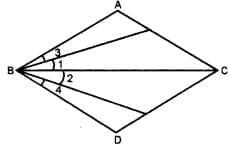
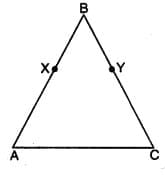
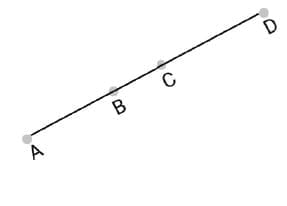
Q1: In the figure, we have BX and 1/2 AB = 1/2 BC. Show that BX = BY.
Solution:
Ans: Here, BX = 1/2 AB and BY = 1/2 BC ...(i) [given] Also, AB = BC [given] ⇒ 1/2AB = 1/2BC ...(ii) [∵ Euclid's seventh axiom says, things which are halves of the same thing are equal to one another] From (i) and (ii), we have BX = BY
Q2: In the given figure, AB = BC, BX = BY, show that AX = CY.
Solution:
Ans: Given that AB = BC and BX = BY By using Euclid's axiom 3, equals subtracted from equals, then the remainders are equal, we have AB - BX = BC - BY AX = CY
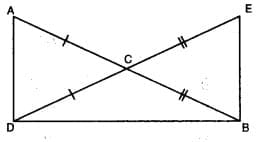
Q3: In the given figure, AC = DC and CB = CE. Show that AB = DE. Write the Euclid's axiom to support this.
Solution:
Ans: We have AC = DC CB = CE By using Euclid's axiom 2, if equals are added to equals, then wholes are equal. ⇒ AC + CB = DC + CE ⇒ AB = DE.
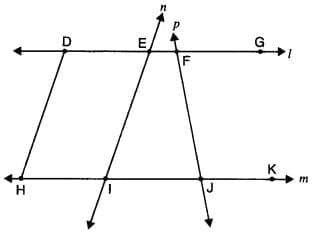
Q4: In the given figure, name the following : (i) Four collinear points (ii) Five rays (iii) Five line segments (iv) Two-pairs of non-intersecting line segments.
Solution:
Ans: (i) Four collinear points are D, E, F, G and H, I, J, K (ii) Five rays are DG, EG, FG, HK, IK. (iii) Five line segments are DH, EI, FJ; DG, HK. (iv) Two-pairs of non-intersecting line segments are (DH, EI) and (DG, HK).
Q5: If a point C lies between two points A and B such that AC = BC, then prove that AC =1/2 AB. Explain by drawing the figure.
Solution:
Ans: Given, AC = BC Now, add AC on both sides. L.H.S + AC = R.H.S + AC AC + AC = BC + AC 2AC = BC + AC Since, we know, BC +AC = AB (as it coincides with line segment AB, from figure) ∴ 2 AC = AB (If equals are added to equals, the wholes are equal.) ⇒ AC = 1/2 AB.
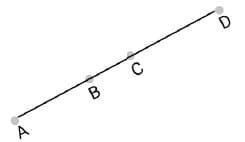
Q6: In the given figure, if AC = BD, then prove that AB = CD.
Solution:
Ans: It is given, AC = BD From the given figure, we get, AC = AB + BC BD = BC + CD ⇒ AB + BC = BC + CD [Given: AC=BD] We know that, according to Euclid's axiom, when equals are subtracted from equals, remainders are also equal. Subtracting BC from the L.H.S and R.H.S of the equation AB + BC = BC + CD, we get, AB + BC - BC = BC + CD - BC AB = CD Hence proved.
Q.7: It is known that x + y = 10 and that x = z. Show that z + y = 10.
Solution:
Ans: According to the question, We have, x+y=10 ...(i) And, x=z ...(ii) Applying Euclid's axiom, "if equals are added to equals, the wholes are equal" We get, From Eq. (i) and (ii) x+y=z+y ....(iii) From Eqs. (i) and (iii) z+y = 10
Q8: In the following figure, if AC = BD, then prove that AB = CD.
Solution:
Ans: We are given that AC = BD We need to prove that AB = CD in the figure given below.
From the figure, we can conclude that AC = AB + BC, and BD = CD + BC. An axiom of the Euclid says that "Things which are equal to the same thing are equal to one another." AB + BC = CD + BC An axiom of the Euclid says that "when equals are subtracted from equals, the remainders are also equal." We need to subtract BC from equation(i) to get AB + BC - BC = CD + BC- BC
AB = CD
Therefore, we can conclude that the desired result is proved.
Q9: What are the five postulates of Euclid's Geometry?
Solution:
Ans: Euclid's postulates were:
A straight line may be drawn from one point to any other point.
A terminated line can be produced indefinitely.
A circle can be drawn with any centre and any radius.
All right angles are equal to one another.
If a straight line falling on two straight lines makes the interior angles on the same side of it taken together less than two right angles, then the two straight lines if produced indefinitely, meet on that side on which the sum of angles is less than two right angles.
Q10: If a point C lies between two points A and B such that AC = BC, then prove that AC = 1/2AB⋅ Explain by drawing the figure.
Solution:
Ans: We are given that a point C lies between two points B and C, such that AC = BC. We need to prove that AC = 1/2AB⋅ Let us consider the given below figure.
We are given that AC = BC-...(i) An axiom of the Euclid says that "If equals are added to equals, the wholes are equal." Let us add AC to both sides of equation (i). AC + AC = BC + AC. An axiom of the Euclid says that "Things which coincide with one another are equal to one another." " We can conclude that BC+AC coincide with AB, or AB = BC + AC....(ii) An axiom of the Euclid says that "Things which are equal to the same thing are equal to one another." From equations (i) and (ii), we can conclude that AC + AC = AB, or 2AC = AB An axiom of the Euclid says that "Things which are halves of the same things are equal to one another." Therefore, we can conclude that AC = 1/2AB
The document Sure Shot Questions for Board Exams: Introduction to Euclid's Geometry is a part of the Class 9 Course Mathematics (Maths) Class 9.
FAQs on Sure Shot Questions for Board Exams: Introduction to Euclid's Geometry
1. What are the key concepts introduced in Euclid's Geometry?
Ans. The key concepts in Euclid's Geometry include points, lines, planes, angles, and various types of geometric figures such as triangles, quadrilaterals, and circles. Euclid's work also introduces axioms and postulates that serve as the foundation for proving geometric theorems.
2. What is the significance of Euclid's postulates in geometry?
Ans. Euclid's postulates are fundamental statements assumed to be true without proof, forming the basis for geometric reasoning. They include concepts such as the ability to draw a straight line between any two points and the idea that a finite straight line can be extended indefinitely. These postulates help in deriving further geometric truths and theorems.
3. How does Euclid define a point and a line?
Ans. In Euclid's Geometry, a point is defined as that which has no part, representing a precise location in space. A line, on the other hand, is described as a breadthless length that extends infinitely in both directions, composed of an infinite number of points aligned in a straight manner.
4. What are the different types of angles discussed in Euclid's Geometry?
Ans. Euclid's Geometry classifies angles into several types: acute angles (less than 90 degrees), right angles (exactly 90 degrees), obtuse angles (greater than 90 degrees but less than 180 degrees), and straight angles (exactly 180 degrees). These classifications help in understanding the relationships and properties of geometric figures.
5. Can you explain the importance of Euclidean constructions?
Ans. Euclidean constructions involve the use of a compass and straightedge to create geometric figures based on Euclid's postulates. They are essential for visualising and understanding geometric concepts, as well as for solving problems related to geometry. These constructions illustrate the principles of congruence, similarity, and the relationships between different geometric shapes.
Previous Year Questions with Solutions, past year papers, Viva Questions, ppt, mock tests for examination, Free, MCQs, Sample Paper, Objective type Questions, pdf , Sure Shot Questions for Board Exams: Introduction to Euclid's Geometry, practice quizzes, Semester Notes, shortcuts and tricks, Extra Questions, video lectures, Summary, Exam, study material, Sure Shot Questions for Board Exams: Introduction to Euclid's Geometry, Sure Shot Questions for Board Exams: Introduction to Euclid's Geometry, Important questions;