Q1: In which units is air pressure commonly reported in weather reports?
Solution:
Ans: Air pressure is commonly reported in millibar (mb) or hectopascal (hPa).
Q2: In which direction does air move to form wind?
Solution:
Ans: Air moves from a region of high pressure to a region of low pressure.
Q3: What causes a sea breeze during the day?
Solution:
Ans: A sea breeze occurs when cooler air from the sea moves toward warmer low-pressure air over land.
Q4: Explain atmospheric pressure and its magnitude. How does atmospheric pressure affect everyday objects?
Solution:
Ans: Atmospheric pressure is the pressure exerted by the air around us. It is significant, as demonstrated by the difficulty of pulling a sucker off a surface due to atmospheric pressure.
Q5: How does the concept of pressure apply to our bodies, and why don't we get crushed under atmospheric pressure?
Solution:
Ans: Our bodies have internal pressure that balances the external atmospheric pressure, preventing us from being crushed.
Q6: Why are overhead water tanks placed at a height?
Solution:
Ans: Overhead water tanks are placed at a height so that the water column above the taps is large. Pressure exerted by a liquid increases with the height of the liquid column. Therefore, placing the tank higher increases water pressure, ensuring a strong flow of water from taps.
Q7: Explain the life cycle of a cyclone from formation over warm oceans to weakening over land, and relate it to pressure changes.
Solution:
Ans:
Over warm seas, moist air heats, rises, and creates a low-pressure center at the surface. As water vapor condenses into rain, heat is released, making air rise more and lowering pressure further.
Surrounding air rushes in and spins due to Earth's rotation, building a powerful system with an eye of very low pressure. Around the eye, winds are strongest and rain is heavy. After landfall, the cyclone loses warm, moist air and weakens due to friction and lack of fuel.
Q8: Describe a safety and preparedness plan for cyclones and thunderstorms, explaining why each step reduces risk to people and property.
Solution:
Ans:
Staying informed through IMD warnings helps families act before danger arrives. Keeping an emergency kit with water, food, medicines, and a flashlight supports survival during power cuts and blocked roads.
Moving to strong shelters or cyclone centers reduces the risk from high winds and storm surges. During lightning, avoiding tall objects and metal and staying in vehicles or indoors lowers the chance of strikes.
Proper building features like lightning conductors and strong roofs further protect life and property.
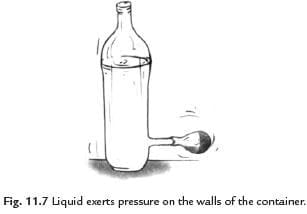
Q9: Show that a liquid exerts pressure on the walls of the container.
Solution:
Ans. Take a plastic bottle. Fix a cylindrical glass tube a few cm long near its bottom. You can do so by slightly heating one end of the glass tube and then quickly inserting it near the bottom of the bottle. Make sure that water does not leak from the joint. If there is any leakage, seal it with molten wax. Cover the mouth of the glass tube with a thin rubber sheet. Now, fill the bottle up to half with water. We observe the bulge in the rubber sheet. Pour some more water into the bottle. We see more bulges in the rubber sheet. This activity indicates that water exerts pressure on the walls of the container.
Q10: Ravi set up two fountains in his garden with water jets at different heights. He observed that the water from the taller fountain shot higher and faster than the lower one. He became curious about how the height of water affects pressure and flow.
(a) How does height affect water pressure in Ravi's fountains? (b) Why does the water flow faster from the higher nozzle? (c) How does this principle apply to overhead water tanks in buildings?
Solution:
Ans: (a) Water pressure increases with increasing height of the water column. (b) Higher pressure at the base pushes water out with more force and speed. (c) Overhead tanks use gravity to create pressure for the water supply.
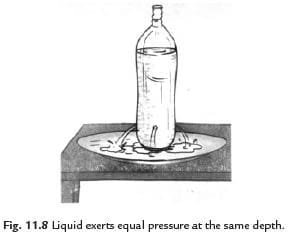
Q11: Explain that liquids exert equal pressure at the same depth.
Solution:
Ans. Take an empty plastic bottle. Drill four holes all around near the bottom of the bottle. Make sure that all the holes are at the same height from the bottom. Now, fill the bottle with water. We observe that different streams of water coming out of the holes fall at the same distance from the bottle. This observation indicates that liquids exert equal pressure at the same depth.
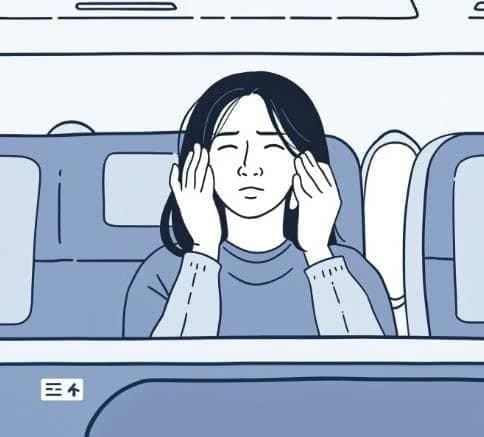
Q12: While flying in a flight, Tina felt pressure changes in her ears during ascent and descent. She noticed discomfort and "popping" sensations, prompting her to understand how air pressure changes with altitude.
(a) How does air pressure change with altitude? (b) Why do ears "pop" during ascent or descent? (c) How does the body equalise pressure changes?
Solution:
Ans: (a) Air pressure decreases as altitude increases. (b) Pressure difference between inside and outside the ear causes discomfort; popping equalises pressure. (c) Swallowing or yawning opens the Eustachian tube, balancing pressures.
Winds, and Cyclones, Objective type Questions, Sure Shot Questions: Pressure, past year papers, Summary, mock tests for examination, Storms, Winds, pdf , shortcuts and tricks, Sample Paper, and Cyclones, Viva Questions, Sure Shot Questions: Pressure, Previous Year Questions with Solutions, Extra Questions, Winds, Semester Notes, Storms, MCQs, and Cyclones, Storms, study material, practice quizzes, Sure Shot Questions: Pressure, Important questions, Exam, Free, video lectures, ppt;