Types of Forces - Force & Pressure

Kinds of Force
Forces are pushes or pulls that can change the state of motion or shape of an object. Forces arise from interactions; some forces require direct contact between objects while others act at a distance. The two broad categories are contact forces and non-contact forces. Below we explain each type, give common examples, and describe related ideas such as pressure.
Contact Force
Contact force is a force that acts only when two objects touch each other. The force acts at the point (or area) of contact. Everyday examples include pushing a box, opening a drawer, or kicking a ball.
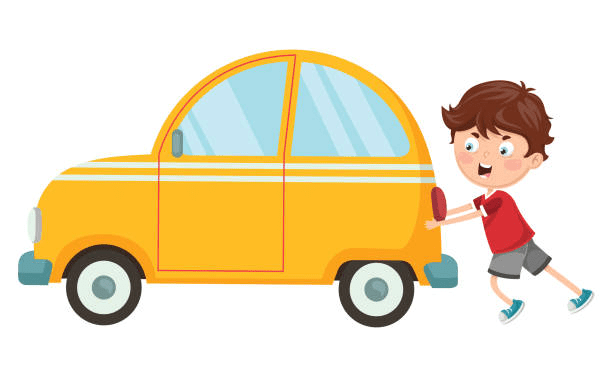 Pushing a Car
Common types of contact forces include muscular force and frictional force.
(i) Muscular Force
Muscular force is the force produced by the contraction of muscles in living organisms. It is a contact force because muscles must act through the body part that touches or holds the object.
- Example: While kicking a football, leg muscles apply force to the ball and change its motion.
- Example: When you pull open a drawer, the muscles in your hand and arm produce the force required to move it.
- Example: An ox or horse pulls a cart by applying muscular force through a harness.
(ii) Friction
Friction is the force that opposes relative motion (or attempted motion) between two surfaces in contact. Friction always acts along the surface and in a direction opposite to the motion or tendency to move.
- Example: A rolling football slows down and stops because friction between the ball and the ground dissipates its kinetic energy.
- Example: A moving boat slows due to friction between the hull and the water.
Important notes about friction:
- There are two commonly considered kinds: static friction (prevents motion when a force is trying to move an object) and kinetic friction (acts when objects slide past each other).
- Friction depends on the nature of the surfaces in contact and the normal force pressing them together. It does not depend directly on the contact area in the simple models taught at this level.
Try yourself: Which of the following is an example of contact force?
Non-contact Force
Non-contact forces act even when objects are not touching; they operate at a distance. Examples are magnetic force, electrostatic force, and gravitational force.
(i) Magnetic Force
Magnetic force is the force exerted by a magnet on magnetic materials (such as iron) or on other magnets. A magnet can attract or repel another magnet without contact.
- Example: Opposite poles of two magnets attract each other; like poles repel each other.
- Example: A magnet can pull small iron nails from a distance into its field of influence.
(ii) Electrostatic Force
Electrostatic force is the force exerted by electrically charged bodies. A charged object can attract neutral objects and can attract or repel other charged objects without direct contact.
- Example: A plastic comb rubbed on dry hair may attract small pieces of paper.
- Example: Two balloons charged with the same sign repel each other; oppositely charged objects attract.
(iii) Gravitational Force
Gravitational force is the attractive force that masses exert on one another. The Earth attracts objects toward its centre and this attraction causes objects released above the ground to fall.
- Example: When you release a stone, it falls because Earth's gravity pulls it downward.
- Example: Gravity keeps the Moon in orbit around the Earth and the planets in orbit around the Sun.
Pressure
Pressure is the amount of force applied per unit area of a surface. It tells how concentrated a force is over an area.
\( \displaystyle \text{Pressure} = \frac{\text{Force}}{\text{Area}} \)
The SI unit of pressure is the pascal (Pa), where
\(1\ \text{Pa} = 1\ \text{N/m}^2\).
Because area appears in the denominator, pressure decreases when the same force is spread over a larger area, and pressure increases when the same force acts over a smaller area.
Everyday examples of pressure
- Using the sharp edge of a knife cuts more easily because the force is concentrated on a smaller area, producing larger pressure.
- When hammering a nail, the pointed tip of the nail has small area, so the pressure on the wood is high and the nail enters easily.
- School bags have wide shoulder straps to spread the bag's weight over a larger area and so reduce the pressure on the shoulders.
Pressure exerted by liquids and gases
Liquids and gases also exert pressure on the walls of their container and on objects immersed in them. The pressure in a fluid (liquid or gas) acts in all directions at a point.
- Example: Water leaks from a bottle if there is a hole because the water exerts pressure on the bottle walls and pushes out through the pore.
- Example: Water flows from a higher level to a lower level because of the pressure differences and gravity acting on the water.
- Example: When air is put into a rubber balloon, the balloon inflates because the air particles push on the inner walls of the balloon from all sides.
In liquids, pressure increases with depth. This means an object deeper in a liquid experiences greater pressure than one near the surface.
Atmospheric pressure
The air around us is a mixture of gases and it exerts pressure on everything on Earth. This pressure is called atmospheric pressure.
The average atmospheric pressure at sea level is approximately \(1.013\times 10^{5}\ \text{Pa}\) (often written as 1 atm).
To give a practical sense of size: on an area of 10 cm × 10 cm (that is, 0.01 m²) the force due to atmospheric pressure at sea level is about
\(F = pA = 1.013\times 10^{5}\ \text{Pa} \times 0.01\ \text{m}^{2} \approx 1013\ \text{N}\).
This force is roughly equivalent to the weight of about 103 kilograms under normal gravity, which is why we do not notice atmospheric pressure - internal body pressures balance the external atmospheric pressure.
Effects and examples of atmospheric pressure
- A rubber suction cup sticks to a smooth surface because air is pushed out from between the cup and the surface and atmospheric pressure outside holds the cup in place.
- At high altitudes (for example in hills or mountains) atmospheric pressure is lower and breathing becomes more difficult because the number of air molecules per unit volume is smaller.
- Liquids boil at lower temperatures at higher altitudes because the external atmospheric pressure is lower.
- Ink from a fountain pen may leak during an aeroplane flight if cabin pressure changes because the pressure difference can force ink out.
Important terms
- Force: A push or a pull on an object that may change its motion or shape.
- Magnitude of force: The numerical value or strength of a force, usually measured in newtons (N).
- Contact force: A force that acts only when objects touch each other.
- Muscular force: Force produced by muscles; a type of contact force.
- Friction: The force that opposes relative motion between surfaces in contact; acts along the surfaces.
- Non-contact force: A force that acts without direct physical contact between bodies (acts at a distance).
- Magnetic force: Force exerted by magnets or magnetic materials.
- Electrostatic force: Force due to electric charges; can attract or repel at a distance.
- Gravitational force: Attractive force between masses; gives objects weight.
- Pressure: Force applied per unit area of a surface; SI unit is the pascal (Pa).
- Atmospheric pressure: Pressure exerted by the air in Earth's atmosphere.
Summary
Forces may be contact or non-contact. Contact forces include muscular force and friction. Non-contact forces include magnetic, electrostatic, and gravitational forces. Pressure quantifies how a force is distributed over an area; liquids and gases exert pressure too, and atmospheric pressure is the pressure of the air around us. Understanding these concepts helps explain many everyday observations - from why knives cut to why balloons inflate or why cooking times change at high altitude.
FAQs on Types of Forces - Force & Pressure
| 1. What are the different types of forces? |  |
| 2. What is the force of pressure? | |
| 3. What is the SI unit of force? | |
| 4. What is the difference between mass and weight? | |
| 5. What is the formula for calculating pressure? | |