CBSE Class 7 > Class 7 Notes > Mathematics (Ganita Prakash) - New NCERT Part 1 & 2 > Short & Long Answer Questions: Geometric Twins
Short & Long Answer Questions: Geometric Twins

Q1. The angles of a triangle are 30°, 70°, and 80°. Explain why these measurements alone are not sufficient to guarantee congruence between two triangles.
Sol: The three angles of a triangle being 30°, 70°, and 80° determine only the shape of the triangle, not its size.
Many triangles of different sizes can be drawn having the same three angles. Such triangles are similar but not necessarily congruent.
Since congruent triangles must have both the same shape and the same size, angle measurements alone are not sufficient to guarantee congruence.
Q2. In ΔABC, AB = AC, and altitude AD is drawn to BC. Prove that ∠B = ∠C using congruence.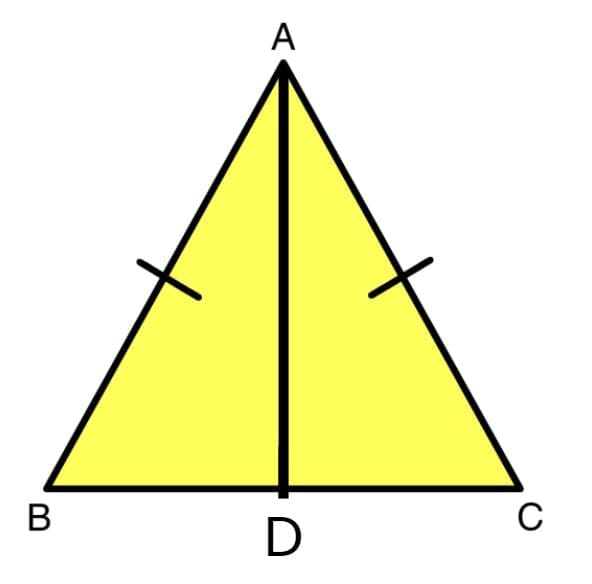
Sol: Given: AB = AC (isosceles triangle).
Draw AD ⟂ BC.
In triangles ΔADB and ΔADC:
- AD = AD (common)
- ∠ADB = ∠ADC = 90° (altitude)
- AB = AC (given)
Thus, by RHS congruence condition,
ΔADB ≅ ΔADC.
Corresponding angles are equal, so ∠B = ∠C.
Q3. In a rectangle ABCD, show that ΔABD ≅ ΔCDB. Give the correct correspondence of vertices.
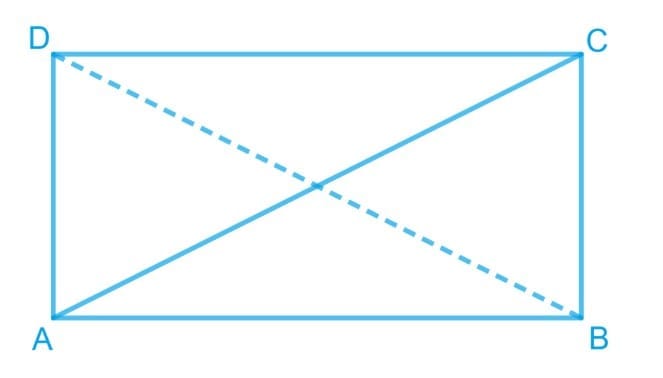
Sol: Given: ABCD is a rectangle.
In rectangle ABCD:
AB = CD (opposite sides of a rectangle)
AD = BC (opposite sides of a rectangle)
BD = BD (common side)
Thus, in triangles ΔABD and ΔCDB, all three corresponding sides are equal.
∴ ΔABD ≅ ΔCDB (by SSS congruence condition)
Correct correspondence of vertices:
A ↔ C, B ↔ D, D ↔ B
Hence, ΔABD ≅ ΔCDB.
Q4. Given, OB = OC and OA = OD. Prove that AB ∥ CD using triangle congruence.
Sol: Given:
OB = OC
OA = OD
To prove: AB ∥ CD
Consider triangles ΔAOB and ΔDOC.
OA = OD (given)
OB = OC (given)
∠AOB = ∠DOC (vertically opposite angles)
∴ ΔAOB ≅ ΔDOC (by SAS congruence condition)
Therefore, corresponding angles are equal:
∠ABO = ∠OCD
These angles are alternate interior angles.
∴ AB ∥ CD.
Hence proved.
Q5. AB = AD and BC = CD. Prove that AC bisects both ∠BAD and ∠BCD.
Sol: Given:
AB = AD
BC = CD
To prove: AC bisects ∠BAD and ∠BCD
Consider triangles ΔBAC and ΔCAD.
- AB = AD (given)
- BC = CD (given)
- AC = AC (common side)
∴ ΔBAC ≅ ΔCAD (by SSS congruence condition)
Since corresponding angles of congruent triangles are equal:
- ∠BAC = ∠CAD
- ∠BCA = ∠ACD
Therefore, AC divides both ∠BAD and ∠BCD into two equal parts.
Hence, AC bisects both angles.
Q6. ΔABC is equilateral. A point D lies on BC such that BD = DC. Prove that ΔABD ≅ ΔACD, and hence prove ∠BAD = ∠CAD.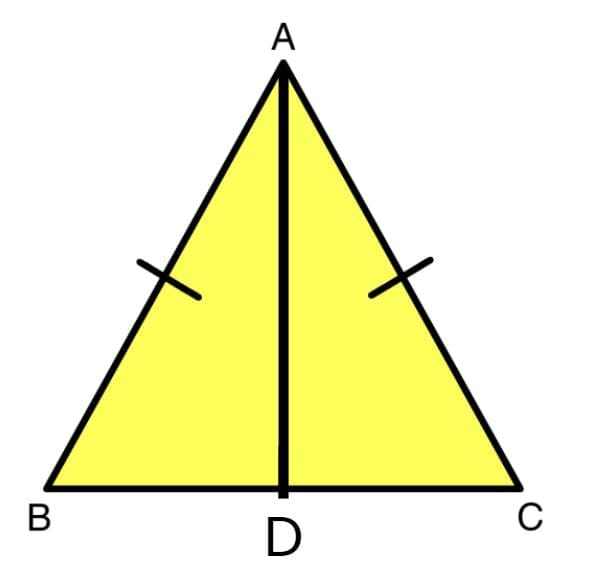 Sol: Given:
ΔABC is equilateral ⇒ AB = AC
BD = DC
To prove:
(i) ΔABD ≅ ΔACD
(ii) ∠BAD = ∠CAD
Consider triangles ΔABD and ΔACD.
AB = AC (definition of equilateral triangle)
BD = DC (given)
AD = AD (common side)
∴ ΔABD ≅ ΔACD (by SSS congruence condition)
Hence, corresponding angles are equal:
∠BAD = ∠CAD
Therefore, AD bisects ∠A.
The document Short & Long Answer Questions: Geometric Twins is a part of the Class 7 Course Mathematics (Ganita Prakash) Class 7 - New NCERT Part 1 & 2.
All you need of Class 7 at this link: Class 7
FAQs on Short & Long Answer Questions: Geometric Twins
| 1. What are geometric twins in the context of geometry? |  |
Ans. Geometric twins refer to pairs of shapes that are congruent or similar in nature. Congruent shapes have the same size and shape, while similar shapes have the same shape but may differ in size. Understanding geometric twins helps in identifying relationships between different geometric figures.
| 2. How can we identify geometric twins in a set of shapes? | |
Ans. To identify geometric twins, one can compare the shapes by measuring their sides and angles. If two shapes have identical corresponding angles and their sides are in proportion, they are considered similar. If all corresponding sides and angles are identical, they are congruent twins.
| 3. Why is it important to study geometric twins in mathematics? | |
Ans. Studying geometric twins is important as it enhances spatial reasoning and helps in understanding the properties of shapes. It also aids in solving problems related to congruence and similarity, which are fundamental concepts in geometry and have practical applications in various fields such as architecture and design.
| 4. Can geometric twins exist in three-dimensional shapes as well? | |
Ans. Yes, geometric twins can exist in three-dimensional shapes. Just like in two dimensions, three-dimensional shapes can be congruent or similar. For example, two cubes of the same size are congruent twins, while two cubes of different sizes but the same shape are similar twins.
| 5. What is the difference between congruence and similarity in geometric twins? | |
Ans. The difference between congruence and similarity lies in their properties. Congruent shapes are identical in both size and shape, meaning all corresponding sides and angles are equal. In contrast, similar shapes have the same shape but can differ in size, with corresponding angles being equal and sides being proportional.
About this Document

1.1K Views

4.93/5 Rating

Apr 18, 2026 Last updated
Related Exams
Document Description: Short & Long Answer Questions: Geometric Twins for Class 7 2026 is part of Mathematics (Ganita Prakash) Class 7 - New NCERT Part 1 & 2 preparation. The notes and questions for Short & Long Answer Questions: Geometric Twins have been prepared according to the Class 7 exam syllabus. Information about Short & Long Answer Questions: Geometric Twins covers topics like and Short & Long Answer Questions: Geometric Twins Example, for Class 7 2026 Exam. Find important definitions, questions, notes, meanings, examples, exercises and tests below for Short & Long Answer Questions: Geometric Twins.
Introduction of Short & Long Answer Questions: Geometric Twins in English is available as part of our Mathematics (Ganita Prakash) Class 7 - New NCERT Part 1 & 2 for Class 7 & Short & Long Answer Questions: Geometric Twins in Hindi for Mathematics (Ganita Prakash) Class 7 - New NCERT Part 1 & 2 course. Download more important topics related with notes, lectures and mock test series for Class 7 Exam by signing up for free. Class 7: Short & Long Answer Questions: Geometric Twins
Description
Short & Long Answer Questions: Geometric Twins of Mathematics - variety of important questions with solutions, helping you prepare for exam. Download free PDF from EduRev.
Information about Short & Long Answer Questions: Geometric Twins
In this doc you can find the meaning of Short & Long Answer Questions: Geometric Twins defined & explained in the simplest way possible. Besides explaining types of Short & Long Answer Questions: Geometric Twins theory, EduRev gives you an ample number of questions to practice Short & Long Answer Questions: Geometric Twins tests, examples and also practice Class 7 tests



Related Searches
practice quizzes, Short & Long Answer Questions: Geometric Twins, Summary, mock tests for examination, Free, Short & Long Answer Questions: Geometric Twins, ppt, study material, Exam, Viva Questions, MCQs, Extra Questions, shortcuts and tricks, pdf , Previous Year Questions with Solutions, Semester Notes, Important questions, Sample Paper, video lectures, Objective type Questions, past year papers, Short & Long Answer Questions: Geometric Twins;