Economies on the Basis of Development


Economies of the world can be classified based on their level of development. This classification helps understand how different countries have grown economically and what factors determine their progress. Understanding these categories is crucial for analyzing global economic patterns and comparing nations' economic health and standards of living.
1. Classification of Economies Based on Development
Economies are broadly divided into three main categories based on their level of economic development, income levels, and standard of living of their people.
1.1 Developed Economies (Advanced Economies)
These are countries that have achieved high levels of economic growth and have advanced industrial and technological infrastructure.
- High Per Capita Income: Citizens earn significantly high average income. Per capita income means total national income divided by total population.
- Industrialized Economy: Manufacturing and service sectors dominate the economy. Agriculture contributes a very small percentage to GDP (Gross Domestic Product).
- Advanced Technology: High use of modern technology in production, communication, and daily life.
- High Standard of Living: People enjoy better healthcare, education, housing, and social security systems.
- High Literacy Rate: Nearly 100% literacy rate with quality education systems.
- Low Population Growth Rate: Birth rates and death rates are both low, leading to slow population growth.
- Better Infrastructure: Well-developed roads, railways, airports, communication networks, and public utilities.
Examples: USA, Canada, United Kingdom, Germany, Japan, Australia
1.2 Developing Economies (Emerging Economies)
These countries are in the process of economic development. They are transitioning from agricultural-based economies to industrial economies.
- Medium Per Capita Income: Income levels are moderate, neither very high nor very low.
- Growing Industrial Sector: Industries are expanding but agriculture still employs a significant portion of the workforce.
- Improving Technology: Adoption of modern technology is increasing but not uniform across all sectors.
- Moderate Standard of Living: Basic amenities are available but quality varies. Healthcare and education are improving.
- Moderate Literacy Rate: Literacy rates are improving but still lower than developed countries (typically 60-90%).
- Moderate Population Growth: Birth rates are declining but still higher than developed countries.
- Developing Infrastructure: Infrastructure is being built and improved but gaps remain between urban and rural areas.
- Economic Diversification: Economies are becoming more diverse with growth in manufacturing and services.
Examples: India, China, Brazil, Mexico, South Africa
1.3 Underdeveloped Economies (Least Developed Countries)
These countries have the lowest levels of economic development with very poor living standards.
- Low Per Capita Income: Very low average income, often below the international poverty line.
- Agriculture-Dependent: Majority of population depends on agriculture for livelihood. Industrial sector is very weak.
- Limited Technology: Use of traditional methods in production. Modern technology is scarce.
- Low Standard of Living: Poor healthcare, inadequate nutrition, limited access to clean water and sanitation.
- Low Literacy Rate: Very low literacy rates (often below 50%) with limited educational facilities.
- High Population Growth Rate: High birth rates and declining death rates lead to rapid population growth.
- Poor Infrastructure: Lack of basic infrastructure like roads, electricity, and communication systems.
- High Unemployment: Large sections of the population remain unemployed or underemployed.
- Heavy Dependence on Foreign Aid: These countries often depend on international assistance for development.
Examples: Bangladesh (historically), Nepal, Afghanistan, many African countries like Chad, Niger
2. Key Indicators for Classification
Several economic and social indicators are used to classify economies. These help in objective comparison between countries.
2.1 Per Capita Income
Per Capita Income is the average income earned per person in a country in a given year.
- Formula: Per Capita Income = Total National Income ÷ Total Population
- Significance: It is the most commonly used indicator to measure economic development.
- Limitation: It does not show how income is distributed among people. A country may have high per capita income but high inequality.
2.2 Gross Domestic Product (GDP)
GDP is the total value of all goods and services produced within a country's borders in a year.
- Indicator of Economic Size: Higher GDP indicates larger economy.
- GDP Growth Rate: Shows how fast an economy is growing year-on-year.
- Developed countries: High GDP but moderate growth rates (2-4% annually)
- Developing countries: Moderate GDP but higher growth rates (5-8% annually)
- Underdeveloped countries: Low GDP and low or negative growth rates
2.3 Human Development Index (HDI)
HDI is a composite index that measures average achievement in three basic dimensions of human development.
- Three Components:
- Life Expectancy: Measures health and longevity of people
- Education: Measured by mean years of schooling and expected years of schooling
- Per Capita Income: Measures standard of living
- HDI Range: Values range from 0 to 1. Higher value indicates better human development.
- Categories:
- Very High HDI: Above 0.800 (Developed countries)
- High HDI: 0.700-0.799 (Better developing countries)
- Medium HDI: 0.550-0.699 (Developing countries)
- Low HDI: Below 0.550 (Underdeveloped countries)
2.4 Literacy Rate
- Definition: Percentage of population aged 7 years and above who can read and write.
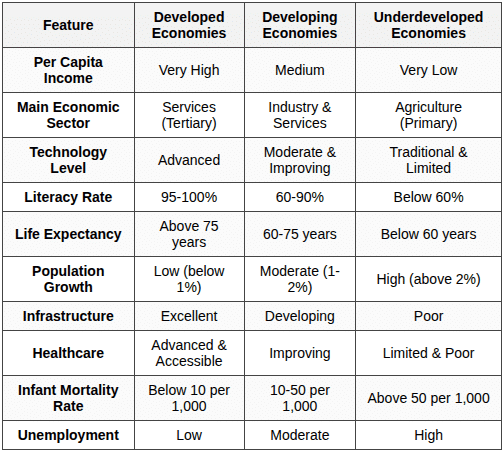
- Developed economies: 95-100% literacy rate
- Developing economies: 60-90% literacy rate
- Underdeveloped economies: Below 60% literacy rate
2.5 Infant Mortality Rate (IMR)
- Definition: Number of infants (below 1 year) dying per 1,000 live births in a year.
- Health Indicator: Reflects quality of healthcare, nutrition, and sanitation.
- Developed economies: Very low IMR (below 10 per 1,000)
- Developing economies: Moderate IMR (10-50 per 1,000)
- Underdeveloped economies: High IMR (above 50 per 1,000)
2.6 Life Expectancy
- Definition: Average number of years a person is expected to live from birth.
- Developed economies: Above 75 years
- Developing economies: 60-75 years
- Underdeveloped economies: Below 60 years
3. Sectoral Distribution of Economy
The contribution of different sectors to GDP varies based on the level of development. Understanding this pattern helps identify a country's development stage.
3.1 Primary Sector (Agriculture, Forestry, Mining, Fishing)
- Underdeveloped Economies: 50-70% of GDP and workforce depends on primary sector
- Developing Economies: 20-40% of GDP comes from primary sector
- Developed Economies: Less than 5% of GDP, very small workforce in this sector
3.2 Secondary Sector (Manufacturing and Industry)
- Underdeveloped Economies: 10-20% contribution to GDP, weak industrial base
- Developing Economies: 25-40% contribution, rapidly growing industrial sector
- Developed Economies: 20-30% contribution, highly advanced industries with automation
3.3 Tertiary Sector (Services)
- Underdeveloped Economies: 20-30% contribution, limited service industries
- Developing Economies: 40-55% contribution, expanding service sector
- Developed Economies: 65-80% contribution, service sector dominates the economy
4. Common Features Comparison Table
5. Challenges Faced by Different Economies
5.1 Challenges in Developed Economies
- Aging Population: Low birth rates lead to aging workforce and increased pension burden.
- Slow Economic Growth: Mature economies grow at slower rates (2-3% annually).
- High Cost of Living: Expensive housing, healthcare, and education.
- Environmental Concerns: High consumption leads to greater environmental degradation.
5.2 Challenges in Developing Economies
- Income Inequality: Wide gap between rich and poor despite overall growth.
- Unemployment and Underemployment: Not enough quality jobs for growing workforce.
- Infrastructure Gaps: Urban areas develop faster than rural areas, creating regional imbalances.
- Environmental Degradation: Rapid industrialization causes pollution and resource depletion.
- Population Pressure: Growing population puts strain on resources and services.
5.3 Challenges in Underdeveloped Economies
- Poverty: Majority of population lives below poverty line with inadequate income.
- Low Productivity: Use of outdated methods results in low agricultural and industrial output.
- Lack of Capital: Insufficient savings and investment limit economic growth.
- Political Instability: Many underdeveloped countries face governance issues and conflicts.
- Dependence on Primary Sector: Over-reliance on agriculture makes economy vulnerable to natural disasters.
- Brain Drain: Educated and skilled people migrate to developed countries for better opportunities.
- High Population Growth: Rapid population increase without economic growth worsens poverty.
6. Path to Development
Countries move from underdeveloped to developing and eventually to developed status through systematic economic reforms and policies.
6.1 Key Steps for Economic Development
- Investment in Education: Building schools and improving literacy creates skilled workforce.
- Healthcare Improvement: Better health services increase productivity and life expectancy.
- Infrastructure Development: Roads, electricity, and communication networks enable economic activity.
- Industrialization: Shifting from agriculture to manufacturing increases income and employment.
- Technology Adoption: Modern technology improves efficiency in all sectors.
- Foreign Investment: Attracting foreign capital brings money and technology into the country.
- Good Governance: Stable government with transparent policies encourages development.
- Population Control: Managing population growth ensures resources are not overstretched.
6.2 Role of Government
- Policy Making: Government creates economic policies that promote growth and development.
- Public Investment: Government spends on infrastructure, education, and healthcare.
- Regulation: Laws and regulations protect workers, consumers, and environment.
- Social Security: Welfare schemes protect vulnerable sections of society.
7. Common Student Mistakes - Trap Alerts
- Confusing Per Capita Income with National Income: Per capita income is national income divided by population, not the same as total national income.
- Assuming High GDP Always Means Development: A country can have high GDP but still poor distribution of wealth and low human development indicators.
- Mixing Up HDI Components: HDI includes health (life expectancy), education (schooling years), and income. Do not confuse with just income or literacy alone.
- Wrong Sectoral Classification: Remember - Primary (agriculture), Secondary (manufacturing), Tertiary (services). Many students confuse industry placement.
- Overlooking Quality Indicators: Development is not just about income. Healthcare, education, and quality of life are equally important indicators.
Understanding economies based on development helps in comparative analysis of countries and their economic policies. The classification system using per capita income, HDI, literacy rate, and sectoral distribution provides a comprehensive framework to assess a nation's progress. While developed economies focus on maintaining high standards and innovation, developing economies work toward industrialization and infrastructure, and underdeveloped economies struggle with basic necessities. Each category faces unique challenges that require targeted policies and international cooperation for global economic progress.



