MCQs': Index numbers

Q1: During a certain period, the cost of living index goes up from 110 to 200 and the salary of a worker is also raised from ₹330 to ₹500, then in the real terms, the raise in the salary is effectively:
(a) Gain by Rs. 50
(b) Gain by Rs. 75
(c) Loss by Rs. 90
(d) Loss by Rs. 50
Ans: (d)
Sol:
Given: The cost of living index goes up from 110 to 200 and the salary of a worker is also raised from Rs.330 to Rs.500i.e., Real wagesI = 330/ 110 × 100 = Rs. 300
Now, Real wagesII =500/200 × 100 = Rs. 250
Clearly, it is loss of Rs. 50.
Q2: The consumer price index for the year 2023 is 273 with 2010 as base year. The average monthly wages of industrial worker in year 2023 is Rs. 8,190. What is the real wage?
(a) Rs. 2,800
(b) Rs. 3,000
(c) Rs. 3,200
(d) Rs. 3,400
Ans: (b)
Sol:
Real wage is given by
Real wage = 8190/273 × 100 = Rs. 3000
Q3: The cost of living is always
(a) Price index number
(b) Quantity index number
(c) Weighted index number
(d) Value index number
Ans: (c)
Sol:
The cost of living is always weighted index number.
Q4: Which index measure the change from month to month in the cost of a representative basket of goods and services of the type bought by a typical household?
(a) Retail price index
(b) Laspeyre's index
(c) Fisher's index
(d) Paasche's index
Ans: (a)
Sol:
We know that,
Retail Price index is a list of the prices of typical goods and it shows how much the cost of living changes from month to month.
Q5: When the prices for quantities consumed of all commodities are changing in the same ratio, then the index numbers due to Laspeyres' and Paasche's will be.
(a) Equal
(b) Unequal
(c) Reciprocal of Marshall Edgeworth's Index number
(d) Reciprocal of Fisher's index number
Ans: (a)
Sol:
We know that,
When the prices for quantities consumed of all commodities are changing in the same ratio, then the index numbers due to Laspeyre's and Paasche's will be equal.
Q6: An index number constructed to measure the relative change in the price of an item or a group of items is called:
(a) Quantity index number
(b) Price index number
(c) Volume index number
(d) Composite index number
Ans: (b)
Sol:
A Price Index Number measures the relative change in prices over time for a single item or group of items.
Q7: The index number of prices for a country at a given date is 250. In comparison to the base period price, the price of all commodities in the country has increased by ______ times.
(a) 1.25
(b) 1.5
(c) 2
(d) 2.5
Ans: (b)
Sol:
Base period = 100
Current period = 250
Increase = 250 - 100 = 150
Increase in times = 150/100 = 1.5
Q8: Which of the following index uses the method of average of base year & current year?
(a) Paasche's Index
(b) Laspeyres's Index
(c) Marshall-Edgeworth Index
(d) Fisher's Index
Ans: (c)
Sol:
We know,
L0 = q 0 + q1 /2
Thus, Marshall-Edgeworth Index uses the method of average of base year and current year.
Q9: Which of the following is not a test of adequacy in the context of index numbers?
(a) Unit test
(b) Circular test
(c) Square test
(d) Factor reversal test
Ans: (b)
Sol:
We know,Square test is not the test of adequecy in the test of adequecy in the context of index number.
Q10: Fisher's index number is called as ideal index number because it satisfies
(a) Factor reversal test
(b) Time reversal test
(c) Both factor and time reversal tests
(d) Circular test
Ans: (c)
Sol:
Fisher's index number is called as ideal index number because it satisfies both factor and time reversal test.
Q11: Circular test is satisfied by which of the following index?
(a) Laspeyre's index
(b) Paasche's index
(c) Fisher's index
(d) Simple geometric mean of price relatives
Ans: (d
Sol:
We know that,Circular test is not satisfied by Laspeyre's, Paasche's or Fisher's Index but satisfied by Simple geometric mean of price relatives.
Q12: The Laspeyre's index number is a weighted aggregate method by taking ______ as weight.
(a) quantity consumed in the base year
(b) quantity consumed in the current year
(c) value of items consumed in the base year
(d) value of items consumed in the current year
Ans: (a)
Sol:
The Laspeyre's index number is a weighted aggregate method by taking quantity consumed in the base year as weight.
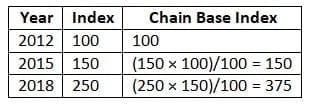
Q13: If the 2018 index with base 2015 is 250 and 2015 index with base 2012 is 150, the index 2018 on base 2012 will be:
(a) 800
(b) 375
(c) 600
(d) None
Ans: (b)
Sol:
Given,
If the 2018 index with base 2015 = 250 and 2015 index with base 2012 = 150
To find: The index 2018 on base 2012
Using chain base index:
Or'
Index 2018 on base 2012,
P20 = P21 × P10/100
⇒250 × 150/100
⇒375
Therefore, the index 2018 on base 2012 will be 375.
Q14: Fisher index number is ______ of Laspeyre's and Paasche's Index Number.
(a) A.M
(b) G.M
(c) H.M
(d) None of these
Ans: (b)
Sol:
We know,
Therefore, Fisher index number is geometric mean of Laspeyres and Paasches Index Number

Q15: The simple index number for the current year using simple aggregative method for the following data:
Commodity | Base Year Price (P₀) | Current Year Price (P₁)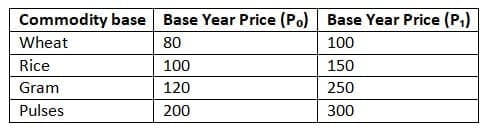 (a) 200
(b) 150
(c) 240
(d) 160
Ans: (d)
Sol:
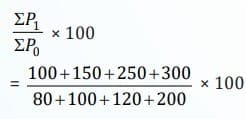
The simple Aggregative index is given by the formula,
= 800/500 × 100 = 160
Q16: The cost-of-living index number in year 2015 and 2018 were 97.5 and 115 respectively. The salary of CA Jitendra in 2015 was ₹40,000. How much additional salary was required for him in 2018 to maintain the same standard of living as in 2015?
(a) 30,000
(b) 40,000
(c) 35,000
(d) 45,000
Ans: (c)
Sol:
Let the salary of CA Jitendr in 2018 be x, then According to the question,Thus,
= 97.5/115 = 195000
⇒ x =195000 × 115/97.5⇒ x = 2,30,000 - 1,95,000
Therefore, the additional salary required
= 2,30,000 - 1,95,000
= 35,000
Q17: If the prices of all the goods change in the same ratio, then:
(a) Laspeyres' index and Paasche's index number are not equal.
(b) Laspeyres' index and Paasche's index number are equal.
(c) Laspeyres' index is greater than Paasche's index number.
(d) Laspeyres' index is less than Paasche's index number.
Ans: (b)
Sol:
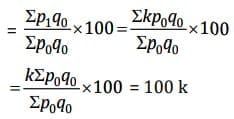
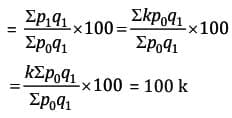
Given: Prices of all the goods change in the same ratio
Let P1/P0 = k
⇒ p1 = kp0
Therefore, Laspeyre's indexNow, paasche's index
Therefore, if the prices of all the goods change in the same ratio, then Laspeyre's index and Paasche's index number are equal.
Q18: Weighted geometric mean of relative formula satisfies _________ test while Factor Reversal test is satisfied by _________.
(a) Time Reversal, Fisher's Ideal index
(b) Time Reversal, Laspeyres's index
(c) Factor Reversal, Paasche's index
(d) Factor Reversal, Fisher's Ideal index
Ans: (a)
Sol:
Weighted geometric mean satisfies Time Reversal test and Factor Reversal test is satisfied by Fisher's Ideal index.
Q19: The gross monthly pay of an employee was ₹15,000 in the year 2020. The consumer price index number in 2023 is 155 with 2020 as the base year. If the employee is to be rightly compensated, what dearness allowance is required to be paid?
(a) ₹8,000
(b) ₹8,250
(c) ₹8,500
(d) ₹8,750
Ans: (b)
Sol:
Let the equivalent salary in 2023 be x
Therefore, 100/15,000 = 155/x
x = 15,000 x 155/100 = ₹23,250
Hence, Dearness Allowance (DA) is given by
DA = ₹23,250 - ₹15,000 = ₹8,250
Q20: From the year 2013 to 2023, the Consumer Price Index (CPI) number increased from 135 to 180. During this period, the salary of employees as per pay commission recommendations was revised from ₹23,000 to ₹29,500.
In real terms, an employee should get the following additional amount (upto the nearest whole number) to maintain the previous standard of living:
(a) ₹1,618
(b) ₹666
(c) ₹990
(d) ₹6,500
Ans: (a)
Sol:
Given,
CPI in 2013 = 135
CPI in 2023 = 180
Salary in 2013 = ₹23,000
Salary in 2023 = ₹29,500
Let required salary in 2023 to maintain standard of living = x
x = 23,000 x 180/135 = ₹30,666.66
Additional amount = ₹30,666.66 - ₹29,500
= ₹1,666.66 ≈ ₹1,168
FAQs on MCQs': Index numbers
| 1. What are index numbers and why are they important in economics? |  |
| 2. What are the different types of index numbers used in economic analysis? | |
| 3. How is the Consumer Price Index (CPI) calculated, and what does it represent? | |
| 4. What is the significance of using a base year in index number calculations? | |
| 5. What are some limitations of index numbers in economic analysis? | |