Previous Year Questions: The World Population Distribution, Density and Growth

Previous Year Questions 2025
Q.1. Choose the correct option to fill the blank: By 2050, the world population is estimated to live in urban areas is __________. (1 Mark)
(A) One fourth
(B) Half
(C) Two third
(D) Three fourth
Answer: (C) Two third.
Solution: Cities grow in size as rural-to-urban migration continues, and mega-cities attract large numbers of migrants annually. While the specific "two-third" statistic for 2050, this information is widely recognized in geographical studies as the projected urban population proportion.
Q.2. Examine the role of climate, water availability and soil fertility on the distribution of world population. (3 Marks)
Answer: Geographical factors are fundamental in determining where people live. Water availability is the most vital factor; hence, river valleys are the most densely populated areas as water is needed for drinking, crops, and industries. Regarding climate, people avoid extreme hot or cold deserts and heavy rainfall zones. Comfortable climates with little seasonal variation, such as the Mediterranean regions, attract larger populations. Lastly, soil fertility is essential for agriculture. Areas with fertile loamy soils support intensive farming and allied activities, making them highly attractive for human settlement compared to regions with poor soils.
Q.3. Examine three stages of demographic transition theory. (3 Marks)
Answer: The Demographic Transition Theory consists of three main stages. In the first stage, high fertility and high mortality lead to slow growth in rural, agrarian societies with low technology. The second stage is characterized by a "population explosion" where fertility remains high but mortality drops sharply due to better sanitation and health. In the third stage, the population becomes urbanized and literate; both birth and death rates decline significantly, leading to a stable or slowly growing population as people deliberately control their family sizes.
Study the following graph carefully and answer the questions no. 4 to 6.
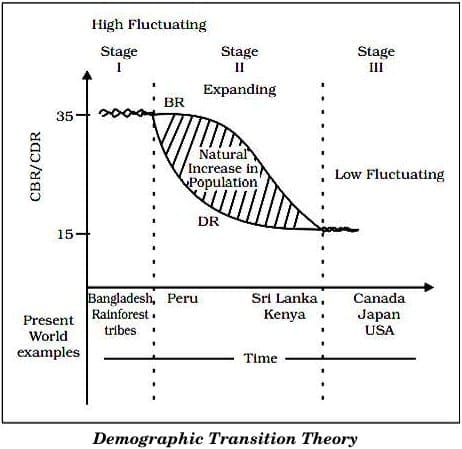
Q.4. Which one of the following stages of demographic transition theory is an indicative of primitive stage? (1 Mark)
(A) Stage I
(B) First part of stage II
(C) Second part of stage II
(D) Stage III
Answer: (A) Stage I
Solution: Stage I is the primitive stage where birth and death rates are both high, technology is low, and the society is primarily rural and agrarian.
Q.5. The highest difference between the crude birth rate and crude death rate is observed in which one of the following stages of demographic transition theory? (1 Mark)
(A) End of stage I
(B) End of the first part of stage II
(C) End of the second part of stage II
(D) End of stage III
Answer: (B) End of the first part of stage II
Solution: The gap is widest here because mortality declines rapidly due to health improvements while fertility remains high, resulting in high net population increase.
Q.6. Net increase in population during third stage of demographic transition theory is low due to which one of the following reasons? (1 Mark)
(A) Low birth rate and low death rate
(B) Low birth rate and high death rate
(C) High birth rate and low death rate
(D) High birth rate and high death rate
Answer: (A) Low birth rate and low death rate
Solution: In Stage III, growth is low because the population becomes urbanised and literate, leading to a deliberate decline in both fertility and mortality rates.
Study the following graph carefully and answer the questions no. 7 to 9:
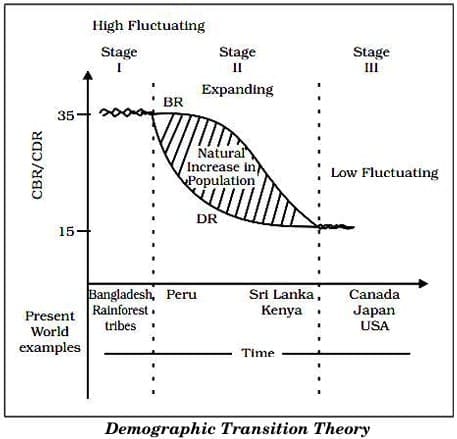
Q.7. Explain the reason of high net population increase in stage II of demographic transition theory. (1 Mark)
Answer: High growth in Stage II occurs because fertility remains high while mortality drops sharply due to improved health and sanitation, creating a significant gap between births and deaths.
Q.8. Differentiate between stage I and III of demographic transition theory. (1 Mark)
Answer: Stage I involves high births/deaths in a rural, agrarian society. Conversely, Stage III involves low births/deaths in an urban, industrial society where people deliberately control family size.
Q.9. Describe the socio-economic conditions of countries under stage III of demographic transition theory. (1 Mark)
Answer: In Stage III, countries are urbanised, literate, and possess high technical know-how. Societies are industrial, and individuals exercise deliberate control over family size to ensure stable population growth.
Q.10. Define the terms immigration and emigration. Analyse demographic transition theory in the world. (5 Marks)
Answer: Immigration refers to migrants who move into a new place, whereas emigration refers to migrants who move out of a place. Demographic Transition Theory describes how a region's population changes as it progresses from a rural, agrarian, and illiterate society to an urban, industrial, and literate one.
In Stage I, both fertility and mortality are high, resulting in slow population growth, often seen in primitive societies where large families are an asset. Stage II involves high fertility initially, but mortality declines significantly due to improved sanitation and health conditions, creating a high net population increase. Finally, in Stage III, both fertility and mortality decline considerably, leading to a stable or slowly growing population. In this advanced stage, the population becomes highly urbanized and literate, and humans deliberately control family sizes.
Q.11. Explain the Malthus Theory of population growth. Suggest important measures to control the rapidly increasing population. (5 Marks)
Answer: Thomas Malthus, in his 1798 theory, argued that the human population would grow at a faster rate than the available food supply. He predicted that any uncontrolled increase would lead to a "population crash" triggered by famine, disease, and war. Malthus emphasized that preventive checks-which are human-led efforts-are far better than the harsh physical checks imposed by nature.
To control rapid growth and ensure the sustainability of resources, the sources suggest several population control measures. Family planning, defined as spacing or preventing births, is a critical factor in limiting growth. Governments can use propaganda and ensure the free availability of contraceptives to encourage smaller families. Additionally, implementing tax disincentives for large families serves as a policy measure to curb growth. These steps help improve women's health and maintain the balance between people and resources.
Q.12. Define natural growth of population. Describe the impact of migration on changing population in the world. (5 Marks)
Answer: Natural growth of population is the increase in population calculated as the difference between births and deaths in a specific region between two points of time. It is represented by the formula: Natural Growth = Births - Deaths.
Migration significantly impacts world population patterns as it serves as a spontaneous effort to achieve a better balance between population and resources. When people migrate, the place of origin experiences a decrease in population, while the place of destination sees an increase. Migration can be permanent, temporary, or seasonal, occurring between rural and urban areas. Push factors, such as unemployment, poor living conditions, or political turmoil, force people out of their homes. Conversely, pull factors, like better job opportunities, peace, and security of life, attract people to new destinations. Collectively, these movements redistribute the world's population, altering the demographic characteristics of both origin and destination regions.
Q.13. Analyse any five factors influencing the distribution of world population. (5 Marks)
Answer: The distribution of the world's population is influenced by various factors that determine why people congregate in specific areas.
1. Availability of Water: People prefer areas with fresh water for domestic use, cattle, and industries, making river valleys densely populated.
2. Landforms: Flat plains and gentle slopes are preferred for crop production and building infrastructure, unlike mountainous regions like the Himalayas.
3. Climate: Harsh climates like hot or cold deserts are avoided, while pleasant climates with moderate variation attract more inhabitants.
4. Soils: Fertile loamy soils are crucial for intensive agriculture, supporting higher population densities in agricultural belts.
5. Economic Factors (Minerals/Industrialisation): Areas with mineral deposits, like the Katanga Zambia copper belt, and industrial regions, like Kobe-Osaka in Japan, provide employment and draw large numbers of workers and service providers.
Q.14. Define migration. Differentiate between pull and push factors of population migration. (5 Marks)
Answer: Migration is the movement of people from a place of origin to a place of destination, which can be permanent, temporary, or seasonal. It represents an effort to balance population with available resources.
The factors driving this movement are categorized into push and pull factors. Push factors make the place of origin unattractive, compelling people to leave. These include unemployment, poor living conditions, political unrest, unpleasant climate, natural disasters, epidemics, and socio-economic backwardness. Conversely, pull factors make the place of destination appear more attractive. These include better job opportunities, superior living conditions, peace and stability, security of life and property, and a pleasant climate. While push factors are "away" forces rooted in local hardships, pull factors are "toward" forces based on the perceived benefits of the destination.
Q.15. Explain the economic and socio-cultural factors affecting the population distribution in the world. (5 Marks)
Answer: Population distribution is not only affected by geography but also by economic and social considerations. Economic factors include mineral deposits, which attract mining and industrial activities, creating jobs for various workers. For instance, the Katanga Zambia copper belt is densely populated due to mining. Urbanization also plays a role as cities offer better education, medical facilities, and employment, drawing people through rural-to-urban migration. Similarly, industrialization provides job opportunities for everyone from factory workers to teachers, as seen in Japan's Kobe-Osaka region.
Socio-cultural factors further influence where people settle. Some places attract more people because of their religious or cultural significance. On the other hand, people often move away from areas experiencing social and political unrest. Furthermore, government policies can shift distribution; many governments offer incentives to encourage people to move to sparsely populated areas or to decongest overcrowded cities.
Q.16. Define population density. Explain the physical factors affecting the population density in the world. (5 Marks)
Answer: Population density is the ratio between the number of people and the size of the land they occupy, usually measured in persons per square kilometer. It is calculated using the formula: Density = Population / Area.
Several physical (geographical) factors determine population density:
- Availability of Water: As the most important factor for life, fresh water sources like river valleys are the most densely populated regions globally.
- Landforms: People prefer flat plains for farming and infrastructure; hence, the Ganga plains are densely populated while the Himalayas are sparsely populated.
- Climate: Areas with extreme heat, cold, or heavy rainfall are uncomfortable, whereas pleasant climates, like those in the Mediterranean, have been inhabited for centuries.
- Soils: Agriculture depends on fertility; therefore, regions with fertile loamy soils support more people due to their capacity for intensive farming.
Q.17. Explain the measures of population control in the world. (5 Marks)
Answer: Controlling population growth is essential for the sustainability of resources. The primary measure is family planning, which involves spacing or preventing births. Access to these services not only limits growth but also improves women's health. Specific strategies include propaganda to educate the public, the free availability of contraceptives, and implementing tax disincentives for families with many children.
According to Thomas Malthus, the world must adopt preventive checks-voluntary human actions to limit births-to avoid "physical checks" like famine and war that nature imposes when population outstrips food supply. The sources emphasize that because human beings are flexible, they can deliberately adjust their fertility. By moving toward an urbanized and literate society, countries naturally enter the final stage of demographic transition where population growth stabilizes. Ultimately, a combination of social awareness, government policy, and technological access is required to manage global population growth.
Previous Year Questions 2024
Read the given passage and answer the Q. Nos. 1 to 3 :
Stages of Demographic Transition Theory
The first stage of demographic transition theory has high fertility and high mortality because people reproduce more to compensate for the deaths due to epidemics and variable food supply. The population growth is slow and most of the people are engaged in agriculture, where large families are an asset. Life expectancy is low, people are mostly illiterate and have low levels of technology. Two hundred years ago all the countries of the world were in this stage. Fertility remains high in the beginning of second stage but it declines with time. This is accompanied by reduced mortality rate. Improvements in sanitation and health conditions lead to decline in mortality. Because of this gap, the net addition to population is high. In the last stage, both fertility and mortality decline considerably. The population is either stable or grows slowly. The population becomes urbanized, literate and has high technical know-how and deliberately controls the family size. This shows that human beings are extremely flexible and are able to adjust their fertility. In the present day, different countries are at different stages of demographic transition.
Q.1. Which among the following stage/stages has/have high growth of population?
(A) Only the first stage
(B) Only the second stage
(C) Both first and second stages
(D) Both second and last stages
Answer: (B) Only the second stage Solution
Solution: In stage two, fertility remains high while mortality declines due to better health. This gap between births and deaths leads to high net population addition.
Q.2. Choose the most appropriate option from the following regarding components of population change:
(A) Births, deaths and migration
(B) Births, density and migration
(C) Density, literacy and age structure
(D) Deaths, literacy and sex ratio
Answer: (A) Births, deaths and migration Solution
Solution: There are three components that drive population change: births, deaths, and migration. These factors determine the actual growth or decline of a territory's inhabitants.
Q.3. Which of the following stage/stages has/have a slow growth of population?
(A) Only the first stage
(B) Only the second stage
(C) Only second and last stages
(D) Only first and last stages
Answer: (D) Only first and last stages Solution
Solution: Stage one has high births and deaths, while the last stage has low births and deaths. In both cases, the rates nearly cancel each other out.
Read the given passage and answer the Q. Nos. 4 to 6 :
Demographic Transition Theory
The first stage of demographic transition theory has high fertility and high mortality because people reproduce more to compensate for the deaths due to epidemics and variable food supply. The population growth is slow and most of the people are engaged in agriculture, where large families are an asset. Life expectancy is low, people are mostly illiterate and have low levels of technology. Two hundred years ago all the countries of the world were in this stage. Fertility remains high in the beginning of second stage but it declines with time. This is accompanied by reduced mortality rate. Improvements in sanitation and health conditions lead to decline in mortality. Because of this gap, the net addition to population is high. In the last stage, both fertility and mortality decline considerably. The population is either stable or grows slowly. The population becomes urbanized, literate and has high technical know-how and deliberately controls the family size. This shows that human beings are extremely flexible and are able to adjust their fertility. In the present day, different countries are at different stages of demographic transition.
Q.4. In which of the following stage/stages, the natural growth of population was/were almost stagnant?
(A) Only I
(B) Only II
(C) Only I and Last
(D) Only II and Last
Answer: (C) Only I and Last Solution
Solution: Natural growth is the difference between births and deaths. In the first and last stages, these rates are closely aligned, resulting in stagnant or slow growth.
Q.5. In which of the following stage/stages, the death rate declined the most?
(A) Only I
(B) Only II
(C) Only I and II
(D) Only I and Last
Answer: (B) Only II Solution
Solution: The second stage is characterized by a significant decline in mortality. This reduction is driven primarily by improvements in sanitation and health conditions within the society.
Q.6. Which one among the following countries is an example of second stage?
(A) Kenya
(B) Bangladesh
(C) Japan
(D) Canada
Answer: (A) Kenya Solution
Solution: According to the demographic transition model, Kenya is currently in the expanding second stage. Countries like Canada and Japan have already reached the last stage.
Q.7. Explain, with examples, any three economic factors affecting population distribution in the world. (3 Marks)
Answer: Economic factors influence distribution by providing livelihood opportunities. First, minerals attract industries and workers; the Katanga Zambia copper belt in Africa is a prime example of high density due to mining. Second, urbanisation pulls people toward cities for better employment, education, and medical facilities. Third, industrialisation creates job opportunities for various service providers; the Kobe-Osaka region of Japan is thickly populated because of its numerous industrial units. Together, these factors lead to significant rural-to-urban migration and the growth of mega-cities.
Q.8. Explain the stages of demographic transition theory in the world. (3 Marks)
Answer: Demographic transition theory describes three stages of population change. Stage I features high fertility and high mortality, resulting in slow growth in agrarian, illiterate societies. In Stage II, fertility remains high initially, but mortality declines sharply due to better sanitation and health, leading to a high net addition to the population. In the Last Stage, both fertility and mortality decline considerably, leading to a stable or slowly growing population that is urbanized, literate, and capable of controlling family size.
Q.9. Explain with examples, any three physical factors affecting the distribution of world population. (3 Marks)
Answer: Physical factors are primary determinants of settlement. Availability of water is most important; people prefer areas with fresh water for domestic use and crops, making river valleys the most crowded regions. Landforms also play a role, as flat plains (like the Ganga plains) are favored for agriculture and roads over rugged mountains (like the Himalayas). Climate affects comfort; Mediterranean regions attract people with pleasant weather, while extreme hot or cold deserts remain sparsely populated due to harsh conditions.
Q.10. How does science and technology help in the increase of population in the world? Explain. (3 Marks)
Answer: Science and technology help increase population primarily by reducing the death rate. Technological progress in the 20th century allowed the population to increase four times. Improvements in sanitation and medical facilities conquered many diseases and lowered mortality, especially in the second stage of demographic transition. Additionally, high technical know-how in advanced stages allows humans to better manage resources and health, though it eventually leads to deliberate family size control to ensure the sustainability of resources.
Q.11. How do landforms affect the distribution of world population? Explain. (3 Marks)
Answer: Landforms determine the suitability of an area for human activity. People generally prefer flat plains and gentle slopes because they are favorable for crop production and the development of transport networks like roads and industries. Consequently, the Ganga plains are among the most densely populated areas globally. In contrast, mountainous and hilly areas hinder transport and initially do not favor agricultural or industrial development, making them scarcely populated, as seen in the mountain zones of the Himalayas.
Q.12. Explain migration as a component of population change in the world. (3 Marks)
Answer: Migration is the movement of people from a place of origin (which sees a decrease) to a place of destination (which sees an increase). It represents a spontaneous effort to balance population and resources. Migration is driven by Push factors like unemployment and poor living conditions that make an area less attractive, and Pull factors like better job opportunities and peace that make a destination more appealing. It can be permanent, temporary, or seasonal, occurring between rural and urban areas.
Q.13. Analyse any five factors affecting world distribution of population. (5 Marks)
Answer: The distribution of the world's population is highly uneven, with 90% of people living on just 10% of the land. This pattern is influenced by several factors. Availability of water is paramount; people settle near fresh water for domestic and industrial use, making river valleys the most crowded areas. Landforms also dictate settlement, as flat plains favor agriculture and infrastructure over rugged mountains. Climate acts as a filter; moderate Mediterranean climates attract large populations, while extreme deserts remain sparsely inhabited. Fertile soils are essential for intensive agriculture, supporting higher densities. Finally, economic factors like mining and urbanization draw people to specific zones for employment; for instance, the Katanga Zambia copper belt attracts workers due to its mineral wealth. These factors collectively explain why population is concentrated in a few favorable locations.
Q.14. Examine any five factors affecting the density of population in world. (5 Marks)
Answer: Population density, the ratio between people and land, is determined by various geographical and human influences. Physical factors like fresh water and fertile loamy soils ensure high density in regions like the Ganga plains, which support intensive agriculture. Economic factors are equally critical; mining and industrial activities generate employment, drawing skilled workers to areas like the Kobe-Osaka region of Japan. Urbanisation increases density as cities offer superior education, healthcare, and transport facilities. Social and cultural factors also play a role, as places of religious significance attract settlers, while people move away from political unrest. Lastly, government policies can influence density by offering incentives to live in sparsely populated areas or managing overcrowded places. These factors ensure that density remains a dynamic indicator of a region's economic and social development.
FAQs on Previous Year Questions: The World Population Distribution, Density and Growth
| 1. What factors influence world population distribution? |  |
| 2. How is population density calculated? | |
| 3. What is the significance of population growth rates? | |
| 4. What are the implications of uneven population distribution? | |
| 5. How has urbanisation affected population distribution and density? | |