Previous Year Questions: Secondary Activities

Previous Year Questions 2025
Q1: Two statements are given below. They are Assertion (A) and Reason (R). Read both the statements carefully and choose the correct option: (1 Mark)
Assertion (A): All manufacturing industries are associated with raw materials.
Reason (R): Resources are essential for human survival.
(A) Both (A) and (R) are true and (R) is the correct explanation of (A).
(B) Both (A) and (R) are true, but (R) is not the correct explanation of (A).
(C) (A) is correct, but (R) is incorrect.
(D) (A) is incorrect, but (R) is correct.
Answer: (B) Both (A) and (R) are true, but (R) is not the correct explanation of (A).
Solution: According to the sources, manufacturing is essentially a process involving the transformation of raw materials into finished goods. It is also stated that all economic activities revolve around obtaining resources necessary for survival. While both statements are factually correct, the general need for resources for survival does not specifically explain the technical definition or requirement of raw materials in the manufacturing process.
Q2: Two statements are given below. They are Assertion (A) and Reason (R). Read both the statements carefully and choose the correct option. (1 Mark)
Assertion (A): Foot loose industries can be located in a wide variety of places.
Reason (R): Location of foot loose industries is determined by transport network accessibility.
(A) Both (A) and (R) are true and (R) is the correct explanation of (A).
(B) Both (A) and (R) are true, but (R) is not the correct explanation of (A).
(C) (A) is incorrect, but (R) is correct.
(D) (A) is correct, but (R) is incorrect.
Answer: (A) Both (A) and (R) are true and (R) is the correct explanation of (A).
Solution: The sources state that footloose industries are not dependent on specific raw materials and rely on component parts obtainable anywhere. Because they are not tied to a specific resource site, their location is primarily influenced by accessibility via road networks, which explains why they can be placed in various locations.
Q3: Two statements are given below. They are Assertion (A) and Reason (R). Read both the statements carefully and choose the correct option. (1 Mark)
Assertion (A): Industries based on cheap, bulky and weight-losing material are located close to the sources of raw materials.
Reason (R): It is followed to reduce the cost of products.
(A) Both (A) and (R) are true and (R) is the correct explanation of (A).
(B) Both (A) and (R) are true, but (R) is not the correct explanation of (A).
(C) (A) is incorrect, but (R) is correct.
(D) (A) is correct, but (R) is incorrect.
Answer: (A) Both (A) and (R) are true and (R) is the correct explanation of (A).
Solution: The sources explain that industries maximize profits by reducing costs. For industries using bulky or weight-losing materials (like steel or sugar), locating close to the raw material source minimizes transportation expenses, thereby effectively reducing the total cost of the finished product.
Q4: Identify the sector concerned with the work of converting raw materials into finished products. (1 Mark)
(A) Primary
(B) Secondary
(C) Tertiary
(D) Quaternary
Answer: (B) Secondary.
Solution: Secondary activities are specifically concerned with adding value to natural resources by transforming raw materials into valuable, finished products, such as turning iron ore into steel or cotton into yarn.
Q5: Differentiate between small scale and large scale industries with examples. (3 Marks)
Answer: According to the sources, small-scale manufacturing is distinguished by the use of local raw materials, simple power-driven machinery, and semi-skilled labor. It typically operates in workshops outside the home and is vital for providing local employment in countries like India and China.
In contrast, large-scale manufacturing involves enormous energy consumption, various raw materials, and advanced technology. It relies on specialized workers and assembly-line mass production supported by vast capital. For example, a local workshop producing simple tools represents small-scale industry, while a massive passenger car assembly plant in Japan exemplifies large-scale manufacturing.
Q6: (a) Explain the main reasons for uneven distribution of modern manufacturing industries in the world. (3 Marks)
Answer: Modern manufacturing is highly concentrated, covering less than 10 per cent of the world's land area. This uneven distribution occurs because industries locate where production costs are minimized to maximize profits. Key factors include access to large markets with high purchasing power, such as North America and Japan, and access to raw materials, especially for weight-losing industries. Additionally, the availability of developed transport systems in Western Europe and government "regional policies" to promote balanced development further influence where these industrial clusters flourish.
OR
(b) Classify the industries based on product and explain their characteristics. (1+2=3 Marks)
Answer: Based on their output or products, industries are classified into two categories: Basic Industries and Consumer Goods (Non-basic) Industries.
1. Basic Industries: These produce goods that are used as raw materials by other industries to manufacture further products. For example, the iron and steel industry is a basic industry because it provides the steel needed to build machines for the textile industry.
2. Consumer Goods Industries: These industries produce commodities that are consumed directly by the end-users. Examples include the production of bread, biscuits, tea, soaps, toiletries, and televisions. Unlike basic industries, their output does not serve as a raw material for another manufacturing process.
Q.7. Read the given passage carefully and answer the questions that follow: (3 Marks)
There are many professionals who provide their services against payment of their fee. Thus, all types of services are special skills provided in exchange of payments. Health, education, law, governance and recreation, etc., require professional skills. These services require other theoretical knowledge and practical training. Tertiary activities are related to the service sector. Manpower is an important component of the service sector as most of the tertiary activities are performed by skilled labour, professionally trained experts and consultants. In the initial stages of economic development, larger proportion of people worked in the primary sector. In a developed economy, the majority of workers get employment in tertiary activity and a moderate proportion is employed in the secondary sector.
(7.1.) How can a person avail services of a professional? (1 Mark)
Answer: A person can avail of professional services by providing a payment of a fee in exchange for the professional's specialized skills and knowledge.
(7.2.) Explain any one difference between secondary and tertiary sectors. (1 Mark)
Answer: The secondary sector focuses on the manufacturing and processing of physical goods, whereas the tertiary sector is concerned with providing specialized services through skilled manpower.
(7.3.) Describe any one example of the relationship between primary and secondary sectors. (1 Mark)
Answer: The primary sector provides raw materials, such as iron ore from mines, which the secondary sector then transforms into valuable finished products like steel and machinery.
Q.8. (a) Explain the main features of large scale manufacturing industries in the world. (5 Marks)
Answer: Large-scale manufacturing is characterized by several distinct features that distinguish it from smaller units. Firstly, it involves specialization of skills, where the "craft" method of made-to-order pieces is replaced by the mass production of standardized parts. Secondly, it relies heavily on mechanization and advanced automation, using automatic factories with computer control systems.
Thirdly, it features a complex organizational structure including extreme division of labor and an executive bureaucracy to manage the vast operations. Fourthly, it requires enormous capital investment and utilizes various raw materials sourced globally. Finally, it is characterized by assembly-line mass production, where each worker performs repetitive tasks to produce large quantities of identical goods at low costs, as seen in modern automotive plants.
OR
(b) Explain the main features of 'High Tech' industries in the world. (5 Marks)
Answer: High technology, or "high-tech," represents the latest generation of manufacturing activities. Its main features include:
1. Research and Development: It is fundamentally based on the application of intensive research and development (R&D), resulting in products of an advanced scientific and engineering character.
2. Workforce Composition: The workforce is dominated by highly skilled "white collar" professionals (specialists and consultants), who greatly outnumber the actual "blue collar" production workers.
3. Advanced Processes: Production involves the use of robotics on assembly lines, computer-aided design (CAD), and electronic controls in smelting or refining.
4. Modern Landscape: The high-tech landscape features neatly spaced, modern, office-plant-lab buildings rather than massive traditional factories or storage areas. These are often situated in planned business parks.
5. Technopolies: Regionally concentrated, self-sustained, and highly specialized hubs of high-tech industries are known as technopolies, such as Silicon Valley near San Francisco and Silicon Forest near Seattle.
Q.9. "High-tech industries are regionally concentrated, self-sustained and highly specialized". Justify the statement (5 Marks)
Answer: High-tech industries represent the latest generation of manufacturing, driven by intensive research and development (R&D). They are "highly specialized" because the workforce consists primarily of highly skilled "white collar" professionals-specialists and consultants-who outnumber actual production workers. Their "regionally concentrated" nature is evidenced by the development of technopolies, which are self-sustained hubs of high-tech activity.
These industries favor a distinct landscape of neatly spaced, modern, office-plant-lab buildings within planned business parks rather than massive, traditional factory structures. Notable examples include Silicon Valley near San Francisco and Silicon Forest near Seattle. These centers remain self-sustained through constant innovation in fields like robotics, computer-aided design (CAD), and the development of new pharmaceutical products, making them the leading edge of modern economic power.
Q.10. Explain the classification of industries on the basis of raw materials with examples. (5 Marks)
Answer: Industries are classified based on the nature of the raw materials they process:
1. Agro-based: These process materials from fields and farms, such as sugar, tea, and food processing (canning/pickling).
2. Mineral-based: These use minerals as inputs. They are divided into ferrous (iron and steel) and non-ferrous (aluminum, copper, and jewelry), as well as non-metallic (cement and pottery).
3. Chemical-based: These utilize natural chemical minerals or materials from wood and coal, such as petrochemicals, synthetic fibers, and plastics.
4. Forest-based: These rely on forest products like timber for furniture and wood/bamboo for the paper industry.
5. Animal-based: These utilize animal products, such as leather for shoes and wool for textiles.
Previous Year Questions 2024
Q.1. Synthetic fibre and plastic manufacturing is an example of which one of the following? (1 Mark)
(A) Mineral-based industry
(B) Chemical-based industry
(C) Forest-based industry
(D) Animal-based industry
Answer: (B) Chemical-based industry
Solution: These industries utilize natural chemical minerals like mineral oil (petroleum) and salts to create synthetic products. They are distinct from industries using direct mineral ores or organic forest materials.
Q.2. Two statements are given below. They are Assertion (A) and Reason (R). Read both the statements carefully and choose the correct option: (1 Mark)
Assertion (A): Footloose industries can be located in a wide variety of places.
Reason (R): The important factor in the location of footloose industries is accessibility by transport network.
(A) Both (A) and (R) are true and (R) is the correct explanation of (A).
(B) Both (A) and (R) are true, but (R) is not the correct explanation of (A).
(C) (A) is true, but (R) is false.
(D) (A) is false, but (R) is true.
Answer: (A) Both (A) and (R) are true and (R) is the correct explanation of (A)
Solution: Footloose industries do not depend on specific raw materials and instead rely on component parts obtainable anywhere. Therefore, their primary locational requirement is accessibility by road or transport networks.
Q.3. Match Column I with Column II and choose the correct option:
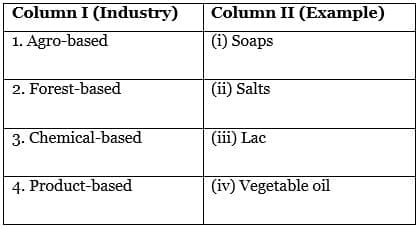
(A) 1-(iii), 2-(iv), 3-(ii), 4-(i)
(B) 1-(iii), 2-(iv), 3-(i), 4-(ii)
(C) 1-(iv), 2-(iii), 3-(ii), 4-(i)
(D) 1-(iv), 2-(iii), 3-(i), 4-(ii)
Answer: (C) 1-(iv), 2-(iii), 3-(ii), 4-(i)
Solution: Vegetable oil is processed from agricultural fields; Lac is a forest product; Salts are chemical minerals; and Soaps are consumer products ready for direct use.
Q.4. Two statements are given below. They are Assertion (A) and Reason (R). Read both the statements carefully and choose the correct option: (1 Mark)
Assertion (A): Industries based on ores are located close to the sources of raw material.
Reason (R): Industries maximise profits by reducing transportation costs.
(A) (A) is correct and (R) is false.
(B) (A) is false and (R) is correct.
(C) Both (A) and (R) are correct and (R) is correct explanation of (A).
(D) Both (A) and (R) are correct, but (R) is not correct explanation of (A).
Answer: (C) Both (A) and (R) are correct and (R) is correct explanation of (A)
Solution: Ores are bulky and weight-losing materials that are expensive to move. To maximize profit, industries like steel or cement must be located near the source to minimize these transport costs.
Q.5.Explain the difference between cottage and large scale industries in the world, with examples. (5 Marks)
Answer: Cottage (household) industries are the smallest manufacturing units where artisans use local raw materials and simple tools to produce goods at home with family help. These have low commercial significance, and products like pottery, mats, or figurines are often for local consumption or barter. Large scale industries, in contrast, involve massive markets, various raw materials, and enormous energy consumption. They are characterized by advanced technology, assembly-line mass production, and specialized workers. While cottage industries are dispersed and rely on local skills, large-scale manufacturing requires vast capital and complex organizational structures. Examples of large-scale industries include automobile plants and integrated steel factories, which originally developed in regions like the North-eastern U.S.A. and Western Europe before diffusing globally.
Q.6. Explain any five factors affecting the location of industries in the world. (5 Marks)
Answer: Industrial location is strategically chosen to minimize production costs and maximize profits. Five key factors include:
1. Access to Market: This is the most vital factor; a market consists of people with demand and the purchasing power to buy goods.
2. Access to Raw Materials: Industries using bulky, weight-losing materials (like steel or sugar) or perishable goods (like dairy) are located near the source to reduce transport expenses.
3. Access to Labour Supply: While mechanization has reduced dependence, many industries still require specialized, skilled labor in factory settings.
4. Access to Energy: Power-intensive industries, such as aluminum, are situated near energy sources like hydroelectricity or coal.
5. Transportation and Communication: Speedy and efficient transport systems are essential to move raw materials to factories and finished goods to markets; regions like Western Europe flourish due to highly developed networks.
Q.7. Explain five types of industries classified on the basis of raw materials. (5 Marks)
Answer: Industries are classified into five major groups based on the inputs they use:
1. Agro-based: These process raw materials from fields and farms into products like sugar, beverages (tea, coffee), and textiles (cotton, jute).
2. Mineral-based: These use minerals as raw materials. They include ferrous metallic industries (iron and steel), non-ferrous (aluminum, copper), and non-metallic (cement, pottery).
3. Chemical-based: These utilize natural chemical minerals like petroleum for petrochemicals, or salts and sulfur. They also include synthetic fiber and plastic manufacturing.
4. Forest-based: These rely on forest products, providing timber for furniture, wood or bamboo for the paper industry, and lac for lac industries.
5. Animal-based: These obtain raw materials from animals, such as leather for the footwear industry and wool for textiles.
Q.8. Differentiate the small and large scale manufacturing industries in the world. (5 Marks)
Answer: Small scale manufacturing is distinguished by its use of local raw materials, simple power-driven machines, and semi-skilled labor. Production typically takes place in workshops outside the home, and it is a labor-intensive sector aimed at providing local employment and raising purchasing power in countries like India and China. Large scale manufacturing, however, is characterized by its massive market reach, specialized workers, and assembly-line mass production. It requires enormous energy, advanced technology, and vast capital investment. While small-scale industries focus on local regional development, large-scale industries often have complex bureaucratic organizations and are concentrated in a few global economic centers. Additionally, large-scale industries rely on a much more diverse range of raw materials and complex machines compared to the simpler processes of small-scale workshops.
Q.9. Analyse the important characteristics of large scale manufacturing industries in the world. (5 Marks)
Answer: Modern large-scale manufacturing is defined by several distinct characteristics:
1. Specialisation of Skills: It utilizes mass production where workers perform standardized tasks repeatedly to produce identical parts at lower costs.
2. Mechanisation and Automation: Advanced gadgets and automatic factories with computer-control systems complete tasks without human thinking during the process.
3. Technological Innovation: Continuous Research and Development (R&D) is applied to maintain quality control, eliminate waste, and combat pollution.
4. Complex Organisational Structure: It involves an executive bureaucracy, extreme division of labor, and requires vast capital investment.
5. Uneven Geographic Distribution: These industries are concentrated in a few places covering less than 10% of the world's land area, becoming centers of economic and political power.
Q.10. Classify industries on the basis of their raw materials and explain each one of them. (5 Marks)
Answer: Industries are categorized into five types based on their raw material inputs:
- Agro-based: Process materials from the farm (canning, fruit processing, beverages) into finished goods for urban markets.
- Mineral-based: Categorized into metallic (ferrous like iron/steel; non-ferrous like aluminum/copper) and non-metallic (cement, pottery).
- Chemical-based: Use petroleum for petrochemicals and natural minerals like potash or sulfur for various chemicals; also includes synthetic fibers and plastics.
- Forest-based: Use major and minor forest products, such as timber for furniture and bamboo or grass for paper production.
- Animal-based: Use materials obtained from livestock, such as wool for textiles and leather for footwear. Each type focuses on adding value to these primary resources by transforming them into valuable finished products.
FAQs on Previous Year Questions: Secondary Activities
| 1. What are secondary activities in the context of humanities and arts? |  |
| 2. How do secondary activities influence cultural identity? | |
| 3. What are some examples of secondary activities in the arts? | |
| 4. How do economic factors affect secondary activities in the humanities and arts? | |
| 5. What is the importance of preserving secondary activities in the humanities and arts? | |