Commerce Exam > Commerce Notes > Economics Class 12 > Infographic: Indian Economy 1950-1990
Infographic: Indian Economy 1950-1990

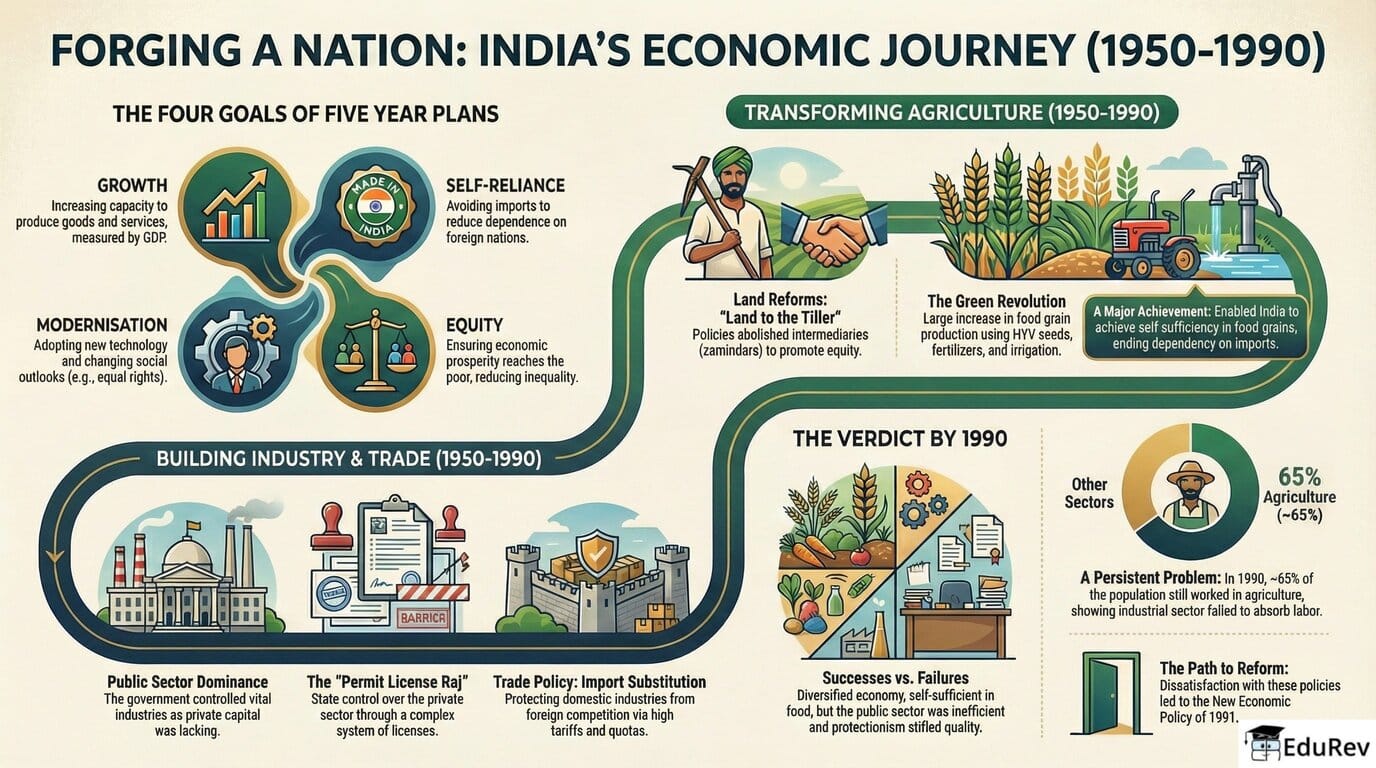
The document Infographic: Indian Economy 1950-1990 is a part of the Commerce Course Economics Class 12.
All you need of Commerce at this link: Commerce
FAQs on Infographic: Indian Economy 1950-1990
| 1. What were the key features of the Indian economy from 1950 to 1990? |  |
Ans. The Indian economy from 1950 to 1990 was characterised by a mixed economy framework, combining both public and private sector participation. Key features included import substitution industrialisation, state-led economic planning, and an emphasis on heavy industries. The Five-Year Plans were instrumental in directing economic goals, while agriculture remained a significant focus to achieve self-sufficiency in food production.
| 2. How did the economic policies of India evolve during this period? | |
Ans. Economic policies in India evolved from a focus on self-reliance and protectionism in the early years to more liberalisation and market-oriented reforms towards the end of the 1980s. Initially, policies aimed at building a robust public sector and controlling foreign investments, while later policies began to encourage private enterprise and foreign direct investment, setting the stage for subsequent economic reforms.
| 3. What was the role of agriculture in the Indian economy during 1950-1990? | |
Ans. Agriculture played a crucial role in the Indian economy during this period, being the primary source of livelihood for the majority of the population. The Green Revolution in the 1960s introduced high-yield variety seeds and modern agricultural practices, significantly increasing food production. Agricultural policies aimed at land reform and irrigation development were also essential to enhance productivity and achieve food security.
| 4. What impact did the Licence Raj have on Indian commerce? | |
Ans. The Licence Raj system imposed strict controls over production, pricing, and investment, requiring businesses to obtain government licences for operation. This led to bureaucratic delays, corruption, and inefficiencies, stifling innovation and competition in commerce. It created a sheltered market that often favoured established firms, limiting opportunities for new entrants and hindering overall economic growth.
| 5. How did India's trade relations change during this period? | |
Ans. India's trade relations during this period were largely influenced by its economic policies, emphasising self-sufficiency and protectionism. Initially, trade was limited, with a focus on imports of essential goods and minimal exports. However, by the late 1980s, there was a gradual shift towards more open trade policies, leading to increased engagement with international markets and an emphasis on export promotion, particularly in sectors like textiles and agriculture.
About this Document

4.91/5 Rating

Apr 19, 2026 Last updated
Related Exams
Document Description: Infographic: Indian Economy 1950-1990 for Commerce 2026 is part of Economics Class 12 preparation. The notes and questions for Infographic: Indian Economy 1950-1990 have been prepared according to the Commerce exam syllabus. Information about Infographic: Indian Economy 1950-1990 covers topics like and Infographic: Indian Economy 1950-1990 Example, for Commerce 2026 Exam. Find important definitions, questions, notes, meanings, examples, exercises and tests below for Infographic: Indian Economy 1950-1990.
Introduction of Infographic: Indian Economy 1950-1990 in English is available as part of our Economics Class 12 for Commerce & Infographic: Indian Economy 1950-1990 in Hindi for Economics Class 12 course. Download more important topics related with notes, lectures and mock test series for Commerce Exam by signing up for free. Commerce: Infographic: Indian Economy 1950-1990
Description
Infographic: Indian Economy 1950 of Economics Class 12 provides you one-page visual summary of the chapter covering all the important topics. Download the PDF from EduRev.
Information about Infographic: Indian Economy 1950-1990
In this doc you can find the meaning of Infographic: Indian Economy 1950-1990 defined & explained in the simplest way possible. Besides explaining types of Infographic: Indian Economy 1950-1990 theory, EduRev gives you an ample number of questions to practice Infographic: Indian Economy 1950-1990 tests, examples and also practice Commerce tests



Related Searches
MCQs, practice quizzes, Free, pdf , Important questions, past year papers, study material, Infographic: Indian Economy 1950-1990, Objective type Questions, mock tests for examination, Extra Questions, Viva Questions, Semester Notes, ppt, Previous Year Questions with Solutions, Sample Paper, Summary, Infographic: Indian Economy 1950-1990, video lectures, Infographic: Indian Economy 1950-1990, shortcuts and tricks, Exam;