Commerce Exam > Commerce Notes > Economics Class 12 > Infographic: Money and Banking
Infographic: Money and Banking

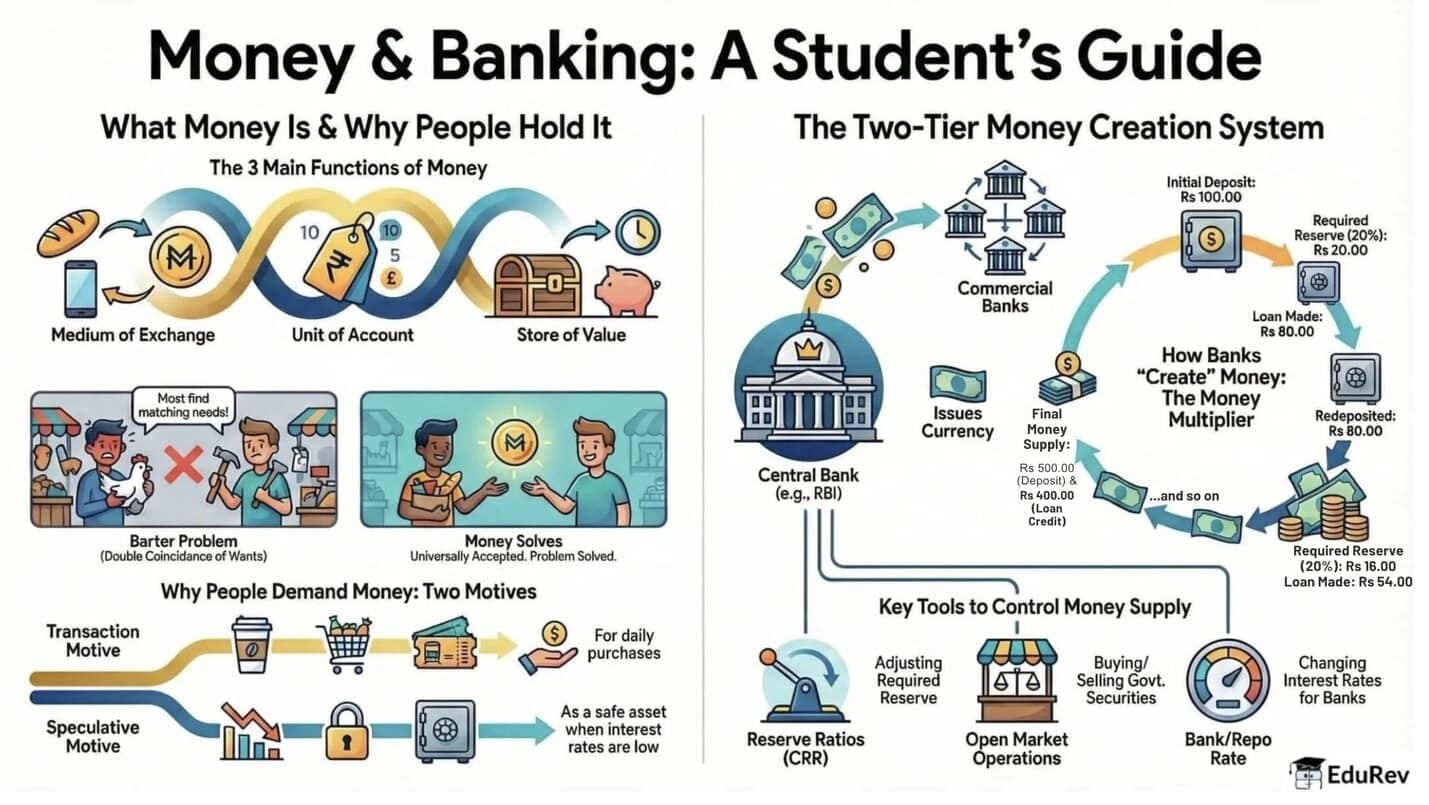
The document Infographic: Money and Banking is a part of the Commerce Course Economics Class 12.
All you need of Commerce at this link: Commerce
FAQs on Infographic: Money and Banking
| 1. What are the primary functions of money in an economy? |  |
Ans. The primary functions of money in an economy include serving as a medium of exchange, a unit of account, and a store of value. It facilitates trade by eliminating the inefficiencies of barter, provides a standard measure for pricing goods and services, and helps individuals and businesses save for future consumption.
| 2. How does banking contribute to economic growth? | |
Ans. Banking contributes to economic growth by mobilising savings and providing loans for investment. Banks collect deposits from individuals and businesses, which they then lend to entrepreneurs and companies, enabling them to expand operations, innovate, and create jobs. This cycle of saving and lending stimulates overall economic activity.
| 3. What is the role of central banks in the banking system? | |
Ans. Central banks play a crucial role in the banking system by regulating monetary policy, controlling inflation, and ensuring financial stability. They serve as lenders of last resort to commercial banks, oversee the money supply, and manage interest rates to foster a stable economic environment.
| 4. What are the differences between commercial banks and investment banks? | |
Ans. Commercial banks primarily focus on accepting deposits and providing loans to individuals and businesses, while investment banks specialise in underwriting and facilitating the sale of securities, advising on mergers and acquisitions, and managing investment portfolios. Their functions cater to different segments of the financial market.
| 5. How do interest rates affect consumer behaviour and spending? | |
Ans. Interest rates significantly affect consumer behaviour and spending by influencing the cost of borrowing and the return on savings. Higher interest rates tend to discourage borrowing and reduce consumer spending, as loans become more expensive. Conversely, lower interest rates encourage borrowing and spending, stimulating economic activity.
About this Document

4.76/5 Rating

Apr 19, 2026 Last updated
Related Exams
Document Description: Infographic: Money and Banking for Commerce 2026 is part of Economics Class 12 preparation. The notes and questions for Infographic: Money and Banking have been prepared according to the Commerce exam syllabus. Information about Infographic: Money and Banking covers topics like and Infographic: Money and Banking Example, for Commerce 2026 Exam. Find important definitions, questions, notes, meanings, examples, exercises and tests below for Infographic: Money and Banking.
Introduction of Infographic: Money and Banking in English is available as part of our Economics Class 12 for Commerce & Infographic: Money and Banking in Hindi for Economics Class 12 course. Download more important topics related with notes, lectures and mock test series for Commerce Exam by signing up for free. Commerce: Infographic: Money and Banking
Description
Infographic: Money & Banking of Economics Class 12 provides you one-page visual summary of the chapter covering all the important topics. Download the PDF from EduRev.
Information about Infographic: Money and Banking
In this doc you can find the meaning of Infographic: Money and Banking defined & explained in the simplest way possible. Besides explaining types of Infographic: Money and Banking theory, EduRev gives you an ample number of questions to practice Infographic: Money and Banking tests, examples and also practice Commerce tests



Related Searches
Exam, study material, video lectures, practice quizzes, ppt, Semester Notes, Extra Questions, pdf , Sample Paper, shortcuts and tricks, Summary, MCQs, Viva Questions, mock tests for examination, Important questions, Infographic: Money and Banking, Free, Objective type Questions, Previous Year Questions with Solutions, Infographic: Money and Banking, past year papers, Infographic: Money and Banking;