CBSE Class 7 > Class 7 Notes > Social Science - New NCERT ( Part 1 and Part 2) > Chapter Notes: Turning Tides: 11th and 12th Centuries
Chapter Notes: Turning Tides: 11th and 12th Centuries


This chapter covers the 11th and 12th centuries in Indian history, a period of major transitions.
- While invasions by Turkic rulers brought destruction to parts of north India, many Indian kingdoms continued to flourish, building monuments and advancing science, literature and the arts.
- Trade across land and sea remained important and Indian cultural influence spread to Southeast Asia.
The Ghaznavid Invasions
Hindu Shāhis and the Khyber Pass
- The Hindu Shāhis ruled areas of present-day Afghanistan and northern Pakistan and controlled the Khyber Pass, a key gateway across the Hindu Kush used by traders and invading armies for over two thousand years.
- The Hindu Shāhis resisted repeated invasion attempts and received support from other Indian rulers at times.
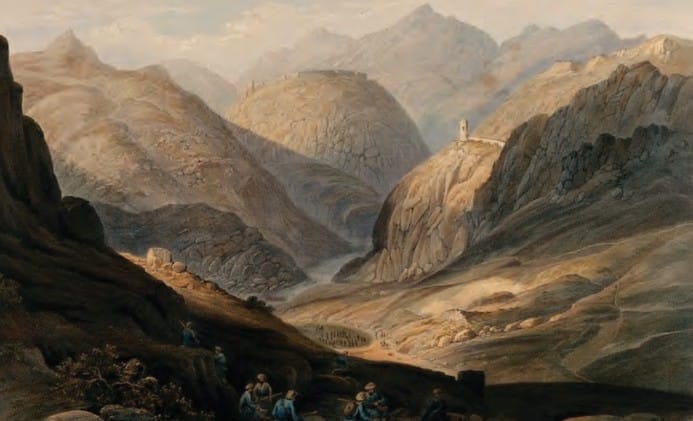 Khyber Pass painting, 1847
Mahmūd of Ghazni (1000-1030)
- Mahmūd was ruler of the Ghaznavid Empire, based at Ghazna (modern Ghazni in Afghanistan).
- He defeated Hindu Shāhi rulers such as Jayapāla (early 11th century) and Ānandapāla (1008) and thereby gained access to the Indus plains.
- Between 1000 and 1030 he led about 17 campaigns into India, returning each time to Ghazna with large amounts of wealth taken from temples, towns and rich settlements.
- Mahmūd used the Arabic title Sultan, meaning authority or power.
Major Campaigns of Mahmūd
- 1018 - Mathura: Mahmūd reached Mathura, found a prosperous city with an important temple, destroyed the temple and carried away its wealth. His court historian al-Utbi described the temple's splendour.
- Kannauj: He surprised one of the last Pratihāra rulers, looted and damaged temples and treasury.
- 1026 - Somnath (Gujarat): Somnath was an active seaport with the famous Somanātha Śhiva temple. Despite stiff local resistance, Mahmūd destroyed the temple and took enormous treasure. The temple site was rebuilt and destroyed several times afterwards; the present structure was rebuilt in the 20th century from public donations.
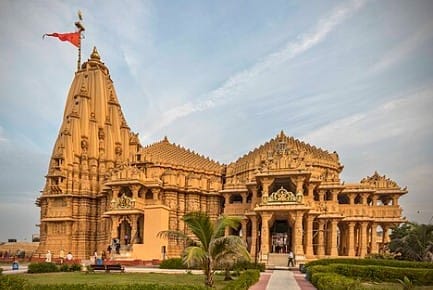 Somanātha Temple
Mahmūd's Motives and Methods
- Plunder: Temples and wealthy towns held great treasures and attracted raids.
- Religious motive: Mahmūd portrayed his campaigns as attacks on non-Muslim places of worship, though political and economic gain was central.
- His campaigns often involved widespread destruction, killing of civilians and capturing prisoners who were sold into slavery in Central Asia.
Resistance to Mahmūd
- Regional powers, notably the Chandellas of central India, resisted his advances.
- Local traditions and oral histories credit rulers such as Suheldev (also called Suhaldev) with defeating Mahmūd's nephew Sālār Masūd near Bahraich; this story survives as popular memory in the region.
Impact of Mahmūd's Invasions
- Mahmūd did not establish long-term political control beyond parts of the Punjab; his campaigns were raids rather than sustained annexation in most regions.
- Persian scholars travelling with these expeditions, such as Al-Bīrūnī, recorded that centres of learning in India became more isolated and scholars moved to safer places like Kashmir and Varanasi.
MULTIPLE CHOICE QUESTIONTry yourself: What was the Khyber Pass used for?
Al-Bīrūnī and Intellectual Exchange
Al-Bīrūnī (c. 1017)
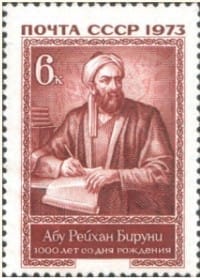
- Al-Bīrūnī was a Persian scholar from Khwārizm (in present-day Uzbekistan) and a polymath: mathematician, astronomer, geographer, historian and linguist.
- He learnt Sanskrit and produced an encyclopaedic survey of Indian religion, philosophy, literature, geography and sciences, recording many Indian ideas with care and respect.
- He studied the work of Indian astronomers such as Āryabhaṭa, Varāhamihira and Brahmagupta, and he translated or commented on Indian texts; he also translated Patanjali's Yogasūtras into Arabic.
Bhāskarāchārya (Bhāskara II)
- Bhāskara II (often called Bhāskarāchārya) was one of India's great mathematicians and astronomers, probably born in the Deccan region.
- His main Sanskrit works were Līlāvatī (elementary mathematics taught through problems and riddles), Bījagaṇita (algebra) and Siddhāntaśhiromaṇi (advanced astronomical calculations).
- His clear, often poetic style made mathematics more enjoyable for students; later scholars translated his works into Persian and other languages.
Eastern India
Sena Dynasty
- After the decline of the Pālas, the Sena dynasty became important in Bengal from the 11th century.
- Their capital was Nādīya (in present-day Nadia district).
- They promoted Hindu thought and literature; the poet Jayadeva, author of the Gītagovindam, enjoyed patronage in this region.
Eastern Gangas
- The Eastern Gangas ruled Kalinga (present-day Odisha); by the late 12th century their influence extended widely, described as stretching "from the Gangā to the Godāvarī".
- They began the construction of the Jagannātha temple at Puri and initiated the building of the Sun temple at Konark (the Konark temple was completed in the 13th century).
Further South
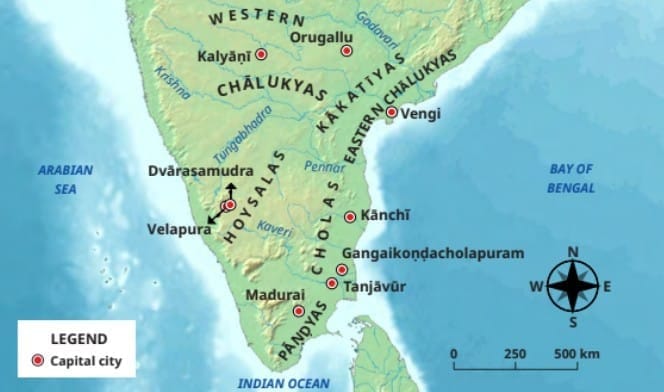
The Kākatīyas (12th century)
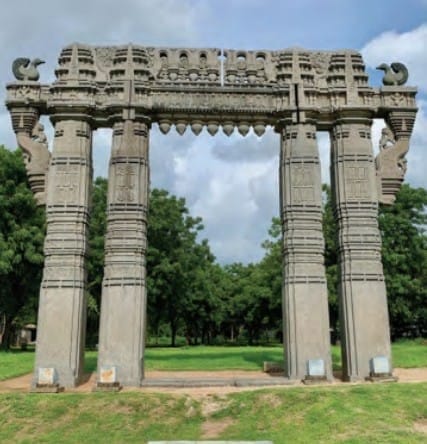
- The Kākatīyas ruled much of present-day Telangana and coastal Andhra Pradesh; their capital was Orugallu (modern Warangal).
- They built strong forts with impressive stone toraṇas (ornamental gateways), patronised Telugu literature and constructed important temples such as the Thousand Pillar Temple at Hanamkonda.
- Kākatīya rulers promoted village self-governance and developed efficient revenue and irrigation systems to support agriculture and settlements.
The Hoysalas
- The Hoysalas emerged in southern Karnataka. Their early capitals included Velāpura (Belur) and Dvārasamudra (Halebidu).
- Under rulers such as Viṣhṇuvardhana, they asserted independence from Chālukya overlords and extended control over much of Karnataka.
- The Hoysalas are famous for uniquely ornate temple architecture with highly detailed stone carvings; the temples at Belur and Halebidu are among their finest monuments and are protected today as important heritage sites.
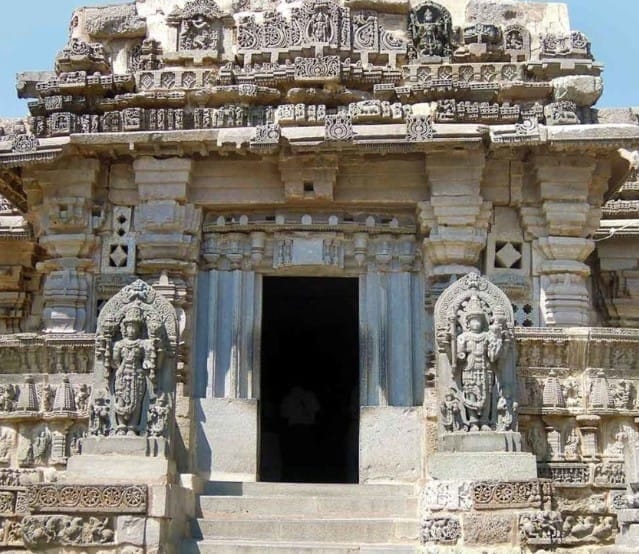 Hoysala Temple
Try yourself: Which feature is the Hoysala dynasty best known for?MULTIPLE CHOICE QUESTION
The Cholas
Rājarāja Chola I (985-1014)
- Rājarāja I extended Chola influence into parts of Karnataka, Andhra Pradesh and northern Sri Lanka, and overseas to the Maldives.
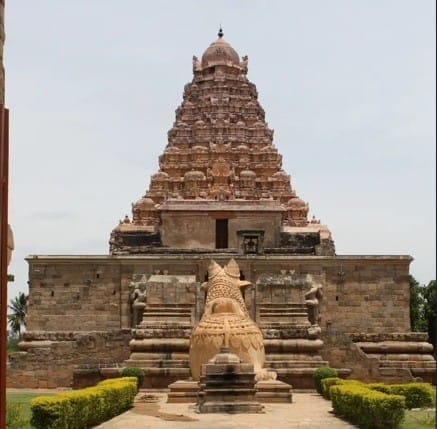
- He commissioned large public works and is best known for building the great Bṛihadīśhvara temple at Thanjavur (also called Rājarājeśhvaram), an architectural and administrative centre.
- The Cholas also supported Buddhist establishments abroad: they facilitated the construction of a vihāra at Nāgapaṭṭinam for the Śhrīvijaya rulers, indicating active maritime and cultural links.
Rājendra Chola I (1014-1044)
- Rājendra I expanded Chola influence into parts of Odisha and Bengal and took the title Gangaikoṇḍachola ("the Chola who seized the Gangā").
- He consolidated Chola control over northern Sri Lanka for several decades and led a major naval expedition against the Śhrīvijaya Empire (based in parts of present-day Malaysia and Indonesia) around 1025 to control sea routes through the Strait of Malacca.
Chola Administration and Decline
- The Cholas carried out large public works - roads, irrigation tanks, wells, canals and artificial lakes - to support agriculture and trade.
- Repeated conflicts with the Western Chālukyas, the Pāṇḍyas and Sri Lankan rulers strained Chola resources.
- By the 13th century the Chola empire had weakened and was gradually absorbed by rising powers such as the Pāṇḍyas.
Back to the North
The Paramāras
- The Paramāras emerged in Malwa (present-day Madhya Pradesh) in the late 10th century, with their capital at Dhārā (modern Dhar).
- The most famous Paramāra king was Bhoja (ruled c. 1010-1055), known as a scholar-king and a patron of learning.
King Bhoja - The Scholar-King
- Bhoja extended his kingdom across large areas and founded the town of Bhojpur.
- He built a large lake (now called Bhojtal) that served irrigation and water management purposes.
- He constructed the Bhojeshwar Temple and turned his capital into a centre of learning by patronising scholars.
- Bhoja wrote and patronised works on architecture and engineering such as the Samarāṅgaṇa Sūtradhāra (on temple construction, town planning and mechanical devices) and supported treatises on governance, Sanskrit poetics and medicine, as well as commentaries on classical texts.
MULTIPLE CHOICE QUESTIONTry yourself: Who was the most famous king of the Paramāras?
A Turning Point: The Ghūrids in India
Muhammad Ghūrī (Late 12th century)
- Muhammad Ghūrī was the Sultan of Ghūr (present-day Ghor, Afghanistan) who sought territorial conquest rather than only raiding.
- He brought parts of Punjab and Sindh under his control and launched campaigns further into northern India.
- In 1178 his forces were defeated at Mount Abu in Gujarat by the Chaulukya ruler Mūlarāja II (or led by Queen Nāīkīdevī, according to some chronicles).
The Chāhamānas (Chauhāns)
- The Chāhamānas (also called Chauhāns) were a powerful Rajput dynasty centred at Ajayameru (modern Ajmer), extending control over Delhi, Haryana, parts of Punjab, Uttar Pradesh and most of Rajasthan.
Battles of Tarain
- First Battle of Tarain (1191): Pṛithvīrāja III (Prithviraj Chauhan) defeated Muhammad Ghūrī's advance into northern India.
- Second Battle of Tarain (1192): Muhammad Ghūrī returned with a larger and better prepared army, defeated Pṛithvīrāja III and captured Delhi; this defeat opened the path to the establishment of Turkic rule in northern India.
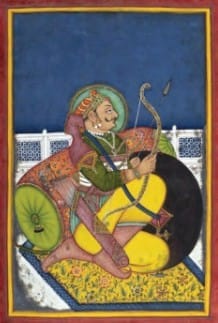 Pṛithvīrāja III
Establishment of Turkic Rule
- After capturing Delhi, Muhammad Ghūrī left his general Qutb-ud-din Aibak to consolidate territory; Aibak later became the founder of the early Delhi Sultanate.
Bakhtiyār Khiljī in Eastern India
- Bakhtiyār Khiljī was a military commander who served under Aibak and led campaigns into eastern India at the end of the 12th century and the start of the 13th century.
- He conquered large parts of Bihar and Bengal (c. 1203-04) and attacked major Buddhist institutions, including Nālandā and Vikramaśhilā, carrying off wealth and causing great loss of life among monks and scholars.
- The destruction of these large monastic centres was a turning point that contributed to the decline of organised Buddhism in much of India.
Nālandā's Destruction
- Nālandā's library and monastery were famous, with vast collections of manuscripts housed in several multi-storey buildings.
- Contemporary accounts say the library burned for months after the attack; many manuscripts were lost while some scholars and texts escaped to Tibet.
- About thirty years later, Tibetan accounts mention a surviving teacher of advanced age still teaching a small number of students, showing that some continuity persisted despite devastation.
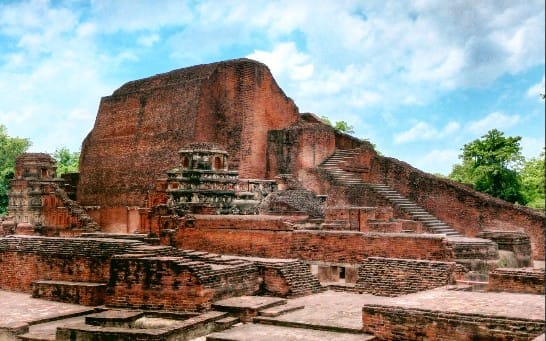 Nālandā Mahāvihāra
Defeat in Kāmarūpa
- Bakhtiyār attempted an expedition into Tibet through the region of Kāmarūpa (Assam) around 1205 but suffered severe losses because local rulers and people destroyed food and supplies, making his campaign impossible to sustain.
- He escaped with very few men and was later assassinated in 1206, the same year Muhammad Ghūrī was killed.
Try yourself: What was the outcome of the Second Battle of Tarain (1192)?MULTIPLE CHOICE QUESTION
Governance, Trade and Culture
Administration and Military Needs
- Large kingdoms required sizeable armies (soldiers, weapons, horses, elephants and camels) and therefore effective administration to collect revenue and maintain military forces.
- Some later Turkic systems introduced more centralised methods of finance and military provisioning, including temporary assignments of land or revenue rights to officers in return for military service and revenue collection.
Economy and Trade
- Political disturbances did not stop trade; maritime and overland trade with China, Southeast Asia and West Asia continued to grow.
- India's west coast had many busy seaports and shipyards that supported coastal and overseas trade.
- Agriculture remained the mainstay of the economy. Different regions produced different crops: rice and barley in the Gangetic plains and Bengal, saffron in Kashmir, spices in Kerala, wheat in north-west India, and cotton in western India and the Deccan.
- Rulers invested in irrigation works - tanks, canals and wells - to increase agricultural productivity and revenue.
Cultural Achievements
Architecture
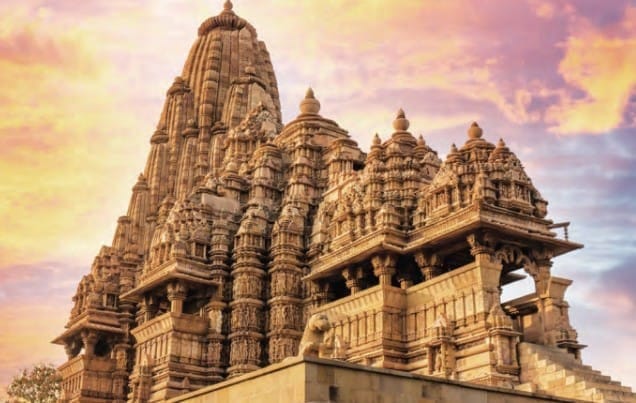 Kandāriyā Mahādeva Temple
- Khajuraho temples: Built by the Chandella rulers of central India, these include the Kandāriyā Mahādeva and Lakṣhmaṇa temples with elaborate sculpture and architectural design.
- Hoysala temples: The Hoysalas created richly carved temples at Belur and Halebidu, known for delicate sculpture and complex plan forms.
- Konark Sun temple: Initiated by the Eastern Gangas, this monumental stone temple (at Konark in Odisha) is celebrated for its scale and sculptural decoration.
Literature and Encyclopaedic Works
- Royal patrons supported literature and learning. King Bhoja wrote on many subjects and patronised scholars.
- Someshvara III, a Chālukya ruler, authored Mānasollāsa (12th century), an encyclopaedic work covering astronomy, architecture, music, medicine, cooking and games.
Religious Thinkers and Reform Movements
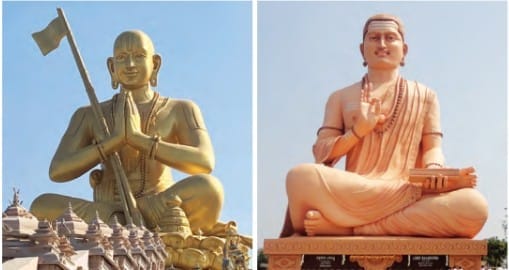 Rāmānujāchārya and Basaveśhvara
- Rāmānujāchārya (in south India) responded to Ādi Śhankarācārya's advaita vedānta by developing viśhiṣhṭādvaita vedānta, a philosophy that accepts the reality of the world and souls and stresses devotion (bhakti) to God.
- Basaveśhvara (also called Basavaṇṇa) founded the Lingāyat movement centred at Kalyāṇī in Karnataka. He rejected rigid caste distinctions and ritualism, emphasised direct devotion and equality of men and women, wrote short devotional poems called vachanas in Kannada and established an anubhava maṇḍapa ("pavilion of experience") where people from different backgrounds met to discuss religion and moral values.
Try yourself: Which religious thinker founded the Lingāyat movement and rejected caste distinctions and ritualism?MULTIPLE CHOICE QUESTION
India's Cultural Influence Abroad
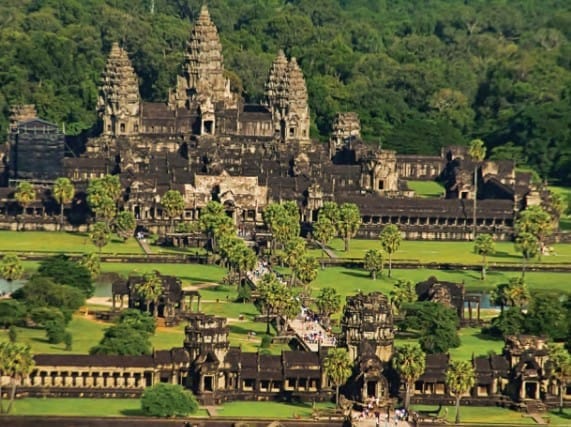
- Indian ideas, religious forms and architectural features spread across Southeast Asia through trade, marriage alliances and religious missions, leaving a visible imprint on local art and temple architecture.
- Angkor Wat in Cambodia (12th century), built by Khmer king Sūryavarman II, is the world's largest religious monument and was originally dedicated to Viṣhṇu. It contains inscriptions in Old Khmer and Sanskrit and bas-relief panels illustrating episodes from the Rāmāyaṇa and Mahābhārata.
- Angkor Wat's five tall towers symbolise Mount Meru and its plan and sculptural decoration show clear influence from South Indian temple design; later the complex became a Buddhist temple.
MULTIPLE CHOICE QUESTIONTry yourself: What are three important aspects mentioned in the text?
The document Chapter Notes: Turning Tides: 11th and 12th Centuries is a part of the Class 7 Course Social Science Class 7 - New NCERT ( Part 1 and Part 2).
All you need of Class 7 at this link: Class 7
FAQs on Chapter Notes: Turning Tides: 11th and 12th Centuries
| 1. What were the Ghaznavid invasions and their impact on India? |  |
Ans. The Ghaznavid invasions were a series of military campaigns initiated by the Ghaznavid Empire, led by Mahmud of Ghazni, in the 11th century. These invasions primarily targeted northern India, aiming to plunder its wealth and establish control over the region. The impact of these invasions was significant; they resulted in the destabilisation of local kingdoms, the spread of Islam in parts of India, and the introduction of new cultural and administrative practices that influenced Indian society for centuries.
| 2. Who was Al-Bīrūnī and what contributions did he make to the understanding of India? | |
Ans. Al-Bīrūnī was a Persian scholar and polymath who visited India around the 11th century. His work, particularly in the field of mathematics, astronomy, and geography, provided valuable insights into Indian culture, religion, and sciences. He is known for his book "Kitab al-Hind," which detailed various aspects of Indian society, including its customs, beliefs, and scientific achievements, thus bridging knowledge between the East and the West.
| 3. How did Bhāskarāchārya influence mathematics and astronomy during his time? | |
Ans. Bhāskarāchārya, also known as Bhaskara II, was a prominent Indian mathematician and astronomer of the 12th century. He made significant contributions to the fields of mathematics and astronomy, including the concepts of calculus and the use of zero as a placeholder. His famous works, such as "Lilavati" and "Bijaganita," provided comprehensive treatises on arithmetic and algebra, which were instrumental in advancing mathematical knowledge in India and beyond.
| 4. What role did trade play in governance and culture during the 11th and 12th centuries in India? | |
Ans. Trade played a crucial role in shaping governance and culture during the 11th and 12th centuries in India. The flourishing trade routes facilitated economic prosperity, leading to the rise of powerful kingdoms that aimed to control these trade networks. This economic power allowed for the patronage of arts and culture, resulting in the development of unique regional identities and the exchange of ideas, technologies, and cultural practices, significantly enriching Indian society during this period.
| 5. How did India's cultural influence extend beyond its borders during the 11th and 12th centuries? | |
Ans. During the 11th and 12th centuries, India's cultural influence extended beyond its borders primarily through trade, conquests, and the spread of religion. Indian art, architecture, and literature were disseminated to Southeast Asia, where they influenced local cultures. The spread of Hinduism and Buddhism also contributed to India's cultural imprint in these regions. Additionally, Indian advancements in mathematics and astronomy were adopted by scholars in the Islamic world, further establishing India's significance in global intellectual history.
About this Document

1.1K Views

4.80/5 Rating

Apr 21, 2026 Last updated
Related Exams
Document Description: Chapter Notes: Turning Tides: 11th and 12th Centuries for Class 7 2026 is part of Social Science Class 7 - New NCERT ( Part 1 and Part 2) preparation. The notes and questions for Chapter Notes: Turning Tides: 11th and 12th Centuries have been prepared according to the Class 7 exam syllabus. Information about Chapter Notes: Turning Tides: 11th and 12th Centuries covers topics like and Chapter Notes: Turning Tides: 11th and 12th Centuries Example, for Class 7 2026 Exam. Find important definitions, questions, notes, meanings, examples, exercises and tests below for Chapter Notes: Turning Tides: 11th and 12th Centuries.
Introduction of Chapter Notes: Turning Tides: 11th and 12th Centuries in English is available as part of our Social Science Class 7 - New NCERT ( Part 1 and Part 2) for Class 7 & Chapter Notes: Turning Tides: 11th and 12th Centuries in Hindi for Social Science Class 7 - New NCERT ( Part 1 and Part 2) course. Download more important topics related with notes, lectures and mock test series for Class 7 Exam by signing up for free. Class 7: Chapter Notes: Turning Tides: 11th and 12th Centuries
Description
Chapter Notes: Turning Tides: 11th & 12th Centuries of SST Class 7 with clear explanations of key concepts & important topics of the chapter, to help you underst& lessons better & revise quickly, & crack the Class 7 exam.
Information about Chapter Notes: Turning Tides: 11th and 12th Centuries
In this doc you can find the meaning of Chapter Notes: Turning Tides: 11th and 12th Centuries defined & explained in the simplest way possible. Besides explaining types of Chapter Notes: Turning Tides: 11th and 12th Centuries theory, EduRev gives you an ample number of questions to practice Chapter Notes: Turning Tides: 11th and 12th Centuries tests, examples and also practice Class 7 tests



Related Searches
mock tests for examination, Free, video lectures, Chapter Notes: Turning Tides: 11th and 12th Centuries, practice quizzes, Exam, Summary, study material, Previous Year Questions with Solutions, ppt, Objective type Questions, Sample Paper, Extra Questions, Chapter Notes: Turning Tides: 11th and 12th Centuries, past year papers, Viva Questions, Semester Notes, MCQs, shortcuts and tricks, pdf , Important questions, Chapter Notes: Turning Tides: 11th and 12th Centuries;