Chapter Notes: The State, the Government, and You


This chapter explains the difference between a state and a government, and between democracy and republic. It explores how India's government is structured with three organs (legislature, executive, judiciary) and three levels (union, state, local).
What is a State?
A state (or nation) is a political organisation that has authority to govern a defined territory and its population.
Four Important Parts of a State

1. People: The citizens who live in the country (permanent population)
2. Land: A fixed area or territory with clear boundaries
3. Government: A system to run the country.
4. Sovereignty: The full power to make laws and take decisions without any outside control
Understanding Each Part
People (Permanent Population)
- Without people, there can be no state.
- A permanent population means people who identify with a place and usually live there (not just tourists visiting).
- This group develops its own culture and society connected to their territory.
Territory (Geographically Defined)
- A place or geographical area with clear boundaries.
- Boundaries are not necessarily geographical features but agreed-upon lines that separate states.
Government
- Because people live together, they need laws to be made and implemented.
- The government does this work for the state.
- Government is a part of the state, but it is not the state itself.
Sovereignty
- Sovereignty means the state has complete control over its own matters.
- It can make and implement laws according to its own needs.
- No other state or external body can interfere in the internal affairs of that state.
- This is an essential feature of a state.
Don't Miss Out
In India, the word state may mean either the Indian nation or its present-day units such as Maharashtra, Tamil Nadu, or Kerala. Except when used in this sense, the chapter uses state (without a capital letter), as is common practice today.
What is a Government?
- The government is a group of people or system that runs the country.
- It includes leaders, ministers, and officials who:
- Make laws
- Enforce laws
- Resolve disputes - Government is just one part of the state.
- Government can change after elections, but the state remains the same.
- Analogy: Think of the state as a school, and government as the principal and teachers. Teachers may come and go, but the school remains.
Why these terms are used interchangeably
- The government acts on behalf of the state.
- Government is the face of the state that we see in action every day.
- The government runs the daily work of the state.
- We usually interact with the government, not the whole state.
People, Police, and the Government
- Police are part of the state government.
- They are agents of the state who can legally use force.
- They work with local communities in towns, cities, and villages.
Responsibilities of Police
- Maintain law and order
- Ensure people live in a safe and secure environment, free from crime and violence
- Investigate and present cases to the judiciary
- Work closely with courts, prisons, and the criminal justice system
- Contribute to social change through awareness programs (road safety, drug abuse, women's safety)
- Must respect and protect rights guaranteed under the Constitution
- The executive implements laws made by the legislature.
- The judiciary ensures laws are followed.
- Together, they form the three organs of government.
- People mostly interact with the executive.
- Democracy allows people to choose their leaders.
- Governments may have separate or overlapping powers.
Try yourself: Which of the following is an essential feature that gives a state complete authority over its internal affairs?
Democracy and Republic
- The core idea is 'rule by the people' (demos = people, kratos = rule).
- In a democracy, people have power to choose their government through free and fair elections.
- In a republic, the head of state (the highest office) is elected, not hereditary.
- The head of state is elected directly or indirectly by the people, rather than being a king or queen who inherits power.
- In a republic, there are limitations on the power of rulers through a constitution or laws.
Can a Country be Both?
- Yes, a country can be both a democracy and a republic (e.g., India, USA).
- But not all democracies are republics (e.g., UK, Canada, Sweden have monarchs but are democracies).
India's Choice
- When India got Independence, she did not blindly adopt the British parliamentary system.
- The British have a monarch (king or queen) as head of state.
- Constitution makers decided India's head of state, the President, would be elected by a group of elected representatives.
- India is both a democratic republic.
India, a Republic that Protects the Rights of All
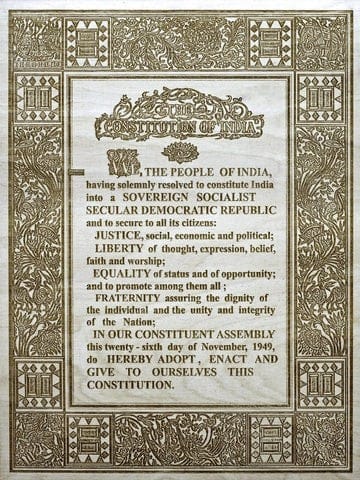
- India's Constitution guarantees fundamental rights to all citizens.
- Constitutional provisions ensure that rule by a representative majority does not violate fundamental rights of any citizen.
Why is the protection of rights important?
- In a republic, the rule of law is stronger than the will of the majority.
- Republics like India, France, and the USA protect minorities from majority dominance.
- The Constitution prevents any branch of government from becoming too powerful.
- Elected leaders cannot make laws that violate fundamental rights such as equality, freedom of speech, and religion.
Protection Against 'Dominance of the Majority'
- The rule of law is more powerful than wishes of the majority.
- Republics like India, France, and USA defend against this dominance.
- The Constitution ensures no part of government becomes too powerful.
- Elected leaders cannot pass laws that go against basic rights (freedom of speech, religion, equality before law).
Don't Miss Out
- In 1782, as the American War of Independence was ending, an officer suggested George Washington become king of America.
- Washington firmly refused, saying it would harm the country.
- He believed only in government by the people under a constitution.
- He became the first President of the United States in 1789.
Kauṭilya's View
- According to Kauṭilya (author of Arthashastra), the king must follow Raja Dharma and have good governance.
- He should ensure law and order.
- Without government, society becomes chaotic with the powerful eating the weak (Matsya nyāya - "big fish swallow smaller ones").

Legislature: The Lawmaking Body
- The legislature is a branch of government that makes laws for the country.
- In a democracy, it represents the people.
- It creates rules that apply to everyone.
- It ensures governance happens through well-defined laws, not personal wishes or arbitrary decisions.
- States also have their own legislatures that make laws only for the state.
Executive: The Law-Implementing and Policymaking Body
- The executive is responsible for implementing or executing laws formulated by the legislature.
- It also takes policy decisions (a set of ideas or actions that an institution or government decides on).
The executive: political and permanent
1. Political Executive
- Consists of leaders who are elected by the people.
- Includes: Prime Minister, Chief Ministers, and their ministers, as well as President and Governors (who mostly have formal or symbolic roles).
- Responsibilities:
- Making big decisions
- Introducing new laws
- Setting goals for the country
- Representing India in other countries - They stay in power for a fixed time (usually five years) unless re-elected or dismissed.
- Their power depends on the trust and support of the people.
2. Permanent Executive
- Includes government officers who are not elected but selected through examinations (like UPSC).
- Also called bureaucrats or civil servants.
- They are not removed after every election.
- They work in the background to keep government running smoothly, no matter which party is in power.
- Their job:
- Offer expert advice
- Implement policies
- Manage public services
Key Functions of Bureaucracy:
- Implementing laws, policies, and schemes: Ensure laws and government programs are implemented across the country
- Creating a link between citizens and government: Through various departments and field offices, deliver services like public schools, roads, hospitals, and address grievances
- Record-keeping and governance: Keep records of government work, decisions, and procedures
Examples of Bureaucracies in India
- Indian Foreign Service (IFS)
- Indian Administrative Service (IAS)
- Indian Police Service (IPS)
- Indian Revenue Service (IRS)
- Indian Forest Service (IFoS)
Grassroots Bureaucrats
- We usually interact with bureaucrats at grassroots level.
- Examples: Government school teachers, anganwadi workers, health workers, water and sanitation workers, bus conductors
Large-Scale Programs
Bureaucracy manages large programs like:
- Census
- National elections
- Disaster relief
- Welfare schemes (MGNREGS, COVID-19 vaccination drive)
Chonira Belliappa Muthamma (1924-2009)
- Born in Karnataka.
- First woman to clear the examination for public services in 1948.
- First woman to join the Indian Foreign Service in 1949.
- Faced strong gender bias (women had to sign undertaking to resign if they got married).
- Conducted a distinguished diplomatic career.
- Became India's first woman ambassador in several countries.
- When unjustly denied promotion, she approached the Supreme Court.
- Justice V.R. Krishna Iyer struck down gender-biased provisions as violating the Constitution.
- Her struggle remains a milestone in pursuit of gender equality in Indian public service.
- She wrote that "unbounded freedom of thought and belief" in Indian religions is "the single most important factor that makes democracy possible in this country."
The Government and You
The government of India plays a triple role:
1. Protector: Law and defence
2. Provider: Public welfare and infrastructure
3. Regulator: Economic activity and social justice
- Maintains law and order through police forces
- Provides free education by building schools and hiring teachers
- Constructs infrastructure like roads, bridges, railways, airports
- Takes initiatives to ensure food safety
Making Government Work for You
1. Grievance Redressal
- Many government departments have grievance redressal offices where you can file grievances.
- Government has vigilance commissions to investigate corruption.
- Public Grievances Portal (https://pgportal.gov.in/) allows you to lodge complaints and grievances online.
- Concerned government department will respond within a specified time.
- Several states also have such portals.
2. Right to Information (RTI) Act
- A powerful Act through which we can ask for information about government actions of public interest.
- Examples of what you can ask:
- How much money was spent on building roads in your neighbourhood
- List of beneficiaries of government schemes (like merit scholarship)
- Status of infrastructure projects (like metro line) - Officials are bound to provide information under this Act.
- Information brings transparency (open access to information about government policies and actions) and accountability (those in power are responsible for their actions).
Example: Bagepalli
- A small town near Bengaluru where government officials made unprofessional roadwork.
- A local citizen filed an RTI to get information about finances allocated.
- Armed with this information, citizens confronted officials.
- Officials then ensured roadwork was completed satisfactorily.
3. Use the Media
- Write in print or electronic media about issues where government can take action.
- Many government officials are active on social media.
- Use platforms like YouTube, X (formerly Twitter), Facebook, Instagram to share concerns and tag officials.
4. Engage Through Civil Society Organisations (NGOs)
- India has thousands of citizen groups, collectively termed as civil society.
- They work on issues like education, health, environment, livelihood, women empowerment.
- You can join any (or create one!) to push government to address issues you care about.
Don't Miss Out
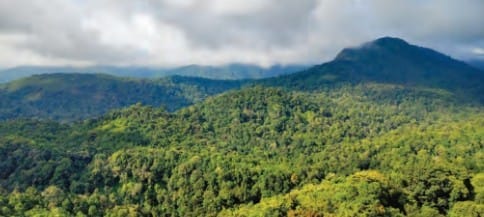
- In 1970, Kerala Government planned a hydroelectric project in Silent Valley.
- It would have submerged untouched evergreen forests and destroyed biodiversity.
- Many NGOs mobilised public opinion against the dam.
- Hundreds of scientists, environmentalists, writers, teachers, and villagers joined.
- In 1983, Central Government cancelled the project.
- In 1985, Silent Valley was declared a National Park.
5. Write to Political Representatives
- You can write letters to your local representatives, ministers, or parliamentarians seeking action on particular issues.
6. Vote in Elections
- Once you are old enough to vote, participate in local, state, and national elections.
- Help ensure that leaders who care about issues you care about are elected.
Try yourself: Which law allows citizens to seek information from the government to ensure transparency and accountability?
Judiciary: The 'Watchdog'
- The judiciary is the part of government that makes sure everyone follows the law.
- It settles disputes, protects people's rights, and checks whether laws are fair and just.
- In a democracy like India, the judiciary is independent (not controlled by government or politicians).
What Does the Judiciary Do?
- Protects and defends the laws: Makes sure laws are followed properly
- Interprets the laws: Explains what a law means when wording is complex or people disagree
- Protects rights and liberty of citizens: Protects rights and freedoms given by the Constitution; if fundamental rights are violated, we can go to court
- Safeguards the Constitution through judicial review: Acts as a referee when government or others break the law
Why is the Judiciary Important?
- Protects the rule of law (everyone must follow the law, even the government)
- Keeps a check on unfair actions
- Ensures laws don't harm people's rights
- Resolves conflicts peacefully
- Without a strong and fair judiciary, democracy cannot survive
Tiers of Government
- India is a vast and diverse country with over 1.4 billion people, thousands of towns and villages, and many languages and cultures.
- India is a federal country with 28 states and 8 union territories.
- A single central government cannot meet the needs of all people.
- Therefore, governance must be decentralised at multiple levels.
Original Structure
- Originally, the Constitution provided for only two levels of government:
1. Union Government (for entire country)
2. State governments (for each state) - Local governments (panchayats and municipalities) were not separate constitutional levels.
- They were listed under the State List (state governments decided how they worked).
Constitutional Amendment (Early 1990s)
- The Constitution was amended to create:
- Panchayati raj system (for villages)
- System of municipalities (for towns and cities) - These made local governments the 'third tier' of India's democracy.
- This was done to strengthen democracy at the grassroots and enable people to participate directly in decision-making.
Don't Miss Out
One of the Directive Principles stated: "The state shall take steps to organise village panchayats and endow them with such powers and authority as may be necessary to enable them to function as units of self-government."
What is Decentralisation?
- Decentralisation means power and decision-making are spread out and not concentrated in just one place or one small group.
- Local problems should be solved locally.
- Bigger issues can be solved by higher-level governments (state or central).
- Decisions regarding local matters are taken at the level closest to the people.
- Tasks that can be performed locally should be left in the hands of local people and their representatives.
- Example: A broken streetlamp is fixed by local municipal body (faster).
- But country's defence is the responsibility of central government.
Why is Decentralisation Important?
1. More Democratic: People get a chance to be more involved in decisions that affect their daily lives.
2. Local Discussions: Local issues (water supply, roads, schools) can be discussed and solved by people who face them every day.
3. Better Knowledge: Local leaders know the area, its needs, and traditions of people better than distant officials.
4. More Accountability: When leaders are closer to people, it is easier to question them, ask for answers, and make sure they do their job.
5. Stronger Local Governments: With power and responsibility, panchayats and municipalities can become lively places where people participate actively and leaders work responsibly.
Don't Miss Out
- Gandhi was a strong advocate of decentralisation.
- He believed in largely self-sufficient village governments called grām swarāj.
- He stated: "My idea of village swarāj is that it is a complete republic, independent of its neighbours for its own vital wants, and yet interdependent for many others in which dependence is a necessity."
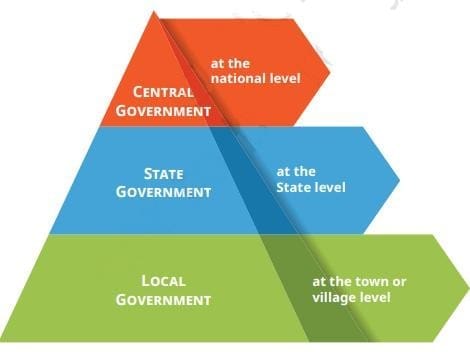
The Three Levels
1. Central (Union) Government: Looks after matters related to the whole country (defence, foreign affairs, currency, and concurrent subjects like education and marriage)
2. State Governments: Take care of needs of people in each state (police, land, health, agriculture, and education in the state)
3. Local Governments: Work in villages, towns, and cities to solve local problems (land, agriculture, water, drainage, streetlamps, parks, etc.)
Try yourself: Why is decentralisation considered more democratic?
How the Three Levels Work Together: Example of School Education
Legislative (Lawmaking)
- Parliament for whole country and State Legislature for each state
- Make laws for schools (e.g., Right to Education Act)
- Approve budgets
- Example: All schools must have separate toilets for boys and girls
Executive (Law-Implementation)
Political Executive:
- Elected members: ministers at union and state levels → Guide policy, make rules
- Examples: Samagra Shiksha, PM Poshan Yojana, budgets for teacher training
Permanent Executive:
- Non-elected bureaucrats/officers (like District and Block Education Officers) → Ensure laws are followed, Improve teacher training
- Example: like schools have separate toilets for boys and girls
Judiciary (Guardian of Law)
- Courts, NCPCR (National Council for the Protection of Child Rights), SCPCR (State Council for the Protection of Child Rights)
- Protect rights of children
- Take action if rights are denied
FAQs on Chapter Notes: The State, the Government, and You
| 1. What is the difference between a State and a Government? |  |
| 2. How do the People, Police, and Government interact in a society? | |
| 3. What is the distinction between a Democracy and a Republic? | |
| 4. How does India function as a Republic that protects the rights of all citizens? | |
| 5. What are the three organs of Government, and what roles do they play? | |