Estoppel – Exceptions and Judicial Interpretation


Estoppel is a crucial doctrine under the Indian Evidence Act, 1872 (Sections 115-117). It prevents a party from going back on their earlier statement or conduct when another person has relied on it. While the general principle seems straightforward, the law recognizes important exceptions and has been extensively interpreted by courts. Understanding these exceptions and judicial pronouncements is critical for legal practice and judiciary examinations.
1. Meaning and Essential Elements of Estoppel
1.1 Definition under Section 115
Section 115 of the Indian Evidence Act states that when one person has, by declaration, act or omission, intentionally caused or permitted another person to believe a thing to be true and to act upon such belief, neither he nor his representative shall be allowed to deny the truth of that thing in any suit or proceeding between himself and such person or his representative.
- Essential Elements: There must be a representation (by declaration, act, or omission)
- The representation must be made with intention or knowledge that it will be acted upon
- The other party must have actually acted upon such representation
- The other party must have acted in the belief that the representation is true
- The other party must have altered his position to his detriment
- The representation must be as to a matter of fact, not law
1.2 Nature of Estoppel
- Rule of Evidence: Estoppel is not a substantive right but a rule of evidence
- Disability: It creates a disability to speak or prove the truth
- Judicial Interpretation: In Pickard v. Sears, it was held that estoppel prevents a person from denying what he has led another to believe
- Indian Context: Section 115 is based on English common law principles but is narrower in scope
2. Types of Estoppel
2.1 Estoppel by Representation (Section 115)
This is the primary form covered under Section 115. A person who has made a representation of existing fact cannot deny it later.
- Representation of Fact: Must relate to an existing or past fact, not future promise
- Case Law: In Rabiakhatun v. Khelanand, the Supreme Court held that estoppel applies only when there is clear representation of fact
- Active Representation Required: Mere silence generally does not create estoppel unless there is duty to speak
- Detrimental Reliance: The representee must have suffered detriment by acting on the representation
2.2 Estoppel by Conduct
- Through Actions: When a person's conduct leads another to believe a certain state of affairs
- Negligence: In Pickard v. Sears, negligent conduct allowing another to pass as owner created estoppel
- Election Doctrine: Once a party elects between two inconsistent rights, he cannot go back
2.3 Estoppel by Deed (Section 116)
Section 116 states that no party to a deed or his representative shall be allowed to deny the execution of the deed or any matter recited in the deed.
- Limited Scope: Applies only to the execution of deed and recitals in it
- Not Absolute: Does not prevent challenging the deed on grounds of fraud, coercion, or illegality
2.4 Estoppel by Tenancy (Section 116)
- Tenant Cannot Deny Landlord's Title: A tenant is estopped from denying his landlord's title at the time of commencement of tenancy
- Exception: Tenant can deny if landlord's title has been extinguished or if tenant claims through paramount title
- Case Law: In Ganpat Lal v. Ganga Prasad, Supreme Court held tenant cannot dispute landlord's title unless title has come to an end
3. Exceptions to Estoppel
3.1 Estoppel Cannot Override Statute Law
The most important exception is that estoppel cannot be invoked against a statute. No representation can validate an act that is prohibited by law.
- Fundamental Principle: Public policy requires that illegal acts cannot become legal through estoppel
- Leading Case - Bengal Immunity v. State of Bihar: Supreme Court held that estoppel cannot be raised against express provision of statute
- Government Functions: Estoppel generally does not apply to prevent the government from performing its statutory duties
- Taxation Matters: In Madan Gopal v. State of Punjab, held that estoppel cannot create liability to pay tax where none exists in law
3.2 Estoppel Cannot Override Records and Public Documents
- Recitals in Judgments: Estoppel cannot contradict the operative part of a judgment
- Public Records: Entries in public documents like revenue records cannot be contradicted by private estoppel
- Registration: Representation cannot cure defect in compulsory registration under the Registration Act
3.3 No Estoppel in Matters of Law
Section 115 applies only to representations of existing fact, not questions of law.
- Rationale: Courts are expected to know the law; parties cannot bind courts by wrong representation of law
- Case Law: In Collector of Bombay v. Municipal Corporation, Supreme Court reiterated that estoppel does not apply to questions of law
- Exception to Exception: In cases involving foreign law, estoppel may apply as foreign law is treated as question of fact
3.4 No Estoppel Against Title or Rights in Immovable Property
- Limited Application: Estoppel cannot create title to property where none exists
- Case Law - Ram Coomar v. Chunder Cant: Held that estoppel cannot give title to immovable property
- Qualification: Estoppel can temporarily prevent denial but cannot permanently transfer title
- Doctrine of Part Performance: Under Section 53A of Transfer of Property Act, estoppel-like protection exists for part performance
3.5 No Estoppel Where Representation is Made Without Authority
- Lack of Capacity: Representation by a person without authority or capacity does not bind the principal
- Government Officers: Unauthorized acts of government servants do not bind the government
- Case Law - Union of India v. Godfrey Phillips: Representation by officers beyond their authority cannot create estoppel against government
3.6 No Estoppel in Matters of Fraud, Mistake, or Illegal Contracts
- Fraud: If representation was obtained by fraud, no estoppel arises
- Mutual Mistake: Both parties acting under a common mistake are not bound by estoppel
- Illegal Contracts: Estoppel cannot enforce an illegal or void contract
- Case Law: In Sahebzada Mohd. Kamgarshah v. Jagdish Chandra, Supreme Court held fraud vitiates estoppel
3.7 Estoppel Cannot Confer Jurisdiction on Court
- Jurisdictional Facts: Parties cannot by consent or representation confer jurisdiction on a court which it does not possess
- Subject Matter Jurisdiction: Estoppel cannot validate proceedings in a court lacking inherent jurisdiction
- Case Law - Kiran Singh v. Chaman Paswan: Supreme Court held parties cannot create jurisdiction by consent
4. Estoppel Against Statute
4.1 General Principle
The maxim "nullum tempus occurrit regi" (time does not run against the King) and public policy considerations prevent estoppel from operating against statutory provisions.
- No Waiver of Statutory Rights: Government cannot waive rights conferred by statute for public benefit
- Leading Case - Maritime Board v. Machineries: Held that estoppel cannot be invoked to compel government to carry out a representation contrary to law
- Ultra Vires Acts: Acts beyond statutory powers remain invalid despite representation
4.2 Emerging Exception - Promissory Estoppel Against Government
Indian courts have developed the doctrine of promissory estoppel which can bind the government in certain circumstances.
- Constitutional Foundation: Based on Articles 14 (Equality) and Article 299 (Contracts by government)
- Landmark Case - Motilal Padampat Sugar Mills v. State of UP: Supreme Court recognized that government can be bound by promissory estoppel
- Conditions: Promise must be clear, unambiguous, and made with intention that it will be acted upon
- Public Interest Override: Even promissory estoppel yields to larger public interest
- Case Law - MRF Ltd v. Inspector: Held that government can resile from promise if required by public interest
4.3 Limitations on Government Estoppel
- Sovereign Functions: Estoppel cannot operate against exercise of sovereign/legislative powers
- Taxation: In Jit Ram v. State of Haryana, held that promissory estoppel cannot prevent levy of tax authorized by law
- Statutory Duty: Government cannot be estopped from performing its statutory obligations
- Section 299 Contract: For promissory estoppel to bind government, representation should generally comply with Article 299 requirements
5. Estoppel and Pleadings
5.1 Requirement of Pleading
Estoppel must be specifically pleaded in written statement or plaint. It cannot be raised as a general objection.
- Order 6 Rule 16 CPC: Requires that estoppel must be specifically pleaded
- Facts Must Be Stated: The party claiming estoppel must state facts showing all essential elements
- Case Law - State Bank of India v. Inderpreet: Court cannot presume estoppel; it must be pleaded and proved
- Amendment: Courts may allow amendment to plead estoppel if justice requires
5.2 Particulars to be Pleaded
- Nature of Representation: Whether by words, conduct, or omission
- When Made: The specific time when representation was made
- To Whom Made: Identity of the person to whom representation was made
- Action Taken: Specific facts showing how the representee acted on the belief
- Detriment Suffered: Particulars of prejudice or change of position
5.3 Burden of Proof
- On Party Claiming Estoppel: Under Section 110 of Evidence Act, burden lies on party alleging estoppel
- Standard of Proof: Must be proved by clear and unambiguous evidence
- All Elements Required: Failure to prove even one element defeats the claim of estoppel
6. Estoppel and Admissions
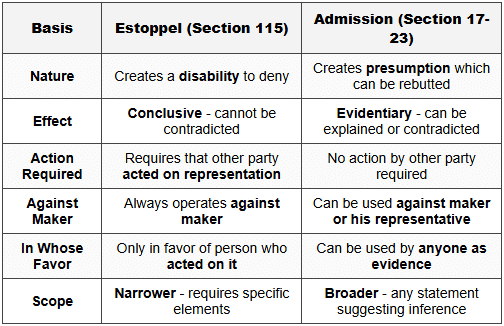
6.1 Distinction between Estoppel and Admission
6.2 Admissions Not Amounting to Estoppel
- Voluntary Statement: A mere admission in pleading or evidence is not estoppel unless acted upon
- Case Law - Ramanna v. Sankamma: Supreme Court held that admission does not create estoppel unless accompanied by action
- Judicial Admissions: Even judicial admissions (admissions in pleadings) are binding but not estoppel in strict sense
- Distinction Significance: Admission can be withdrawn with leave of court; estoppel cannot be withdrawn
6.3 When Admission May Create Estoppel
- Action Based on Admission: If a party acts on another's admission to his detriment, estoppel may arise
- Representation of Fact: Admission amounts to representation if made with intention that other will act
- Change of Position: The party relying on admission must have altered his position
7. Important Judicial Decisions on Estoppel
7.1 Foundational Cases
7.1.1 Pickard v. Sears (1837) - English Case
- Principle Established: A person who by his conduct leads another to believe certain facts cannot deny them
- Facts: Owner's negligence allowed another to appear as owner and sell goods
- Held: True owner was estopped from asserting title as against innocent purchaser
- Relevance: Foundation for estoppel by conduct
7.1.2 Bengal Immunity Co. v. State of Bihar (1955)
- Issue: Whether estoppel can operate against express provisions of statute
- Held: No estoppel against statute - Court cannot by estoppel give effect to what statute prohibits
- Ratio: Public interest and rule of law require that statutory provisions cannot be defeated by estoppel
- Frequently Cited: Most authoritative case on estoppel against statute
7.2 Promissory Estoppel - Evolution
7.2.1 Union of India v. Indo-Afghan Agencies (1968)
- Introduction to India: Supreme Court first recognized doctrine of promissory estoppel in Indian law
- Principle: If government makes a promise intending that it will be acted upon, and it is acted upon, government is bound
- Limitation: Promise must be clear and unequivocal
7.2.2 Motilal Padampat Sugar Mills v. State of UP (1979)
- Landmark Judgment: Most comprehensive judgment on promissory estoppel against government
- Constitutional Basis: Linked promissory estoppel to Article 14 (right to equality)
- Held: Government cannot resile from promise if party has acted on it to his detriment
- Conditions Laid Down: Promise must be clear, definite, and made with intention of creating legal relations
- Significance: Extended equitable doctrine to bind the government
7.2.3 MRF Ltd. v. Inspector of Central Excise (2006)
- Public Interest Exception: Supreme Court held that promissory estoppel yields to larger public interest
- Held: Government can resile from promise if required by public interest or policy change
- Balance: Courts must balance private interest with public interest
- Current Law: Represents the present state of law on government estoppel
7.3 Cases on Application and Scope
7.3.1 Rabiakhatun v. Khelanand (2000)
- Issue: When does Section 115 apply?
- Held: For estoppel to apply, there must be clear representation of existing fact
- Principle: Representation must be intentional or knowledge-based that other will act on it
- Strict Interpretation: All elements of Section 115 must be satisfied
7.3.2 Collector of Bombay v. Municipal Corporation of Bombay (1951)
- Estoppel in Law: Supreme Court held that there is no estoppel on questions of law
- Rationale: Courts are presumed to know law; parties cannot bind courts by agreement on law
- Exception: Foreign law may be subject to estoppel as it is treated as question of fact
7.3.3 Ganpat Lal v. Ganga Prasad (1968)
- Tenant's Estoppel: Application of Section 116 to landlord-tenant relationship
- Held: Tenant cannot dispute landlord's title unless it has been extinguished
- Exception Recognized: Tenant can challenge if claiming under paramount title
7.3.4 Ram Coomar Coondoo v. Chunder Canto Mookerjee (1876)
- Privy Council Decision: Important case on estoppel and property title
- Held: Estoppel cannot create title to immovable property; it can only prevent denial temporarily
- Principle: Transfer of immovable property must comply with substantive law
- Limitation: Estoppel is an evidentiary rule, not a mode of transfer
7.3.5 Union of India v. Godfrey Phillips India Ltd (1985)
- Unauthorized Acts: Representation by government officer beyond his authority does not bind government
- Held: Officer's act must be within scope of authority for estoppel to operate
- Principle: Third party dealing with government must verify officer's authority
7.3.6 Kiran Singh v. Chaman Paswan (1954)
- Jurisdiction Cannot be Conferred: Supreme Court held that estoppel cannot confer jurisdiction on a court
- Rationale: Jurisdiction is matter of law and public policy, not subject to party consent
- Application: Even if parties consent or remain silent, court must examine its jurisdiction
7.3.7 Jit Ram Shiv Kumar v. State of Haryana (1980)
- Promissory Estoppel in Taxation: Held that promissory estoppel cannot prevent levy of tax authorized by law
- Principle: Government's power to tax cannot be surrendered by estoppel
- Public Revenue: Protection of public revenue is paramount over individual representations
7.3.8 Sahebzada Mohammad Kamgarshah v. Jagdish Chandra (1966)
- Fraud Vitiates Estoppel: If representation obtained by fraud, no estoppel arises
- Held: Party cannot take benefit of his own fraudulent conduct
- Principle: Clean hands doctrine applies to estoppel
7.4 Recent Developments
7.4.1 State Bank of India v. Inderpreet Singh Vohra (2010)
- Pleading Requirement: Reiterated that estoppel must be specifically pleaded
- Held: Court cannot presume estoppel; all elements must be pleaded and proved
- Burden of Proof: Party claiming estoppel bears burden to establish all ingredients
7.4.2 Kasinka Trading v. Union of India (1995)
- Policy Change: Government can change policy even if private parties affected
- Held: Promissory estoppel cannot prevent government from exercising legislative or executive functions in public interest
- Balance: Individual equity must yield to larger public good
8. Common Mistakes and Trap Alerts
⚠️ Common Student Mistakes
- Confusing Estoppel with Admission: Remember - estoppel is conclusive (cannot be contradicted), while admission is evidentiary (can be explained or rebutted). Estoppel requires action by other party; admission does not.
- Assuming Estoppel Works Against Statute: The golden rule is that estoppel cannot override statute. Even if government made a promise, it cannot validate what statute prohibits. Exception is promissory estoppel which has limited application.
- Forgetting to Plead Estoppel: Estoppel must be specifically pleaded under Order 6 Rule 16 CPC. Court cannot presume estoppel. All five elements must be stated in pleadings.
- Thinking Estoppel Creates Title: Estoppel is a rule of evidence, not a mode of transfer. It cannot create title to property; it only prevents denial temporarily. Transfer of immovable property must comply with Transfer of Property Act.
- Believing Promissory Estoppel Always Binds Government: While promissory estoppel can bind government, it yields to larger public interest. Government can resile from promise if required by public policy (MRF case).
- Assuming Mere Silence Creates Estoppel: Generally, silence does not create estoppel unless there is a duty to speak. There must be active representation by words, conduct, or intentional omission.
- Ignoring Section 115 Requirements: All five ingredients must be satisfied: (1) representation of fact, (2) intention/knowledge it will be acted upon, (3) actual action, (4) belief in truth, (5) detriment suffered. Missing even one defeats estoppel.
- Thinking Estoppel Applies to Future Promises: Section 115 applies only to representation of existing or past fact, not promises about future conduct. This is a key distinction.
9. Quick Revision Points
9.1 Key Statutory Provisions
- Section 115: Estoppel - prevents denial when one has caused another to believe and act
- Section 116: Estoppel of tenant and party to deed
- Section 117: Estoppel of acceptor of bill of exchange, bailee, or licensee
9.2 Five Essential Elements of Section 115
- Representation of existing fact (by declaration, act, or omission)
- Intention or knowledge that it will be acted upon
- Actual action taken by the other party
- Belief that the representation is true
- Alteration of position to detriment
9.3 Major Exceptions - Memory Aid "SLIP-JAF"
- S - Statute (cannot override statute)
- L - Law (no estoppel on questions of law)
- I - Illegal contracts (cannot enforce illegal contracts)
- P - Property title (cannot create title)
- J - Jurisdiction (cannot confer jurisdiction)
- A - Authority (no estoppel when representation without authority)
- F - Fraud (fraud vitiates estoppel)
9.4 Must-Remember Cases
- Bengal Immunity (1955): No estoppel against statute
- Motilal Padampat (1979): Promissory estoppel against government recognized
- MRF Ltd (2006): Public interest overrides promissory estoppel
- Rabiakhatun (2000): All elements of Section 115 must be satisfied
- Ram Coomar (1876): Estoppel cannot create property title
- Kiran Singh (1954): Estoppel cannot confer jurisdiction
Understanding estoppel requires mastering both its foundational principles and the numerous exceptions carved out by courts. While Section 115 provides the basic framework, judicial interpretation has significantly shaped its application, particularly through the development of promissory estoppel. The key to answering exam questions is identifying which exception applies and citing the relevant case law. Remember that estoppel is essentially an equitable doctrine balanced against statutory provisions and public interest considerations. Always check whether all five elements are satisfied before concluding that estoppel operates in a given situation.