Judge’s Power to Put Questions (Section 165)


Section 165 of the Indian Evidence Act, 1872 grants judges extraordinary powers to ask questions to witnesses at any stage of examination. This provision ensures that courts arrive at the truth by filling gaps left by advocates. It is a cornerstone of the inquisitorial function of judges in an otherwise adversarial system. Understanding its scope, limitations, and judicial interpretations is critical for judiciary exams as it balances judicial activism with fair trial principles.
1. Object and Purpose of Section 165
Section 165 empowers judges to discover the truth and ensure justice. The primary objectives are:
- Discovery of Truth: Courts must ascertain facts accurately. Judges can fill lacunae in examination conducted by lawyers.
- Clarification of Ambiguities: When witness testimony is unclear or contradictory, judges can seek clarification to form correct conclusions.
- Eliciting Relevant Facts: Advocates may miss relevant facts. Judges ensure no material fact remains unexplored.
- Preventing Miscarriage of Justice: Protects against incompetent or negligent advocacy that may harm a party's case.
- Inquisitorial Role in Adversarial System: Though Indian trial procedure is adversarial, Section 165 introduces an inquisitorial element allowing judges to actively participate in fact-finding.
1.1 Legislative Intent
- Framers intended judges to be active seekers of truth, not passive umpires.
- Section 165 prevents trials from becoming mere contests between lawyers where truth may be obscured.
- It ensures that justice is not defeated by technicalities or poor advocacy.
2. Scope of Judicial Questioning
The scope of Section 165 is extremely wide, granting judges broad discretion to question witnesses:
2.1 Timing of Questions
- At Any Stage: Judge can ask questions during examination-in-chief, cross-examination, or re-examination.
- Before or After Examination: Questions may be put even before lawyers begin examination or after they conclude.
- Suo Motu Power: Judge can exercise this power on their own motion without any party's request.
2.2 Subject Matter of Questions
- Any Fact Relevant to the Case: Questions must pertain to facts relevant under Sections 5 to 55 of the Evidence Act.
- Clarifying Contradictions: Judge may ask questions to resolve contradictions in witness statements.
- Testing Credibility: Questions can be directed to assess the credibility and reliability of witnesses.
- Filling Gaps: Judge can explore areas not covered by advocates to get a complete picture.
2.3 Form and Manner of Questions
- Any Form: Questions may be direct, cross-examining in nature, or leading questions (though ordinarily avoided in examination-in-chief).
- No Restriction on Type: Judge can ask questions that would be improper if asked by advocates (e.g., leading questions to own witness).
- Right to Cause Production of Documents: Judge can order production of any document or thing under Section 165.
3. Powers of Judge Under Section 165
Section 165 confers the following specific powers on judges:
3.1 Power to Put Questions
- Judge can ask any question, in any form, at any time to any witness.
- Questions can be asked to witnesses called by either party or court witnesses.
- Power extends to asking questions on facts not pleaded by parties if relevant to the case.
3.2 Power to Order Production of Documents/Things
- Judge can order any party to produce documents or objects necessary for determination of questions.
- This power supplements Section 91 (summons to produce documents).
- Judge may call for documents even if neither party sought their production.
3.3 Power of Judicial Notice Extension
- Judge can ask questions to gather facts for taking judicial notice under Sections 56-57.
- Questions may be directed to establish notorious or common knowledge facts.
3.4 Power to Recall Witnesses
- Judge can recall witnesses already examined if further questioning is necessary for justice.
- Recalled witnesses can be questioned by judge and re-examined by parties.
4. Limitations on Power Under Section 165
Though Section 165 grants wide powers, they are not absolute. Important limitations include:
4.1 Questions Must Be Relevant
- Questions must relate to relevant facts as defined under Sections 5-55.
- Irrelevant or immaterial questions not permitted even under Section 165.
- Example: In a theft case, judge cannot ask about witness's religious beliefs unless relevant to credibility.
4.2 Must Not Violate Principles of Natural Justice
- Fair Trial Must Not Be Compromised: Judge's intervention should not create bias or prejudice against any party.
- Questions must remain neutral and impartial, not favoring prosecution or defense.
- Judge should not appear to be conducting the case for either party.
4.3 Cannot Fill Gaps in Prosecution/Defense Case Unfairly
- Judge cannot become an advocate for prosecution or defense.
- While clarifying evidence is permitted, building a party's case through excessive questioning violates impartiality.
- Trap Alert: Line between clarification and advocacy is thin; excessive intervention favoring one side can vitiate trial.
4.4 Must Not Embarrass or Intimidate Witnesses
- Questions should be asked in dignified and respectful manner.
- Harsh or intimidating questioning by judge may frighten witnesses and defeat truth-finding.
- Judge must maintain judicial decorum while exercising powers.
4.5 Cannot Override Privilege Under Sections 121-131
- Judge cannot compel disclosure of privileged communications (e.g., attorney-client privilege under Section 126).
- Official secrets protected under Section 123 cannot be extracted through judicial questioning.
4.6 Cannot Ask Questions to Secure Conviction/Acquittal
- Purpose must be eliciting truth, not achieving a predetermined outcome.
- Judge appearing to seek conviction/acquittal compromises judicial impartiality.
5. Role in Ensuring Fair Trial
Section 165 plays a critical role in upholding fair trial principles:
5.1 Balancing Adversarial and Inquisitorial Systems
- Indian criminal justice is primarily adversarial (parties present evidence, judge adjudicates).
- Section 165 introduces inquisitorial element where judge actively seeks truth.
- This hybrid approach combines strengths of both systems for better justice delivery.
5.2 Compensating for Poor Advocacy
- Indigent accused may have incompetent counsel; judicial questioning protects their interests.
- Similarly, weak prosecution can be supplemented to prevent guilty from escaping.
- Example: If defense counsel fails to cross-examine on crucial contradiction, judge may intervene.
5.3 Protecting Vulnerable Witnesses
- Judge can ask simplified questions to children, illiterate, or mentally challenged witnesses.
- Judicial intervention ensures vulnerable witnesses are not confused by lawyer tactics.
5.4 Preventing Abuse of Process
- Judge can stop irrelevant, repetitive, or harassing questions by lawyers.
- Section 165 allows judge to redirect examination toward material facts.
5.5 Ensuring Complete Appreciation of Evidence
- Judicial questions help courts understand evidence in proper context.
- Prevents miscarriage of justice due to incomplete or misunderstood evidence.
6. Judicial Interpretations and Landmark Cases
Indian courts have extensively interpreted Section 165's scope and limitations:
6.1 Width of Power
- State of Punjab v. Barkat Ram (1962): Supreme Court held Section 165 confers very wide discretion on judges to elicit truth.
- Rai Sankar Das v. State of Bihar (1954): Court emphasized judge's duty to discover truth even if parties don't seek it.
- Power extends to all stages of trial and covers all relevant facts.
6.2 Limitations on Judicial Intervention
- Zahira Habibulla Sheikh v. State of Gujarat (2004): Judge must remain impartial; excessive intervention creating bias vitiates trial.
- Mohanlal Shamji Soni v. Union of India (1991): Judge cannot fill gaps in prosecution case to secure conviction; must maintain neutrality.
- Ram Chandra v. State of UP (1957): Judge should not descend into arena and become advocate for prosecution/defense.
6.3 Relevance Requirement
- Basavaraj v. State of Karnataka (1999): Questions under Section 165 must pertain to relevant facts only.
- Irrelevant questions, even if well-intentioned, violate Evidence Act provisions.
6.4 Fair Trial Balance
- Sheo Nandan Paswan v. State of Bihar (1987): Judicial questioning legitimate if aimed at clarification, not building prosecution case.
- Tara Singh v. State (1951): Judge's questions must not show prejudice or predetermination of guilt/innocence.
6.5 Impact on Cross-Examination Rights
- State of MP v. Kallu (1975): Parties must be given opportunity to cross-examine on answers elicited by judge's questions.
- Failure to allow such cross-examination violates fair trial principles.
- Trap Alert: If judge's questions bring out new facts, parties have right to further examination on those facts.
6.6 Recall of Witnesses
- Jamatraj Kewalji Govani v. State of Maharashtra (1968): Judge can recall witnesses under Section 165 for interests of justice.
- This power should be exercised judiciously, not arbitrarily.
6.7 Production of Documents
- Amritlal v. State of Gujarat (1964): Judge can order production of documents even if not sought by parties.
- Power must be exercised to clarify evidence, not to conduct roving inquiry.
7. Distinction Between Section 165 and Section 311 CrPC
Both provisions empower judges but serve different purposes:
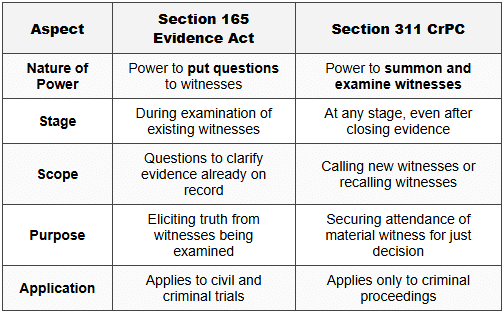
Common Ground: Both provisions aim at discovery of truth and ensure fair trial. Both are discretionary powers exercised judiciously.
8. Common Mistakes and Exam Traps
- Mistake 1: Assuming Section 165 allows judges unlimited questioning. Correction: Questions must be relevant and not violate fair trial principles.
- Mistake 2: Believing judge can compel disclosure of privileged communications under Section 165. Correction: Privilege provisions (Sections 121-131) override Section 165.
- Mistake 3: Thinking judicial questioning always helps weaker party. Correction: Judge must remain neutral; excessive help to one party vitiates trial.
- Mistake 4: Confusing Section 165 with Section 311 CrPC. Correction: Section 165 covers questioning existing witnesses; Section 311 covers summoning new witnesses.
- Mistake 5: Assuming parties cannot cross-examine on judge's questions. Correction: Parties have right to further examine witnesses on facts elicited by judge.
- Trap Alert: In exam questions, distinguish between legitimate clarification (permissible) and building a party's case (impermissible) by judges.
9. Practical Application Points for Judiciary Exams
- Drafting Orders: When judge exercises Section 165 powers, questions and answers must be recorded in case record.
- Appellate Review: Excessive or biased questioning can be ground for appeal challenging trial fairness.
- Balancing Act: Judge must balance active truth-seeking with maintaining impartiality-this balance is frequently tested in exams.
- Cross-Reference: Section 165 should be read with Order X Rule 12 CPC (examination of witnesses by court) for civil cases.
- Witness Protection: Judge can use Section 165 to protect witnesses from harassment while ensuring thorough examination.
Section 165 represents the legislature's intent to make judges active participants in truth discovery while maintaining the adversarial framework. Its proper application requires judges to exercise wide powers judiciously, ensuring that pursuit of truth never compromises impartiality or fair trial. For judiciary exams, focus on understanding the scope-limitations balance, judicial precedents on impartiality, and practical scenarios where Section 165 intervention is necessary versus situations where it would be excessive or prejudicial.