Commerce Exam > Commerce Notes > Accountancy Class 11 > Infographic: Financial Statements - II
Infographic: Financial Statements - II

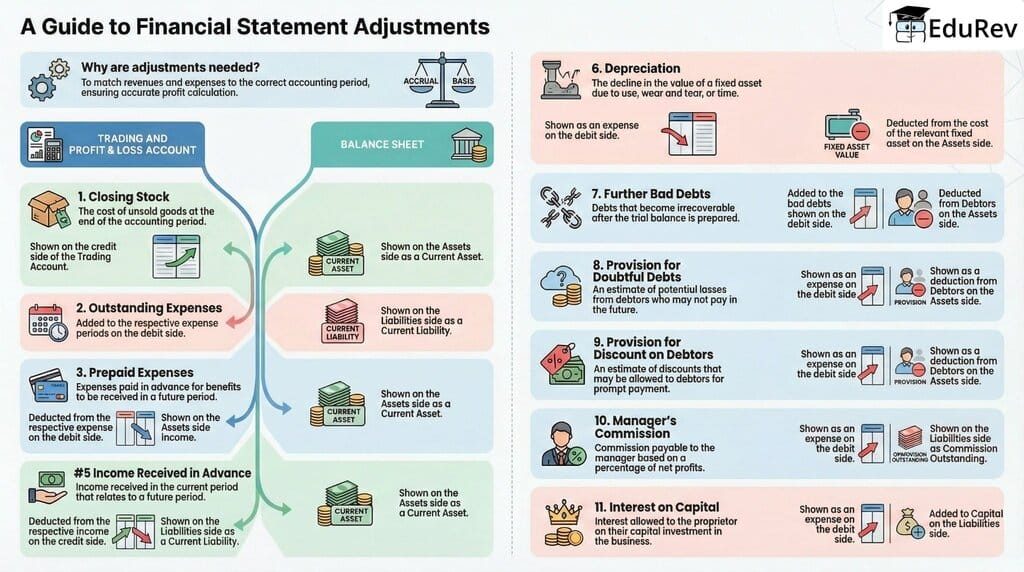
The document Infographic: Financial Statements - II is a part of the Commerce Course Accountancy Class 11.
All you need of Commerce at this link: Commerce
FAQs on Infographic: Financial Statements - II
| 1. What are the primary financial statements used in commerce? |  |
Ans. The primary financial statements used in commerce are the Income Statement, Balance Sheet, and Cash Flow Statement. The Income Statement shows the company's revenues and expenses over a specific period, the Balance Sheet presents the assets, liabilities, and equity at a specific point in time, while the Cash Flow Statement details the inflows and outflows of cash during a period.
| 2. How does the Income Statement differ from the Balance Sheet? | |
Ans. The Income Statement focuses on a company's performance over a period, reflecting how much profit or loss was made by comparing revenues and expenses. In contrast, the Balance Sheet provides a snapshot of the company's financial position at a specific date, summarising assets, liabilities, and shareholders' equity.
| 3. Why is the Cash Flow Statement important for businesses? | |
Ans. The Cash Flow Statement is crucial because it shows how cash is generated and used within a business. It helps stakeholders understand the liquidity of the company and its ability to meet obligations, fund operations, and invest in growth opportunities.
| 4. What role do financial statements play in decision-making for stakeholders? | |
Ans. Financial statements serve as essential tools for stakeholders such as investors, creditors, and management to make informed decisions. They provide insights into the company's profitability, financial stability, and cash flow, enabling stakeholders to assess performance, evaluate risks, and determine investment strategies.
| 5. How often should financial statements be prepared and why? | |
Ans. Financial statements should typically be prepared on a quarterly and annual basis. This regular preparation allows for timely assessment of the company's financial health, compliance with regulatory requirements, and effective planning and forecasting, ensuring that stakeholders have up-to-date information for decision-making.
About this Document

4.65/5 Rating

Apr 19, 2026 Last updated
Related Exams
Document Description: Infographic: Financial Statements - II for Commerce 2026 is part of Accountancy Class 11 preparation. The notes and questions for Infographic: Financial Statements - II have been prepared according to the Commerce exam syllabus. Information about Infographic: Financial Statements - II covers topics like and Infographic: Financial Statements - II Example, for Commerce 2026 Exam. Find important definitions, questions, notes, meanings, examples, exercises and tests below for Infographic: Financial Statements - II.
Introduction of Infographic: Financial Statements - II in English is available as part of our Accountancy Class 11 for Commerce & Infographic: Financial Statements - II in Hindi for Accountancy Class 11 course. Download more important topics related with notes, lectures and mock test series for Commerce Exam by signing up for free. Commerce: Infographic: Financial Statements - II
Description
Infographic: Financial Statements of Accountancy Class 11 provides you one-page visual summary of the chapter covering all the important topics. Download the PDF from EduRev.
Information about Infographic: Financial Statements - II
In this doc you can find the meaning of Infographic: Financial Statements - II defined & explained in the simplest way possible. Besides explaining types of Infographic: Financial Statements - II theory, EduRev gives you an ample number of questions to practice Infographic: Financial Statements - II tests, examples and also practice Commerce tests



Related Searches
Previous Year Questions with Solutions, Exam, Infographic: Financial Statements - II, mock tests for examination, pdf , Objective type Questions, Extra Questions, Infographic: Financial Statements - II, Semester Notes, Viva Questions, ppt, past year papers, Free, Important questions, video lectures, Sample Paper, shortcuts and tricks, MCQs, Infographic: Financial Statements - II, study material, practice quizzes, Summary;