
Time: 3 Hours
Maximum Marks: 80
General Instructions
The question paper consists of 34 questions divided into four sections: A, B, C, and D.
All questions are compulsory.
Section A: Questions 1 to 15 are multiple-choice questions, carrying 1 mark each. Select the most appropriate response.
Section B: Questions 16 to 22 are short-answer questions, carrying 2 marks each.
Section C: Questions 23 to 31 are short-answer questions, carrying 4 marks each.
Section D: Questions 32 to 34 are short-answer questions, carrying 5 marks each.
Syllabus: The Final Exam Question Paper is framed from the following chapters: Temperature and its Measurement, A Journey through States of Water, Methods of Separation in Everyday Life, Living Creatures: Exploring their Characteristics, Nature's Treasures, Beyond Earth.
Section A
Q1. What is the typical temperature range of a laboratory thermometer? (1 mark)
(a) 35 °C to 42 °C
(b) 0 °C to 100 °C
(c) -10 °C to 110 °C
(d) -5 °C to 50 °C
Ans: (c) -10 °C to 110 °C
Sol: Laboratory thermometers typically have a temperature range from -10 °C to 110 °C.
Q2. The difference in temperature between two bodies tells us: (1 mark)
(a) Their distance
(b) How hot a body is compared to another
(c) Their mass
(d) Their volume
Ans: (b) How hot a body is compared to another
Sol: The difference in temperature between the two bodies tells us how hot a body is in comparison to another body.
Q3. Which state of water is characterized by retaining its shape irrespective of the container? (1 mark)
(a) Water vapour
(b) Liquid state
(c) Gaseous state
(d) Solid state (Ice)
Ans: (d) Solid state (Ice)
Sol: Ice, which is water in the solid state, retains its shape irrespective of the container in which it is placed.
Q4. What is the process of beating stalks to separate grains called? (1 mark)
(a) Winnowing
(b) Threshing
(c) Sieving
(d) Churning
Ans: (b) Threshing
Sol: The process of separating grains from the stalks by beating them is known as threshing.
Q5. Why is reproduction necessary for living beings? (1 mark)
(a) For growth
(b) For movement
(c) For cooling
(d) For the continuity of life
Ans: (d) For the continuity of life
Sol: Reproduction, the process of producing new ones of one's own kind, is necessary for the continuity of life.
Q6. Which stage immediately follows the egg stage in the mosquito life cycle? (1 mark)
(a) Pupa
(b) Adult
(c) Larva
(d) Froglet
Ans: (c) Larva
Sol: The egg (stage I) develops into a larva (stage II) in the life cycle of a mosquito.
Q7. Resources created by human beings, such as electric bulbs or furniture, are called: (1 mark)
(a) Renewable resources
(b) Non-renewable resources
(c) Natural resources
(d) Human-made resources
Ans: (d) Human-made resources
Sol: Resources created by human beings to make things more comfortable are called human-made resources.
Q8. What gas is produced when fossil fuels are burnt, contributing to air pollution? (1 mark)
(a) Oxygen
(b) Nitrogen
(c) Carbon dioxide
(d) Argon
Ans: (c) Carbon dioxide
Sol: When fossil fuels are burnt, smoke and carbon dioxide gas are produced, which pollutes the air.
Q9. Which object is Earth's nearest neighbor in space? (1 mark)
(a) Mars
(b) Venus
(c) The Moon
(d) The Sun
Ans: (c) The Moon
Sol: The Moon is Earth's natural satellite and is our nearest neighbor in space.
Q10. Which star is the star closest to us? (1 mark)
(a) Sirius
(b) Proxima Centauri
(c) Pole Star
(d) The Sun
Ans: (d) The Sun
Sol: The Sun is a star and it is the star closest to us.
Q11. The temperature of a person's body is influenced by factors such as age, time of day, and: (1 mark)
(a) Mass
(b) Activity level
(c) Location (city/village)
(d) Diet
Ans: (b) Activity level
Sol: The body temperature is influenced by several factors, such as age, time of the day and activity level.
Q12. The change in the state of water from water to ice (liquid to solid) is done by: (1 mark)
(a) Supplying heat
(b) Increasing pressure
(c) Placing it in a cold environment
(d) Stirring it quickly
Ans: (c) Placing it in a cold environment
Sol: To change water into ice, it should be placed in a cold environment, such as a freezer.
Q13. Which separation method would you use to separate a mixture of mustard oil and water? (1 mark)
(a) Filtration
(b) Decantation
(c) Sieving
(d) Evaporation
Ans: (b) Decantation
Sol: Since oil does not mix with water (immiscible) and forms a separate layer when left undisturbed, decantation can be used to separate oil and water.
Q14. Any thing or any event that prompts living beings to respond is called a: (1 mark)
(a) Response
(b) Movement
(c) Stimulus
(d) Excretion
Ans: (c) Stimulus
Sol: Any thing or any event that prompts living beings to respond is called a stimulus.
Q15. In comparison to Earth, the inner four planets are: (1 mark)
(a) Much larger
(b) Made mostly of gases
(c) Smaller in size
(d) Surrounded by rings
Ans: (c) Smaller in size
Sol: The inner four planets nearest to the Sun (Mercury, Venus, Earth, and Mars) are smaller in size.
Section B
Q16. List two necessary precautions that should be taken while using a laboratory thermometer to measure the temperature of water. (2 mark)
Ans:
The bulb of the thermometer should not touch the bottom or the sides of the beaker.
The thermometer should be held vertically and should not be tilted.
Q17. Based on their behavior, describe one difference between water (liquid state) and water vapour (gaseous state). (2 mark)
Ans:
Shape/Volume: Water (liquid state) flows and changes its shape to fit the container, but its volume remains constant.
Spreading: Water vapor (gaseous state) exhibits a property of spreading out in the entire available space, and gases do not possess a fixed shape.
Q18. Define Magnetic Separation. Give one example of where this process is used commercially. (2 mark)
Ans: Magnetic Separation is the method of separating magnetic and non-magnetic substances by using a magnet.
In many industries, recyclers use magnets fitted to a crane to separate scrap iron articles (which are magnetic) from a heap of waste material, allowing the scrap iron to be recycled and reused.
Q19. How are living beings differentiated from non-living things? List three essential characteristics shared by all living beings. (2 mark)
Ans:
Differentiation: Living beings exhibit a set of essential features (like movement, growth, reproduction, etc.). The absence of any of these features indicates that objects are non-living things.
Three Characteristics: Movement, need for food/nutrition, and growth.
Q20. Why is water conservation important, given that water covers about two-thirds of Earth's surface? Name two methods for conserving water. (2 mark)
Ans:
Importance: Most of the water on Earth is saline (salty) and not fit for domestic, agricultural, or industrial use. The freshwater sources that are easily accessible (rivers, lakes, wells) form only a very small fraction of the total water available. Due to increasing demand and pollution, it is important to conserve water and use it judiciously.
Two Conservation Methods: Recycling water and Rainwater Harvesting.
Q21. Explain why the Sun appears much bigger and brighter than other stars in the night sky. (2 mark)
Ans:
The Sun is a star, and it is the star closest to us.
Although other stars may be much bigger than the Sun, they look very small, appearing like points, because they are vastly farther away from Earth. During the day, the extreme brightness of the Sun prevents us from seeing other stars.
Q22. Explain why spraying kerosene oil on stagnant water helps disrupt the mosquito life cycle. (2 mark)
Ans:
Mosquito larvae and pupae live in water but need to come to the surface frequently to get air for respiration.
Kerosene oil forms a thin layer over the water surface, which separates the water from the air. This prevents the larvae and pupae from inhaling air, causing them to die and thus disrupting the life cycle.
Section C
Q23. By referring to Activity 7.4, explain how one determines the smallest value (least count) that a specific laboratory thermometer can read. (4 mark)
Ans:
Identify Marks: Take the laboratory thermometer and note the temperature difference indicated between two successive bigger marked divisions (e.g., between 0 °C and 10 °C is 10 °C).
Count Divisions: Count the number of smaller divisions (marks) present between these two bigger marks (e.g., 10 divisions).
Calculation: The smallest value the thermometer can read is calculated by dividing the temperature difference by the number of divisions. (e.g., 10 °C / 10 divisions = 1 °C).
Q24. Describe the properties of the three states of water (Solid, Liquid, Gas) focusing on their shape, ability to flow, and volume. (4 mark)
Ans:
Solid State (Ice): Ice retains its fixed shape irrespective of the container it is placed in. It does not flow or spread.
Liquid State (Water): Water flows and changes its shape to take up the shape of the container it is kept in. However, the volume of water remains constant. It possesses the ability to spread.
Gaseous State (Water Vapour): Water vapour does not possess a fixed shape. It exhibits the property of spreading out in the entire available space.
Q25. Describe the method of Sieving. Explain why it is used and provide a practical example from daily life. (4 mark)
Ans:
Definition and Mechanism: Sieving is a method of separation typically used when the components of a solid-solid mixture have different sizes. The mixture is passed through a sieve.
Function: The finer particles pass through the holes of the sieve. The bigger particles, like bran or small stones, remain trapped on the sieve.
Example: Sieving is used in the kitchen to remove bran and small stones from wheat flour. It is also used at construction sites to separate pebbles and stones from sand.
Q26. Define "Stimulus" and provide three detailed examples of how living beings (humans or plants) respond to different stimuli. (4 mark)
Ans: Definition: A stimulus is any thing or any event that prompts living beings to react or respond.
Three Examples of Response:
- Human Response to Pain/Heat: Stimulus is stepping on a sharp object (like a thorn) or touching a hot object. The response is instantly withdrawing the foot or pulling the hand away.
- Plant Response to Touch: The touch-me-not (chhui-mui) plant folds its leaves when touched.
- Plant Directional Growth: Plants respond to gravity (roots grow downwards) and light (shoots grow towards sunlight).
Q27. Differentiate between Renewable and Non-renewable resources. Give two examples of each type with reasons for their classification. (4 mark)
Ans: Renewable Resources:
- Definition: Resources that get renewed, replenished, or restored by natural processes within a reasonable period of time.
- Examples: Air and Forests (Forests regenerate over time, and air is naturally replenished).
Non-renewable Resources:
Definition: Resources found in limited quantities that take millions of years to form and get exhausted once used; they are not replenished within a reasonable period.
Examples: Fossil fuels (e.g., Coal, Petroleum) and Minerals (These are formed from ancient remains over millions of years).
Q28. Describe how an observer in the Northern Hemisphere should locate the constellation Orion and the bright star Sirius in the night sky. (4 mark)
Ans:
Locating Orion: Orion is best viewed in India during the months of December to April after sunset. It is easiest to identify Orion by locating the three bright stars in a short straight line around the middle, which are imagined to be the hunter's belt.
Locating Sirius: Once Orion is identified, Sirius (the brightest star in the night sky) can be located easily. Imagine a straight line passing through the three middle stars of Orion and look along this line towards the east; this direction will lead to Sirius.
Q29. Describe how plants exhibit movement, giving three specific examples. Define how Movement and Growth are considered essential characteristics of plants. (4 mark)
Ans:
Movement in Plants: While plants do not move from place to place (locomotion), they show internal and directional movements.
Examples of Movement:
Directional Growth: The shoot grows towards light, and the root grows downwards towards gravity.
Response to Touch: The leaves of the touch-me-not (chhui-mui) plant fold when touched.
Specialized Movement: In insectivorous plants like Drosera, hair-like projections move inward to trap insects for nutrition.
Movement and Growth as Essential Characteristics:
Growth: Plants increase in size. Growth, along with other characteristics like movement, respiration, and reproduction, are essential features that differentiate living plants from non-living things.
Movement: The presence of inherent movement (like directional growth or response to stimuli) is a fundamental characteristic shared by all living beings, which includes plants.
Q30. Describe the Evaporation process in detail, its application in separating common salt from seawater, and how one can confirm the presence of salt left behind. (4 mark)
Ans:
Evaporation Process: Evaporation is the process where a liquid (like water) converts into its vapor state (water vapor). This process takes place continuously, even at room temperature.
Application (Salt from Seawater): Seawater (a mixture of salt dissolved in water) is collected in shallow pits. When exposed to sunlight and air, the water evaporates completely, leaving behind the solid mixture of salts. Evaporation is effectively used here to separate a dissolved solid from a liquid.
Confirming Salt Presence (Activity 9.2): To confirm the residue is salt, a few drops of the salt solution can be spread on a dark paper and allowed to dry. Once the water disappears (evaporates), white patches or residues are left on the paper. The presence of salt can be confirmed by touching or tasting (theoretically) the residue.
Q31. Differentiate between Clinical and Laboratory Thermometers by highlighting their intended use, typical temperature range, and the liquids commonly contained within them. (4 mark)
Ans: 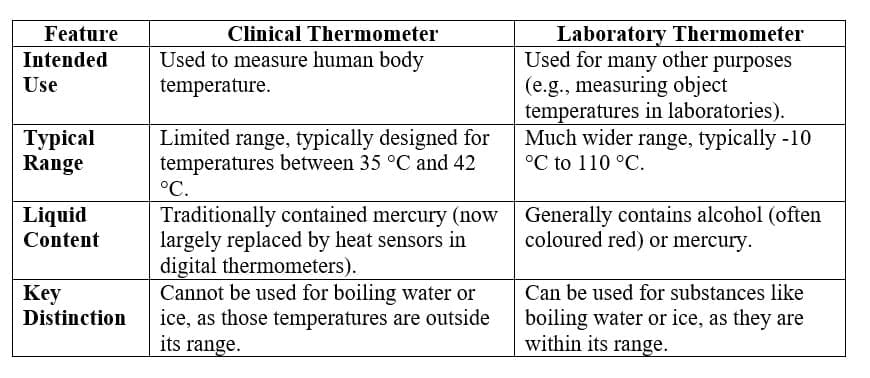
Section D
Q32. Describe the life cycle of a frog, specifically explaining the physical adaptations and habitat changes that occur between the tadpole and adult stages. (5 mark)
Ans:
Initial Stage (Eggs/Spawn): The life of a frog begins as a cluster of eggs called spawn, laid in water. Each egg develops into an embryo.
Tadpole Stage: The embryo hatches into a tadpole, which has a tail but no legs. The tail is a key adaptation that helps the tadpole swim efficiently in water, as it is entirely aquatic at this stage.
Froglet Stage (Transition): As the tadpole grows into a froglet, it develops legs, and its tail gradually shortens. The froglet starts spending time both in water and on land.
Adult Frog Stage: The adult frog completely loses its tail and develops strong legs for jumping and moving on land. It becomes amphibious, living both in water and on land, showing adaptations to both habitats.
Q33. Differentiate between renewable and non-renewable natural resources. Provide two examples of each and explain why fossil fuels fall into the non-renewable category. (5 mark)
Ans: Renewable Resources:
Definition: Renewable resources are those natural resources that can be replenished or regenerated naturally over a short period of time and can be used repeatedly without the risk of permanent depletion.
Examples:
Air: The air is continuously replenished through natural processes like photosynthesis and the water cycle.
Forests: Trees grow and regenerate over time, making forests a renewable source of wood, oxygen, and other resources.
Non-renewable Resources:
Definition: Non-renewable resources are natural resources that are available in limited quantities and take millions of years to form. Once used, they cannot be quickly replenished and may eventually get exhausted.
Examples:
Coal: Formed from the remains of plants buried under earth layers over millions of years.
Petroleum: Formed from ancient microscopic organisms over millions of years under high pressure and temperature.
Why Fossil Fuels are Non-renewable:
Fossil fuels like coal, petroleum, and natural gas are formed over millions of years from the remains of plants and animals.
Because their formation is extremely slow, they cannot be replenished on a human timescale. Once extracted and used, they are permanently depleted, which is why they are classified as non-renewable resources.
Q34. Explain how an observer can locate the Pole Star in the night sky using the Big Dipper constellation. Why has the Pole Star been significant for travellers throughout history? (5 mark)
Ans: Identifying the Big Dipper (Saptaṛiṣhi): The Big Dipper is part of the Ursa Major constellation and is shaped like a ladle or a spoon. It is easily visible in the northern sky.
Locating the Pole Star (Dhruva Tārā):
- Look at the two stars at the end of the "bowl" of the Big Dipper (these are called pointer stars).
- Imagine a straight line passing through these two stars, extending outwards.
- Measure roughly five times the distance between these two stars along the line. The star you reach is the Pole Star, which is located almost exactly above the North Pole.
Historical Significance of the Pole Star:
- The Pole Star remains almost stationary in the night sky and always indicates the north direction in the Northern Hemisphere.
- Before modern navigation tools like the compass, sailors, travellers, and explorers used the Pole Star to determine direction, helping them travel safely across seas and deserts.


