Worksheet Solutions: Infrastructure: Engine of India’s Development

Multiple Choice Questions
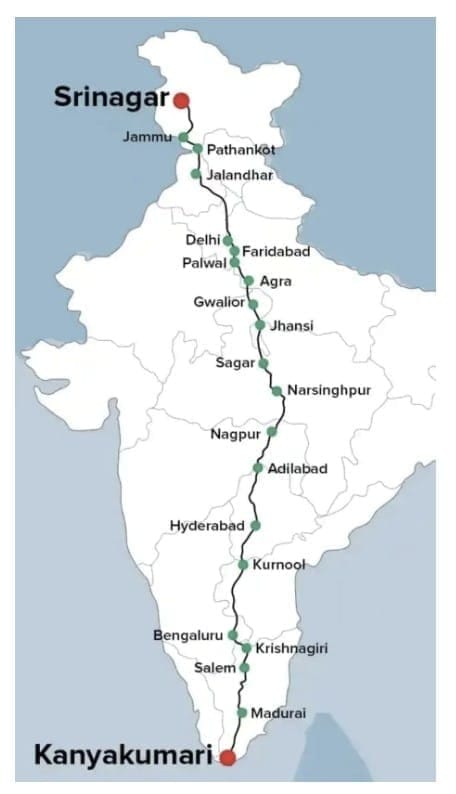
Q1: What is the length of NH44, India's longest national highway?
(a) 3,500 km
(b) 4,112 km
(c) 5,000 km
(d) 2,800 km
Ans: (b)
NH44 stretches 4,112 km from Srinagar in the north to Kanyakumari in the south, making it India's longest national highway.
Q2: Which railway system was introduced by the British in India primarily to transport raw materials to ports for export?
(a) Metro trains
(b) Electric trains
(c) Steam locomotives
(d) Vande Bharat trains
Ans: (c)
The British introduced railways in 1853 using steam locomotives primarily to transport raw materials like cotton and tea to ports for export to Britain.
Q3: How many major and minor ports does India have in total?
(a) 12 major and 150 minor ports
(b) 10 major and 200 minor ports
(c) 12 major and 217 minor ports
(d) 15 major and 217 minor ports
Ans: (c)
India has 12 major ports and 217 minor ports along its approximately 11,100 km coastline, handling increasing cargo volumes annually.
Q4: Which indigenous tribes craft the living root bridges of Meghalaya?
(a) Garo and Rabha tribes
(b) Khāsi and Jaintia tribes
(c) Bodo and Mishing tribes
(d) Santhal and Munda tribes
Ans: (b)
The Khāsi and Jaintia tribes craft living root bridges called jingkieng jri using roots of the Ficus elastica tree across generations.
Q5: What was the approximate cost per minute for mobile calls in India during the 1990s?
(a) ₹5 per minute
(b) ₹10 per minute
(c) ₹17 per minute
(d) ₹25 per minute
Ans: (c)
In the 1990s, mobile calls in India cost up to ₹17 per minute with charges even for incoming calls, contrasting today's affordable rates.
Fill in the Blanks
Q1: The Dhola Sadiya Bridge connects Assam and Arunachal Pradesh across the __________ River.
Ans: Lohit
Q2: The Golden Quadrilateral is an important highway network connecting Delhi, Mumbai, Chennai, and __________.
Ans: Kolkata
Q3: India is aiming to have 100% trains running on __________ by 2025.
Ans: electricity
Q4: J. C. Bose pioneered __________ communication in India by demonstrating wireless signals in 1895.
Ans: wireless
Q5: The __________ emphasised planned infrastructure under state supervision with fixed road widths based on purpose.
Ans: Arthaśhāstra
True or False
Q1: India has the largest road network in the world as of 2024.
Ans: False
India has the second-largest road network in the world after the USA as of 2024.
Q2: Indian Railways is the largest employer in India with approximately 1.21 million employees in 2024.
Ans: True
Indian Railways employs about 1.21 million people including engineers, ticket collectors, and service staff, making it India's largest employer.
Q3: Metro trains in India use only underground tracks to reduce travel time.
Ans: False
Metro trains in India run on both underground and elevated tracks to reduce travel time and congestion.
Q4: The Bengal Gazette was India's first printed newspaper, published in 1780.
Ans: True
The Bengal Gazette was India's first printed newspaper, published in 1780 during the print era of communication.
Q5: Living root bridges in Meghalaya can be built within a few months.
Ans: False
Living root bridges take decades or even centuries to mature fully, as roots are guided and nurtured over generations.
Match the Following
Q1: Match the infrastructure components in Column A with their descriptions in Column B.
| Column A | Column B |
|---|---|
| 1. Kempegowda International Airport | A. Connects Delhi, Mumbai, Chennai, and Kolkata |
| 2. Dhola Sadiya Bridge | B. First electric signal transmission system invented by Samuel Morse |
| 3. Golden Quadrilateral | C. Designed based on 'garden city' concept in Bengaluru |
| 4. Telegraph | D. At 9.15 km, it is India's second longest bridge |
| 5. Indian Railways | E. Fourth-largest railway system in the world |
Ans:
1 - C: Kempegowda International Airport in Bengaluru is designed based on the 'garden city' concept with bamboo structures and green spaces.
2 - D: Dhola Sadiya Bridge is 9.15 km long, making it India's second longest bridge connecting Assam and Arunachal Pradesh.
3 - A: The Golden Quadrilateral is an important highway network connecting the four major cities Delhi, Mumbai, Chennai, and Kolkata.
4 - B: The telegraph was invented by Samuel Morse in 1844, transmitting the first electric signals using dots and dashes.
5 - E: Indian Railways is the fourth-largest railway system globally, carrying over 20 million passengers daily with extensive network coverage.
Short Answer Questions
Q1: Explain how the Dhola Sadiya Bridge has improved the lives of people in Assam and Arunachal Pradesh.
Ans: The Dhola Sadiya Bridge, also called Bhupen Hazarika Setu, connects Assam and Arunachal Pradesh across the Lohit River. Before its construction, people relied on ferries that did not operate during floods. The bridge provides year-round travel, cutting journey time by four hours. Farmers can now transport vegetables and fruits to markets before they spoil, whilst people can access hospitals and medicines faster even during floods.
Q2: Describe the significance of living root bridges in Meghalaya and how they are constructed.
Ans: Living root bridges, called jingkieng jri in Khasi language, are crafted by the Khāsi and Jaintia tribes of Meghalaya using roots of Ficus elastica trees. Indigenous people guide roots across streams with bamboo and palm trunks. Over decades or centuries, roots grow stronger and twist into natural bridges standing 15-30 metres high. These living structures reflect local knowledge about nature, have cultural meaning, and connect generations.
Q3: Why were railways introduced in India by the British, and how did they impact Indian society?
Ans: The British introduced railways in India in 1853 primarily to transport raw materials like cotton and tea to ports for export to Britain. They also wanted to move British goods across India, exploit resources, and enable quicker troop movement. As the railway network expanded, trade grew, major markets developed, and new settlements emerged near stations. Railways eventually became the lifeline for moving people and goods across India.
Q4: How has modern communication infrastructure benefited Indian society across different sectors?
Ans: Modern communication infrastructure has transformed Indian society significantly. In education, students access online classes, digital libraries, and educational videos even in remote areas. Quick mobile alerts help during natural disasters for emergency response. Businesses sell products globally through e-commerce platforms. E-governance enables citizens to apply for documents, file complaints, and get information easily through services like DigiLocker, promoting ease of living for communities nationwide.
Q5: What is the collective responsibility of citizens and government towards maintaining public infrastructure in India?
Ans: Protecting public infrastructure is a shared responsibility of government and citizens. Littering, defacing buildings, and damaging monuments reduce ease of living. Panchayats and municipalities must improve waste management, sanitation, traffic, and water supply. Infrastructure should be safe, inclusive, and environmentally sustainable using clean energy and eco-friendly materials. Citizens must use public facilities responsibly and report damage like potholes or broken lights to authorities.
FAQs on Worksheet Solutions: Infrastructure: Engine of India’s Development
| 1. What is the significance of infrastructure in India's development? |  |
| 2. How does transportation infrastructure contribute to economic growth? | |
| 3. What role does energy infrastructure play in India's progress? | |
| 4. Why is water supply considered a critical component of infrastructure? | |
| 5. How can communication infrastructure impact social development? | |




