Contemporary Legal Debates and Reforms


Contemporary legal debates and reforms represent the dynamic intersection of established legal principles and evolving societal needs. This area examines ongoing discussions about critical legal issues, recent legislative changes, judicial interventions, and proposed reforms that reshape the Indian legal landscape. Understanding these debates is essential for appreciating how law adapts to modern challenges while maintaining constitutional values and ensuring justice delivery.
1. Judicial Reforms and Access to Justice
1.1 Pendency Crisis and Case Management
- Scale of Pendency: Over 5 crore cases pending across all judicial levels in India. Supreme Court has approximately 70,000+ pending cases, High Courts have around 60 lakh cases, and subordinate courts carry the burden of over 4 crore cases.
- National Judicial Data Grid (NJDG): Digital platform launched to monitor case pendency in real-time across all levels of judiciary. Provides data-driven insights for policy interventions and resource allocation.
- Fast Track Courts: Specialized courts established under Article 227 supervision to expedite disposal of specific categories like sexual offenses (under POCSO Act), cases against MPs/MLAs, and senior citizen matters.
- Case Management Systems: Introduction of e-Courts Mission Mode Project (Phase I and II) for digitization, e-filing, virtual hearings, and online case status tracking.
1.2 Judicial Appointments and Collegium System
- Collegium System: Evolved through First Judges Case (1981), Second Judges Case (1993), and Third Judges Case (1998). Supreme Court collegium comprises CJI and four senior-most judges; High Court collegium has CJ and two senior-most judges.
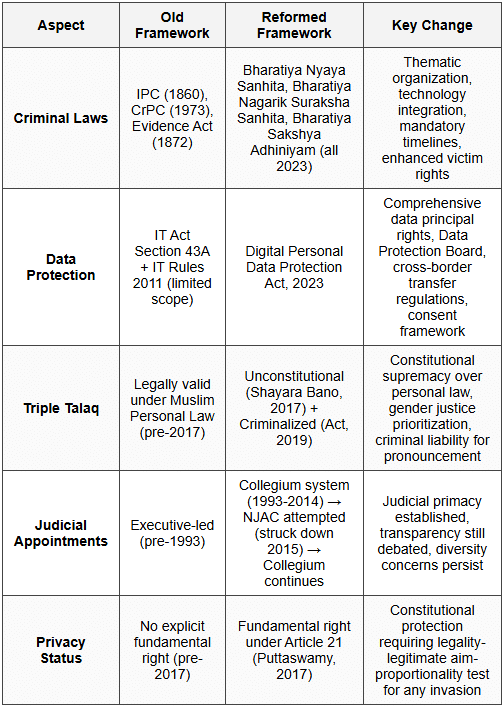
- NJAC Controversy: National Judicial Appointments Commission Act, 2014 (99th Constitutional Amendment) struck down in Supreme Court Advocates-on-Record Association v. Union of India (2015) as violating basic structure doctrine by compromising judicial independence.
- Transparency Debates: Demands for making collegium proceedings transparent, recording reasons for appointments/rejections, and reducing delays in recommendation processing.
- Diversity Concerns: Underrepresentation of women judges (approximately 11% in High Courts, 11% in Supreme Court), SC/ST judges, and judges from marginalized communities in higher judiciary.
1.3 Alternative Dispute Resolution (ADR) Mechanisms
- Statutory Framework: Governed by Arbitration and Conciliation Act, 1996 (based on UNCITRAL Model Law), Legal Services Authorities Act, 1987, and Code of Civil Procedure provisions (Order X Rule 1A, Section 89).
- Mediation Bill, 2021: Proposed legislation to institutionalize mediation, establish Mediation Council of India, and make pre-litigation mediation mandatory for certain civil/commercial disputes.
- Commercial Courts Act, 2015: Mandates pre-institution mediation for commercial disputes above specified value thresholds. Commercial Appellate Division established in High Courts.
- Lok Adalats: Organized under Section 19 of Legal Services Authorities Act. Awards have status of civil court decree under Section 21. Particularly effective for compoundable offenses, matrimonial disputes, and public utility service matters.
1.4 Legal Aid and Pro Bono Services
- Constitutional Mandate: Article 39A (DPSP) ensures free legal aid. Hussainara Khatoon v. State of Bihar (1979) established right to free legal aid as part of Article 21.
- National Legal Services Authority (NALSA): Statutory body under Legal Services Authorities Act, 1987, headed by CJI as Patron-in-Chief. State Legal Services Authorities (SLSAs) at state level, District Legal Services Authorities (DLSAs) at district level.
- Eligibility Criteria: Income below ₹3 lakhs (varies by state), SC/ST persons, women and children, persons with disabilities, industrial workers, victims of mass disasters/violence, and persons in custody.
- Quality Concerns: Debates about adequacy of legal aid lawyers' remuneration, training standards, and effectiveness of representation in complex matters.
2. Criminal Justice System Reforms
2.1 Criminal Law Reform (2023 Legislation)
- Bharatiya Nyaya Sanhita, 2023: Replaces Indian Penal Code, 1860. Introduces community service as punishment, organizes crimes thematically rather than numerically, enhances penalties for crimes against women and children.
- Bharatiya Nagarik Suraksha Sanhita, 2023: Replaces Code of Criminal Procedure, 1973. Mandates videography of crime scenes, electronic service of summons, timelines for trial completion (investigation within 180 days, charge framing within 60 days).
- Bharatiya Sakshya Adhiniyam, 2023: Replaces Indian Evidence Act, 1872. Recognizes electronic and digital records as primary evidence, provisions for video conferencing testimony, enhanced protection for vulnerable witnesses.
- Key Debates: Concerns about adequate stakeholder consultation, potential for misuse of expanded police powers, impact on federal structure, and readiness of infrastructure for technology-dependent provisions.
2.2 Death Penalty and Sentencing Reforms
- Rarest of Rare Doctrine: Established in Bachan Singh v. State of Punjab (1980). Death penalty permissible when alternative option is unquestionably foreclosed. Mithu v. State of Punjab (1983) struck down mandatory death penalty as unconstitutional.
- Sentencing Guidelines: Malimath Committee Report (2003) recommended victim compensation, structured sentencing policy, and sentencing hearings separate from conviction proceedings.
- Curative Petitions: Procedure for death row convicts after dismissal of review petitions. Rupa Ashok Hurra v. Ashok Hurra (2002) recognized curative petitions as exceptional remedy.
- Abolition Debates: India retains death penalty but uses it sparingly (retentionist in practice but abolitionist in application). Arguments center on deterrence effectiveness, irreversibility, and international human rights obligations.
2.3 Bail Reform and Undertrial Detention
- Bail Jurisprudence Evolution: Arnesh Kumar v. State of Bihar (2014) restricted arrest powers. Satender Kumar Antil v. CBI (2022) held "bail is rule, jail is exception" for offenses punishable below 7 years.
- Undertrial Population Crisis: Approximately 76% of prison population comprises undertrials. Many detained beyond maximum sentence period for alleged offense.
- Section 436A CrPC: Mandates release of undertrials who have served half of maximum sentence period (inserted by Criminal Law Amendment Act, 2005).
- High Court Undertrial Review Committees: Established pursuant to Supreme Court directions in Bhim Singh v. Union of India (2014) to periodically review undertrial detention and recommend release.
2.4 Witness Protection and Victim Rights
- Witness Protection Scheme, 2018: Central government scheme providing three-tier security (threat categorization), identity protection, relocation assistance, and in-court protection measures.
- Victim Compensation: Section 357A CrPC (inserted 2009) mandates state victim compensation schemes. Delhi Domestic Working Women's Forum v. Union of India (1995) recognized victim's right to compensation.
- Vulnerable Witness Protection: Provisions for screening, video-link testimony, support persons during examination (especially for child witnesses under Section 118 of Evidence Act).
- Victim Participation Rights: Right to be heard during bail hearings, plea bargaining proceedings, and sentencing. Mallikarjun Kodagali v. State of Karnataka (2019) emphasized meaningful victim participation.
3. Gender Justice and Personal Laws
3.1 Sexual Harassment and Workplace Protection
- Vishakha Guidelines (1997): Vishakha v. State of Rajasthan laid down guidelines for workplace sexual harassment prevention in absence of legislation, invoking Articles 14, 19(1)(g), and 21 read with CEDAW.
- Sexual Harassment of Women at Workplace Act, 2013: Statutory implementation of Vishakha principles. Mandates Internal Complaints Committee (ICC) in establishments with 10+ employees, Local Complaints Committee (LCC) at district level for unorganized sector.
- ICC Composition: Minimum four members with senior woman employee as presiding officer, external member from NGO/association committed to women's causes, and at least half members should be women.
- Implementation Challenges: Non-constitution of ICCs, inadequate training, concerns about confidentiality breaches, and lack of awareness among women workers, especially in informal sector.
3.2 Triple Talaq and Muslim Personal Law Reforms
- Shayara Bano v. Union of India (2017): 3:2 majority struck down instant triple talaq (talaq-e-biddat) as unconstitutional. Held practice violated Articles 14, 15, and 21.
- Muslim Women (Protection of Rights on Marriage) Act, 2019: Criminalizes instant triple talaq with imprisonment up to 3 years. Provides maintenance and custody rights to affected women.
- Debates and Concerns: Critics argue criminalization approach may harm women (breadwinner imprisonment), lack of community consultation, and potential for misuse. Supporters emphasize gender justice and constitutional supremacy over personal law.
- Reform Trajectory: Earlier reforms include Muslim Women (Protection of Rights on Divorce) Act, 1986 (post-Shah Bano case), and Dissolution of Muslim Marriages Act, 1939 granting women divorce rights.
3.3 Uniform Civil Code Debate
- Constitutional Provision: Article 44 (DPSP) directs state to secure Uniform Civil Code (UCC) for citizens throughout India.
- Judicial Pronouncements: Shah Bano v. Union of India (1985), Sarla Mudgal v. Union of India (1995), and John Vallamattom v. Union of India (2003) advocated for UCC implementation.
- Arguments in Favor: Gender justice uniformity, national integration, simplification of legal system, elimination of discriminatory personal law provisions, and constitutional directive implementation.
- Arguments Against: Religious freedom concerns (Article 25), cultural diversity preservation, federal structure implications (personal laws in Concurrent List), minority rights protection, and need for community-led reform rather than imposed legislation.
- Goa Civil Code: Goa retains Portuguese Civil Code of 1867 (adapted as Goa Family Laws), which applies uniformly regardless of religion-often cited as model but criticized for its colonial origins and specific provisions.
3.4 LGBTQ+ Rights and Marriage Equality
- Navtej Singh Johar v. Union of India (2018): Unanimously decriminalized consensual homosexual acts by reading down Section 377 IPC. Affirmed constitutional morality, dignity, privacy, and equality.
- Transgender Persons Act, 2019: Recognizes transgender identity, prohibits discrimination, provides for welfare measures. Criticized for medicalization of identity recognition process and not addressing reservation/affirmative action.
- NALSA v. Union of India (2014): Recognized transgender persons as "third gender," directed legal recognition of self-perceived gender identity, and recommended affirmative action in education and employment.
- Marriage Equality Litigation: Pending petitions in Supreme Court seeking recognition of same-sex marriages under Special Marriage Act, 1954. Arguments invoke equality (Article 14), non-discrimination (Article 15), and right to life with dignity (Article 21). Counter-arguments emphasize legislative domain, social acceptance, and marriage being heterosexual institution in Indian legal framework.
4. Digital Age Legal Challenges
4.1 Data Protection and Privacy
- Puttaswamy Judgment (2017): Nine-judge bench in Justice K.S. Puttaswamy v. Union of India unanimously declared privacy as fundamental right under Article 21 and part of freedom under Article 19(1). Laid down three-fold test: legality, legitimate aim, and proportionality.
- Digital Personal Data Protection Act, 2023: Replaces earlier proposed bills. Establishes Data Protection Board of India, mandates consent for processing personal data, provides data principal rights (access, correction, erasure), exempts government processing for legitimate state purposes.
- Key Principles: Purpose limitation (data collection only for specified purpose), data minimization (only necessary data collection), storage limitation (retention only as long as needed), and accountability.
- Enforcement Challenges: Implementation of cross-border data transfer provisions, balancing innovation with privacy protection, resource constraints for Data Protection Board, and technical capacity building for compliance.
4.2 Social Media Regulation and Intermediary Liability
- Information Technology (Intermediary Guidelines and Digital Media Ethics Code) Rules, 2021: Mandates due diligence by intermediaries, grievance redressal mechanism (72-hour response), traceability of first originator for certain messages, and content moderation.
- Significant Social Media Intermediary (SSMI): Platforms with 50 lakh+ registered users in India. Additional obligations include resident grievance officer, nodal contact person, and chief compliance officer appointments.
- Safe Harbor Provisions: Section 79 of IT Act, 2000 provides conditional immunity from liability for third-party content. Immunity lost if intermediary fails to act upon actual knowledge or fails government notification to remove content.
- Constitutional Concerns: Petitions challenging Rules for violating freedom of speech (Article 19(1)(a)), traceability provisions undermining encryption and privacy, lack of judicial oversight for content removal, and vague standards for content moderation.
4.3 Artificial Intelligence and Algorithm Accountability
- Emerging Legal Issues: Algorithmic bias in hiring/lending/criminal justice, liability for AI-driven decisions (autonomous vehicles, medical diagnosis), intellectual property in AI-generated works, and transparency in automated decision-making.
- Right to Explanation: Debates around whether individuals have right to meaningful explanation of algorithmic decisions affecting them. Digital Personal Data Protection Act, 2023 provides limited grievance redressal but not explicit algorithmic transparency.
- Predictive Policing Concerns: Use of AI in crime prediction and prevention raises profiling concerns, potential discrimination against marginalized communities, and due process implications.
- Regulatory Approaches: Discussions around AI-specific legislation versus sector-specific regulation, ethical frameworks, certification requirements, and judicial capacity to adjudicate AI-related disputes.
4.4 Cybersecurity and Digital Crimes
- IT Act Penal Provisions: Section 66 (computer-related offenses), Section 66C (identity theft), Section 66D (cheating by personation using computer), Section 66E (privacy violation), Section 67 (pornography), Section 67A (sexually explicit material), Section 67B (child pornography).
- National Cyber Security Policy, 2013: Framework for protecting information infrastructure, public-private collaboration, capacity building, and international cooperation.
- Computer Emergency Response Team (CERT-In): Nodal agency under Section 70B of IT Act for cybersecurity threat response, vulnerability management, and coordination.
- Jurisdictional Challenges: Cross-border nature of cybercrimes, lack of international enforcement cooperation, technical expertise deficits in investigative agencies, and victim reluctance to report due to stigma or procedural complexity.
5. Environmental Law and Climate Justice
5.1 Constitutional Environmental Jurisprudence
- Article 21 Environmental Dimensions: M.C. Mehta v. Union of India (Oleum Gas Leak case, 1987) established right to clean environment as part of right to life. Absolute liability principle for hazardous industries introduced.
- Article 48A and 51A(g): Added by 42nd Amendment (1976). Article 48A (DPSP) directs state to protect environment, forests, and wildlife. Article 51A(g) creates fundamental duty to protect and improve natural environment.
- Public Trust Doctrine: M.C. Mehta v. Kamal Nath (1997) held natural resources like rivers, seashores, and forests held by government in trusteeship for public benefit. State cannot alienate essential public resources.
- Intergenerational Equity: State of Himachal Pradesh v. Ganesh Wood Products (1995) recognized obligation to preserve environment for future generations. Current generation as trustee of natural resources.
5.2 Precautionary Principle and Sustainable Development
- Vellore Citizens Welfare Forum v. Union of India (1996): Supreme Court adopted Precautionary Principle (anticipatory action against environmental harm despite scientific uncertainty) and Polluter Pays Principle (liability for environmental restoration costs).
- Sustainable Development: Development that meets present needs without compromising future generations' ability to meet their needs. Balances economic growth with environmental protection and social equity.
- Environmental Impact Assessment (EIA): Mandatory under EIA Notification, 2006 (amended by EIA Draft 2020-controversial) for specified projects. Public participation through hearings, scientific assessment of environmental impacts, and mitigation measures.
- Draft EIA 2020 Controversies: Reduced public consultation period (40 to 20 days), post-facto approvals for ongoing projects, exemptions for sensitive projects, and limited public participation in certain categories.
5.3 Climate Change Litigation and Policy
- National Action Plan on Climate Change (NAPCC): Eight national missions including Solar Mission, Enhanced Energy Efficiency, Sustainable Habitat, Water, Himalayan Ecosystem, Green India, Sustainable Agriculture, and Strategic Knowledge for Climate Change.
- Paris Agreement Commitments: India pledged to reduce emissions intensity of GDP by 45% (from 2005 levels) by 2030, achieve 50% cumulative electric power installed capacity from non-fossil sources by 2030, and net-zero emissions by 2070.
- Climate Litigation Trends: Ridhim Aggarwal v. Union of India (2021) recognized right against adverse effects of climate change as fundamental right. Increasing PIL petitions for enforcement of climate policies and corporate accountability.
- Loss and Damage Framework: Debates around liability for climate-induced disasters, compensation for vulnerable communities, developed vs. developing nation responsibilities, and common but differentiated responsibilities principle.
5.4 Forest Rights and Indigenous Communities
- Scheduled Tribes and Other Traditional Forest Dwellers (Recognition of Forest Rights) Act, 2006: Recognizes individual and community forest rights, right to protect-regenerate-conserve forests, and rights over minor forest produce.
- Implementation Challenges: Large-scale rejection of claims (approximately 50% rejected applications), inadequate Gram Sabha empowerment, conflict with conservation laws like Wildlife Protection Act, and eviction drives despite pending claims.
- Compensatory Afforestation: Compensatory Afforestation Fund Act, 2016 establishes national and state funds for compensatory afforestation when forest land diverted for non-forest use. Concerns about quality of compensatory afforestation vs. loss of primary forests.
- T.N. Godavarman v. Union of India (ongoing since 1996): Continuous mandamus expanding to cover all forest-related issues. Court-appointed Central Empowered Committee (CEC) for monitoring and recommending on forest conservation matters.
6. Emerging Areas and Future Directions
6.1 Medical Ethics and Healthcare Law
- Euthanasia and Living Will: Common Cause v. Union of India (2018) recognized passive euthanasia and living will (advance directive for medical treatment). Guidelines for withdrawal of life support under medical board supervision.
- Surrogacy Regulation: Surrogacy (Regulation) Act, 2021 permits altruistic surrogacy only for Indian married couples with proven infertility. Commercial surrogacy banned. Age and medical eligibility criteria prescribed.
- Abortion Rights: Medical Termination of Pregnancy Act, 1971 (amended 2021) allows termination up to 20 weeks (24 weeks for special categories) with medical opinion. Supreme Court in X v. Principal Secretary, Health (2022) expanded interpretation for unmarried women.
- Clinical Trials Ethics: Drugs and Cosmetics Rules mandate Ethics Committee approval, informed consent, compensation for trial-related injury, and registration. Debates continue on liability for harm and adequacy of compensation standards.
6.2 Intellectual Property Rights Reforms
- Compulsory Licensing: Section 84 of Patents Act, 1970 allows compulsory licenses if patented invention not reasonably affordable or available. Natco Pharma v. Bayer (2012) granted first compulsory license for cancer drug Sorafenib.
- TRIPS Flexibilities: India utilizes flexibilities like pre-grant and post-grant opposition, Section 3(d) (enhanced efficacy requirement), and parallel imports to balance patent protection with public health access.
- Traditional Knowledge Protection: Traditional Knowledge Digital Library (TKDL) documents Indian traditional knowledge to prevent biopiracy and wrongful patenting. Over 2.9 lakh formulations documented in multiple languages.
- Copyright in Digital Age: Debates around fair use vs. fair dealing, liability of streaming platforms, protection for AI-generated works, and Digital Rights Management (DRM) circumvention provisions under Section 65A of Copyright Act.
6.3 Electoral Reforms and Political Finance
- Disqualification Provisions: Lily Thomas v. Union of India (2013) struck down Section 8(4) of Representation of People Act, mandating immediate disqualification upon conviction (no protection during appeal period).
- Electoral Bonds Scheme: Introduced 2018, allowed anonymous political donations through bonds purchased from State Bank of India. Association for Democratic Reforms v. Union of India (2024) struck down scheme as violating voters' right to information (Article 19(1)(a)) and violating equality (Article 14).
- Criminalization of Politics: Public Interest Foundation v. Union of India (2019) mandated candidates to disclose criminal antecedents through newspaper/TV advertisements and social media. Pending petitions seek disqualification of persons with serious criminal charges from contesting elections.
- NOTA Option: PUCL v. Union of India (2013) directed inclusion of None of the Above (NOTA) option in ballot/EVM. However, NOTA votes do not lead to fresh election or rejection of candidates-purely negative voting right.
6.4 Space Law and Emerging Technologies
- Space Activities Bill (proposed): Framework for regulating private space activities, licensing, liability for damage, safety standards, and international obligations under Outer Space Treaty, 1967.
- Blockchain and Cryptocurrency: Regulatory uncertainty continues. Reserve Bank of India initially banned crypto transactions (2018), struck down by Supreme Court (2020), but ban reinstated through proposed legislation. Debates around legal tender status, financial stability risks, and use in illegal activities vs. innovation potential.
- Biotechnology Regulation: Genetic Engineering Appraisal Committee (GEAC) under Environment Ministry regulates GMOs. Debates around GM crops (Bt Brinjal moratorium 2010), gene editing technologies (CRISPR), and biosafety vs. food security considerations.
- Robotics and Automation: Emerging questions around robot legal personhood, liability for autonomous systems, impact on employment rights, and regulatory frameworks for human-robot interaction in healthcare, manufacturing, and service sectors.
7. Common Mistakes and Important Distinctions
7.1 Trap Alerts: Frequent Confusion Points
- Collegium vs. NJAC: Collegium system is currently operational (post-Third Judges Case, 1998). NJAC was enacted but struck down (2015). Many confuse NJAC as current system-it is NOT.
- Passive vs. Active Euthanasia: Only passive euthanasia (withdrawal of life support) is legally recognized in India through Common Cause judgment (2018). Active euthanasia (administering lethal substance) remains illegal-equivalent to culpable homicide.
- Decriminalization vs. Legalization: Navtej Singh Johar judgment (2018) decriminalized homosexuality (removed criminal penalty under Section 377), but did NOT legalize same-sex marriage. Marriage equality is separate ongoing debate.
- Safe Harbor Limitation: Section 79 IT Act provides intermediary immunity only if due diligence observed and prompt action taken upon knowledge of illegal content. Immunity is conditional, not absolute-many incorrectly assume blanket protection.
- NOTA Effect: NOTA votes are counted but do not trigger re-election or candidate rejection. Candidate with highest votes wins even if NOTA secures maximum votes. NOTA is expression of disapproval, not mechanism for election invalidation.
7.2 Comparative Table: Key Legal Frameworks
7.3 Interconnected Reform Areas
- Justice Delivery + Technology: Digital courts, e-filing, virtual hearings accelerated during COVID-19 pandemic. Permanent integration requires infrastructure investment, digital literacy training, and cybersecurity safeguards.
- Gender Justice + Personal Laws: Reforms in triple talaq, divorce rights, maintenance, and property inheritance demonstrate tension between religious autonomy (Article 25) and gender equality (Articles 14-15). UCC debate epitomizes this intersection.
- Environmental Protection + Economic Development: Sustainable development principle attempts balance. EIA process, forest clearances, and climate commitments show practical application. Key question: who bears cost of conservation-present generation or future generations?
- Privacy + Security: Data protection vs. national security (government exemptions in DPDP Act), encryption vs. traceability (IT Rules 2021), and anonymity vs. accountability (electoral bonds case) reflect ongoing balancing exercise.
Contemporary legal debates and reforms illustrate law's responsiveness to societal evolution while maintaining constitutional foundations. These reforms emerge from judicial interpretation, legislative action, executive policy, and civil society advocacy. Understanding these debates requires appreciation of competing values, institutional roles, and practical implementation challenges. As technology advances, social norms evolve, and global interconnections deepen, Indian legal system continues adapting through interpretive innovation, legislative updates, and institutional reforms-all aimed at realizing constitutional vision of justice, liberty, equality, and fraternity for all citizens.