Very Short Answer Questions: The Story of Indian Farming

Q1: What does agriculture include?
Ans: Agriculture includes the preparation of soil, cultivation of plants, and rearing of livestock. It covers farming, animal husbandry, forestry, and horticulture.
Q2: What is the origin of the word agriculture?
Ans: The word agriculture comes from two Latin words. Agri means field, and Culture means to cultivate. These words describe farming activities.
Q3: How much of India's working population depends on agriculture?
Ans: Around 46% of India's working population depends on agriculture for their livelihood. More than 75% of agricultural workers are women.
Q4: What is intercropping?
Ans: Intercropping means growing two or more different crops at the same time in the same field. This practice was used at Kalibangan around 2800 BCE.
Q5: Which crops are mentioned in the Vedas?
Ans: The Vedas mention yava, which is barley, godhuma, which is wheat, and vrihi, which is rice, along with other crops.
Q6: What is grafting in agriculture?
Ans: Grafting is a technique that joins one plant with another plant to combine desirable traits like resistance to pests or the sweetness of fruit.
Q7: How many agroclimatic zones does India have?
Ans: India is divided into 15 agroclimatic zones. These zones combine climate factors, soil types, terrain, and vegetation to help the government plan agricultural activities.
Q8: When does the southwest monsoon occur?
Ans: The southwest monsoon occurs from June to September each year. It brings rain for kharif crops grown in northern and central India.
Q9: When are kharif crops sown and harvested?
Ans: Kharif crops are sown in June-July and harvested in September-October. These crops need hot weather and heavy rainfall to grow well.
Q10: Name three crops grown during the rabi season.
Ans: Three crops grown during the rabi season are wheat, barley, and peas. Rabi crops are sown in October-November and harvested in March-April.
Q11: Which crops are grown in the zaid season?
Ans: Zaid season crops include watermelon, cucumber, muskmelon, and pumpkin. These summer crops are grown between the rabi and kharif seasons.
Q12: What is the origin of the terms kharif, rabi, and zaid?
Ans: The terms kharif, rabi, and zaid are Arabic words that have been used since Mughal times in India to describe crop seasons.
Q13: What is humus?
Ans: Humus is dark organic matter in soil formed by the decomposition of plant and animal matter. It is rich in nutrients and retains moisture.
Q14: How many major soil types does India have?
Ans: India has six major soil types: alluvial soil, black soil, red soil, laterite soil, desert soil, and mountain or alpine soil.
Q15: How is alluvial soil formed?
Ans: Alluvial soil is formed by silt deposits brought by rivers from the mountains. It is very fertile and found in northern plains and river valleys.
Q16: Why is black soil also called cotton soil?
Ans: Black soil is called cotton soil because it is very suitable for growing cotton. It is found in the Deccan Plateau and holds lots of moisture.
Q17: Why is red soil red in colour?
Ans: Red soil is red in colour because of the presence of iron in it. This soil is formed by the weathering of old rocks.
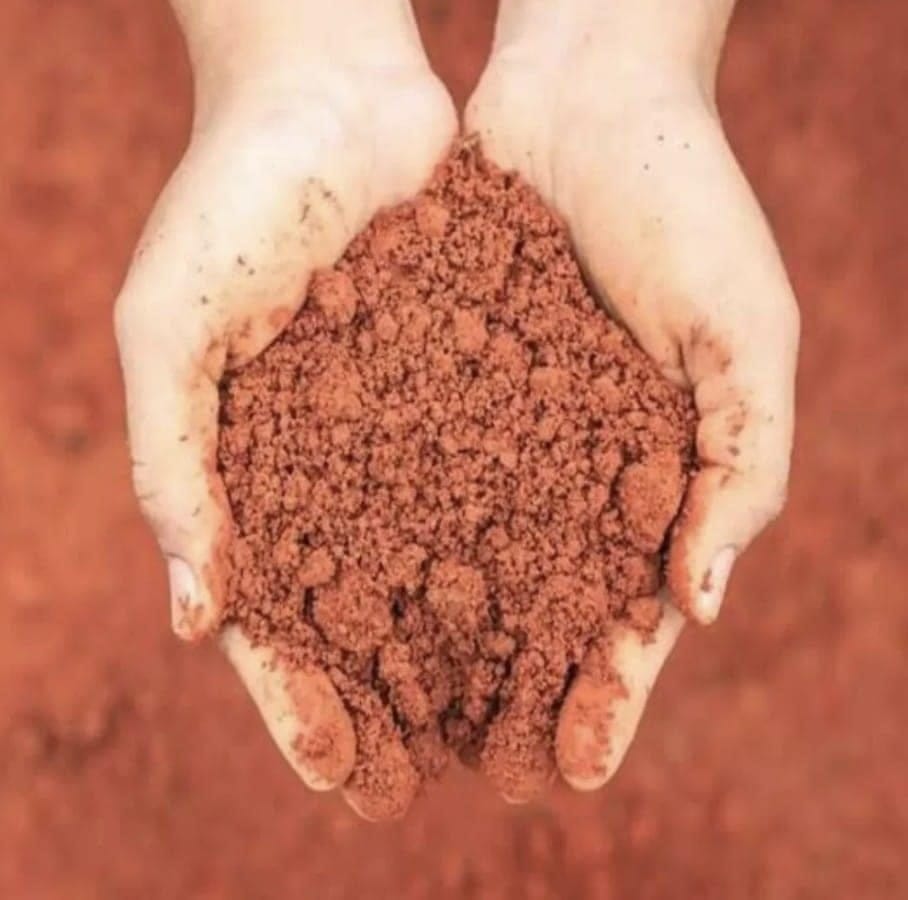 Red Soil
Q18: What happens to laterite soil in hot weather?
Ans: Laterite soil becomes hard in hot weather. It has a reddish colour because of iron and aluminium, and it is not very fertile.
Q19: What is crop rotation?
Ans: Crop rotation means growing different crops in the same field in different seasons. This helps prevent the soil from losing specific nutrients.
Q20: What is Panchagavya made from?
Ans: Panchagavya is made from a fermented mixture of five cow products: dung, urine, milk, curd, and ghee. It is used as a biofertiliser.
Q21: What is terracing in agriculture?
Ans: Terracing means creating flat steps in hilly areas to slow down water runoff. This method is used on hill slopes to prevent soil erosion.
Q22: How does drip irrigation work?
Ans: Drip irrigation delivers water slowly and directly to plant roots through tubes and emitters. This method uses water efficiently and saves resources.
Q23: What is Beejamrit used for?
Ans: Beejamrit is a paste made of cow dung and urine used to coat seeds before planting. It protects seeds and reduces germination time.
Q24: Who introduced the Green Revolution in India?
Ans: M.S. Swaminathan introduced the Green Revolution in India during the 1960s-1970s. It used high-yielding seeds, irrigation, chemical fertilisers, and mechanised equipment.
Q25: Which is the world's first 100% organic state?
Ans: Sikkim is the world's first 100% organic state. It banned chemical fertilisers and pesticides in 2014 to promote sustainable and organic farming practices.
FAQs on Very Short Answer Questions: The Story of Indian Farming
| 1. What are the main types of farming in India? |  |
| 2. How has the Green Revolution impacted Indian agriculture? | |
| 3. What role do monsoons play in Indian farming? | |
| 4. What are some challenges faced by Indian farmers? | |
| 5. How is organic farming different from conventional farming in India? | |





