Changes Across Life Stages


Human development is a continuous process of change that occurs from conception to death. Each life stage brings distinct physical, cognitive, emotional, and social transformations. Understanding these changes helps us comprehend human behavior and adaptability across different ages. This topic is crucial for understanding developmental milestones, challenges, and the factors influencing growth at each stage.
1. Prenatal Stage (Conception to Birth)
The prenatal stage is the period from conception to birth, lasting approximately 38-40 weeks. This stage involves rapid physical growth and development of all major body systems.
1.1 Three Phases of Prenatal Development
- Germinal Stage (0-2 weeks): Fertilized egg (zygote) travels to the uterus. Rapid cell division occurs. Implantation in the uterine wall happens around day 10-14.
- Embryonic Stage (3-8 weeks): Major organs and body systems begin to form. This is called organogenesis. The embryo is most vulnerable to harmful substances (teratogens) during this period. Heart begins to beat by week 4.
- Fetal Stage (9 weeks to birth): Rapid growth and refinement of organs. Sex organs become visible. Brain development accelerates. By 24-28 weeks, the fetus reaches age of viability (can potentially survive outside the womb with medical support).
1.2 Environmental Influences on Prenatal Development
- Teratogens: Environmental agents that can cause developmental abnormalities. Examples include alcohol, drugs, certain medications, infections (rubella, toxoplasmosis), and radiation.
- Maternal Nutrition: Adequate nutrition is essential for proper fetal growth. Deficiencies can lead to low birth weight and developmental delays.
- Maternal Stress: High stress levels can affect fetal development through hormonal changes.
- Critical Period: Specific time during development when an organism is most sensitive to environmental influences.
2. Infancy (Birth to 2 Years)
Infancy is marked by rapid physical growth, development of motor skills, and formation of first social attachments. Infants develop basic trust and begin exploring their environment.
2.1 Physical and Motor Development
- Cephalocaudal Principle: Development proceeds from head to tail. Head and upper body develop before lower body.
- Proximodistal Principle: Development proceeds from center of body outward. Control of trunk develops before arms and legs.
- Gross Motor Skills: Large muscle movements develop in sequence - sitting (6-7 months), crawling (8-10 months), standing (10-12 months), walking (12-15 months).
- Fine Motor Skills: Small muscle movements develop gradually. Grasping reflex present at birth. Pincer grasp (using thumb and forefinger) develops around 9-12 months.
- Brain Development: Brain grows rapidly, reaching 70% of adult weight by age 2. Synaptic pruning (elimination of unused neural connections) begins.
2.2 Cognitive Development
- Piaget's Sensorimotor Stage (0-2 years): Infants learn through sensory experiences and motor actions. Six sub-stages of increasing complexity occur.
- Object Permanence: Understanding that objects continue to exist even when out of sight. Develops around 8-12 months. Major cognitive milestone of infancy.
- Reflexes: Innate automatic responses present at birth. Examples include rooting reflex, sucking reflex, grasping reflex, Moro reflex.
- Imitation: Ability to copy actions begins early. Deferred imitation (copying actions seen earlier) develops around 18 months.
2.3 Social and Emotional Development
- Attachment: Strong emotional bond between infant and caregiver. Critical for emotional security and later relationships.
- Stranger Anxiety: Fear of unfamiliar people, typically emerging around 6-8 months.
- Separation Anxiety: Distress when separated from primary caregiver, peaks around 12-18 months.
- Temperament: Individual differences in emotional reactivity and self-regulation. Three basic types identified by Thomas and Chess: easy, difficult, slow-to-warm-up.
- Erikson's Stage - Trust vs. Mistrust: First psychosocial stage (0-1 year). Infants develop trust when caregivers provide reliable care and affection.
2.4 Language Development
- Cooing: Vowel-like sounds produced around 2-3 months.
- Babbling: Consonant-vowel combinations emerge around 6 months (e.g., "ba-ba-ba").
- First Words: Typically appear around 12 months. Usually concrete nouns (mama, dada).
- Holophrastic Speech: One-word utterances that convey complete thoughts (around 12-18 months).
- Two-Word Stage: Simple combinations of words emerge around 18-24 months (e.g., "more milk").
3. Early Childhood (2 to 6 Years)
Early childhood involves continued physical growth at a slower rate than infancy. Language abilities expand rapidly. Children develop self-awareness and engage in symbolic play.
3.1 Physical Development
- Growth Rate: Slower than infancy but steady. Children gain approximately 2-3 kg and grow 5-7 cm per year.
- Body Proportions: Head becomes proportionally smaller. Body lengthens and slims. Brain reaches 90% of adult weight by age 5.
- Motor Skills: Gross motor skills improve (running, jumping, climbing). Fine motor skills develop (drawing, using scissors, buttoning clothes).
- Myelination: Continued development of myelin sheath around neurons, improving neural efficiency.
3.2 Cognitive Development
- Piaget's Preoperational Stage (2-7 years): Children use symbols and language but lack logical operations. Thinking is intuitive rather than logical.
- Symbolic Function: Ability to use symbols, words, or objects to represent something else. Enables pretend play and language development.
- Egocentrism: Inability to take another person's perspective. Children assume others see, think, and feel as they do. Demonstrated by Piaget's three-mountains task.
- Centration: Focus on one aspect of a situation while ignoring others. Children cannot consider multiple dimensions simultaneously.
- Conservation: Understanding that quantity remains the same despite changes in appearance. Not achieved in preoperational stage. Tests include conservation of number, liquid, mass.
- Animism: Attribution of life-like qualities to inanimate objects (e.g., "The sun is happy today").
- Irreversibility: Inability to mentally reverse actions or operations.
3.3 Language Development
- Vocabulary Explosion: Rapid expansion of vocabulary, learning several new words daily. By age 6, children know approximately 10,000 words.
- Telegraphic Speech: Short, simple sentences containing only essential words (2-3 years).
- Grammar Development: Children begin using plural forms, past tense, and complex sentences. Some grammatical errors occur (e.g., "goed" instead of "went").
- Private Speech: Talking to oneself, which helps guide behavior and thinking. Decreases with age.
3.4 Social and Emotional Development
- Erikson's Stage - Autonomy vs. Shame and Doubt (1-3 years): Children develop sense of independence through exploration. Success leads to autonomy; excessive criticism leads to shame.
- Erikson's Stage - Initiative vs. Guilt (3-6 years): Children assert themselves through play and social interaction. Success leads to initiative; disapproval leads to guilt.
- Self-Concept: Awareness of self as separate entity develops. Children describe themselves in concrete, physical terms.
- Gender Identity: Recognition of being male or female develops around age 2-3. Gender constancy (understanding gender remains stable) achieved around 5-7 years.
- Play Types: Parallel play (playing alongside but not with others) dominates early years. Cooperative play increases with age.
- Emotional Regulation: Gradual improvement in managing and expressing emotions appropriately.
4. Middle Childhood (6 to 12 Years)
Middle childhood is characterized by steady physical growth, development of logical thinking abilities, and increased social interactions with peers. School becomes central to child's life.
4.1 Physical Development
- Growth Pattern: Slow, steady growth averaging 5-7 cm in height and 2-3 kg in weight annually.
- Motor Skills: Refinement of both gross and fine motor skills. Improved coordination enables participation in sports and complex activities.
- Brain Development: Continued myelination and synaptic pruning. Improved attention span and information processing.
- Loss of Primary Teeth: Begins around age 6-7, replaced by permanent teeth.
4.2 Cognitive Development
- Piaget's Concrete Operational Stage (7-11 years): Children develop logical thinking about concrete objects and events. Cannot yet handle abstract concepts.
- Conservation: Mastery of conservation tasks (number, mass, volume, liquid). Children understand quantity remains constant despite perceptual changes.
- Decentration: Ability to consider multiple aspects of a situation simultaneously. Overcomes centration of preoperational stage.
- Reversibility: Mental ability to reverse actions or operations (e.g., understanding 2 + 3 = 5 and 5 - 3 = 2).
- Seriation: Ability to arrange objects in logical sequence based on dimension (size, weight, etc.).
- Classification: Ability to organize objects into hierarchical categories and understand class inclusion.
- Limitations: Thinking remains concrete; difficulty with hypothetical or abstract reasoning.
4.3 Social and Emotional Development
- Erikson's Stage - Industry vs. Inferiority (6-12 years): Children develop competence in academic and social skills. Success leads to sense of industry; repeated failure leads to inferiority feelings.
- Self-Esteem: More realistic self-evaluation develops. Children compare themselves with peers.
- Peer Relationships: Friendships become increasingly important. Same-sex friendships dominate. Peer acceptance influences self-worth.
- Social Comparison: Children evaluate their abilities by comparing themselves with others.
- Moral Development: Understanding of rules and fairness develops. Kohlberg's conventional morality begins to emerge.
4.4 Language and Academic Skills
- Vocabulary: Continues expanding, reaching 40,000 words by end of middle childhood.
- Metalinguistic Awareness: Understanding of language as a system. Children can analyze and reflect on language.
- Reading and Writing: Development of literacy skills. Fluency improves with practice.
- Memory Strategies: Increased use of rehearsal, organization, and elaboration to remember information.
5. Adolescence (12 to 18 Years)
Adolescence is a transitional period between childhood and adulthood. It involves dramatic physical changes due to puberty, development of abstract thinking, and formation of identity.
5.1 Physical Development
- Puberty: Period of rapid physical maturation involving hormonal and bodily changes. Girls typically begin 1-2 years earlier than boys (ages 10-14 for girls; 12-16 for boys).
- Growth Spurt: Rapid increase in height and weight. Peak height velocity occurs around age 12 for girls, 14 for boys.
- Primary Sexual Characteristics: Development of reproductive organs. Girls: menarche (first menstruation). Boys: first ejaculation.
- Secondary Sexual Characteristics: Physical features not directly involved in reproduction. Examples: breast development, facial hair, voice deepening, body hair.
- Brain Development: Significant reorganization, especially in prefrontal cortex (responsible for planning, impulse control, decision-making). Limbic system (emotion processing) matures earlier than prefrontal cortex, explaining increased emotional reactivity.
- Early vs. Late Maturation: Timing of puberty affects psychological adjustment. Early-maturing girls and late-maturing boys may face more adjustment challenges.
5.2 Cognitive Development
- Piaget's Formal Operational Stage (11+ years): Development of abstract, hypothetical, and scientific thinking. Not all adolescents or adults consistently use formal operations.
- Abstract Thinking: Ability to think about concepts not tied to concrete reality (justice, love, freedom).
- Hypothetical-Deductive Reasoning: Ability to develop and test hypotheses systematically. Can consider "what if" scenarios.
- Metacognition: Thinking about thinking. Increased awareness of own thought processes.
- Adolescent Egocentrism: Heightened self-consciousness and belief that others are focused on them. Two components identified by David Elkind:
- Imaginary Audience: Belief that others are constantly watching and evaluating them.
- Personal Fable: Belief that one's experiences and feelings are unique and that one is invulnerable to harm.
5.3 Social and Emotional Development
- Erikson's Stage - Identity vs. Role Confusion (12-18 years): Adolescents explore different roles and ideas to develop sense of self. Success leads to strong identity; failure leads to role confusion.
- Identity Formation: Process of defining who one is, what one values, and life directions. James Marcia identified four identity statuses:
- Identity Diffusion: No exploration, no commitment. Lack of direction.
- Identity Foreclosure: Commitment without exploration. Accepting others' choices without questioning.
- Identity Moratorium: Active exploration without commitment. Period of searching.
- Identity Achievement: Exploration followed by commitment. Stable sense of self achieved.
- Peer Relationships: Extremely important. Peer groups provide support, identity, and belonging. Conformity to peer norms peaks in early adolescence.
- Parent-Child Relationships: Conflicts increase, particularly in early adolescence. Conflicts typically involve everyday matters, not core values. Gradual movement toward autonomy.
- Romantic Relationships: Dating and romantic interests emerge. Important for identity exploration and intimacy development.
- Risk-Taking Behavior: Increased due to brain development patterns (emotional system maturing before control system). Examples include substance use, reckless driving, unsafe sexual behavior.
5.4 Moral Development
- Kohlberg's Conventional Level: Most adolescents reason at this level. Stage 3 (Good interpersonal relationships): conforming to social expectations to gain approval. Stage 4 (Maintaining social order): following laws and rules to maintain social order.
- Kohlberg's Post-conventional Level: Some adolescents and adults reach this level. Moral reasoning based on universal ethical principles rather than social conventions.
6. Early Adulthood (18 to 40 Years)
Early adulthood involves peak physical performance, establishing intimate relationships, career development, and possibly starting a family. This is a period of exploration and establishment.
6.1 Physical Development
- Peak Physical Performance: Individuals reach peak strength, coordination, and reaction time in twenties. Athletes typically perform best during this period.
- Sensory Abilities: Vision, hearing, and other senses function optimally in early twenties.
- Health: Generally excellent health. Risk-taking behaviors decline compared to adolescence.
- Lifestyle Factors: Health behaviors established during this period (diet, exercise, substance use) affect later life.
6.2 Cognitive Development
- Post-formal Thought: Some researchers identify stage beyond Piaget's formal operations. Characteristics include recognition that multiple perspectives can be valid, integration of logic with emotion, acceptance of contradiction and ambiguity.
- Cognitive Skills: Peak performance in information processing, problem-solving, and memory.
- Expertise Development: Knowledge in specific domains increases through education and experience.
6.3 Social and Emotional Development
- Erikson's Stage - Intimacy vs. Isolation (18-40 years): Young adults form close, committed relationships. Success leads to intimacy; failure leads to isolation and loneliness.
- Levinson's Theory: Identified life structure development during early adulthood. Includes periods of stability and transition. Key tasks: forming dream (vision for future), finding mentor, developing career, establishing intimate relationships.
- Mate Selection: Process of choosing life partner. Influenced by similarity (homogamy), physical attraction, proximity, and reciprocal liking.
- Marriage and Partnerships: Many form long-term committed relationships. Requires adjustment, communication, and compromise.
- Parenthood: Transition to parenthood brings significant life changes, stress, and satisfaction. Affects couple relationship and individual identity.
- Career Development: Establishing career identity, gaining skills, and advancing professionally. Career choice influenced by interests, abilities, values, and opportunities.
- Friendship: Friendships remain important but may decline in quantity as romantic relationships and careers take priority.
7. Middle Adulthood (40 to 65 Years)
Middle adulthood involves gradual physical decline, peak productivity in career, possible reassessment of life goals, and changing family relationships as children grow independent.
7.1 Physical Development
- Gradual Physical Decline: Noticeable but gradual changes in physical abilities. Reaction time slows slightly. Muscle strength decreases unless maintained through exercise.
- Sensory Changes: Vision changes (presbyopia - difficulty focusing on near objects) common after 40. Hearing loss (presbycusis) begins, especially for high-frequency sounds.
- Appearance Changes: Hair graying and thinning. Skin becomes less elastic, wrinkles appear. Weight gain common due to slower metabolism.
- Menopause: Cessation of menstruation in women, typically between 45-55 years. Caused by decline in estrogen production. May involve physical symptoms (hot flashes) and mood changes. Individual variation in experience.
- Male Climacteric: Gradual decline in testosterone levels in men. Less dramatic than menopause. May involve decreased sexual drive and energy.
- Health Concerns: Increased risk of chronic diseases (hypertension, diabetes, heart disease). Importance of preventive health behaviors increases.
7.2 Cognitive Development
- Fluid Intelligence: Ability to reason quickly and think abstractly. Shows gradual decline from peak in twenties.
- Crystallized Intelligence: Accumulated knowledge and skills. Continues to increase or remain stable through middle adulthood.
- Practical Problem-Solving: Often improves due to accumulated experience and expertise.
- Memory: Minor declines in some areas (working memory, processing speed). Expertise and experience often compensate.
- Creativity: Can remain high, though may shift in form. Quality over quantity in creative output.
7.3 Social and Emotional Development
- Erikson's Stage - Generativity vs. Stagnation (40-65 years): Adults contribute to society and help guide next generation through parenting, teaching, mentoring. Success leads to generativity; failure leads to stagnation and self-absorption.
- Midlife Crisis: Popularized but not universal experience. Some adults experience period of questioning and reassessment. Research suggests most adults experience gradual transitions rather than crisis.
- Work and Career: Often peak productivity and leadership. Career satisfaction may increase due to expertise and autonomy. Some experience career plateau or burnout.
- Family Relationships: Empty nest (children leaving home) brings mixed emotions. Marital satisfaction often increases after children leave. Increased responsibility for aging parents (sandwich generation).
- Grandparenthood: New role providing satisfaction and opportunities for generativity without daily responsibilities.
8. Late Adulthood (65+ Years)
Late adulthood involves continued physical and cognitive changes, retirement from work, adjustment to aging, and reflection on life. This stage shows high individual variation in health and functioning.
8.1 Physical Development
- Physical Decline: More pronounced changes in physical abilities. Strength, stamina, and balance decline. Reaction time slows further.
- Sensory Changes: Vision problems increase (cataracts, glaucoma, macular degeneration). Hearing loss becomes more common and severe. Taste and smell sensitivity decrease.
- Brain Changes: Brain weight decreases slightly. Some loss of neurons. Slowed neural processing. However, brain shows plasticity and can form new connections.
- Health Issues: Increased prevalence of chronic diseases (arthritis, osteoporosis, cardiovascular disease, diabetes). Immune system weakens.
- Sleep Patterns: Changes in sleep architecture. Less deep sleep, more frequent waking. Earlier sleep and wake times.
- Life Expectancy: Has increased significantly. Individual variation based on genetics, lifestyle, healthcare access.
8.2 Cognitive Development
- Processing Speed: Declines with age, affecting performance on timed tasks.
- Memory Changes: Working memory shows decline. Long-term memory for recent events (episodic memory) may decline, but memory for general knowledge (semantic memory) remains relatively stable. Procedural memory (skills) well-preserved.
- Wisdom: Expert knowledge about practical aspects of life. Involves good judgment and advice about complex life problems. May increase with age and experience.
- Cognitive Variability: Large individual differences. Some show minimal decline, others significant impairment.
- Dementia: Severe cognitive impairment interfering with daily functioning. Not normal part of aging. Alzheimer's disease most common form. Characterized by memory loss, confusion, personality changes.
- Cognitive Reserve: Brain's resilience to damage. Built through education, mentally stimulating activities, social engagement.
8.3 Social and Emotional Development
- Erikson's Stage - Ego Integrity vs. Despair (65+ years): Reflection on life. Success involves accepting one's life as meaningful; failure leads to regret and despair.
- Retirement: Major life transition. Can bring relief, leisure, and new opportunities, or loss of identity and purpose. Adjustment depends on health, finances, preparation, and attitudes.
- Social Relationships: Quality becomes more important than quantity. Social networks typically smaller but more meaningful. Close relationships provide emotional support.
- Marriage: Marital satisfaction often high in late adulthood. Long-term couples develop routines and deep understanding.
- Widowhood: Loss of spouse common, especially for women. Grief process involves psychological adjustment. Social support crucial for coping.
- Life Review: Process of reflecting on and evaluating one's life. Can promote ego integrity and acceptance.
- Successful Aging: Maintaining physical health, cognitive functioning, and social engagement. Selective optimization with compensation (focusing energy on important activities, finding new ways to accomplish goals).
- Well-being: Despite declines, many older adults report high life satisfaction. Positivity effect: tendency to focus more on positive information and memories than negative.
8.4 Theories of Aging
- Activity Theory: Maintaining active engagement in life leads to successful aging. Replacing lost roles with new activities promotes well-being.
- Disengagement Theory: Natural and mutual withdrawal between aging persons and society. Controversial theory suggesting withdrawal is normal and adaptive.
- Socioemotional Selectivity Theory: Older adults become more selective about social partners, prioritizing emotionally meaningful relationships. Time perspective shifts from future-oriented to present-oriented.
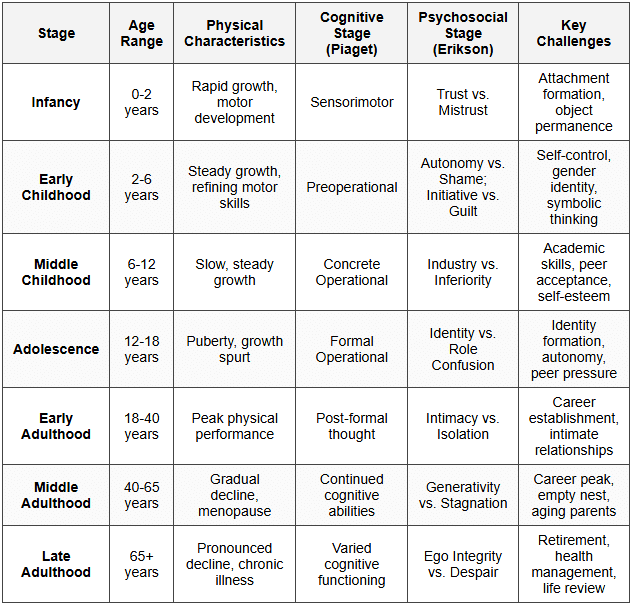
9. Comparison of Developmental Stages
10. Factors Influencing Development Across Life Stages
10.1 Biological Factors
- Genetics: Inherited characteristics influence physical features, temperament, intelligence, and susceptibility to certain conditions.
- Maturation: Biologically programmed sequence of growth and development. Example: walking emerges when nervous system and muscles mature sufficiently.
- Brain Development: Neural growth, myelination, and synaptic pruning shape cognitive and behavioral capabilities across lifespan.
- Hormones: Influence growth, sexual development, mood, and behavior throughout life.
10.2 Environmental Factors
- Family: First and most influential environment. Parenting styles, attachment quality, family structure affect development.
- Peers: Increasingly important with age. Influence social skills, self-concept, behaviors, especially during adolescence.
- Culture: Shapes values, beliefs, practices, developmental expectations and timing. Collectivist vs. individualist cultures emphasize different developmental goals.
- Socioeconomic Status (SES): Affects access to resources, education, healthcare, nutrition. Impacts developmental outcomes across all domains.
- Education: Formal schooling shapes cognitive development, knowledge acquisition, social skills, career opportunities.
- Nutrition: Adequate nutrition essential for physical and cognitive development, especially during periods of rapid growth.
10.3 Life Events
- Normative Age-Graded Events: Experiences common to most people at particular ages (starting school, puberty, retirement).
- Normative History-Graded Events: Historical events affecting entire cohorts (wars, economic depression, pandemics).
- Non-normative Events: Unique events that don't happen to most people or don't occur at predictable times (serious illness, winning lottery, unexpected loss).
Understanding changes across life stages helps us recognize that development is continuous, multidimensional, and influenced by multiple factors. Each stage builds upon previous ones while presenting unique challenges and opportunities for growth. Individual variation is significant at every stage, reminding us that developmental patterns represent general trends rather than fixed rules. This knowledge is valuable for understanding ourselves, supporting others at different life stages, and anticipating future developmental transitions.