How Meditation Helps the Mind and Brain


Meditation is a mental training practice that significantly influences both the mind and brain. It works by systematically training attention, awareness, and emotional regulation. Scientific research shows that regular meditation creates measurable changes in brain structure and function. Understanding these mechanisms helps students appreciate why meditation is a powerful tool for academic success and overall well-being.
1. How Meditation Improves Attention
Attention is the ability to focus mental resources on specific information while ignoring distractions. Meditation directly strengthens this capacity through systematic practice.
1.1 Types of Attention Enhanced by Meditation
- Sustained Attention: The ability to maintain focus on a single task or object for extended periods. Meditation trains this by keeping focus on breath or mantra.
- Selective Attention: The capacity to focus on relevant information while filtering out distractions. Regular practice strengthens the mental "filter" against irrelevant stimuli.
- Divided Attention: The skill to manage multiple tasks simultaneously. Meditation improves cognitive flexibility, making task-switching more efficient.
- Attention Span: The duration one can concentrate without mental wandering. Studies show meditation increases span by reducing mind-wandering frequency.
1.2 Brain Mechanisms Behind Improved Attention
- Prefrontal Cortex Activation: This brain region controls executive functions including attention control. Meditation increases activity and grey matter density in this area.
- Default Mode Network (DMN) Regulation: The DMN is active during mind-wandering and self-referential thinking. Meditation reduces excessive DMN activity, decreasing mental distraction.
- Anterior Cingulate Cortex (ACC) Enhancement: The ACC monitors conflicts and errors. Meditation strengthens this region, improving focus maintenance and error detection.
- Parietal Lobe Changes: This region processes sensory information and spatial attention. Regular practice increases grey matter concentration here, enhancing attentional capacity.
1.3 Practical Benefits for Students
- Reduced Mind-Wandering: Students can stay focused during lectures and study sessions without frequent mental drift.
- Better Information Retention: Enhanced attention during learning leads to stronger memory encoding and recall.
- Improved Reading Comprehension: Sustained attention allows deeper engagement with complex texts and academic materials.
- Faster Task Completion: Reduced distraction means more efficient completion of assignments and homework.
1.4 Common Mistakes About Attention Training
Trap Alert: Many students believe meditation means "emptying the mind completely." This is incorrect. Meditation trains attention by noticing when the mind wanders and gently bringing focus back. The practice is in the returning, not in perfect stillness.
2. How Meditation Enhances Emotional Balance
Emotional balance refers to the ability to experience emotions without being overwhelmed or controlled by them. Meditation develops this capacity through awareness and regulation training.
2.1 Key Components of Emotional Balance
- Emotional Awareness: Recognizing and identifying emotions as they arise. Meditation develops the skill to observe feelings without immediate reaction.
- Emotional Regulation: Managing emotional responses appropriately. Regular practice strengthens the ability to respond rather than react impulsively.
- Emotional Resilience: Recovering quickly from stress or setbacks. Meditation builds mental flexibility to adapt to challenging situations.
- Reduced Emotional Reactivity: Decreased tendency to overreact to negative stimuli. Practice creates a "pause" between stimulus and response.
2.2 Brain Changes Supporting Emotional Balance
- Amygdala Modification: The amygdala processes fear and emotional responses. Meditation reduces amygdala volume and reactivity, decreasing anxiety and stress responses.
- Hippocampus Growth: This region regulates emotions and memory. Meditation increases grey matter density here, improving emotional processing and stress management.
- Prefrontal-Amygdala Connection: The prefrontal cortex regulates the amygdala. Meditation strengthens this connection, enhancing top-down emotional control.
- Insula Enhancement: The insula processes internal body sensations and emotions. Practice increases activity here, improving emotional awareness and empathy.
2.3 Stress Response Regulation
- Cortisol Reduction: Cortisol is the primary stress hormone. Regular meditation lowers baseline cortisol levels, reducing chronic stress impact.
- Parasympathetic Activation: The parasympathetic nervous system promotes relaxation. Meditation activates this "rest and digest" system, countering stress responses.
- HPA Axis Balance: The Hypothalamic-Pituitary-Adrenal axis controls stress response. Meditation normalizes this system, preventing stress overactivation.
- Inflammatory Marker Decrease: Chronic stress causes inflammation. Practice reduces inflammatory markers, protecting physical and mental health.
2.4 Practical Emotional Benefits for Students
- Exam Anxiety Management: Better emotional regulation reduces test anxiety and performance pressure.
- Conflict Resolution: Reduced reactivity helps students handle peer conflicts and disagreements calmly.
- Disappointment Coping: Emotional resilience helps students bounce back from poor grades or setbacks.
- Social Confidence: Balanced emotions reduce social anxiety and improve interpersonal interactions.
2.5 Common Mistakes About Emotional Balance
Trap Alert: Students often think meditation means "never feeling negative emotions." This is false. Emotional balance means experiencing all emotions appropriately without being controlled by them. Meditation teaches healthy processing, not emotional suppression.
3. How Meditation Improves Mental Clarity
Mental clarity is the state of clear, organized thinking without confusion or mental fog. Meditation enhances this through multiple cognitive and neurological pathways.
3.1 Components of Mental Clarity
- Clear Thinking: The ability to think logically without mental confusion. Meditation reduces cognitive noise and intrusive thoughts.
- Decision-Making Ability: Making choices efficiently without excessive rumination. Practice improves executive function and cognitive control.
- Mental Organization: Structuring thoughts and information systematically. Regular meditation enhances working memory and information processing.
- Cognitive Flexibility: Adapting thinking strategies to different situations. Meditation develops the ability to shift perspectives easily.
3.2 Brain Mechanisms for Enhanced Clarity
- Working Memory Enhancement: Working memory holds information temporarily for processing. Meditation increases capacity, allowing better manipulation of information.
- Theta Wave Increase: Theta brain waves (4-8 Hz) are associated with deep relaxation and clarity. Meditation increases theta activity during practice and rest.
- Alpha Wave Enhancement: Alpha waves (8-12 Hz) indicate relaxed alertness. Practice strengthens alpha activity, promoting calm focus and mental clarity.
- Neural Pruning: The brain eliminates unnecessary neural connections. Meditation may support efficient pruning, streamlining cognitive processing.
3.3 Cognitive Benefits Observed in Research
- Processing Speed Improvement: Regular practitioners show faster information processing and cognitive task completion.
- Metacognition Enhancement: Metacognition means "thinking about thinking." Meditation improves awareness of one's own thought processes.
- Reduced Mental Clutter: Practice decreases intrusive thoughts and mental chatter, creating psychological space for clear thinking.
- Improved Problem-Solving: Enhanced clarity supports creative and analytical problem-solving abilities.
3.4 Neuroplasticity and Brain Structure Changes
Neuroplasticity is the brain's ability to reorganize and form new neural connections. Meditation harnesses this capacity for positive change.
- Grey Matter Increase: Grey matter contains neuron cell bodies. Studies show meditation increases grey matter in regions controlling attention, emotion, and memory.
- White Matter Integrity: White matter connects brain regions. Practice improves white matter quality, enhancing communication between brain areas.
- Cortical Thickness: The cortex is the brain's outer layer. Meditation increases cortical thickness in attention and sensory processing areas.
- Hippocampal Volume: Long-term meditation practice increases hippocampal volume, supporting memory and learning capacity.
3.5 Mental Clarity Benefits for Academic Performance
- Better Comprehension: Clear thinking improves understanding of complex concepts and academic materials.
- Enhanced Creativity: Mental clarity creates space for creative insights and innovative problem-solving.
- Efficient Study Sessions: Organized thinking leads to more productive and focused study time.
- Reduced Mental Fatigue: Regular practice decreases cognitive exhaustion during intensive academic work.
3.6 Common Mistakes About Mental Clarity
Trap Alert: Students sometimes expect immediate, dramatic clarity after one session. Mental clarity develops gradually with consistent practice. Initial sessions may actually reveal how cluttered the mind normally is-this awareness itself is the first step toward clarity.
4. Neurotransmitter Changes Through Meditation
Neurotransmitters are chemical messengers that transmit signals between neurons. Meditation influences several key neurotransmitters affecting mood, attention, and cognition.
4.1 Key Neurotransmitter Modifications
- Serotonin Increase: Serotonin regulates mood, sleep, and appetite. Meditation raises serotonin levels, improving mood stability and reducing depression risk.
- GABA Enhancement: Gamma-Aminobutyric Acid (GABA) is an inhibitory neurotransmitter reducing neural excitability. Practice increases GABA, promoting calmness and reducing anxiety.
- Dopamine Regulation: Dopamine affects motivation and reward processing. Meditation normalizes dopamine function, supporting healthy motivation and pleasure experience.
- Norepinephrine Balance: Norepinephrine affects alertness and arousal. Practice optimizes levels, improving attention without overstimulation.
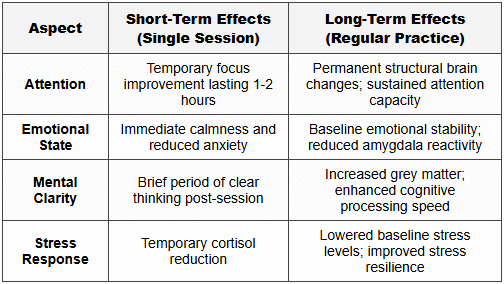
4.2 Long-Term vs Short-Term Effects
5. Optimal Conditions for Brain Benefits
Certain practices and conditions maximize meditation's impact on the mind and brain.
5.1 Practice Duration and Frequency
- Minimum Effective Dose: Research shows 10-15 minutes daily produces measurable benefits within 8 weeks.
- Optimal Duration: 20-30 minutes daily provides robust attention, emotional, and clarity improvements.
- Consistency Over Intensity: Daily brief practice is more effective than occasional long sessions for brain changes.
- Progressive Increase: Starting with 5-10 minutes and gradually increasing duration prevents overwhelm and builds sustainable habits.
5.2 Types of Meditation for Specific Benefits
- Focused Attention Meditation: Concentrating on a single object (breath, mantra) primarily enhances attention and concentration abilities.
- Open Monitoring Meditation: Observing thoughts without attachment mainly improves emotional regulation and mental clarity.
- Loving-Kindness Meditation: Cultivating compassion specifically enhances positive emotions and social connection.
- Body Scan Meditation: Systematic attention to body sensations particularly improves mind-body awareness and stress reduction.
5.3 Critical Success Factors
- Regular Practice Schedule: Same time daily strengthens habit formation and maximizes neuroplastic changes.
- Quiet Environment: Minimal distractions support attention training, especially for beginners.
- Comfortable Posture: Stable, alert posture (sitting, not lying) maintains wakefulness while promoting relaxation.
- Patient Attitude: Non-judgmental approach to practice prevents frustration and supports consistent engagement.
6. Time Course of Benefits
Understanding when different benefits appear helps set realistic expectations and maintain motivation.
6.1 Timeline of Observable Changes
- Week 1-2: Immediate post-session calmness; slight improvement in stress reactivity; increased awareness of thought patterns.
- Week 3-4: Noticeable attention span increase; reduced mind-wandering during tasks; improved sleep quality.
- Week 5-8: Measurable emotional regulation improvement; decreased anxiety levels; enhanced mental clarity during complex tasks.
- 3-6 Months: Structural brain changes visible on imaging; significant stress resilience; stable mood improvements.
- 6+ Months: Deep cognitive changes; sustained attention mastery; profound emotional balance; permanent neuroplastic modifications.
6.2 Individual Variation Factors
- Baseline Stress Levels: Individuals with higher initial stress may notice emotional benefits faster.
- Practice Quality: Engaged, focused practice produces faster results than distracted sessions.
- Age Considerations: Younger brains show faster neuroplastic changes; students particularly benefit from practice.
- Prior Experience: Those with previous meditation experience progress more rapidly in depth and stability.
Meditation creates profound, scientifically verified changes in brain structure and function. It enhances attention through prefrontal cortex strengthening and DMN regulation. It improves emotional balance by modifying the amygdala and stress response systems. It develops mental clarity through increased grey matter, enhanced working memory, and optimized neurotransmitter function. For students, these benefits translate directly into better academic performance, reduced stress, and improved overall well-being. The key is consistent, daily practice-even brief sessions accumulate significant effects over time through the brain's remarkable capacity for neuroplasticity.




