Creating a Daily Meditation Routine


Daily meditation is a powerful mental training technique that helps students manage exam stress, improve focus, and enhance memory retention. Building a consistent meditation habit requires understanding practical routines that fit into a student's busy schedule. This note focuses on designing realistic 5-minute and 10-minute meditation routines that can be practiced every day without disrupting study plans. These short, structured sessions help develop consistency over intensity, which is the key to long-term habit formation.
1. Foundation Principles for Daily Meditation Routines
Before designing specific routines, students must understand core principles that make meditation sustainable and effective.
1.1 The Consistency-Over-Duration Rule
- Daily practice for 5 minutes is more beneficial than occasional 30-minute sessions
- The brain forms neural pathways through repetition, not through long single sessions
- Students should aim for same time, same place practice to trigger automatic habit formation
- Missing one day should not lead to abandoning the routine completely
1.2 Optimal Timing for Student Schedules
- Early morning (5-6 AM): Before study sessions begin; mind is fresh and calm
- Post-lunch (1-2 PM): Reduces afternoon drowsiness; improves focus for second study session
- Pre-sleep (9-10 PM): Helps process the day's learning; improves sleep quality
- Avoid meditating immediately after heavy meals or when extremely sleepy
1.3 Essential Setup Requirements
- Quiet space: Not necessarily silent, but free from sudden disruptions
- Comfortable seating: Chair with back support or cushion on floor; spine should be upright
- Timer device: Phone with airplane mode or simple alarm clock to track duration
- Minimal props: No incense, music, or special equipment needed for basic practice
1.4 Common Student Mistakes to Avoid
- Trap Alert: Students often think meditation means "emptying the mind completely." This is incorrect. Meditation is about noticing thoughts without engaging with them, not eliminating thoughts entirely
- Perfection trap: Waiting for the "perfect time" or "right mood" prevents habit formation
- Duration pressure: Starting with 20-30 minute sessions leads to quick burnout
- Posture obsession: Forcing uncomfortable cross-legged positions creates pain distractions
2. The 5-Minute Basic Meditation Routine
This routine is designed for absolute beginners and students with extremely tight schedules. It focuses on breath awareness meditation, the most researched and accessible technique.
2.1 Structure Breakdown (Total: 5 Minutes)
Minute 1 - Settling Phase:
- Sit in chosen position with straight spine
- Close eyes gently or keep half-open with soft gaze downward
- Take 3 deep breaths: Inhale for 4 counts, exhale for 6 counts
- Place hands on knees or lap in comfortable position
Minutes 2-4 - Core Practice Phase:
- Shift attention to natural breathing without controlling it
- Notice the sensation at nostrils (air moving in/out) or abdomen (rising/falling)
- When mind wanders to thoughts, exams, or worries: Notice without judgment
- Gently return attention to breath sensation; this "returning" is the actual practice
- Count breaths if helpful: 1 (inhale-exhale), 2 (inhale-exhale), up to 10, then restart
Minute 5 - Closing Phase:
- Take 2 deep breaths consciously
- Slowly open eyes if closed
- Move fingers and toes gently before standing up
- Mentally note: "Session complete" to create closure
2.2 Technique Variations for 5-Minute Practice
Body Scan Variant:
- Minutes 1-2: Focus attention on top of head, notice any sensations
- Minutes 3-4: Move attention down through face, neck, shoulders, arms
- Minute 5: Bring awareness to chest and abdomen area
Anchor Word Variant:
- Choose a calming word: "Calm," "Peace," "Focus," or "Steady"
- Repeat silently with each exhale throughout 5 minutes
- When distracted, return to word repetition
2.3 Progress Tracking for 5-Minute Routine
- Use simple calendar marking: ✓ for completed days, X for missed days
- Track consistency percentage: (Days practiced ÷ Total days) × 100
- Target: 80% consistency over 21 days to form initial habit
- Do not track "quality" or "how good the session felt" in first month
3. The 10-Minute Intermediate Meditation Routine
This routine is for students who have practiced 5-minute sessions for at least 2-3 weeks consistently. It introduces structured phases and deeper concentration techniques.
3.1 Structure Breakdown (Total: 10 Minutes)
Minutes 1-2 - Preparation and Grounding:
- Settle into position with awareness of body contact points
- Notice sounds in environment without labeling them
- Take 5 deep breaths using 4-7-8 technique: Inhale 4 counts, hold 7 counts, exhale 8 counts
- Set mental intention: "I practice to develop focus" or similar
Minutes 3-7 - Core Concentration Phase:
- Use counting meditation for deeper focus:
- Count "1" on inhale, "2" on exhale, "3" on next inhale, "4" on exhale
- Continue counting up to 10, then restart from 1
- If you lose count or reach beyond 10, restart from 1 without frustration
- Alternative: Focus on complete breath cycle - notice beginning, middle, end of each inhale and exhale
Minutes 8-9 - Open Awareness Phase:
- Stop counting; allow breathing to be completely natural
- Expand awareness to include body sensations, sounds, thoughts
- Practice non-reactive observation: Notice everything without engaging
- Maintain alert but relaxed mental state
Minute 10 - Integration and Closing:
- Take 3 deep, conscious breaths
- Mentally acknowledge the practice: "I practiced mindful awareness"
- Gradually open eyes; sit for 10-15 seconds before standing
- Carry calm state into next activity consciously
3.2 Advanced Techniques for 10-Minute Practice
Noting Technique:
- Mentally label experiences: "Thinking," "Hearing," "Feeling," "Planning"
- Use one-word labels softly; avoid analysis
- Return to breath after noting
- Develops meta-awareness - awareness of what mind is doing
Loving-Kindness Variant (Metta):
- Minutes 1-3: Generate feeling of warmth towards yourself; repeat "May I be calm, may I be focused"
- Minutes 4-6: Extend feeling towards a supportive person (parent, friend, teacher)
- Minutes 7-9: Extend towards all students preparing for exams
- Minute 10: Rest in the generated positive emotional state
Visualization Technique:
- Minutes 1-3: Establish breath awareness
- Minutes 4-8: Visualize calm study environment; see yourself studying with complete focus
- Imagine turning pages, understanding concepts clearly, feeling confident
- Minutes 9-10: Release visualization; return to breath
3.3 Common Challenges in 10-Minute Practice
Trap Alert - The Drowsiness Problem:
- If falling asleep during practice, meditation position is too comfortable
- Solution: Sit on chair with feet flat on floor, no back support, eyes half-open
- Practice at time when naturally alert (not pre-sleep)
- Splash cold water on face before session
Trap Alert - The Restlessness Trap:
- Students often experience increased restlessness around minutes 5-7
- This is normal; the mind resists unfamiliar sustained attention
- Solution: Acknowledge restlessness: "This is restlessness," then return to breath
- Do not change position unless physical pain occurs
4. Building the Daily Habit System
Designing the routine is only half the process. Implementation requires understanding habit formation science.
4.1 The Habit Stacking Method
- Link meditation to existing strong habit: "After brushing teeth, I meditate 5 minutes"
- Formula: After [EXISTING HABIT], I will [MEDITATE]
- Examples for students: After morning tea, after reaching study table, before opening first book
- The existing habit serves as automatic trigger for meditation
4.2 The Two-Day Rule
- Students can miss one day without breaking habit chain
- Never miss two consecutive days - this breaks momentum completely
- If day 1 is missed, day 2 becomes mandatory even if for just 2 minutes
- Better to practice poorly than to skip entirely
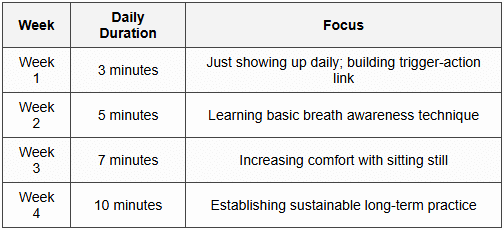
4.3 Progressive Duration Schedule
For complete beginners, use this 4-week buildup plan:
4.4 Environmental Design for Consistency
- Visual cue: Place meditation cushion or chair in visible location
- Reduce friction: Keep timer/phone ready at meditation spot
- Accountability: Mark calendar immediately after session, not before
- Social commitment: Inform one person about meditation goal for external accountability
4.5 Dealing with Motivation Fluctuation
Trap Alert - Motivation is Unreliable:
- Students wait to "feel motivated" to meditate - this approach fails
- Key principle: Action creates motivation, not the reverse
- Use 2-minute rule: Commit to sitting for only 2 minutes; usually continue longer once started
- Remember: The goal is habit formation, not perfect meditation experiences
5. Troubleshooting Common Student Barriers
5.1 "I Don't Have Time" Barrier
- Reality check: 5 minutes = 0.35% of waking day (assuming 16 waking hours)
- Time audit: Track phone usage for one day; most students have 60+ minutes on social media
- Solution: Replace 5 minutes of scrolling with meditation
- Use waiting time: Before online class starts, during tea break
5.2 "My Mind Won't Stop Thinking" Barrier
- Misconception correction: Meditation is not about stopping thoughts
- Actual goal: Noticing thoughts and returning to focus object (breath)
- More thoughts = More opportunities to practice returning attention
- Trap Alert: Students judge themselves for thinking; this judgment itself is another thought to notice
5.3 "I Feel More Anxious During Meditation" Barrier
- Explanation: Meditation increases awareness; students notice existing anxiety they usually distract from
- This is temporary phase lasting 1-2 weeks for most students
- Solution: Switch to active meditation: Walking slowly while counting steps, mindful hand movements
- Keep eyes open during practice if closed eyes increase anxiety
5.4 "I Keep Forgetting to Practice" Barrier
- Habit has not been anchored to strong trigger
- Implementation intention formula: "When situation X arises, I will perform response Y"
- Example: "When alarm rings at 6 AM, I will sit on my meditation cushion before checking phone"
- Use phone reminders for first 21 days only; external reminders prevent internal habit formation
6. Measuring Progress and Outcomes
6.1 Practice Metrics (What to Track)
- Consistency rate: Number of days practiced per week
- Streak count: Maximum consecutive days without missing
- Total practice time: Accumulated minutes per month
- Do not track: "Quality of session," "Depth of calm," "Number of thoughts" - these are unmeasurable and demotivating
6.2 Indirect Benefits to Notice
After 3-4 weeks of consistent practice, students typically observe:
- Academic benefits: Improved concentration span during study; faster return to focus after distraction
- Emotional regulation: Longer gap between trigger and reaction to stress; less exam anxiety
- Sleep quality: Faster sleep onset; more restful sleep cycles
- Self-awareness: Earlier recognition of stress, fatigue, or overwhelm states
6.3 Realistic Timeline Expectations
- Week 1-2: Focus on consistency only; minimal noticeable benefits
- Week 3-4: Habit becomes easier; slight improvement in focus during study
- Week 5-8: Clear stress reduction; better emotional balance during exam preparation
- Week 9-12: Meditation feels natural; sustained attention improves significantly
- Trap Alert: Students expect dramatic benefits in first week; unrealistic expectations lead to quitting
7. Sample Weekly Practice Schedules
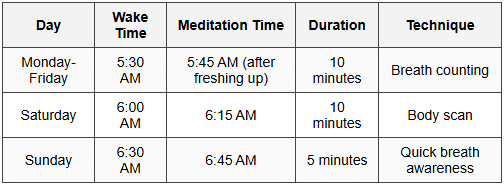
7.1 Schedule for Early Morning Students
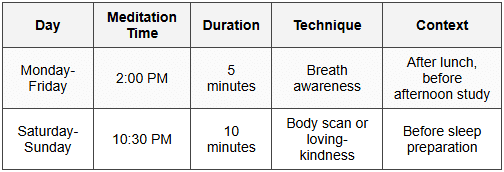
7.2 Schedule for Late-Night Study Students
7.3 Emergency Backup Routine
For extremely busy exam days when even 5 minutes seems impossible:
- 2-Minute Breathing Reset: Sit anywhere; take 10 conscious deep breaths; count each exhale
- Can be done: Between subjects, in bathroom break, before entering exam hall
- Purpose: Maintains habit chain even on impossible days
- Use maximum 2-3 times per month only; not meant as regular practice
8. Integration with Study Routine
8.1 Pre-Study Meditation Protocol
- Practice 5-minute breath awareness before starting study session
- Benefit: Clears mental clutter from previous activities; establishes focused state
- Sets clear boundary between leisure time and study time
- Students report 20-30% faster achievement of "study flow state"
8.2 Mid-Study Reset Technique
- After 2 hours of continuous study: 3-minute breath awareness with eyes closed
- Helps prevent mental fatigue accumulation
- More effective than social media breaks for mental refreshment
- Return to study with renewed concentration capacity
8.3 Post-Study Integration Practice
- 5-minute body scan after completing study session
- Purpose: Releases accumulated physical tension from sitting; creates closure
- Helps brain transition to rest mode; improves information consolidation during sleep
- Particularly useful after intensive problem-solving or memorization sessions
Building a daily meditation routine requires understanding that consistency matters more than duration, especially for students with demanding exam schedules. The 5-minute and 10-minute routines provided are scientifically structured to be realistic and sustainable. Success depends on treating meditation as a non-negotiable daily commitment like brushing teeth, using habit stacking techniques, and measuring only consistency rather than experience quality. Students should expect gradual benefits over 3-4 weeks rather than immediate dramatic changes. The key is starting with minimal time investment, anchoring practice to existing habits, and never missing two consecutive days. With systematic implementation, daily meditation becomes an automatic routine that significantly enhances focus, stress management, and overall exam performance.




