Naming Words (Nouns)


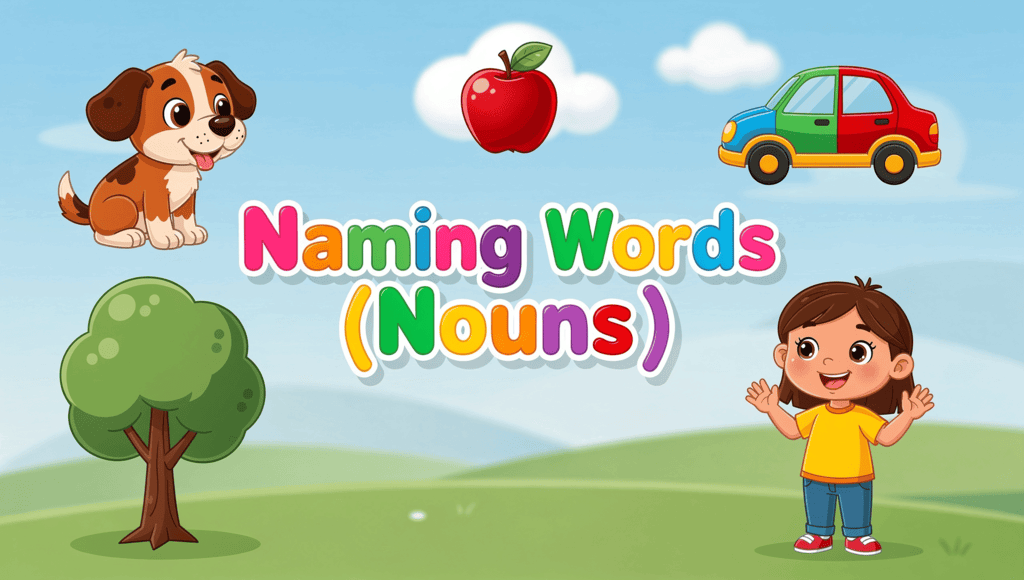
Naming words are called Nouns. A noun is a word that names a person, place, animal, or thing. Nouns help us identify and talk about everything around us. Learning nouns is the first step to building strong vocabulary and speaking clearly.
1. What are Nouns?
A Noun is a naming word. It gives a name to people, places, animals, and things we see or think about.
- Definition: A noun is a word used to name a person, place, animal, or thing.
- Purpose: Nouns help us talk about the world around us. Without nouns, we cannot name anything.
- Examples: Dog, school, teacher, book are all nouns.
2. Types of Nouns Based on Categories
Nouns can be grouped into four main categories based on what they name.
2.1 Names of People
These nouns name human beings. They tell us who someone is.
- Examples: Mother, father, teacher, doctor, sister, brother, baby, boy, girl, student, friend.
- Common People Nouns: Names like child, man, woman, uncle, aunt are people nouns.
- Specific Names: Actual names like Ravi, Sita, John, Mary are also people nouns.
2.2 Names of Places
These nouns name locations or areas where people live, visit, or work.
- Examples: School, park, home, hospital, market, library, playground, city, village, country.
- Common Place Nouns: Words like house, shop, farm, zoo, beach are place nouns.
- Specific Names: Names like India, Delhi, Mumbai, London are also place nouns.
2.3 Names of Animals
These nouns name living creatures that are not human beings. They include all animals, birds, and insects.
- Examples: Dog, cat, cow, elephant, lion, tiger, horse, bird, fish, butterfly, ant, bee.
- Common Animal Nouns: Words like puppy, kitten, calf, hen, duck are animal nouns.
- Wild and Pet Animals: Both wild animals (bear, wolf) and pet animals (rabbit, parrot) are nouns.
2.4 Names of Things
These nouns name objects or items that we can see, touch, or use. Things can be big or small.
- Examples: Book, pen, table, chair, ball, toy, car, bag, water, apple, tree, flower.
- Everyday Things: Items like cup, plate, shirt, shoes, door, window are thing nouns.
- Natural Things: Words like sun, moon, star, cloud, river, mountain are also thing nouns.
3. Recognizing Nouns in Sentences
Nouns appear in sentences to name someone or something. We can spot them easily by asking questions.
- Ask "Who?": To find the name of a person. Example: Ravi plays cricket. (Who? Ravi)
- Ask "Where?": To find the name of a place. Example: Children go to school. (Where? School)
- Ask "What?": To find the name of an animal or thing. Example: The dog is barking. (What? Dog)
3.1 Simple Sentence Examples
Here are sentences with nouns highlighted to understand their use.
- Teacher teaches in the classroom. (Person noun)
- We play in the park. (Place noun)
- The cat drinks milk. (Animal noun)
- I read a book. (Thing noun)
4. Common and Proper Nouns (Basic Introduction)
Nouns can be Common Nouns or Proper Nouns based on how specific they are.
4.1 Common Nouns
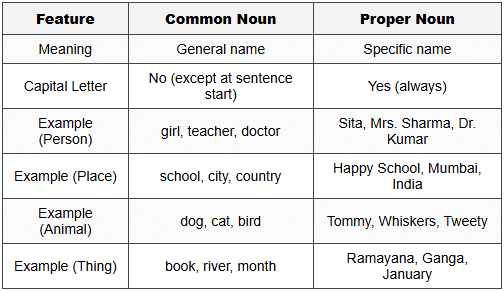
A Common Noun is a general name for any person, place, animal, or thing. It does not name one specific item.
- Examples: boy, city, dog, book
- Not Specific: These words can refer to any boy, any city, any dog, any book.
- Writing Rule: Common nouns start with a small letter (unless they begin a sentence).
4.2 Proper Nouns
A Proper Noun is a special name for a specific person, place, animal, or thing. It names only one particular item.
- Examples: Ravi (specific boy), Delhi (specific city), Tommy (specific dog's name), Ramayana (specific book)
- Always Specific: These words refer to only one particular person, place, animal, or thing.
- Writing Rule: Proper nouns always start with a capital letter.
4.3 Comparison Table: Common vs Proper Nouns
5. Singular and Plural Nouns (Basic Introduction)
Nouns can be Singular or Plural based on the number they represent.
5.1 Singular Nouns
A Singular Noun names only one person, place, animal, or thing.
- Examples: boy, school, dog, book, apple, tree
- Meaning: Only one item is being talked about.
5.2 Plural Nouns
A Plural Noun names more than one person, place, animal, or thing.
- Examples: boys, schools, dogs, books, apples, trees
- Meaning: Two or more items are being talked about.
- Common Rule: Add -s or -es to make most nouns plural. Example: cat → cats, box → boxes
6. Important Noun Lists for Practice
Below are commonly used nouns grouped by category for vocabulary building.
6.1 People Nouns
- mother, father, brother, sister, baby, boy, girl, teacher, doctor, farmer, friend
6.2 Place Nouns
- home, school, park, hospital, shop, market, library, zoo, farm, beach
6.3 Animal Nouns
- dog, cat, cow, horse, elephant, lion, tiger, bird, fish, rabbit, butterfly
6.4 Thing Nouns
- book, pen, pencil, bag, table, chair, ball, toy, apple, water, tree, flower
7. Common Mistakes to Avoid
Students often make errors while learning nouns. Here are the common traps.
- Mistake 1: Not using capital letters for proper nouns. Remember: Names of specific people, places, days, and months always start with capital letters.
- Mistake 2: Confusing action words (verbs) with naming words (nouns). Example: "run" is an action (verb), but "runner" is a person (noun).
- Mistake 3: Forgetting to add -s or -es for plural nouns. Example: One cat, two cats (not "two cat").
- Mistake 4: Thinking all nouns are only things we can touch. Remember: Sun, moon, air, water are also nouns even though some are not solid objects.
8. Practice Tips for Mastering Nouns
Regular practice helps in identifying and using nouns correctly.
- Look Around: Observe your surroundings and name everything you see. Each name is a noun.
- Make Lists: Create lists of people, places, animals, and things you know. This builds vocabulary.
- Read Simple Stories: Identify all the nouns in a story. Notice how they name characters, places, and objects.
- Use Nouns in Sentences: Practice making sentences using different nouns. Example: "The teacher reads a book in the library."
Understanding nouns is the foundation of building strong vocabulary. By learning to identify and use nouns correctly, you can name everything around you and communicate clearly. Practice recognizing people, places, animals, and things in your daily life to strengthen your noun knowledge.
FAQs on Naming Words (Nouns)
| 1. What are nouns? |  |
| 2. What are the types of nouns based on categories? | |
| 3. How can one recognise nouns in sentences? | |
| 4. What is the difference between common and proper nouns? | |
| 5. What are singular and plural nouns? | |