Japanese Writing Systems Made Easy: Hiragana, Katakana & Kanji Basics


Japanese writing is unique because it uses three different scripts together in a single sentence. Understanding when and how to use Hiragana, Katakana, and Kanji is essential for reading and writing Japanese. Each script has distinct characteristics, functions, and usage rules. Mastering these basics will help you recognize mixed-script texts and build a strong foundation for Japanese language proficiency.
1. Overview of Japanese Writing Systems
Japanese writing combines three scripts simultaneously. This mixed-script system developed over centuries through cultural borrowing and adaptation.
- Three Scripts in One Language: Japanese uses Hiragana, Katakana, and Kanji together. A single sentence typically contains all three scripts working in harmony.
- Historical Development: Kanji came from China around 5th century CE. Hiragana and Katakana were derived from simplified Kanji forms during the Heian period (794-1185 CE).
- No Spaces Between Words: Unlike English, Japanese text flows continuously. Different scripts help readers identify word boundaries and meanings.
- Complementary Functions: Each script serves specific grammatical and semantic purposes. They are not interchangeable alternatives.
1.1 Script Classification
- Hiragana (ひらがな): Phonetic script with 46 basic characters. Curved, flowing shapes. Used for native Japanese words and grammar.
- Katakana (カタカナ): Phonetic script with 46 basic characters. Angular, sharp shapes. Used for foreign loanwords and special effects.
- Kanji (漢字): Logographic script borrowed from Chinese. Each character represents meaning and sound. Over 2,000 characters in common use.
1.2 Why Three Scripts?
- Visual Clarity: Different scripts create visual breaks that help identify grammatical structures and word types instantly.
- Meaning Distinction: Homophones (words that sound the same) can be distinguished. For example, "はし" can mean bridge (橋), chopsticks (箸), or edge (端) depending on Kanji used.
- Cultural Identity: Kanji connects to Chinese literary heritage. Hiragana represents Japanese phonetic identity. Katakana shows modern international borrowing.
- Reading Speed: Mixed scripts allow faster reading. Kanji conveys core meaning at a glance while Hiragana shows grammatical relationships.
2. Hiragana (ひらがな) - The Basic Phonetic Script
Hiragana is the first script Japanese children learn. It represents every sound in Japanese and forms the backbone of Japanese writing.
2.1 Characteristics of Hiragana
- 46 Basic Characters: Represents all Japanese phonetic sounds (mora). Each character = one sound unit (consonant + vowel or vowel alone).
- Rounded, Flowing Shapes: Characters have curved lines. Example: か, き, く, け, こ (ka, ki, ku, ke, ko).
- Pure Japanese Origin: Developed from simplified cursive Kanji forms. Originally called onnade (women's hand) because it was initially used mainly by women.
- Complete Phonetic Coverage: Any Japanese word can be written entirely in Hiragana, though this is not standard practice.
2.2 When to Use Hiragana
- Native Japanese Words: Words that don't have Kanji or where Kanji is too difficult. Example: ありがとう (arigatou - thank you).
- Grammatical Particles: Small words that show grammatical relationships. Example: は (wa - topic marker), を (wo - object marker), に (ni - direction/location marker).
- Verb/Adjective Endings (Okurigana): Hiragana attached to Kanji stems to show conjugation. Example: 食べる (taberu - to eat): 食 is Kanji, べる is Hiragana ending.
- Words Without Common Kanji: Some native words are typically written in Hiragana only. Example: かわいい (kawaii - cute).
- Furigana (Reading Aids): Small Hiragana written above or beside Kanji to show pronunciation. Essential in children's books and learner materials.
2.3 Hiragana Structure
- Five Vowel Base: あ (a), い (i), う (u), え (e), お (o) - all other characters build on these vowel sounds.
- Consonant Rows: か-row (ka, ki, ku, ke, ko), さ-row (sa, shi, su, se, so), た-row (ta, chi, tsu, te, to), and so on.
- Dakuten and Handakuten: Diacritical marks that change sounds. Dakuten (゛) makes sounds voiced: か→が (ka→ga). Handakuten (゜) for "p" sounds: は→ぱ (ha→pa).
- Combination Characters (Yōon): Small や, ゆ, よ combine with certain characters. Example: きゃ (kya), しゅ (shu), ちょ (cho).
3. Katakana (カタカナ) - The Foreign Word Script
Katakana has the same sounds as Hiragana but uses angular shapes. It serves specific functional purposes in modern Japanese writing.
3.1 Characteristics of Katakana
- 46 Basic Characters: Mirror the same sounds as Hiragana. Each Katakana has a Hiragana equivalent with identical pronunciation.
- Angular, Sharp Shapes: Straight lines and sharp corners. Example: カ, キ, ク, ケ, コ (ka, ki, ku, ke, ko).
- Visual Distinctiveness: Angular shape makes foreign words stand out immediately in Japanese text.
- Modern Utility: Became especially important after Japan's modernization (Meiji period onwards) as foreign loanwords increased dramatically.
3.2 When to Use Katakana
- Foreign Loanwords (Gairaigo): Words borrowed from other languages (mainly English). Example: コーヒー (kōhī - coffee), コンピューター (konpyūtā - computer).
- Foreign Names: Personal names and place names from outside Japan. Example: アメリカ (Amerika - America), ジョン (Jon - John).
- Onomatopoeia: Sound-effect words and animal sounds. Example: ワンワン (wanwan - dog barking), ドキドキ (dokidoki - heartbeat sound).
- Scientific/Technical Terms: Biological species names, scientific terminology. Example: エネルギー (enerugī - energy).
- Emphasis: Similar to italics or bold in English. Draws attention to specific words. Used in advertising and manga.
- Telegrams and Official Documents: Historically used for clarity in official communications. Less common now but still seen in formal contexts.
3.3 Katakana Adaptation Rules
- Sound Approximation: Foreign sounds are adapted to fit Japanese phonetic system. "L" becomes "R" (ライト raito - light), "V" becomes "B" (バイオリン baiorin - violin).
- Long Vowel Mark (ー): Extends vowel sound. Used frequently in Katakana. Example: ケーキ (kēki - cake), スーパー (sūpā - supermarket).
- Syllable Addition: Japanese syllables cannot end in consonants (except "n"). Extra vowels added. Example: "cup" becomes カップ (kappu).
- Standardization Issues: Some loanwords have multiple accepted spellings due to different phonetic interpretations.
4. Kanji (漢字) - Chinese Characters
Kanji are logographic characters where each symbol represents meaning and pronunciation. They form the semantic core of Japanese writing.
4.1 Characteristics of Kanji
- Logographic System: Each character represents a concept/meaning, not just a sound. Example: 水 means "water" and can be read as "mizu" or "sui" depending on context.
- Chinese Origin: Borrowed from Chinese writing system. Many characters retain similar meanings but pronunciations differ completely.
- Complex Structure: Characters contain multiple strokes (from 1 to over 30). Stroke order is standardized and must be followed.
- Vast Number: Total Kanji exceeds 50,000. However, practical literacy requires far fewer.
4.2 Essential Kanji Classifications
- Jōyō Kanji (常用漢字): "Regular-use Kanji" - official list of 2,136 characters designated by Japanese Ministry of Education. Required for general literacy.
- Kyōiku Kanji (教育漢字): "Education Kanji" - subset of 1,026 characters taught in elementary school (grades 1-6). Foundation for all further learning.
- Jinmeiyō Kanji (人名用漢字): Additional 863 characters approved for use in personal names only.
4.3 When to Use Kanji
- Nouns: Most nouns representing concrete objects or abstract concepts. Example: 学校 (gakkō - school), 時間 (jikan - time).
- Verb Stems: Root meaning of verbs written in Kanji, with Hiragana endings. Example: 読む (yomu - to read): 読 is Kanji stem, む is Hiragana ending.
- Adjective Stems: Core meaning in Kanji with Hiragana endings. Example: 新しい (atarashii - new): 新 is Kanji, しい is Hiragana.
- Adverbs: Many adverbs use Kanji. Example: 今日 (kyō - today), 明日 (ashita - tomorrow).
- Names: Japanese personal names and place names primarily use Kanji. Example: 東京 (Tōkyō - Tokyo), 田中 (Tanaka - common surname).
4.4 Kanji Readings - Critical Concept
Most Kanji have multiple readings. This is a major source of complexity in Japanese.
- On-yomi (音読み): "Sound reading" - Chinese-derived pronunciation. Used when Kanji appears in compound words with other Kanji. Example: 山 = サン (san) in 火山 (kazan - volcano).
- Kun-yomi (訓読み): "Meaning reading" - native Japanese pronunciation. Used when Kanji stands alone or with Okurigana. Example: 山 = やま (yama) meaning "mountain" by itself.
- Multiple On/Kun Readings: Single Kanji can have several readings of each type. Example: 生 has on-readings セイ (sei), ショウ (shō) and kun-readings いきる (ikiru), うまれる (umareru), etc.
- Context Determines Reading: Surrounding Kanji and grammatical structure indicate which reading to use.
4.5 Kanji Structure - Radicals
- Radicals (部首 - Bushu): Building blocks of Kanji. Each Kanji contains one main radical that often indicates meaning category.
- 214 Classical Radicals: Traditional classification system. Modern dictionaries organize Kanji by radical.
- Semantic Hints: Radicals provide meaning clues. Example: 氵(water radical) appears in 海 (ocean), 池 (pond), 泳 (swim).
- Phonetic Components: Some Kanji parts suggest pronunciation, though not always reliable.
5. Comparison: Hiragana vs Katakana vs Kanji
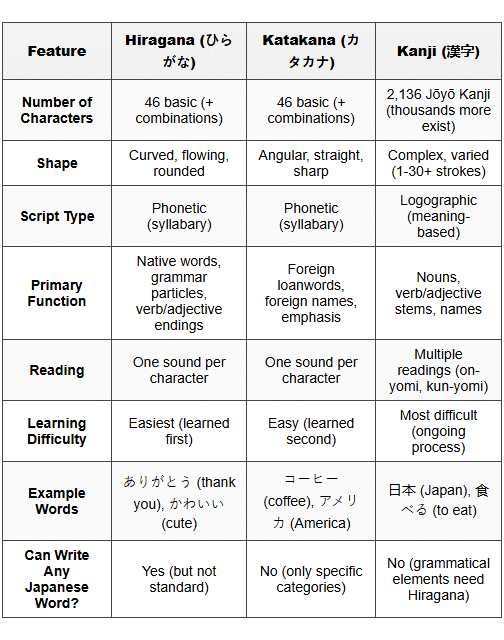
6. Mixed-Script Usage - How Scripts Work Together
Real Japanese writing combines all three scripts in single sentences. Understanding mixed-script patterns is essential for reading comprehension.
6.1 Standard Mixed-Script Patterns
- Kanji for Content Words: Nouns, verb stems, adjective stems use Kanji to convey core meaning quickly.
- Hiragana for Grammar: Particles, verb endings, adjective endings use Hiragana to show grammatical relationships.
- Katakana for Foreign Elements: Loanwords and foreign names use Katakana to signal non-Japanese origin.
- No Spaces: Scripts themselves create visual boundaries between word types and grammatical units.
6.2 Simple Mixed-Script Examples with Breakdown
Example 1: 私は学生です。
(Watashi wa gakusei desu - I am a student)
- 私 (watashi) - Kanji = "I/me" (pronoun)
- は (wa) - Hiragana = topic marker particle
- 学生 (gakusei) - Kanji = "student" (noun)
- です (desu) - Hiragana = "to be" (copula verb)
Example 2: コーヒーを飲みます。
(Kōhī wo nomimasu - I drink coffee)
- コーヒー (kōhī) - Katakana = "coffee" (foreign loanword)
- を (wo) - Hiragana = object marker particle
- 飲 (no) - Kanji = "drink" (verb stem)
- みます (mimasu) - Hiragana = polite present tense ending
Example 3: 東京のレストランで日本料理を食べました。
(Tōkyō no resutoran de Nihon ryōri wo tabemashita - I ate Japanese food at a restaurant in Tokyo)
- 東京 (Tōkyō) - Kanji = "Tokyo" (place name)
- の (no) - Hiragana = possessive/connective particle
- レストラン (resutoran) - Katakana = "restaurant" (foreign loanword)
- で (de) - Hiragana = location/means particle
- 日本 (Nihon) - Kanji = "Japan"
- 料理 (ryōri) - Kanji = "cooking/cuisine"
- を (wo) - Hiragana = object marker particle
- 食 (ta) - Kanji = "eat" (verb stem)
- べました (bemashita) - Hiragana = polite past tense ending
6.3 Special Cases and Variations
- Furigana Addition: Small Hiragana written above/beside Kanji shows reading. Common in learner texts, children's books, and difficult Kanji. Format: 漢字(かんじ).
- All-Hiragana Writing: Used in children's books for early readers, song lyrics for aesthetic effect, or when teaching beginners. Not standard adult writing.
- Rōmaji (Roman Letters): Not part of traditional Japanese writing but used for acronyms (DVD, USB), stylistic purposes in advertising, or learning aids. Example: NHK (Japan Broadcasting Corporation).
- Numbers: Can be written with Kanji (一、二、三), Arabic numerals (1, 2, 3), or combination depending on context. Arabic numerals more common in modern horizontal writing.
7. Practical Guidelines for Script Selection
Choosing the correct script requires understanding both grammatical rules and contextual conventions.
7.1 Decision Flowchart for Script Choice
- Is it a foreign loanword or foreign name? → Use Katakana (コーヒー, アメリカ)
- Is it a grammatical particle or verb/adjective ending? → Use Hiragana (は, を, に, ます, です)
- Is it a noun, verb stem, or adjective stem with common Kanji? → Use Kanji (学生, 食べる, 新しい)
- Is it a native Japanese word without common Kanji or with very difficult Kanji? → Use Hiragana (ありがとう, かわいい)
- Is it for emphasis or special effect? → Consider Katakana (similar to italics/bold in English)
7.2 Words That Can Use Multiple Scripts
Some words have legitimate variations depending on context or preference:
- Onomatopoeia: Can be Hiragana or Katakana. Katakana adds emphasis. Example: きらきら or キラキラ (kirakira - sparkling)
- Some Native Words: Optional Kanji usage. Example: "cute" = かわいい (common) or 可愛い (formal/literary)
- Counters and Numbers: Flexible between Kanji and Arabic numerals. Example: "3 books" = 三冊 or 3冊
7.3 Context-Dependent Variations
- Children's Materials: More Hiragana, less Kanji. All Kanji have Furigana readings.
- Formal Documents: Maximum Kanji usage following Jōyō Kanji standards. Minimal Hiragana.
- Casual Writing (texts, social media): More Hiragana, fewer Kanji. Sometimes all-Hiragana for speed.
- Academic/Technical: Specialized Kanji beyond Jōyō list may appear with Furigana.
8. Learning Strategy and Progression
Effective Japanese writing system mastery follows a structured progression from simple to complex.
8.1 Recommended Learning Order
- Stage 1 - Hiragana: Master all 46 characters first (typically 1-2 weeks intensive study). Essential foundation for everything else.
- Stage 2 - Katakana: Learn all 46 characters (typically 1-2 weeks). Easier because you understand the syllabary system from Hiragana.
- Stage 3 - Basic Kanji: Start with Kyōiku Kanji grade 1 (80 characters). Learn in context with actual vocabulary words.
- Stage 4 - Progressive Kanji: Continue through elementary grades (1,026 Kyōiku Kanji), then move to full Jōyō list (2,136 characters). This is a multi-year process.
- Stage 5 - Mixed-Script Reading: Practice reading authentic Japanese texts combining all three scripts from early stages.
8.2 Key Learning Principles
- Kana First, Always: Never attempt Kanji before mastering Hiragana and Katakana. You need Kana to write Furigana and look up Kanji.
- Kanji in Context: Learn Kanji with vocabulary words, not as isolated characters. Each Kanji should be learned with 2-3 common words that use it.
- Stroke Order Matters: Correct stroke order makes writing faster and characters more legible. Learn standard stroke order from the beginning.
- Daily Practice: Writing practice is essential. Passive recognition is insufficient - you must be able to produce characters from memory.
- Radical Recognition: Learn to identify radicals early. This helps with Kanji lookup and meaning inference.
8.3 Memorization Techniques
- Mnemonics: Create memory stories linking character shapes to meanings. Example: 人 (person) looks like walking legs.
- Component Recognition: Break complex Kanji into recognizable parts. Example: 語 (language) = 言 (speak) + 五 (five) + 口 (mouth).
- Spaced Repetition: Use SRS (Spaced Repetition System) software/apps for efficient long-term retention.
- Writing Practice: Physical writing reinforces muscle memory. Digital input alone is insufficient for character mastery.
- Reading Practice: Expose yourself to real Japanese texts early and often. Context reinforces character recognition.
Mastering Japanese writing systems requires patience and consistent practice. Start with Hiragana, progress to Katakana, then gradually build Kanji knowledge. Understanding when to use each script comes naturally as you encounter more authentic Japanese text. The three-script system may seem complex initially, but it provides rich visual and semantic information that makes Japanese reading efficient once mastered. Focus on building solid Kana foundations first, then systematically expand your Kanji repertoire while practicing mixed-script reading from early learning stages.