Day 6 - Talk About Food


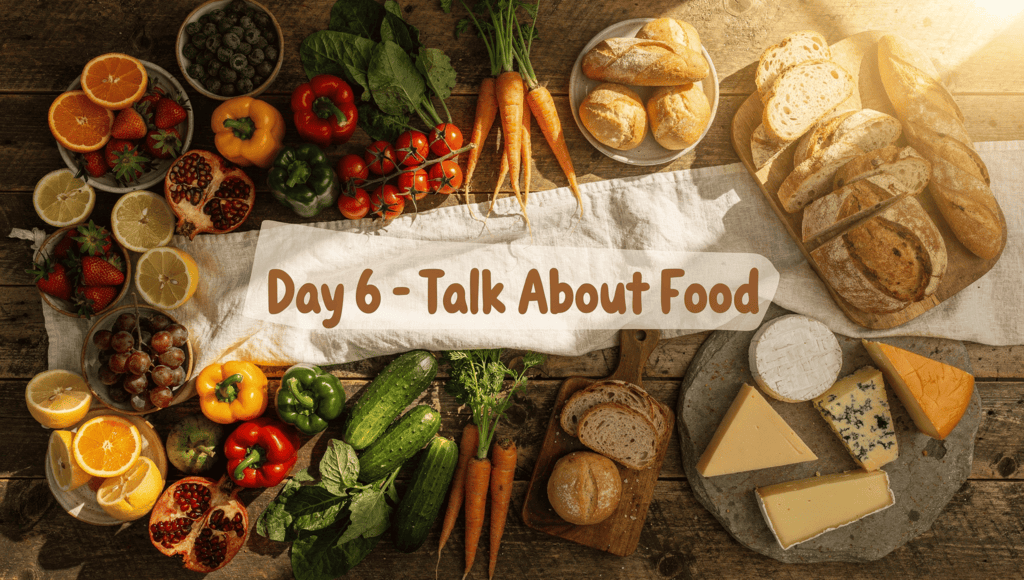
Food is one of the most common topics in daily conversations. Mastering food vocabulary and grammar structures related to food helps you express preferences, order meals, and discuss eating habits confidently. This lesson focuses on practical vocabulary, noun types, and sentence patterns for talking about food.
1. Food Vocabulary (Core Categories)
Food words are divided into main categories based on meal types, food groups, and cooking methods. Learning these categories helps organize vocabulary efficiently.
1.1 Meal Types
- Breakfast: The first meal of the day (morning meal). Examples: toast, eggs, cereal, porridge
- Lunch: Mid-day meal eaten around noon. Examples: sandwich, salad, rice, curry
- Dinner/Supper: Evening meal, usually the main meal. Examples: pasta, chicken, vegetables, soup
- Snacks: Small portions eaten between meals. Examples: biscuits, chips, fruits, nuts
1.2 Basic Food Groups
- Fruits: apple, banana, orange, mango (natural sweet foods from plants)
- Vegetables: carrot, potato, tomato, spinach (savory plant foods)
- Grains/Cereals: rice, wheat, bread, pasta (staple foods made from grains)
- Dairy Products: milk, cheese, butter, yogurt (foods made from milk)
- Proteins: chicken, fish, eggs, beans (body-building foods)
- Beverages: tea, coffee, juice, water (drinks/liquids)
1.3 Common Indian Foods (High-Frequency Usage)
- Roti/Chapati: Flatbread made from wheat flour
- Dal: Lentil curry (protein-rich dish)
- Sabzi: Vegetable preparation/curry
- Dosa: South Indian rice pancake
1.4 Taste and Flavor Adjectives
- Sweet: Having sugar taste (chocolate, cake, honey)
- Salty: Having salt taste (chips, pickles)
- Spicy/Hot: Having chili/pepper taste (curry, chili sauce)
- Sour: Sharp acid taste (lemon, vinegar, tamarind)
- Bitter: Sharp unpleasant taste (bitter gourd, black coffee)
- Delicious/Tasty: Very good taste
- Bland: No strong taste, lacking flavor
2. Countable and Uncountable Nouns in Food Context
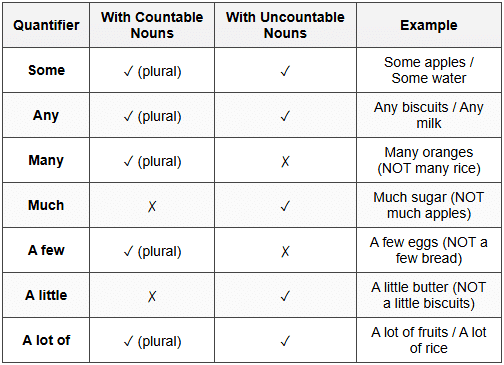
Understanding whether a food noun is countable or uncountable is crucial for using correct grammar with articles and quantifiers.
2.1 Countable Nouns
Countable nouns are items you can count individually. They have both singular and plural forms.
- Singular form: Use "a" or "an" before the noun (a banana, an apple, an egg)
- Plural form: Add -s or -es (bananas, apples, eggs, tomatoes)
- Question form: "How many?" is used for countable nouns
- Common examples: apple, orange, biscuit, potato, sandwich, cup, plate
Usage patterns:
- I ate an apple (singular with article)
- She bought three oranges (plural with number)
- How many eggs do you want? (plural with "How many")
2.2 Uncountable Nouns
Uncountable nouns are substances or masses that cannot be counted individually. They have only one form (no plural).
- No article: Cannot use "a" or "an" directly (NOT "a rice" or "a milk")
- No plural form: Always singular (rice, NOT rices; milk, NOT milks)
- Question form: "How much?" is used for uncountable nouns
- Common examples: rice, bread, water, milk, tea, coffee, sugar, salt, butter, cheese
Usage patterns:
- I need some rice (use "some" instead of "a")
- She drinks milk daily (no article, no plural)
- How much sugar do you need? (singular with "How much")
2.3 Quantifiers for Countable and Uncountable Nouns
2.4 Making Uncountable Nouns Countable
To count uncountable nouns, use container words or measurement units before them.
- Container method: a cup of tea, a glass of water, a bottle of milk, a bowl of rice
- Piece method: a piece of bread, a slice of cheese, a loaf of bread
- Weight/Volume method: a kilo of sugar, a litre of milk, a spoon of salt
Examples:
- I want two cups of coffee (countable: cups)
- She ate three slices of bread (countable: slices)
- He bought two bottles of water (countable: bottles)
2.5 Common Student Mistakes (Trap Alert)
- Wrong: I ate a rice → Correct: I ate some rice or a bowl of rice
- Wrong: She bought two breads → Correct: She bought two loaves of bread
- Wrong: How many sugar? → Correct: How much sugar?
- Wrong: I need many water → Correct: I need much water or a lot of water
- Special case: "Bread" is uncountable, but "biscuit" is countable (a biscuit, two biscuits)
3. Expressing Likes and Dislikes About Food
Using correct sentence structures to express preferences is essential for natural conversation about food.
3.1 Basic Like/Dislike Sentence Patterns
Pattern 1: Like + Noun
- I like apples (general preference, countable plural)
- She likes rice (general preference, uncountable singular)
- He doesn't like vegetables (negative form)
- Do you like tea? (question form)
Pattern 2: Like + Verb-ing (Gerund)
- I like eating ice cream (activity preference)
- She likes cooking pasta (activity preference)
- They don't like drinking coffee (negative activity)
- Does he like making breakfast? (question)
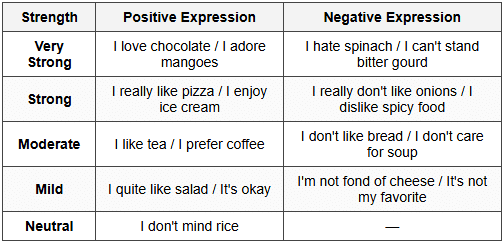
3.2 Intensity Levels (Strong to Weak Preferences)
3.3 Subject-Verb Agreement with Like/Dislike
Present Simple tense rules:
- I/You/We/They: like, don't like (base form)
- He/She/It: likes, doesn't like (add -s to verb)
Examples demonstrating agreement:
- I like bananas, but she likes oranges (different subjects)
- We don't like fast food, but he doesn't like vegetables (negative forms)
- They love pasta, and my brother loves it too (same verb, different forms)
3.4 Extended Preference Structures
Expressing preference between two options:
- I prefer tea to coffee (prefer A to B)
- She would rather have rice than bread (would rather A than B)
- I like apples more than oranges (like A more than B)
Expressing favorite food:
- My favorite food is pizza
- I love chocolate the most
- Biryani is my favorite dish
3.5 Common Questions About Food Preferences
- Do you like...? Do you like Indian food? (Yes/No question)
- What do you like? What food do you like? (Open question)
- What is your favorite...? What is your favorite fruit? (specific preference)
- Which do you prefer...? Which do you prefer, tea or coffee? (choice question)
- How do you like...? How do you like your tea? (manner/style question)
4. Short Written Responses About Food
Building simple sentences and short paragraphs about food helps develop writing fluency for everyday situations.
4.1 Basic Sentence Construction Formula
Formula: Subject + Verb + Object + Additional Details
- Simple sentence: I eat rice (Subject + Verb + Object)
- With time: I eat breakfast at 8 AM (add when)
- With place: We have lunch at the restaurant (add where)
- With manner: She cooks food carefully (add how)
4.2 Describing a Meal (Structured Format)
Template for describing meals:
- Meal type and time: For breakfast, I usually eat...
- Main items: I have bread, eggs, and tea
- Preference statement: I like this meal because it is healthy
Sample response (3-4 sentences):
"For breakfast, I usually eat toast with butter and jam. I also drink a cup of tea. Sometimes I have an egg. I like this meal because it is quick and tasty."
4.3 Describing Your Favorite Food
Four-point structure:
- Name the food: My favorite food is...
- Describe it: It is made from... / It tastes...
- When you eat it: I usually eat it for...
- Why you like it: I like it because...
Sample response:
"My favorite food is biryani. It is made from rice, chicken, and spices. It tastes delicious and spicy. I usually eat it on special occasions. I like it because it has a wonderful aroma and rich flavor."
4.4 Restaurant/Food Ordering Phrases
Polite ordering structures:
- Requesting: I would like..., Can I have..., May I get...
- Examples: I would like a cup of coffee, please / Can I have the menu?
- Specifying: I want tea without sugar / I prefer my food less spicy
- Polite refusal: No, thank you / I don't want dessert, thanks
4.5 Useful Connecting Words for Food Writing
- Adding information: and, also, too, as well (I like tea and coffee)
- Showing contrast: but, however (I like fruits but I don't like vegetables)
- Giving reasons: because, since, as (I eat salad because it is healthy)
- Showing sequence: first, then, after that, finally (First, I boil water. Then, I add tea leaves)
- Showing frequency: always, usually, often, sometimes, rarely, never (I always drink milk)
4.6 Sample Short Responses (Exam-Style Practice)
Question 1: What did you eat for lunch today?
Sample Answer: "For lunch today, I ate rice and dal. I also had some vegetable curry and a chapati. The food was tasty and filling. I drank a glass of water after the meal."
Question 2: Describe a food you don't like.
Sample Answer: "I don't like bitter gourd. It tastes very bitter and unpleasant. My mother often cooks it because it is healthy. However, I avoid eating it. I prefer sweet or mild-tasting vegetables."
Question 3: What is your favorite snack?
Sample Answer: "My favorite snack is samosa. It is a fried pastry filled with potatoes and peas. It is crispy and spicy. I usually eat it with green chutney. I like it because it is very tasty and satisfying."
5. Common Mistakes and Corrections (Trap Alert Section)
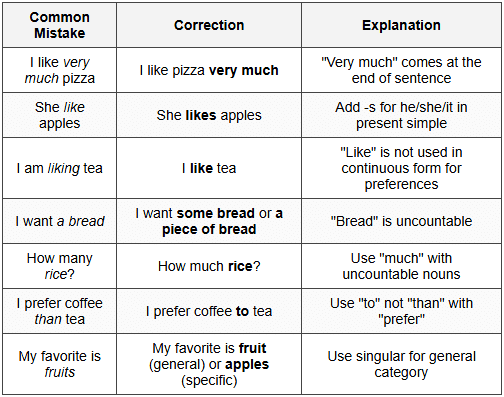
6. Quick Reference Checklist
When talking about food, remember:
- ✓ Check if the noun is countable or uncountable before using articles
- ✓ Use "many" with countable nouns, "much" with uncountable nouns
- ✓ Add -s to verbs for he/she/it in present simple (he likes, she eats)
- ✓ Use "prefer A to B" not "prefer A than B"
- ✓ Put "very much" at the end of the sentence
- ✓ Never use continuous tense with "like" for preferences (NOT "I am liking")
- ✓ Use container words to count uncountable nouns (a cup of, a glass of)
Mastering food vocabulary and related grammar structures enables you to participate confidently in everyday conversations about meals, preferences, and eating habits. Practice building sentences using countable and uncountable nouns correctly, expressing likes and dislikes with appropriate intensity, and writing short, clear responses. Regular practice with these patterns will develop natural fluency in discussing food-related topics.
FAQs on Day 6 - Talk About Food
| 1. What are some core categories of food vocabulary? |  |
| 2. How do countable and uncountable nouns work in a food context? | |
| 3. How can I express my likes and dislikes about food? | |
| 4. What are some examples of short written responses about food? | |
| 5. What are some common mistakes to avoid when discussing food? | |