Major Stock Exchanges


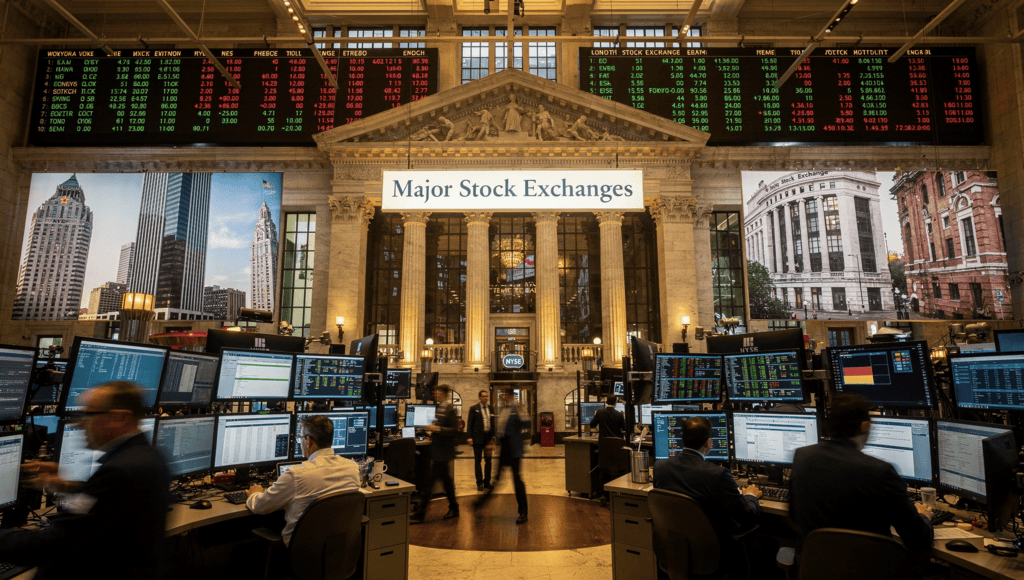
Stock exchanges are organized marketplaces where securities like shares and bonds are bought and sold. They provide a platform for companies to raise capital and for investors to trade securities. Understanding major global and Indian stock exchanges is essential for grasping how financial markets operate and connect economies worldwide.
1. New York Stock Exchange (NYSE)
The NYSE is the world's largest stock exchange by market capitalization. It is located on Wall Street in New York City, USA.
1.1 Key Features
- Established: 1792, making it one of the oldest exchanges globally
- Market Capitalization: Over $25 trillion (largest in the world)
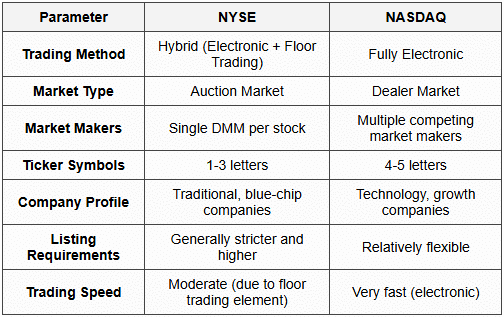
- Trading Method: Uses both electronic trading and traditional floor trading with human brokers
- Listed Companies: Approximately 2,400+ companies including multinational giants
- Symbol/Ticker: Companies listed on NYSE use 1-3 letter ticker symbols
1.2 Trading Mechanism
- Auction Market: NYSE operates as an auction market where buyers and sellers place bids through brokers
- Designated Market Makers (DMMs): Specialists who facilitate trading and maintain orderly markets for specific stocks
- Trading Hours: 9:30 AM to 4:00 PM Eastern Time (ET), Monday to Friday
- Physical Trading Floor: Still maintains an iconic trading floor where brokers execute large trades
1.3 Notable Companies
- Major blue-chip companies like Coca-Cola, IBM, and Walmart are listed here
- Banks and financial institutions prefer NYSE listing
- Traditional industries and established companies dominate the exchange
2. NASDAQ (National Association of Securities Dealers Automated Quotations)
NASDAQ is the world's first fully electronic stock exchange. It is the second-largest exchange by market capitalization globally.
2.1 Key Features
- Established: 1971 as the world's first electronic stock market
- Market Capitalization: Over $20 trillion
- Trading Method: Completely electronic with no physical trading floor
- Listed Companies: Approximately 3,300+ companies
- Symbol/Ticker: Companies use 4-5 letter ticker symbols
2.2 Trading Mechanism
- Dealer Market: Operates as a dealer market where multiple market makers compete for trades
- Market Makers: Unlike NYSE's single DMM, NASDAQ has multiple competing market makers for each stock
- High-Speed Trading: Known for fast electronic execution of trades
- Trading Hours: 9:30 AM to 4:00 PM Eastern Time (ET), Monday to Friday
2.3 Notable Companies
- Technology giants like Apple, Microsoft, Amazon, Google (Alphabet), and Facebook (Meta) are listed here
- NASDAQ is preferred by technology and growth-oriented companies
- Biotechnology and internet-based companies favor this exchange
2.4 NASDAQ vs NYSE Comparison
3. Bombay Stock Exchange (BSE)
The BSE is Asia's oldest stock exchange and India's first stock exchange. It is located in Mumbai, Maharashtra.
3.1 Key Features
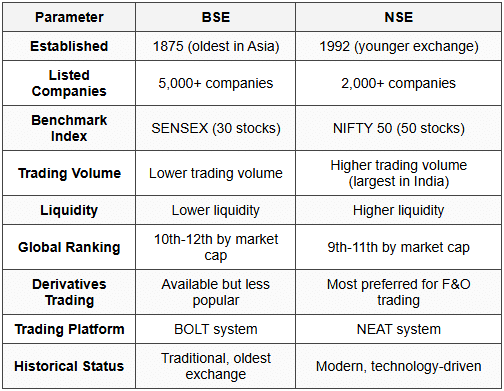
- Established: 1875 (oldest stock exchange in Asia)
- Market Capitalization: Over $3.5 trillion, among the top 10 globally
- Listed Companies: Over 5,000+ companies listed
- Benchmark Index: SENSEX (Sensitive Index) tracks 30 largest and most actively traded stocks
- Trading Platform: Uses the BOLT (BSE On-Line Trading) electronic system
3.2 Historical Significance
- Native System: Initially operated under a banyan tree in Mumbai before moving to Dalal Street
- Recognition: First Indian stock exchange to be recognized by the Government of India under Securities Contracts Act, 1956
- Dalal Street: Located on Dalal Street, which has become synonymous with Indian stock markets
3.3 SENSEX (BSE Sensitive Index)
- Base Year: 1978-79 with base value of 100
- Composition: Consists of 30 financially sound and well-established companies
- Free-Float Method: Calculated using free-float market capitalization method
- Sectoral Representation: Represents various sectors of the Indian economy
- Barometer Function: Acts as a barometer of Indian stock market performance
3.4 Trading Mechanism
- Trading Hours: 9:15 AM to 3:30 PM IST, Monday to Friday (pre-open session starts at 9:00 AM)
- Electronic Trading: Fully electronic order-matching system
- Settlement Cycle: T+2 settlement cycle (trade plus two working days)
- Price Bands: Circuit filters of ±10% and ±20% to prevent excessive volatility
4. National Stock Exchange (NSE)
The NSE is India's largest stock exchange by trading volume and market capitalization. It is also located in Mumbai, Maharashtra.
4.1 Key Features
- Established: 1992 (started operations in 1994)
- Market Capitalization: Over $3.7 trillion, largest in India
- Listed Companies: Approximately 2,000+ companies listed
- Benchmark Index: NIFTY 50 (formerly S&P CNX NIFTY) tracks 50 largest companies
- Trading Platform: Uses National Exchange for Automated Trading (NEAT) system
4.2 Establishment Purpose
- Created to bring transparency and efficiency to Indian capital markets
- First exchange in India to introduce fully automated screen-based trading
- Established on recommendations of the Pherwani Committee
- Promoted by leading financial institutions including IDBI, ICICI, and LIC
4.3 NIFTY 50 Index
- Base Year: November 3, 1995, with base value of 1,000
- Composition: Consists of 50 actively traded stocks across 13 sectors
- Coverage: Represents approximately 65% of the free-float market capitalization
- Free-Float Method: Calculated using free-float market capitalization weighted method
- Derivatives Trading: Most liquid contract in India for derivatives trading
4.4 Innovation and Technology
- First Dematerialized Trading: Introduced electronic/dematerialized trading in India
- Derivatives Segment: First exchange to launch derivatives trading in India (2000)
- Internet Trading: Pioneered internet-based trading platform
- Co-location Facility: Provides co-location services for high-frequency trading
4.5 BSE vs NSE Comparison
5. Regulatory Framework
5.1 US Stock Exchanges Regulation
- SEC (Securities and Exchange Commission): Primary regulator for NYSE and NASDAQ
- FINRA: Self-regulatory organization overseeing broker-dealers
- Key Laws: Securities Act 1933, Securities Exchange Act 1934
5.2 Indian Stock Exchanges Regulation
- SEBI (Securities and Exchange Board of India): Primary regulator established in 1992
- Key Laws: SEBI Act 1992, Securities Contracts (Regulation) Act 1956
- Functions: Protects investor interests, regulates stock exchanges, prevents fraudulent practices
6. Common Trading Concepts Across Exchanges
6.1 Market Capitalization
- Definition: Total market value of a company's outstanding shares
- Formula: Market Cap = Share Price × Total Outstanding Shares
- Classification: Large-cap (over $10 billion), Mid-cap ($2-10 billion), Small-cap (under $2 billion)
6.2 Trading Sessions
- Pre-Open Session: Period before regular trading for order matching and price discovery
- Regular Trading: Main trading hours when most transactions occur
- Post-Close Session: After-hours trading with limited participation
6.3 Circuit Breakers/Filters
- Purpose: Automatic trading halts to prevent panic selling or extreme volatility
- Index-Level: Applied when benchmark indices move beyond specified limits
- Stock-Level: Applied to individual stocks hitting upper or lower price limits
- Indian Exchanges: 10%, 15%, 20% circuit filters at index level
7. Common Student Mistakes and Trap Alerts
- Mistake: Confusing market capitalization with trading volume. Market cap is total value of shares; trading volume is number of shares traded daily
- Trap: BSE is older (1875) but NSE is larger by trading volume and market cap. Don't assume oldest means largest
- Confusion: SENSEX has 30 stocks while NIFTY has 50 stocks. Remember: SENSEX = 30, NIFTY = 50
- Mistake: NYSE uses floor trading AND electronic trading (hybrid), not just floor trading anymore
- Trap: NASDAQ ticker symbols have 4-5 letters; NYSE has 1-3 letters. This difference helps identify where a stock is listed
Understanding major stock exchanges is fundamental to grasping how global and domestic capital markets function. NYSE and NASDAQ dominate global markets with distinct trading mechanisms, while BSE and NSE form the backbone of India's financial ecosystem. Each exchange has unique characteristics, trading systems, and benchmark indices that reflect their respective economies. For exam preparation, focus on establishment dates, key indices (SENSEX vs NIFTY), trading mechanisms (auction vs dealer markets), and comparative differences between exchanges.
FAQs on Major Stock Exchanges
| 1. What are the key differences between the New York Stock Exchange (NYSE) and NASDAQ? |  |
| 2. What is the significance of the Bombay Stock Exchange (BSE) and the National Stock Exchange (NSE) in India? | |
| 3. What are some common trading concepts that are applicable across various stock exchanges? | |
| 4. How does the regulatory framework impact stock exchanges? | |
| 5. What are some common mistakes students make when studying stock exchanges? | |

