Media Influence in Global Affairs


Media plays a crucial role in shaping international relations, influencing public opinion, and determining policy agendas worldwide. Understanding how global media operates and impacts international affairs is essential for analyzing contemporary world politics. This topic examines the mechanisms through which media influences diplomatic relations, conflict resolution, and global governance.
1. Role of Media in Global Affairs
1.1 Functions of International Media
- Information Dissemination: Media serves as the primary source of information about international events, conflicts, and diplomatic developments across borders.
- Agenda Setting: Media determines which international issues receive attention and priority by choosing what to report and how prominently to feature it.
- Public Opinion Formation: Through framing and narrative construction, media shapes how citizens perceive foreign countries, international organizations, and global issues.
- Diplomatic Tool: Governments use media strategically to communicate policy positions, signal intentions, and influence other nations' decisions.
- Watchdog Function: Media monitors government actions in foreign policy, exposes corruption, and holds international institutions accountable.
1.2 CNN Effect
The CNN Effect refers to the phenomenon where real-time television news coverage of international crises influences and pressures governments to intervene or change foreign policy. This concept emerged prominently during the 1990s.
- Mechanism: Graphic images of humanitarian disasters or conflicts create public pressure on governments to act immediately.
- Examples: Somalia intervention (1992-93), Bosnia conflict coverage, Rwanda genocide reporting.
- Criticism: Some scholars argue the effect is overstated; governments still retain control over foreign policy decisions despite media pressure.
- Modern Evolution: Social media has amplified this effect through viral content and citizen journalism.
1.3 Media Diplomacy
Media Diplomacy involves using mass communication channels to influence foreign publics and governments as part of diplomatic strategy.
- Public Diplomacy: Governments communicate directly with foreign populations through media to build favorable images and relationships.
- Strategic Communication: Official statements, press conferences, and interviews are timed and crafted to influence international negotiations.
- Back-Channel Communication: Media can signal positions and test reactions before formal diplomatic engagement.
- Crisis Management: Rapid media responses help control narratives during international incidents.
2. Major International News Agencies
2.1 Global Wire Services
International news agencies collect, verify, and distribute news to media organizations worldwide. They are primary sources for global news coverage.
- Associated Press (AP): American cooperative founded in 1846; one of the largest and oldest news agencies; operates in over 250 locations globally.
- Reuters: British news agency founded in 1851 (now Thomson Reuters); headquartered in London; known for financial and international news.
- Agence France-Presse (AFP): French news agency founded in 1835; third-largest global agency; government-subsidized but editorially independent.
- United Press International (UPI): American agency founded in 1907; reduced operations after financial difficulties in 1990s.
2.2 Regional and National Agencies
- Xinhua News Agency: China's official state-run agency; largest in Asia; publishes in multiple languages; serves as government voice internationally.
- TASS: Russian state-owned agency (formerly Soviet news agency); provides Moscow's official perspective on international affairs.
- Press Trust of India (PTI): India's largest news agency founded in 1947; non-profit cooperative of Indian newspapers.
- Deutsche Presse-Agentur (DPA): German news agency founded in 1949; major European source for international news.
2.3 Broadcast Media Organizations
- BBC World Service: British public broadcaster; operates in 42 languages; known for credibility and global reach; funded partly by UK government.
- CNN International: American 24-hour news network; pioneered continuous global news coverage in 1980; significant influence on international affairs.
- Al Jazeera: Qatar-based network founded in 1996; broadcasts in Arabic and English; provides Middle Eastern perspective; controversial in Western countries.
- RT (Russia Today): Russian state-funded network launched in 2005; broadcasts in multiple languages; accused of propaganda by Western governments.
3. Media Bias and News Flow
3.1 North-South Information Imbalance
The New World Information and Communication Order (NWICO) debate emerged in the 1970s-80s within UNESCO, highlighting disparities in global news flow.
- Dominance of Western Agencies: AP, Reuters, and AFP control majority of international news distribution; content reflects Western perspectives and priorities.
- Limited Southern Representation: Developing countries have minimal presence in global news; covered mainly during crises, disasters, or conflicts.
- One-Way Flow: Information flows predominantly from developed to developing nations, not vice versa.
- Cultural Imperialism Concerns: Developing nations argue Western media imposes values and undermines local cultures.
3.2 Types of Media Bias
- Selection Bias: Choosing which events to cover based on news values that favor dramatic, conflict-oriented stories from certain regions.
- Framing Bias: Presenting stories through particular perspectives that support specific political or ideological positions.
- National Interest Bias: Media tends to favor coverage that aligns with home country's foreign policy interests.
- Commercial Bias: Profit motives lead to sensationalism and entertainment-oriented coverage rather than substantive analysis.
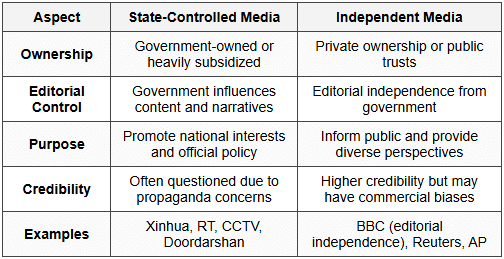
3.3 State-Controlled vs Independent Media
4. Media and International Conflicts
4.1 War Coverage and Reporting
- Embedded Journalism: Reporters attached to military units during conflicts; provides access but raises questions about objectivity and censorship.
- Casualty Reporting: Media focus on own nation's casualties while under-reporting enemy or civilian deaths creates perception gaps.
- Propaganda Tool: Both state and non-state actors use media to justify military actions and demonize opponents.
- Manufacturing Consent: Term by Noam Chomsky describing how media builds public support for government policies including wars.
4.2 Media in Peacekeeping and Humanitarian Crises
- Awareness Creation: Media coverage of humanitarian disasters mobilizes international aid and intervention.
- Donor Fatigue: Continuous crisis reporting can lead to public desensitization and reduced support over time.
- Selective Attention: Some crises receive extensive coverage while others are ignored based on geopolitical interests.
- NGO-Media Partnerships: Humanitarian organizations strategically use media to highlight issues and pressure governments.
4.3 Terrorism and Media
- Oxygen of Publicity: Terrorists use media coverage to spread fear, gain attention, and amplify their message beyond immediate victims.
- Media Dilemma: Balance between reporting newsworthy events and avoiding becoming propaganda tool for terrorist organizations.
- Self-Censorship: Some media outlets limit coverage of terrorist acts to deny them publicity.
- Social Media Exploitation: Terrorist groups use platforms like Twitter and YouTube for recruitment, radicalization, and operational coordination.
5. Digital Media and Global Affairs
5.1 Social Media Impact
- Democratization of Information: Social media enables citizens to report events directly, bypassing traditional gatekeepers.
- Arab Spring (2010-11): Facebook and Twitter facilitated organization of protests and international awareness of uprisings in Tunisia, Egypt, Libya.
- Viral Diplomacy: Viral videos and hashtags influence international public opinion rapidly and unpredictably.
- Echo Chambers: Social media algorithms create information bubbles where users see only confirming perspectives, polarizing international debates.
5.2 Disinformation and Fake News
Disinformation refers to deliberately false information spread to deceive audiences and influence political outcomes.
- Information Warfare: State and non-state actors use fake news to manipulate foreign publics and undermine trust in institutions.
- Deepfakes: AI-generated fake videos and audio recordings create convincing but false content of political leaders.
- Bot Networks: Automated social media accounts amplify certain narratives and create false appearance of widespread support.
- Fact-Checking Challenges: Speed of information spread on social media outpaces verification efforts by journalists.
5.3 Cyber Sovereignty and Internet Governance
- Great Firewall of China: Extensive censorship system controlling internet access and content within China; blocks foreign platforms like Google, Facebook.
- Data Localization: Countries requiring data storage within national borders to control information flow and protect sovereignty.
- Platform Regulation: Governments increasingly regulate social media companies over content moderation and political advertising.
- Splinternet: Growing fragmentation of global internet into regional networks with different rules and access restrictions.
6. Media and Soft Power
6.1 Concept of Soft Power
Soft Power, a term coined by Joseph Nye, refers to the ability to influence others through attraction and persuasion rather than coercion. Media is a key instrument of soft power projection.
- Cultural Influence: Broadcasting entertainment, values, and lifestyle through media creates favorable attitudes toward source countries.
- Agenda Setting Internationally: Nations with global media presence shape what issues receive international attention.
- Legitimacy Building: Positive media coverage enhances a nation's reputation and moral authority in international affairs.
- Economic Benefits: Strong soft power through media attracts tourism, investment, and trade partnerships.
6.2 International Broadcasting as Soft Power
- Voice of America (VOA): US government-funded broadcaster; reaches 280 million people weekly in 47 languages; promotes American values and policies.
- China Global Television Network (CGTN): China's international broadcaster launched in 2016; aims to counter Western media narratives.
- France 24: French international news channel broadcasting in French, English, Arabic; promotes French language and culture.
- NHK World: Japan's international broadcaster; soft power tool promoting Japanese culture and perspectives.
6.3 Challenges to Soft Power Through Media
- Credibility Deficit: State-funded media often perceived as propaganda, reducing effectiveness of soft power messaging.
- Cultural Resistance: Local populations may resist foreign media influence due to cultural preservation concerns.
- Counter-Narratives: Competing nations develop their own media infrastructure to challenge dominant narratives.
- Domestically-Focused Content: Even powerful nations' international broadcasts have limited audience compared to domestic entertainment media.
7. Regulatory Framework and Press Freedom
7.1 International Standards
- Article 19, Universal Declaration of Human Rights (1948): Guarantees right to freedom of opinion and expression including receiving and imparting information across frontiers.
- International Covenant on Civil and Political Rights (1966): Article 19 protects freedom of expression with limited restrictions for national security, public order, or public health.
- UNESCO's Windhoek Declaration (1991): Affirms independent and pluralistic press as essential for democracy and development.
7.2 Press Freedom Indices
- World Press Freedom Index: Published annually by Reporters Without Borders (RSF); ranks countries based on media independence, legal framework, and journalist safety.
- Freedom House Reports: Assesses global press freedom distinguishing between free, partly free, and not free media environments.
- Declining Trends: Recent reports show deteriorating press freedom globally due to authoritarianism, populism, and attacks on journalists.
7.3 Threats to Media Freedom
- Journalist Safety: Increasing violence, imprisonment, and assassination of journalists, particularly in conflict zones and authoritarian states.
- Legal Harassment: Defamation laws, sedition charges, and national security legislation used to silence critical reporting.
- Economic Pressure: Governments withdraw advertising revenue or pressure corporate sponsors to control media content.
- Online Censorship: Internet shutdowns, website blocking, and surveillance of digital communications restrict information flow.
8. Media Ethics in International Reporting
8.1 Ethical Principles
- Accuracy and Verification: Journalists must verify information before publication, especially in international contexts where confirmation is difficult.
- Balance and Fairness: Provide multiple perspectives on international conflicts and avoid one-sided coverage.
- Minimizing Harm: Consider impact of reporting on vulnerable populations, particularly in humanitarian crises.
- Independence: Maintain distance from government and commercial interests to preserve journalistic integrity.
8.2 Common Ethical Dilemmas
- Graphic Content: Balancing public's right to know with dignity of victims when covering conflicts and disasters.
- Source Protection: Protecting confidential sources who provide information about human rights abuses or corruption.
- Access vs Independence: Tension between gaining access to conflict zones through government cooperation and maintaining critical distance.
- Cultural Sensitivity: Avoiding stereotypes and respecting cultural differences while reporting on foreign societies.
8.3 Self-Regulation Mechanisms
- Press Councils: Independent bodies that address complaints about media coverage and enforce ethical standards voluntarily.
- Editorial Guidelines: Major news organizations maintain internal codes of conduct for international reporting.
- Ombudsmen: Internal critics within media organizations who review coverage and address public concerns.
- Professional Associations: Organizations like International Federation of Journalists promote ethical standards globally.
9. Case Studies of Media Impact
9.1 Gulf War (1991) and Embedded Journalism
- First Televised War: CNN's live coverage from Baghdad brought war into living rooms globally, shaping public perception dramatically.
- Military-Media Relations: Coalition forces tightly controlled information flow through pool system and briefings.
- Technology Impact: Satellite technology enabled real-time reporting from war zones for first time.
- Criticism: Limited independent access led to accusations of sanitized coverage favoring coalition narrative.
9.2 WikiLeaks and Diplomatic Cables
- 2010 Diplomatic Cables Release: WikiLeaks published 250,000 classified US diplomatic cables revealing confidential assessments of foreign leaders.
- Impact on Diplomacy: Exposed private diplomatic communications, straining relationships and creating embarrassment for multiple governments.
- Media Partnership: Major newspapers like The Guardian, New York Times coordinated publication after redacting sensitive information.
- Debate: Raised questions about balance between transparency, press freedom, and national security.
9.3 Rohingya Crisis Coverage
- Media Blackout: Myanmar government restricted journalist access to Rakhine State during 2017 violence against Rohingya Muslims.
- Social Media Evidence: Facebook posts and smartphone videos from refugees provided evidence of atrocities when traditional media was blocked.
- International Pressure: Media coverage of refugee crisis led to UN condemnation and international sanctions against Myanmar.
- Platform Responsibility: Facebook criticized for allowing hate speech that incited violence; highlighted role of tech platforms in conflicts.
10. Future Trends in Media and Global Affairs
10.1 Technological Developments
- Artificial Intelligence in Journalism: AI tools for automated news writing, data analysis, and content personalization changing news production.
- Immersive Technologies: Virtual and augmented reality offering new ways to experience international news stories.
- Blockchain for Trust: Distributed ledger technology potentially verifying authenticity of news sources and combating fake news.
- 5G Connectivity: Faster internet enabling more live streaming and real-time reporting from remote locations globally.
10.2 Shifting Power Dynamics
- Declining Traditional Media: Newspapers and television losing audience and revenue to digital platforms, weakening investigative journalism capacity.
- Platform Power: Tech giants like Facebook, Google, Twitter increasingly control information distribution and monetization globally.
- Rise of Alternative Media: Independent digital outlets and influencers challenging traditional media monopoly on international news.
- Multipolar Media Landscape: Chinese and other non-Western media gaining influence, challenging Western dominance in global news.
10.3 Emerging Challenges
- Information Overload: Abundance of sources makes it difficult for audiences to distinguish credible information from misinformation.
- Attention Economy: Competition for audience attention leads to sensationalism and superficial coverage of complex international issues.
- Trust Crisis: Declining public trust in media institutions globally undermines their role in democratic governance and international cooperation.
- Regulatory Uncertainty: Governments struggling to develop appropriate frameworks for regulating digital media without suppressing freedom.
⚠ Common Student Mistakes - Trap Alerts
- CNN Effect Overstatement: Students often assume media always determines foreign policy. Remember that governments retain primary control; media influences but doesn't dictate policy decisions.
- Soft Power Confusion: Soft power is not just cultural exports. It specifically refers to achieving objectives through attraction rather than coercion-media must generate genuine appeal, not just visibility.
- State Media Assumption: Not all government-funded media is propaganda. BBC receives government funding but maintains editorial independence through institutional structures.
- Social Media Revolution Myth: While important in Arab Spring, social media was not the cause of uprisings. Pre-existing grievances, political contexts, and traditional organizing remained crucial.
- Press Freedom vs Media Freedom: These terms are related but distinct. Press freedom refers specifically to news media, while media freedom includes entertainment, social media, and broader communication channels.
Media influence in global affairs continues to evolve with technological advancement and geopolitical shifts. Understanding the mechanisms through which media shapes international relations-from agenda-setting and framing to soft power projection and information warfare-is essential for analyzing contemporary world politics. The emergence of digital platforms, declining traditional media, and increasing information manipulation present both opportunities and challenges for democratic governance and international cooperation. For exam preparation, focus on understanding key concepts like CNN Effect, media diplomacy, major international news agencies, North-South information imbalance, and the relationship between media and soft power, along with contemporary challenges like fake news and platform regulation.




