Types of Investment Risk


Investment risk refers to the possibility of losing money or earning lower-than-expected returns on your investments. Understanding different types of risks helps investors make informed decisions and build a balanced portfolio. Every investment carries some level of risk, and knowing these risks is essential for effective risk management in the stock market.
1. Market Risk (Systematic Risk)
Market risk is the risk that affects the entire market or a large section of the market. It is also called systematic risk because it impacts the whole system.
1.1 Key Characteristics
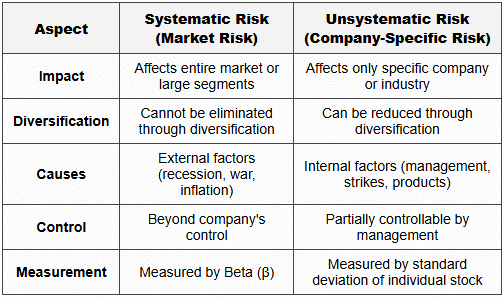
- Cannot be eliminated: This risk cannot be removed through diversification. Even if you invest in many different stocks, market risk still affects your portfolio.
- Affects all securities: When the overall market falls, most stocks fall together regardless of company performance.
- External factors: Caused by events outside any company's control, such as economic recessions, political instability, or natural disasters.
- Beta measurement: Market risk is measured using Beta (β). A Beta greater than 1 means higher market risk. A Beta less than 1 means lower market risk.
1.2 Common Causes
- Economic recessions: When the economy slows down, consumer spending drops, affecting most companies negatively.
- War and political events: Elections, policy changes, or international conflicts create uncertainty in markets.
- Natural disasters: Floods, earthquakes, or pandemics affect business operations across sectors.
- Changes in interest rates: When central banks raise or lower interest rates, it impacts the entire market.
1.3 Example
During the COVID-19 pandemic in March 2020, stock markets worldwide crashed. Both good and bad companies saw their share prices fall. This happened because of market risk, not company-specific problems. Investors couldn't avoid this loss through diversification alone.
2. Company-Specific Risk (Unsystematic Risk)
Company-specific risk affects only a particular company or industry. It is also called unsystematic risk or idiosyncratic risk.
2.1 Key Characteristics
- Can be reduced: This risk can be significantly reduced through diversification. By investing in 15-20 different stocks across various sectors, you can minimize this risk.
- Affects specific securities: Only impacts the particular company or industry facing problems, not the entire market.
- Internal factors: Caused by events within the company or its specific industry.
- Controllable to some extent: Company management decisions can reduce or increase this risk.
2.2 Common Causes
- Poor management decisions: Bad strategy, mismanagement, or fraud by company leadership reduces stock value.
- Labor strikes: Worker protests or strikes stop production and hurt company profits.
- Product recalls: When a company recalls defective products, it faces losses and reputation damage.
- Regulatory issues: When a specific company violates regulations or loses licenses.
- Competition: New competitors taking away market share from a particular company.
2.3 Example
If a pharmaceutical company's new drug fails clinical trials, only that company's stock price falls. Other pharmaceutical companies and the broader market remain unaffected. Investors holding a diversified portfolio won't suffer major losses because this risk affects only one company.
2.4 Comparison: Systematic vs Unsystematic Risk
3. Liquidity Risk
Liquidity risk is the risk that you cannot sell your investment quickly at a fair price. It occurs when there are not enough buyers in the market.
3.1 Key Characteristics
- Difficulty in selling: You may have to wait a long time to find a buyer for your shares.
- Price impact: You may have to sell at a much lower price than expected to find buyers quickly.
- Low trading volume: Stocks with few daily trades have higher liquidity risk.
- Bid-ask spread: A large difference between buying price (ask) and selling price (bid) indicates poor liquidity.
3.2 Types of Stocks Based on Liquidity
- Highly liquid stocks: Large-cap companies like Reliance, TCS, or HDFC Bank trade in large volumes daily. You can buy or sell anytime at fair prices.
- Illiquid stocks: Small-cap or penny stocks have very few buyers. You may struggle to exit your position without accepting losses.
3.3 Example
You bought shares of a small company at ₹100 per share. When you want to sell after a few months, there are no buyers at ₹100. You may have to sell at ₹80 or ₹70 to find buyers. The ₹20-₹30 loss happened due to liquidity risk, not because the company performed badly.
3.4 How to Identify Liquidity Risk
- Check daily trading volume: Look for average daily volume. Higher volume means better liquidity.
- Observe bid-ask spread: Narrow spread indicates good liquidity. Wide spread signals liquidity problems.
- Market capitalization: Large-cap stocks generally have better liquidity than small-cap or micro-cap stocks.
4. Inflation Risk
Inflation risk, also called purchasing power risk, is the risk that inflation reduces the real value of your investment returns. Your money loses its buying power over time.
4.1 Understanding Inflation Risk
- Real return vs Nominal return: If your investment gives 8% return but inflation is 6%, your real return is only 2%.
- Formula: Real Return ≈ Nominal Return - Inflation Rate
- Erosion of value: If inflation is higher than your returns, you actually lose purchasing power despite positive returns.
- Long-term impact: Over many years, even moderate inflation significantly reduces money's value.
4.2 Which Investments Face Higher Inflation Risk
- Fixed deposits and bonds: These give fixed returns. When inflation rises, real returns fall or become negative.
- Cash holdings: Money kept in savings accounts loses value fastest during high inflation.
- Equities (stocks): Generally provide better protection against inflation. Companies can increase product prices during inflation, maintaining profits.
4.3 Example
You invest ₹1,00,000 in a fixed deposit giving 6% annual return. After one year, you have ₹1,06,000. However, if inflation was 7% that year, goods that cost ₹1,00,000 last year now cost ₹1,07,000. Your ₹1,06,000 cannot buy the same goods. You lost purchasing power despite earning positive returns.
4.4 Trap Alert - Common Mistake
Mistake: Students often think positive returns mean profit. Remember, you must always subtract inflation to calculate real profit. A 5% return with 6% inflation means you lost 1% in real terms.
5. Interest Rate Risk
Interest rate risk is the risk that changes in interest rates will affect your investment's value. This primarily affects bond prices but also impacts stock prices.
5.1 How Interest Rates Affect Investments
- Inverse relationship with bonds: When interest rates rise, existing bond prices fall. When interest rates fall, existing bond prices rise.
- Impact on stocks: Higher interest rates make borrowing expensive for companies. This can reduce their profits and stock prices.
- Sector-specific impact: Banking, real estate, and automobile sectors are particularly sensitive to interest rate changes.
5.2 Why Bond Prices Fall When Interest Rates Rise
Suppose you bought a bond paying 6% interest. If new bonds now pay 8% interest, nobody wants your 6% bond at its original price. You must sell it at a discount to attract buyers. Hence, your bond's market value falls.
5.3 Impact on Different Investments
- Fixed-income securities: Bonds, debentures, and fixed deposits face direct interest rate risk.
- Banking sector stocks: Banks benefit from rising rates (higher lending margins) but may face lower demand for loans.
- Real estate stocks: Higher interest rates make home loans expensive. Fewer people buy homes, affecting real estate companies negatively.
- Growth stocks: High-growth technology stocks often fall when interest rates rise because future earnings become less valuable today.
5.4 Example
You bought a government bond for ₹1,000 that pays 6% annual interest (₹60 per year). The Reserve Bank of India then raises interest rates. New bonds now pay 8% (₹80 per year). Investors prefer new bonds. To sell your old bond, you must reduce its price to around ₹750-₹800 so buyers get similar effective returns.
5.5 Who Sets Interest Rates
- Reserve Bank of India (RBI): Sets the repo rate and reverse repo rate, which influence all other interest rates in the economy.
- Banks: Set their lending and deposit rates based on RBI's policy rates.
6. Currency Risk (Exchange Rate Risk)
Currency risk, also called foreign exchange risk or forex risk, is the risk that currency exchange rate movements will affect your investment returns. This applies when you invest in foreign assets or companies with international operations.
6.1 Key Characteristics
- Exchange rate fluctuations: The value of one currency changes relative to another currency over time.
- Two-way impact: Currency movements can either increase or decrease your returns.
- Volatility: Exchange rates can be highly unpredictable and change rapidly based on economic conditions.
6.2 Who Faces Currency Risk
- Foreign stock investors: Indians investing in US, European, or other foreign stocks face currency risk.
- Companies with imports/exports: Indian companies importing raw materials or exporting products face currency risk.
- IT sector stocks: Indian IT companies earn significant revenue in dollars. Rupee-dollar exchange rate changes affect their profits.
- Pharmaceutical exporters: Companies exporting medicines to the US or Europe face currency exposure.
6.3 How Currency Risk Works
Suppose you invest $1,000 in US stocks when $1 = ₹75 (total investment = ₹75,000). After one year, your investment grows 10% to $1,100. However, the rupee strengthens to $1 = ₹70. Your investment in rupees is ₹77,000 (₹1,100 × ₹70). Your return in rupees is only 2.67%, not 10%, because of unfavorable currency movement.
6.4 Currency Risk Example for Companies
An Indian IT company earns $10 million from US clients. When $1 = ₹80, they receive ₹800 million in India. If the rupee strengthens to $1 = ₹75, the same $10 million now equals only ₹750 million. The company loses ₹50 million due to currency risk, even though dollar revenues remained constant.
6.5 Favorable Currency Movements
Currency risk can also work in your favor. If you invested in US stocks and the dollar strengthens against the rupee, your rupee returns increase even if stock prices remain flat. A weaker rupee benefits Indian exporters and IT companies because their foreign earnings convert to more rupees.
6.6 Trap Alert - Currency Risk Misconception
Mistake: Beginners often ignore currency risk when looking at foreign investment returns. Always remember that foreign investments have two components: asset price change AND currency exchange rate change. Both together determine your final return in rupees.
7. Interrelationship Between Different Risks
Different types of investment risks often interact with each other. Understanding these connections helps in better risk management.
7.1 Connected Risks
- Inflation and Interest Rate Risk: Central banks raise interest rates to control high inflation. Rising rates then cause bond prices to fall.
- Interest Rate and Currency Risk: Higher interest rates in a country typically strengthen its currency as foreign investors bring money in.
- Market Risk and Liquidity Risk: During market crashes, liquidity dries up. Even normally liquid stocks become hard to sell without losses.
- Currency Risk and Market Risk: Currency depreciation can trigger market-wide panic, causing systematic risk for all stocks.
7.2 Risk Management Strategy
- Diversification: Reduces company-specific risk but cannot eliminate market risk.
- Asset allocation: Divide investments between stocks, bonds, gold, and cash to manage multiple risk types.
- Stay informed: Monitor RBI policy announcements, inflation data, and global economic news.
- Long-term perspective: Many risks average out over longer time periods. Short-term volatility matters less for long-term investors.
- Avoid illiquid stocks: Stick to stocks with good trading volumes, especially if you're a beginner.
Understanding these six types of investment risks-market risk, company-specific risk, liquidity risk, inflation risk, interest rate risk, and currency risk-is fundamental to becoming a successful investor. Each risk type requires different management strategies. While some risks can be reduced through diversification, others like market risk affect all investments. Smart investors acknowledge these risks, assess their own risk tolerance, and build portfolios accordingly. Remember that risk and return are connected: higher potential returns usually come with higher risks. The key is finding the right balance for your financial goals and comfort level.




