Micronutrients (Vitamins & Minerals)

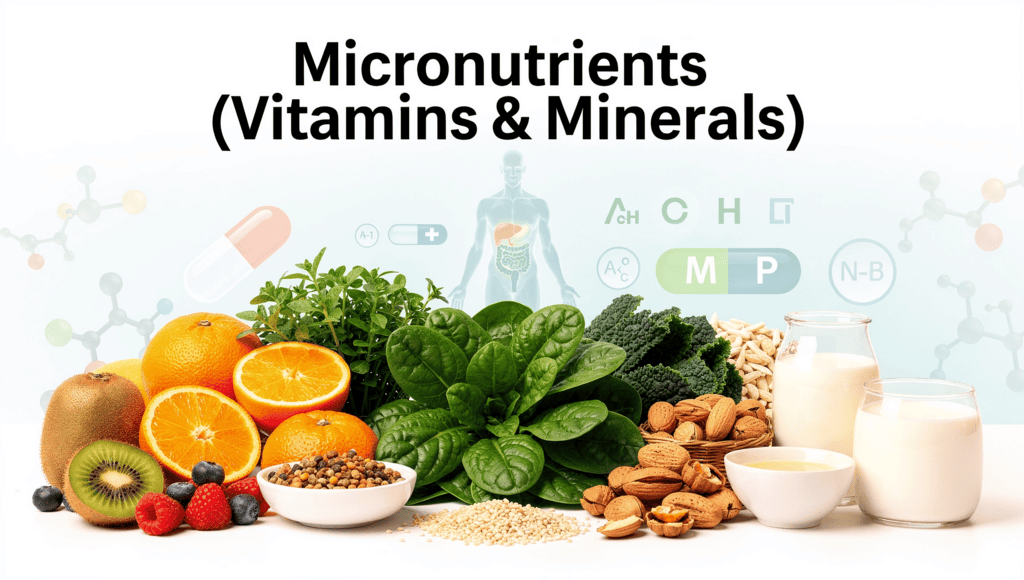
Micronutrients are essential nutrients required by the body in very small amounts (milligrams or micrograms). Unlike macronutrients (carbohydrates, proteins, fats), they provide no energy but are vital for growth, disease prevention, and overall health. There are two main types: vitamins and minerals. Understanding their classification, functions, and deficiency diseases is crucial for nutrition basics.
1. Vitamins
Vitamins are organic compounds that the body cannot produce in sufficient amounts. They must be obtained from food. Based on solubility, vitamins are classified into two categories.
1.1 Fat-Soluble Vitamins
These vitamins dissolve in fats and oils. They can be stored in the body's fatty tissues and liver for future use. Excess intake can lead to toxicity as they accumulate in the body.
- Vitamin A (Retinol): Essential for vision, especially in dim light. Maintains healthy skin and mucous membranes. Sources include liver, fish oils, milk, carrots, and green leafy vegetables.
- Vitamin D (Calciferol): Known as the "sunshine vitamin" as skin produces it when exposed to sunlight. Helps in calcium absorption for strong bones and teeth. Sources include sunlight, fish liver oils, egg yolk, and fortified milk.
- Vitamin E (Tocopherol): Acts as an antioxidant protecting cells from damage. Important for skin health and immunity. Sources include vegetable oils, nuts, seeds, and green leafy vegetables.
- Vitamin K (Phylloquinone): Essential for blood clotting and wound healing. Also helps in bone health. Sources include green leafy vegetables, broccoli, and cabbage.
1.2 Water-Soluble Vitamins
These vitamins dissolve in water. The body cannot store them in large amounts. Excess is excreted through urine. They must be consumed regularly through diet.
- Vitamin B Complex:A group of 8 vitamins that work together for energy production and red blood cell formation.
- Vitamin B1 (Thiamine): Helps convert food into energy. Important for nerve function. Sources include whole grains, pulses, nuts, and pork.
- Vitamin B2 (Riboflavin): Needed for energy production and healthy skin. Sources include milk, eggs, green vegetables, and liver.
- Vitamin B3 (Niacin): Supports digestive system, skin, and nerve health. Sources include meat, fish, whole grains, and peanuts.
- Vitamin B6 (Pyridoxine): Important for protein metabolism and red blood cell formation. Sources include cereals, meat, and bananas.
- Vitamin B12 (Cobalamin): Essential for red blood cell formation and nerve function. Found only in animal foods like meat, fish, eggs, and milk.
- Folic Acid (Folate/B9): Crucial for DNA synthesis and cell division. Very important during pregnancy to prevent birth defects. Sources include green leafy vegetables, pulses, and citrus fruits.
- Vitamin C (Ascorbic Acid): Acts as an antioxidant. Helps in wound healing and iron absorption. Maintains healthy gums and blood vessels. Sources include citrus fruits (oranges, lemons), amla, tomatoes, and green peppers.
2. Minerals
Minerals are inorganic elements obtained from soil and water through plants and animals. They are essential for various body functions. Based on requirement, minerals are classified as macro-minerals (needed in larger amounts) and micro-minerals or trace elements (needed in tiny amounts).
2.1 Calcium (Ca)
Calcium is the most abundant mineral in the human body. About 99% of calcium is stored in bones and teeth.
- Functions: Builds and maintains strong bones and teeth. Essential for blood clotting. Required for muscle contraction and nerve signal transmission. Helps in maintaining normal heart rhythm.
- Sources: Milk and dairy products (cheese, yogurt, paneer), small fish with bones (sardines), green leafy vegetables, ragi, and soybean.
- Daily Requirement: Adults need approximately 1000 mg per day. Growing children, pregnant women, and elderly people need more (1200-1300 mg).
2.2 Iron (Fe)
Iron is a trace mineral but critical for life. It is a component of hemoglobin, the protein in red blood cells that carries oxygen throughout the body.
- Functions: Forms hemoglobin in red blood cells for oxygen transport. Component of myoglobin in muscles. Supports immune function and energy production.
- Types of Dietary Iron:
- Heme Iron: Found in animal foods (meat, fish, poultry). Better absorbed by the body (15-35% absorption rate).
- Non-Heme Iron: Found in plant foods (pulses, green leafy vegetables, jaggery). Lower absorption rate (2-20%). Vitamin C enhances its absorption.
- Sources: Liver, red meat, egg yolk, green leafy vegetables (spinach, fenugreek), pulses, jaggery, and dried fruits.
- Daily Requirement: Adult men need about 10 mg per day. Adult women need 20-30 mg due to menstrual blood loss. Pregnant women need even more.
2.3 Iodine (I)
Iodine is a trace mineral essential for thyroid gland function. The thyroid gland uses iodine to produce thyroid hormones.
- Functions: Required for production of thyroid hormones (T3 and T4). These hormones control metabolism, growth, and development. Critical for brain development in fetuses and young children.
- Sources: Iodized salt (most reliable source in India), sea fish, seafood, seaweed, and milk.
- Daily Requirement: Adults need approximately 150 micrograms per day. Pregnant and lactating women need 220-290 micrograms.
- Special Note: India has a National Iodine Deficiency Disorders Control Programme. Use of iodized salt is mandatory in most states.
2.4 Zinc (Zn)
Zinc is a trace mineral involved in numerous aspects of cellular metabolism. It supports immune function and growth.
- Functions: Boosts immune system function. Essential for wound healing and tissue repair. Required for normal growth and development. Helps in proper sense of taste and smell. Important for DNA synthesis.
- Sources: Meat, poultry, fish, milk, cheese, whole grains, pulses, and nuts.
- Daily Requirement: Adult men need about 10-12 mg per day. Adult women need 8-10 mg. Requirements increase during pregnancy and lactation.
3. Deficiency Diseases
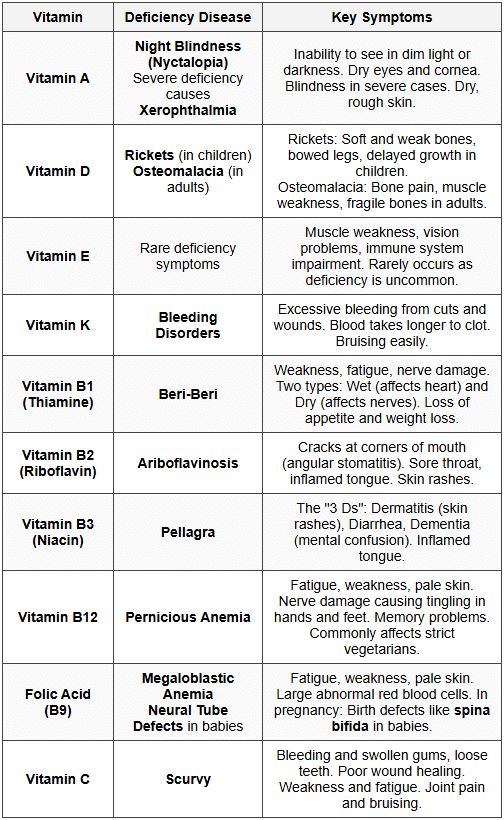
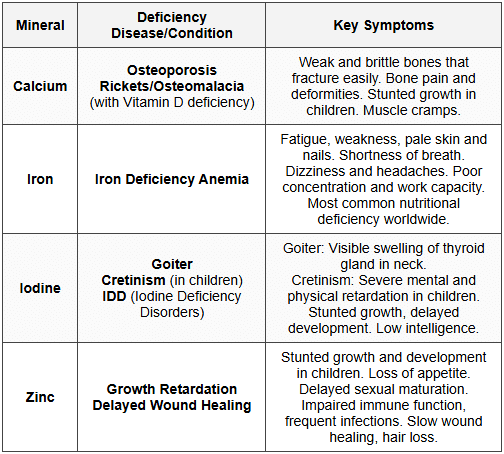
When the body does not get adequate amounts of specific micronutrients over time, deficiency diseases develop. These diseases have specific symptoms and can be prevented or cured by supplying the deficient nutrient.
3.1 Vitamin Deficiency Diseases
3.2 Mineral Deficiency Diseases
3.3 Special Vulnerable Groups
Certain groups are more prone to micronutrient deficiencies and need special attention:
- Pregnant Women: Need extra iron, folic acid, calcium, and iodine for the growing fetus and to prevent maternal anemia.
- Lactating Mothers: Require increased amounts of vitamins and minerals as nutrients pass to the baby through breast milk.
- Infants and Children: Rapid growth phase requires adequate micronutrients, especially iron, calcium, vitamin D, and iodine for proper development.
- Adolescents: Growth spurts increase requirements for iron (especially girls due to menstruation), calcium, and vitamins.
- Elderly: Reduced absorption capacity and dietary intake make them vulnerable to calcium, vitamin D, and vitamin B12 deficiencies.
- Vegetarians/Vegans: At higher risk for vitamin B12, iron (heme iron), and zinc deficiencies as these are more bioavailable in animal foods.
3.4 Prevention Strategies
- Balanced Diet: Consume a variety of foods from all food groups to ensure adequate intake of all micronutrients.
- Food Fortification: Adding micronutrients to commonly consumed foods (e.g., iodized salt, iron-fortified wheat flour, vitamin A-fortified oil).
- Supplementation: Iron and folic acid tablets for pregnant women. Vitamin A supplementation for children. Calcium and vitamin D for elderly.
- Nutrition Education: Awareness about importance of micronutrients and sources helps people make better food choices.
- Government Programs: National programs like Weekly Iron and Folic Acid Supplementation (WIFS) for adolescents, Vitamin A prophylaxis for children.
4. Common Student Mistakes & Confusing Points
- Trap: Students often confuse Rickets (children) with Osteomalacia (adults). Both are caused by vitamin D and/or calcium deficiency, but occur at different ages.
- Trap: Night blindness is an early symptom of vitamin A deficiency. Xerophthalmia is the severe form that can lead to complete blindness. They are not separate diseases.
- Trap: Goiter is the visible swelling of the thyroid gland due to iodine deficiency. Cretinism is severe mental and physical retardation in children born to iodine-deficient mothers. Both come under IDD (Iodine Deficiency Disorders).
- Trap: Anemia is not always due to iron deficiency. Vitamin B12 deficiency causes Pernicious Anemia. Folic acid deficiency causes Megaloblastic Anemia. However, iron deficiency anemia is the most common type.
- Confusion Alert: Fat-soluble vitamins (A, D, E, K) can be stored and excess can be toxic. Water-soluble vitamins (B complex, C) cannot be stored and excess is excreted, so toxicity is rare.
- Confusion Alert: Vitamin D is unique as the body can produce it with sunlight exposure. It is sometimes called a "pro-hormone" rather than just a vitamin.
- Memory Tip: Remember fat-soluble vitamins as "ADEK" (A, D, E, K). All others are water-soluble.
- Memory Tip: Pellagra and the 3 Ds (Dermatitis, Diarrhea, Dementia) is a classic exam question pattern.
Understanding micronutrients is fundamental to nutrition science. While needed in small amounts, their deficiency causes serious health problems. A balanced diet with variety ensures adequate intake of all vitamins and minerals. Special attention should be given to vulnerable groups like pregnant women, children, and elderly. Government programs like iodized salt and iron-folic acid supplementation have significantly reduced deficiency diseases in India. For exam preparation, focus on classification of vitamins, functions of key minerals (calcium, iron, iodine, zinc), and the deficiency diseases with their characteristic symptoms.
FAQs on Micronutrients (Vitamins & Minerals)
| 1. What are vitamins and why are they important for health? |  |
| 2. What are minerals and how do they differ from vitamins? | |
| 3. What are some common deficiency diseases caused by a lack of vitamins and minerals? | |
| 4. What are some common mistakes students make when studying micronutrients? | |
| 5. How can one ensure they are getting enough vitamins and minerals in their diet? | |



