Rapid Revision: Beyond Our Naked Eye


Introduction
- This chapter introduces the microscopic world of living organisms that cannot be seen with the naked eye. It explains cells as the basic unit of life, the structure and diversity of cells, microorganisms and their roles in nature, human life, food production, and environmental balance.
- The invention of lenses and microscopes made it possible to observe this hidden world.
Discovery of the Microscopic World
Human eyes can see only objects above a certain size. The development of lenses and microscopes allowed scientists to observe tiny structures and organisms.
Important contributions:
- Robert Hooke observed cork under a microscope and introduced the term "cell."
- Antonie van Leeuwenhoek observed bacteria and other microorganisms and is known as the Father of Microbiology.
What Is a Cell?
A cell is the basic structural and functional unit of life. All living organisms are made of cells.
Basic Parts of a Cell
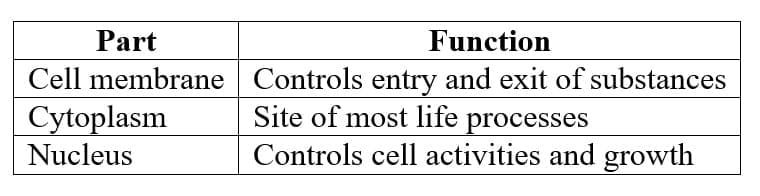
Some plant cells also have a cell wall outside the cell membrane, which provides rigidity and support.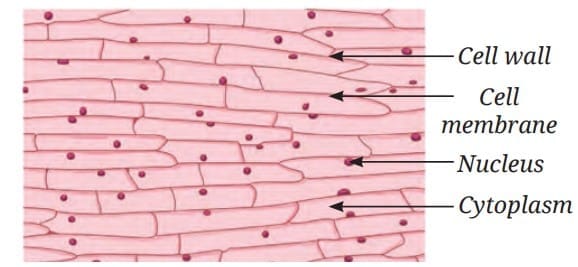 Structure of onion peel under the microscope
Additional Structures in Plant Cells
Plant cells contain special components not found in animal cells:
- Cell wall for strength
- Chloroplasts for photosynthesis
- Large vacuole for storage and maintaining shape
Animal cells generally lack a cell wall and large vacuole.
Variation in Cell Shape and Structure
Cells differ in size, shape, and structure depending on their function.
Examples:
- Muscle cells are spindle-shaped and help in movement.
- Nerve cells are long and branched to transmit messages quickly.
- Cheek cells are flat and form protective linings.
- Some plant cells form tubes for transporting water.
Thus, structure is related to function.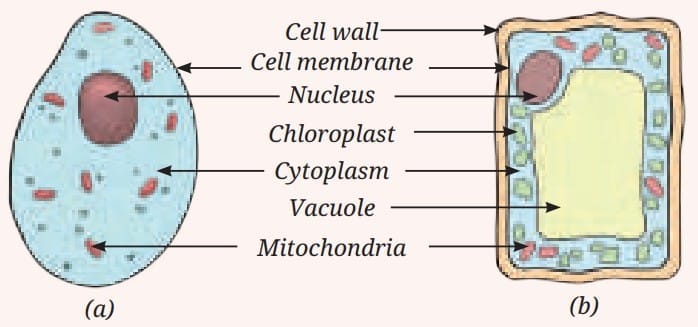 A schematic drawing of (a) An animal cell and (b) A plant cell. (The colours are to show different parts of the cell)
Levels of Organisation in Living Organisms
Living bodies are organised in increasing levels of complexity.
Cell → Tissue → Organ → Organ system → Organism
A group of similar cells forms a tissue. Different tissues combine to form organs, and organs work together as systems.
Multicellular organisms such as plants and animals begin life from a single cell that divides repeatedly.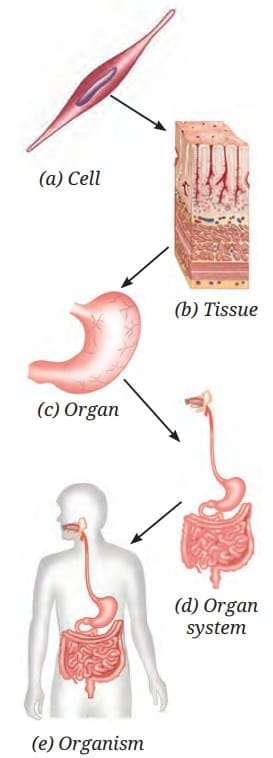
Microorganisms
Microorganisms are extremely small living organisms that cannot be seen without a microscope.
They may be:
- Unicellular (single-celled), such as bacteria and protozoa
- Multicellular, such as some fungi and algae
They are found everywhere - in air, water, soil, extreme environments, and even inside the human body.
Types of Microorganisms
Major groups of microorganisms include:
- Bacteria
- Fungi
- Protozoa
- Some algae
Viruses are microscopic but are not considered true living cells because they reproduce only inside host cells.
Presence of Microbes in Everyday Life
Microorganisms exist in food, air, soil, water, and living bodies. Food spoilage such as rotting fruits occurs due to microbial growth. Microbes can survive even in extreme conditions like hot springs or icy regions.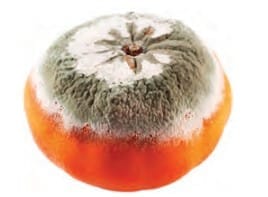 Fruit with microorganism growing on it
Beneficial Roles of Microorganisms
1. Decomposition and Environmental Cleaning
- Microorganisms such as bacteria and fungi break down dead plants, animals, and organic waste into simpler substances. This process forms manure and returns nutrients to the soil.
- This process helps in recycling matter in nature.
2. Production of Biogas
- Some microorganisms decompose waste in the absence of oxygen and produce gases rich in methane. This gas can be used as a fuel for cooking, heating, and electricity generation.
3. Food Production and Fermentation
Microorganisms play an important role in making many foods.
Yeast in Dough
Yeast is a unicellular fungus that grows in warm conditions. It breaks down sugar during respiration and releases carbon dioxide gas, which makes dough rise and become soft and fluffy. It also produces a small amount of alcohol that causes a distinct smell.
Used in making:
- Bread
- Cakes
- Bhatura
- Other baked foods
Bacteria in Curd Formation
Lactobacillus bacteria convert milk into curd by fermenting lactose (milk sugar) into lactic acid. Warm conditions favor this process.
4. Nitrogen Fixation
Some bacteria such as Rhizobium live in root nodules of leguminous plants like peas and beans. They convert atmospheric nitrogen into forms usable by plants, improving soil fertility naturally.
5. Microalgae
Microalgae are microscopic plant-like organisms found in water, soil, and air.
Their importance includes:
- Producing oxygen through photosynthesis
- Serving as food for aquatic organisms
- Providing nutritional supplements (e.g., Spirulina)
- Cleaning water
- Producing biofuels
They contribute more than half of the Earth's oxygen supply.
Harmful Effects of Microorganisms
Some microorganisms cause diseases in plants, animals, and humans. Viruses, bacteria, fungi, and protozoa may act as pathogens. Food spoilage and infections are common harmful effects.
Cell as the Basic Unit of Life
All living organisms are made of cells. Cells perform all essential life functions.
Two major categories of organisms:
- Unicellular organisms - consist of a single cell that performs all life functions
- Multicellular organisms - consist of many specialized cells working together
Examples:
- Bacteria and protozoa - unicellular
- Plants and animals - multicellular
- Yeast - unicellular fungus
- Mould - multicellular fungus
Differences Among Cells of Various Organisms
Key differences:
- Plant, fungal, and bacterial cells have a cell wall
- Animal cells lack a cell wall
- Bacteria do not have a true nucleus; they have a nucleoid region
- Chloroplasts are present only in plant cells
Important Characteristics of Cells
- Cells vary in size and shape
- Shape relates to function
- Cells are surrounded by a membrane
- Cytoplasm contains substances necessary for life
- Nucleus controls activities
FAQs on Rapid Revision: Beyond Our Naked Eye
| 1. What is the significance of the invisible living world? |  |
| 2. How do microscopes enhance our understanding of microorganisms? | |
| 3. What are the basic structures of a cell? | |
| 4. What roles do microorganisms play in the environment? | |
| 5. How do cells vary among different types of microorganisms? | |