Rapid Revision: Exploring The Investigative World Of Science


Introduction
This chapter explains that science is not merely a collection of facts but a method of understanding the world through curiosity, observation, investigation, and logical reasoning. Students are encouraged to ask questions about everyday phenomena and learn how scientists find answers through systematic study.
Science develops from simple questions such as "Why?" and "How?" and progresses through careful observation, experimentation, and explanation. Investigation allows learners to become active participants in discovering knowledge rather than passive recipients.
Scientific Investigation
Scientific investigation is a structured way of finding answers to questions. It involves identifying a problem, planning how to test it, collecting evidence, and drawing conclusions based on observations.
Key steps in scientific investigation include:
- Asking a focused scientific question
- Planning how to investigate the question
- Identifying what can be changed (variables)
- Observing and measuring outcomes
- Recording results carefully
- Drawing conclusions based on evidence
Science works best when careful observation is combined with creative thinking.
Controlled Experiments
Experiments must be designed so that only one factor is changed at a time while all other conditions remain the same. This helps in identifying the true cause of the observed effect.
Important Terms
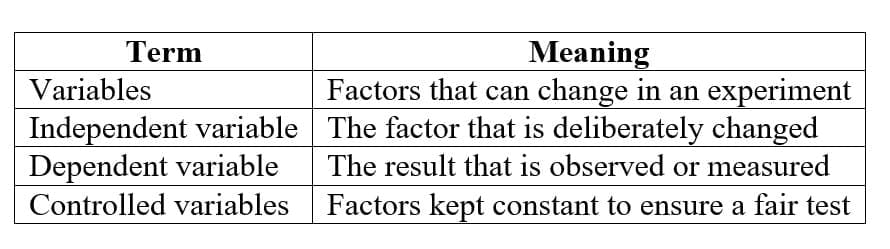
Maintaining control over variables is essential for reliable scientific results.
Science Is Everywhere
Science does not require a sophisticated laboratory. Everyday surroundings provide many opportunities for observation and investigation. Simple household activities can lead to meaningful scientific questions.
Curiosity, careful observation, and systematic thinking are the essential tools of a scientist.
Overview of Topics
The chapter introduces the major themes that will be studied during the year, showing how science connects different aspects of the natural world.
Microorganisms and Health
Tiny organisms exist everywhere, including in water and inside the human body. Some microorganisms are beneficial, such as those that help digestion or produce medicines, while others cause diseases.
Maintaining health depends on several factors:
- Nutritious food
- Physical exercise
- Medicines
- Vaccinations
Electricity and Its Effects
Electric current is widely used in daily life and produces different effects.

These effects help many devices function.
Force and Motion
Force can change the motion of objects in several ways. It can:
- Increase speed
- Decrease speed
- Change direction
- Stop moving objects
Examples include a thrown ball returning to the ground and a car stopping when brakes are applied.
Pressure and Weather
Pressure refers to how force is distributed over an area. Differences in air pressure cause movement of air, leading to weather phenomena.
- Small pressure differences produce gentle winds
- Large pressure differences produce strong winds
- Extreme differences can lead to storms and cyclones

Matter and Particles
All matter is made up of tiny particles that are constantly in motion.
- In solids, particles are closely packed and move very little
- In liquids, particles move more freely
- In gases, particles move rapidly and spread out
Understanding particle behavior helps explain many physical phenomena.
Classification of Materials
Materials can be grouped based on their composition.

Solutions are formed when one substance dissolves in another, such as sugar in tea.
Light
Light interacts with matter in different ways.
- Reflection occurs when light bounces off surfaces
- Refraction occurs when light bends while passing through lenses or different media
These properties help explain image formation in mirrors, lenses, and corrective spectacles. Even rough surfaces and the Moon reflect light.
Moon Phases and Calendars
The Moon appears to change shape because different portions of it are illuminated as it moves relative to the Earth and Sun. Observations of lunar cycles helped early humans develop calendars, linking timekeeping on Earth to celestial motions.
Ecosystems and Interdependence
All living organisms are connected to their environment and to one another. Air, water, sunlight, and interactions with other organisms form ecosystems that support life.
Every organism, from microscopic insects to large animals and plants, depends on these environmental factors.
Earth and Climate
Earth supports life because of several favorable conditions:
- Appropriate distance from the Sun
- Presence of liquid water
- Atmosphere containing oxygen
- Protection from harmful ultraviolet radiation
Human activities can disturb this balance, leading to climate change and environmental challenges.
Importance of Scientific Thinking
Scientific methods are essential for understanding environmental problems and finding solutions. Observing, measuring, and experimenting help scientists study changes on Earth and guide actions to protect the planet.
FAQs on Rapid Revision: Exploring The Investigative World Of Science
| 1. What is investigative science? |  |
| 2. What are the key steps involved in the scientific method? | |
| 3. Why is it important to use controlled experiments in investigative science? | |
| 4. How does data analysis contribute to scientific investigations? | |
| 5. What role does peer review play in the field of investigative science? | |