CBSE Class 6 > Class 6 Notes > Social Studies > Rapid Revision: Oceans And Continents
Rapid Revision: Oceans And Continents


1. Earth - The Blue Planet
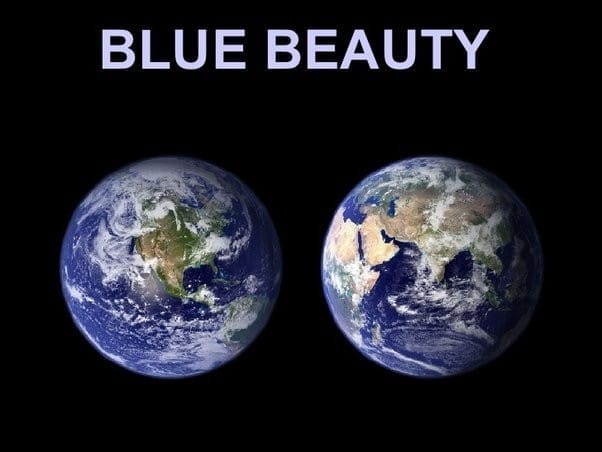
- When viewed from space, Earth appears mostly blue because water covers the majority of its surface. Nearly three-fourths of the planet is covered by water, while land occupies a little over one-fourth. The large water bodies are called oceans, and the large continuous landmasses are called continents.
- Oceans and continents together shape climate, ecosystems, and human life. They influence rainfall, temperature patterns, agriculture, biodiversity, and settlement.
2. Distribution of Water and Land
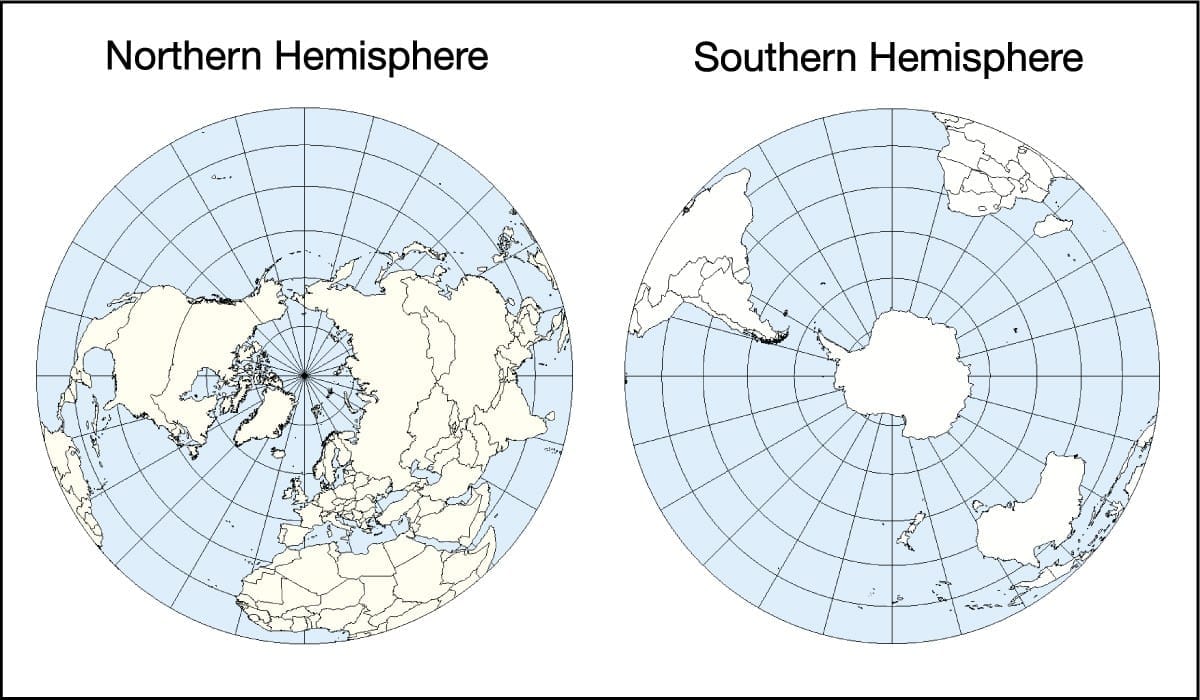
- Water and land are unevenly distributed across the planet. The Northern Hemisphere has more land, while the Southern Hemisphere has more water. Despite being shown separately on maps, all oceans are interconnected and form one continuous global ocean.
- Most of Earth's water is salty seawater. Freshwater forms only a small portion and is found in glaciers, rivers, lakes, underground sources, and the atmosphere. This limited availability of freshwater explains global concerns about water scarcity despite the abundance of water on Earth.
3. The Five Oceans of the World
Although interconnected, oceans are conventionally divided into five major oceans.
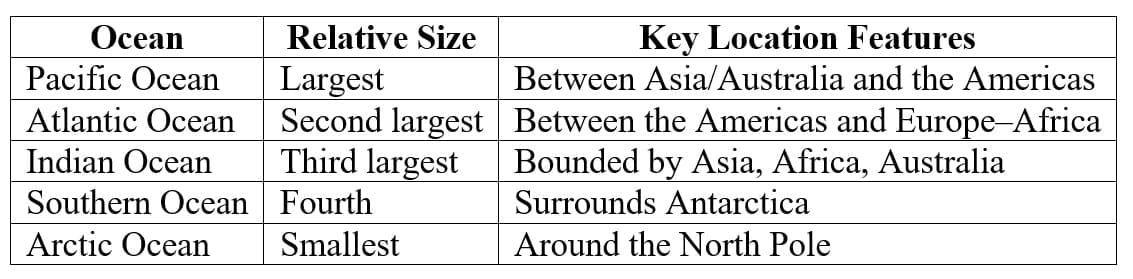
- The Pacific Ocean is the largest, while the Arctic Ocean is the smallest.
- India is bordered by the Indian Ocean, with the Arabian Sea to the west and the Bay of Bengal to the east.
4. Oceans and Marine Life
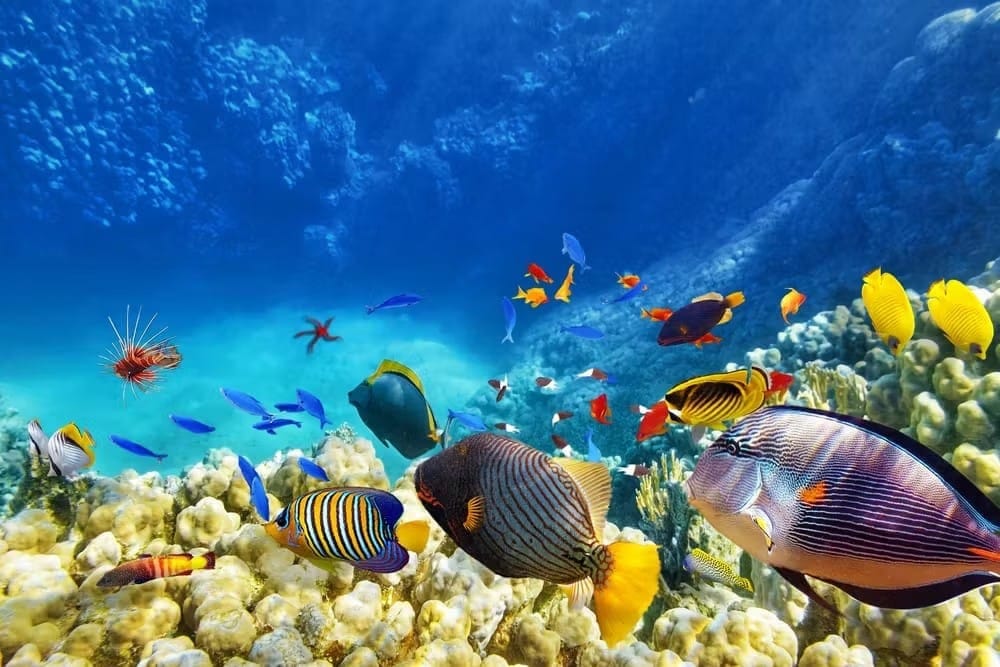
- Oceans support immense biodiversity. Marine flora includes algae and seaweeds, while marine fauna includes fish, dolphins, whales, corals, and numerous deep-sea organisms. Life exists from the sunlit surface to the dark ocean depths, each zone having unique organisms.
- Oceans are also vital for producing oxygen and regulating the planet's climate. More than half of the world's oxygen is generated by oceanic plant life, making oceans essential for sustaining life on Earth.
5. Oceans and Human Life
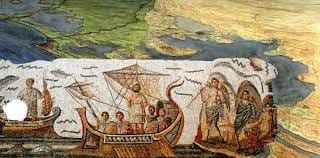
- Oceans have shaped human history and civilisation. They have served as routes for migration, trade, cultural exchange, and exploration. Coastal communities depend heavily on oceans for food, livelihoods, and transportation.
- Oceans also influence weather systems. Monsoon rains, for example, originate over the ocean and are crucial for agriculture in countries like India.
6. Ocean-Related Natural Disasters
- While oceans sustain life, they can also generate destructive events.
- Cyclones are powerful storms formed over warm ocean waters, bringing strong winds and heavy rainfall. Tsunamis are massive sea waves caused by underwater earthquakes or volcanic eruptions, capable of devastating coastal regions.
- Such disasters highlight both the power of oceans and the need for preparedness and early warning systems.
7. Continents - Major Landmasses
- A continent is a very large continuous expanse of land. There is no single universally agreed number of continents because some landmasses can be grouped differently.
However, the most widely accepted classification recognizes seven continents.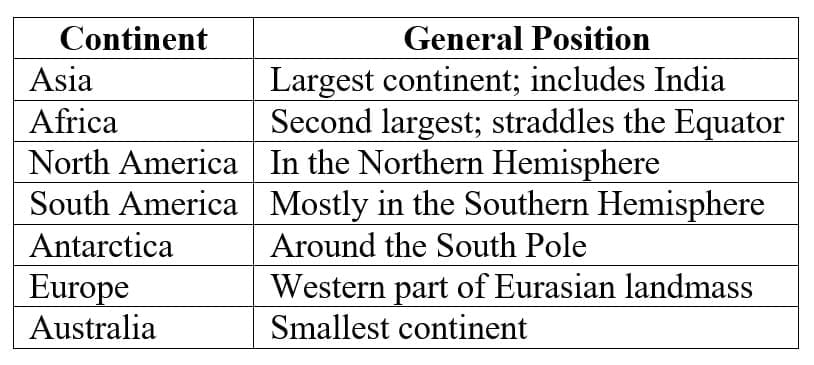
- Asia is the largest continent, while Australia is the smallest. Europe and Asia together form a single landmass called Eurasia, though they are treated as separate continents for historical and cultural reasons.
8. Relative Size of Continents
- Continents vary greatly in size and population. Antarctica is large but sparsely populated due to extreme cold, while Asia supports the largest human population.
- North America and South America together are sometimes referred to as the Americas, as they form one continuous landmass connected by a narrow isthmus.
9. Islands
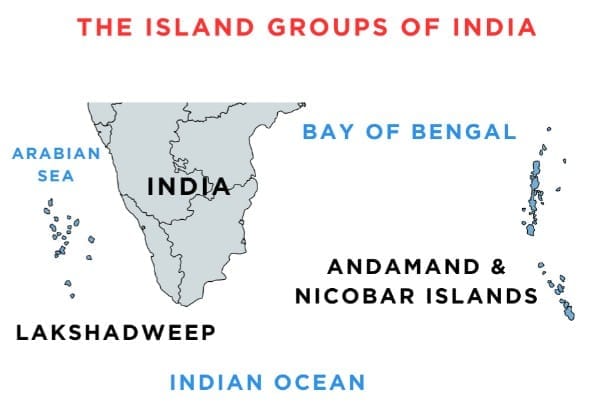
An island is a piece of land surrounded by water on all sides. Unlike continents, islands are smaller landmasses. Greenland is the largest island in the world. India has over a thousand islands, including two major groups:
- Andaman and Nicobar Islands in the Bay of Bengal
- Lakshadweep Islands in the Arabian Sea
Islands can be formed through volcanic activity, coral growth, or geological processes.
10. Oceans, Climate and Environment
- Oceans play a crucial role in the Earth's climate system. They store heat, influence wind patterns, drive rainfall cycles, and regulate global temperatures. Without oceans, the planet would be largely dry and inhabitable.
- Human activities are increasingly harming marine ecosystems. Plastic pollution, oil spills, industrial waste, and overfishing threaten marine life and disrupt ecological balance. Protecting oceans is essential for the future of life on Earth.
The document Rapid Revision: Oceans And Continents is a part of the Class 6 Course Social Studies for Class 6.
All you need of Class 6 at this link: Class 6
FAQs on Rapid Revision: Oceans And Continents
| 1. What are the main features of Earth as the Blue Planet? |  |
Ans. Earth is often referred to as the Blue Planet due to its abundance of water, covering approximately 71% of its surface. The oceans play a crucial role in supporting life, regulating climate, and influencing weather patterns. The presence of water in various forms, such as oceans, rivers, and lakes, is essential for sustaining ecosystems and human activities.
| 2. How do maps help us understand our world? | |
Ans. Maps are vital tools that represent geographical features and help us understand spatial relationships between different locations. They provide information about topography, distances, and landmarks, allowing us to navigate and explore our environment effectively. Understanding maps also aids in recognising the distribution of resources and planning for various activities, like travel and urban development.
| 3. What impact did the tsunami of 2004 have on disaster management practices? | |
Ans. The tsunami of 2004 significantly influenced disaster management approaches worldwide. It highlighted the need for improved early warning systems, effective evacuation plans, and better community preparedness. In its aftermath, many countries strengthened their disaster response frameworks, invested in technology for monitoring seismic activities, and conducted public awareness campaigns to educate communities about tsunami risks and safety measures.
| 4. What types of water bodies are found on Earth? | |
Ans. Earth hosts various types of water bodies, including oceans, seas, rivers, lakes, and ponds. Oceans are the largest bodies of saltwater, while seas are smaller and partially enclosed by land. Rivers are flowing bodies of freshwater that often feed into lakes or oceans, and lakes are substantial inland bodies of water. Each type of water body plays a distinct role in the ecosystem and supports diverse forms of life.
| 5. How do continents and islands differ in terms of geography? | |
Ans. Continents are large landmasses that are significant in size and are usually separated by oceans, whereas islands are smaller landforms surrounded by water. Continents can host a variety of ecosystems, climates, and human populations, while islands may have unique biodiversity and cultural characteristics due to their isolation. Both play important roles in the Earth's geography and ecology.
About this Document

4.61/5 Rating

Apr 29, 2026 Last updated
Related Exams
Document Description: Rapid Revision: Oceans And Continents for Class 6 2026 is part of Social Studies for Class 6 preparation. The notes and questions for Rapid Revision: Oceans And Continents have been prepared according to the Class 6 exam syllabus. Information about Rapid Revision: Oceans And Continents covers topics like and Rapid Revision: Oceans And Continents Example, for Class 6 2026 Exam. Find important definitions, questions, notes, meanings, examples, exercises and tests below for Rapid Revision: Oceans And Continents.
Introduction of Rapid Revision: Oceans And Continents in English is available as part of our Social Studies for Class 6 for Class 6 & Rapid Revision: Oceans And Continents in Hindi for Social Studies for Class 6 course. Download more important topics related with notes, lectures and mock test series for Class 6 Exam by signing up for free. Class 6: Rapid Revision: Oceans And Continents
Description
Rapid Revision: Oceans And Continents of SST to help you remember important concepts with short tricks. Start learning for Class 6 exam & improve retention with EduRev.
Information about Rapid Revision: Oceans And Continents
In this doc you can find the meaning of Rapid Revision: Oceans And Continents defined & explained in the simplest way possible. Besides explaining types of Rapid Revision: Oceans And Continents theory, EduRev gives you an ample number of questions to practice Rapid Revision: Oceans And Continents tests, examples and also practice Class 6 tests



Related Searches
Sample Paper, Objective type Questions, shortcuts and tricks, Rapid Revision: Oceans And Continents, Rapid Revision: Oceans And Continents, ppt, Free, mock tests for examination, Rapid Revision: Oceans And Continents, video lectures, Summary, Semester Notes, MCQs, study material, practice quizzes, past year papers, Exam, Previous Year Questions with Solutions, Extra Questions, Important questions, Viva Questions, pdf ;