Commerce Exam > Commerce Notes > CBSE PYQs: Planning - 2025
CBSE PYQs: Planning - 2025

Q1. Kavi works as a Marketing Manager in stationery mart. It deals in various types of stationery items for many schools across the country. When new session starts in schools, Kavi forecasts the sales of different stationery products for each school for every month. All items are represented in numbers so that it becomes easier for him to compare the actual sales with expected sales.
The type of plan discussed above is: (1 Mark)
(A) Strategy
(B) Policy
(C) Programme
(D) Budget
The type of plan discussed above is: (1 Mark)
(A) Strategy
(B) Policy
(C) Programme
(D) Budget
Answer: (D)
Solution: A Budget is defined as a statement of expected results expressed in numerical terms. It is a plan that quantifies future facts and figures. Since Kavi forecasts sales for each school in numbers and uses these numbers to compare actual sales with expected sales, he is using a budget. Furthermore, a budget acts as a control device, making it easier to compare actual figures with expected figures and take subsequent corrective action.
(NCERT Topic Reference: Types of Plans: Budget)
Q2. Assertion (A): Planning involves looking ahead and preparing for the future. (1 Mark)
Reason (R): The purpose of planning is to meet future events effectively to the best advantage of an organization.
Choose the correct alternative from the options given below:
(A) Both Assertion (A) and Reason (R) are true and Reason (R) is the correct explanation of Assertion (A).
(B) Both Assertion (A) and Reason (R) are true, but Reason (R) is not the correct explanation of Assertion (A).
(C) Assertion (A) is true, but Reason (R) is false.
(D) Assertion (A) is false, but Reason (R) is true.
Reason (R): The purpose of planning is to meet future events effectively to the best advantage of an organization.
Choose the correct alternative from the options given below:
(A) Both Assertion (A) and Reason (R) are true and Reason (R) is the correct explanation of Assertion (A).
(B) Both Assertion (A) and Reason (R) are true, but Reason (R) is not the correct explanation of Assertion (A).
(C) Assertion (A) is true, but Reason (R) is false.
(D) Assertion (A) is false, but Reason (R) is true.
Answer: (A)
Solution: Planning is considered futuristic as it essentially involves looking ahead and preparing for the future (Assertion A is true). The very purpose of planning is to anticipate future events and conditions so that managerial responses can be developed to meet these future events effectively to the best advantage of an organization (Reason R is true). Since the purpose (R) clearly explains why planning is concerned with the future (A), Reason (R) is the correct explanation of Assertion (A).
(NCERT Topic Reference: Features of Planning: Planning is futuristic)
Q3. Read the following statements carefully: (1 Mark)
Statement I: A rule reflects a managerial decision that a certain action must or must not be taken.
Statement II: A rule allows flexibility or discretion. In the light of the given statements, choose the correct alternative from the following: (A) Both Statement I and Statement II are true.
(B) Both Statement I and Statement II are false.
(C) Statement I is true and Statement II is false.
(D) Statement I is false and Statement II is true.
Statement I: A rule reflects a managerial decision that a certain action must or must not be taken.
Statement II: A rule allows flexibility or discretion. In the light of the given statements, choose the correct alternative from the following: (A) Both Statement I and Statement II are true.
(B) Both Statement I and Statement II are false.
(C) Statement I is true and Statement II is false.
(D) Statement I is false and Statement II is true.
Answer: (C)
Solution: Rules are specific statements that inform exactly what must be done. Statement I is correct because a rule reflects a managerial decision that a certain action must or must not be taken. Statement II is false because rules do not allow for any flexibility or discretion; there is no compromise or change unless a policy decision is taken.
(NCERT Topic Reference: Types of Plans: Rule)
Q4. A leading newspaper company decided to increase its market share by 10%. After developing the premises, the company identified the following alternative courses of action to be adopted: (1 Mark)
(i) To have eco-friendly newspapers
(ii) To introduce specific sections for children
(iii) To have columns for increasing general awareness for competitive exams
(iv) To have international news on a daily basis
After identifying the above alternatives, a board meeting was called.
Identify from the following, the next step in the planning process which is to be taken in the board meeting.
(A) Follow-up action
(B) Implementing the plan
(C) Evaluating alternatives courses
(D) Selecting an alternative
(i) To have eco-friendly newspapers
(ii) To introduce specific sections for children
(iii) To have columns for increasing general awareness for competitive exams
(iv) To have international news on a daily basis
After identifying the above alternatives, a board meeting was called.
Identify from the following, the next step in the planning process which is to be taken in the board meeting.
(A) Follow-up action
(B) Implementing the plan
(C) Evaluating alternatives courses
(D) Selecting an alternative
Answer: (C)
Solution: The planning process follows a specific order: Setting Objectives, Developing Premises, Identifying alternative courses of action, Evaluating alternative courses, and then Selecting an alternative. The case states that the company has already completed 'developing premises' and 'identifying alternative courses'. The next logical step, before selecting the best plan, is for the board to weigh the pros and cons of each identified alternative, which is the step known as Evaluating alternative courses.
(NCERT Topic Reference: Planning Process: Evaluating alternative courses)
Q5. 'Monitoring plans is important to ensure that objectives are achieved' is one of the steps in the process of planning.
Identify the step from the following: (1 Mark)
(A) Setting objectives
(B) Developing premises
(C) Implementing the plan
(D) Follow-up action
Identify the step from the following: (1 Mark)
(A) Setting objectives
(B) Developing premises
(C) Implementing the plan
(D) Follow-up action
Answer: (D)
Solution: The last step in the planning process is the Follow-up action, which involves monitoring the plans to ensure they are being implemented and that activities are performed according to schedule. Monitoring the plans is essential to ensure that objectives are ultimately achieved.
(NCERT Topic Reference: Planning Process: Follow-up action)
Q6. Match the type of plan given in Column I with its meaning given in Column II. (1 Mark)
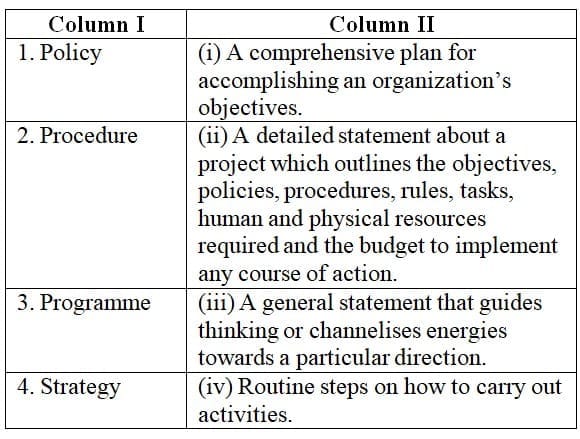 Choose the correct option from the following :
(A) 1-(iii), 2-(iv), 3-(ii), 4-(i)
(B) 1-(i), 2-(iii), 3-(iv), 4-(ii)
(C) 1-(ii), 2-(i), 3-(iii), 4-(iv)
(D) 1-(iv), 2-(ii), 3-(i), 4-(iii)
Choose the correct option from the following :(A) 1-(iii), 2-(iv), 3-(ii), 4-(i)
(B) 1-(i), 2-(iii), 3-(iv), 4-(ii)
(C) 1-(ii), 2-(i), 3-(iii), 4-(iv)
(D) 1-(iv), 2-(ii), 3-(i), 4-(iii)
Answer: (A) 1 - (iii), 2 - (iv), 3 - (ii), 4 - (i)
Solution:
(NCERT Topic Reference: Types of Plans)
Q7. Which of the following is not a limitation of planning function of management? (1 Mark)
(A) Planning leads to rigidity.
(B) Planning reduces creativity.
(C) Planning guarantees success.
(D) Planning may not work in a dynamic environment.
(A) Planning leads to rigidity.
(B) Planning reduces creativity.
(C) Planning guarantees success.
(D) Planning may not work in a dynamic environment.
Answer: (C)
Solution: Planning does not guarantee success; managers relying on previously successful plans can lead to failure. Planning leads to rigidity, reduces creativity, and may not work in a dynamic environment are all actual limitations of the planning function.
(NCERT Topic Reference: Limitations of Planning)
Q8. Read the following statements carefully: (1 Mark)
Statement I: A single-use plan is used for activities that occur regularly over a period of time.
Statement II: Policies are a general form of standing plans that specify the organisation's response to a certain situation. In the light of the given statements, choose the correct alternative from the following:
(A) Statement I is true and Statement II is false.
(B) Statement I is false and Statement II is true.
(C) Both Statement I and Statement II are true.
(D) Both Statement I and Statement II are false.
Statement I: A single-use plan is used for activities that occur regularly over a period of time.
Statement II: Policies are a general form of standing plans that specify the organisation's response to a certain situation. In the light of the given statements, choose the correct alternative from the following:
(A) Statement I is true and Statement II is false.
(B) Statement I is false and Statement II is true.
(C) Both Statement I and Statement II are true.
(D) Both Statement I and Statement II are false.
Answer: (B)
Solution:
Statement I is false: A single-use plan is developed for a one-time event or project, meaning they are for non-recurring situations. Activities that occur regularly over a period of time are covered by Standing Plans.
Statement II is true: Policies are general forms of standing plans that specify the organisation's response to a certain situation.
(NCERT Topic Reference: Types of Plans: Single-use and Standing plans)
Q9. Explain the following features of planning:
(i) Planning involves decision-making.
(ii) Planning is pervasive. (3 Marks)
(i) Planning involves decision-making.
(ii) Planning is pervasive. (3 Marks)
Answer:
(i) Planning involves decision-making: Planning necessitates making a choice among various alternative courses of action and activities. If only one goal or one course of action existed, there would be no requirement for planning. Planning, therefore, requires the thorough examination and evaluation of all available alternatives to select the most appropriate one.(ii) Planning is pervasive: Planning is required throughout the organization, at all levels of management and in all departments. While the depth and focus of planning differ-from overall organizational plans set by top management to day-to-day operational plans set by supervisors-the function itself must be performed everywhere.
(NCERT Topic Reference: Features of Planning)
Q10. Explain the following types of plans:
(i) Method
(ii) Budget. (3 Marks)
(i) Method
(ii) Budget. (3 Marks)
Answer:
(i) Method: The method specifies the prescribed ways or manner in which a specific task (which is often one step of a procedure) must be performed, keeping the overall objective in mind. Selecting an appropriate method is crucial as it helps save time, money, and effort while increasing operational efficiency.(ii) Budget: A budget is a plan that is a statement of expected results expressed in numerical or quantitative terms. It quantifies future facts and figures, such as forecasting sales or projecting the required number of workers. A budget is also vital as a control device, allowing managers to compare actual performance against numerical expectations and take corrective action for deviations.
(NCERT Topic Reference: Types of Plans: Method and Budget)
Q11. Prachi is working as an academic counsellor for specially abled students at one of the top school to provide special support and guidance to these students. She clearly states in advance the methods of teaching and tackling the students. She ensures that the goals are clearly stated for each and every teacher so that they act as a guide for deciding what action should be taken and in which direction.
Her well laid plans will serve as a basis for coordinating the activities and efforts of teachers teaching different subjects to these students. It helps the teachers in bringing clarity of thought and action to their work.
Identify and explain the two points of importance of 'Planning' function of management highlighted in the above para. (4 Marks)
Her well laid plans will serve as a basis for coordinating the activities and efforts of teachers teaching different subjects to these students. It helps the teachers in bringing clarity of thought and action to their work.
Identify and explain the two points of importance of 'Planning' function of management highlighted in the above para. (4 Marks)
Answer:
(i) Planning reduces the risks of uncertainty: Planning requires managers to look ahead, anticipate changes, and predict future trends, thereby enabling them to deal with uncertain events. While changes in the dynamic business environment cannot be entirely eliminated, effective planning allows management to develop appropriate responses in advance.(ii) Planning facilitates decision making: Planning aids the manager by requiring the identification and evaluation of various alternative courses of action available. The manager evaluates the pros and cons of each alternative to select the most viable option. By setting targets and predicting future conditions, planning provides a rational approach to decision-making.
(NCERT Topic Reference: Importance of Planning)
Q12. Explain the following features of planning:
(i) Planning focuses on achieving objectives.
(ii) Planning is pervasive. (4 Marks)
(i) Planning focuses on achieving objectives.
(ii) Planning is pervasive. (4 Marks)
Answer:
(i) Planning focuses on achieving objectives: Planning is purposeful because organizations are established with a general purpose in view, and specific goals are set out in the plans. Planning involves setting objectives and formulating action plans to achieve them, making it meaningless unless it contributes to accomplishing predetermined organizational goals.(ii) Planning is pervasive: Planning is a function that is required at all levels of management-top, middle, and lowest-and in all departments of the organization. Although the scope of planning differs across levels (e.g., top management plans for the whole organization, while supervisors handle day-to-day operational planning), no function or level is exempt from the need for planning.
(NCERT Topic Reference: Features of Planning)
Q13. Explain the following points of importance of planning:
(i) Planning reduces the risks of uncertainty.
(ii) Planning facilitates decision-making. (4 Marks)
(i) Planning reduces the risks of uncertainty.
(ii) Planning facilitates decision-making. (4 Marks)
Answer:
(i) Planning reduces the risks of uncertainty: Planning enables a manager to anticipate changes and look ahead into the future. By deciding tasks beforehand, planning prepares the organization to deal with uncertain events and changes, minimizing risks. Although changes cannot be eliminated, managerial responses can be developed to them.(ii) Planning facilitates decision-making: Planning involves making a choice from among various alternatives or courses of action. The process requires evaluating each alternative, weighing its pros and cons, and selecting the most feasible and profitable option. By helping set targets and predict future conditions, planning provides the framework for rational decision-making.
(NCERT Topic Reference: Importance of Planning)
Q14. Explain the following features of 'Planning':
(i) Planning is a primary function of management.
(ii) Planning is a mental exercise. (4 Marks)
(i) Planning is a primary function of management.
(ii) Planning is a mental exercise. (4 Marks)
Answer:
(i) Planning is a primary function of management: Planning is recognized as the first function of management because it establishes the basis for all other managerial functions (organizing, staffing, directing, and controlling). All other functions are performed within the framework laid down by the plans. This characteristic is also referred to as the primacy of planning.(ii) Planning is a mental exercise: Planning is fundamentally an intellectual activity of thinking rather than doing, as it determines the action to be taken in the future. It requires the application of the mind, involving logical, systematic thinking, foresight, intelligent imagination, and sound judgment, rather than relying on guesswork or wishful thinking.
(NCERT Topic Reference: Features of Planning)
Q15. Explain the following points of importance of planning:
(i) Planning reduces overlapping and wasteful activities.
(ii) Planning promotes innovative ideas. (4 Marks)
(i) Planning reduces overlapping and wasteful activities.
(ii) Planning promotes innovative ideas. (4 Marks)
Answer:
(i) Planning reduces overlapping and wasteful activities: Planning coordinates the efforts and activities of different divisions, departments, and individuals within the enterprise. It ensures clarity in action and thought, minimizing confusion and misunderstanding, which helps avoid duplication of work and unnecessary activities. This coordination allows work to be carried out smoothly and efficiently.(ii) Planning promotes innovative ideas: As the foundational function of management, planning provides an avenue for new ideas to take shape as concrete plans. The process of drawing up future actions guides the management toward challenging activity that leads to business prosperity and growth.
(NCERT Topic Reference: Importance of Planning)
Q16. Explain the following features of 'Planning':
(i) Planning is continuous.
(ii) Planning is futuristic. (4 Marks)
(i) Planning is continuous.
(ii) Planning is futuristic. (4 Marks)
Answer:
(i) Planning is continuous: Plans are typically prepared for a specific period (e.g., month, quarter, year). Upon the conclusion of that period, new plans must be drawn based on new requirements and changing future conditions. Thus, planning is an ongoing process related to the planning cycle, where one plan is framed, implemented, and followed by the next.(ii) Planning is futuristic: Planning essentially involves looking ahead and preparing for the future. It is regarded as a forward-looking function that anticipates future events and conditions through the use of forecasting, allowing plans to be drawn up accordingly to meet future events effectively.
Q17. "Mefco Ltd." has been in online grocery e-commerce business for the last six years. Recently, it started facing increasing competition in the market. Understanding that speed of delivery is the key differentiator amongst online business firms, Mefco Ltd. planned to launch Mefco Fast, a service designed to deliver the products to the customers within 10 minutes. It studied the market and made assumptions about the future regarding the convenience offered by such a service to the consumers who are increasingly seeking faster delivery options.
(a) Identify the step of the planning process highlighted in the above case.
(b) State the next three steps to be followed by 'Mefco Ltd.' after the step identified in (a) above. (4 Marks)
(a) Identify the step of the planning process highlighted in the above case.
(b) State the next three steps to be followed by 'Mefco Ltd.' after the step identified in (a) above. (4 Marks)
Answer:(a) Identification of the step of the planning process: The case states that Mefco Ltd. "studied the market and made assumptions about the future regarding the convenience offered by such a service". This process of making assumptions about the future, which is inherently uncertain, is known as Developing Premises.Concept Applied: The scenario explicitly details market research and assumption setting, aligning perfectly with the definition of Developing Premises.(b) State the next three steps to be followed by 'Mefco Ltd.' after Developing Premises:1. Identifying alternative courses of action: Once objectives are set and premises are made, managers must identify all the various routine or innovative ways through which the set objectives can be achieved.2. Evaluating alternative courses: The pros and cons (positive and negative aspects) of each identified alternative course of action must be weighed against the main objective.This evaluation involves calculating variables such as risks, returns, earnings, and assessing the feasibility and potential consequences of each alternative.3. Selecting an alternative: This step is the actual point of decision-making, where the best plan must be adopted and implemented. The ideal plan should be the most feasible, profitable, and carry the least negative consequences(NCERT Topic Reference: Planning Process)
Q18. Explain the following points of importance of 'Planning' function of management:
(i) Planning reduces overlapping and wasteful activities.
(ii) Planning establishes standards for controlling. (4 Marks)
(i) Planning reduces overlapping and wasteful activities.
(ii) Planning establishes standards for controlling. (4 Marks)
Answer:
(i) Planning reduces overlapping and wasteful activities: Planning provides the foundation for coordinating the activities and efforts of different divisions, departments, and individuals. Because plans ensure clarity in thought and action, the chances of confusion, misunderstanding, and duplication of efforts are minimized or eliminated. This allows work to proceed smoothly and reduces inefficiencies.(ii) Planning establishes standards for controlling: The planning process involves setting goals, which then act as the standards against which actual performance is measured. Controlling requires comparing actual results with these standards set during planning to identify any deviations. If there were no established goals or standards from planning, finding and correcting deviations would be impossible, confirming planning as a prerequisite for control.
(NCERT Topic Reference: Importance of Planning)
Q19. Explain the following features of the 'Planning' function of management:
(i) Planning is continuous.
(ii) Planning is futuristic. (4 Marks)
(i) Planning is continuous.
(ii) Planning is futuristic. (4 Marks)
Answer:
(i) Planning is continuous: Planning is not a one-time activity; plans are always drawn up for specific durations, such as a month or a year. At the end of that period, managers must develop a new plan based on future conditions and requirements. This sequence of framing, implementing, and following up with another plan establishes planning as a continuous process.(ii) Planning is futuristic: Planning is fundamentally a forward-looking function as it involves looking ahead and preparing the organization for the future. Its purpose is to meet future events effectively and maximize organizational advantage. This reliance on peeping into and predicting the future makes it intrinsically linked with forecasting.
(NCERT Topic Reference: Features of Planning: Planning is futuristic)
Q20. Explain the following points of importance of planning:
(i) Planning provides directions.
(ii) Planning reduces the risks of uncertainty. (4 Marks)
(i) Planning provides directions.
(ii) Planning reduces the risks of uncertainty. (4 Marks)
Answer:
(i) Planning provides directions: By explicitly stating in advance how work is to be done, planning gives a clear direction for action. Clear goals and objectives guide employees, who become aware of what the organization needs to achieve, ensuring that individuals and departments work in a coordinated manner toward the common goals.(ii) Planning reduces the risks of uncertainty: Planning is an activity that prompts managers to look ahead and anticipate potential changes and uncertain events. Although planning cannot eliminate uncertainty, it allows management to anticipate changes and develop appropriate courses of action to deal with them, minimizing the risk associated with future business operations.
(NCERT Topic Reference: Importance of Planning)
Q21. Explain the following features of planning:
(i) Planning is futuristic.
(ii) Planning is pervasive. (4 Marks)
(i) Planning is futuristic.
(ii) Planning is pervasive. (4 Marks)
Answer:
(i) Planning is futuristic: Planning is inherently a forward-looking function that involves predicting the future, analyzing it, and preparing for future conditions. The entire function is based on forecasting, and its fundamental purpose is to enable the organization to meet future events to its best advantage.(ii) Planning is pervasive: Planning is mandatory at all levels of management-top, middle, and operational-and is required in all departments of the organization. It is not restricted to top management or any single department, although the scope and focus of planning differ significantly across the hierarchy.
(NCERT Topic Reference: Features of Planning)
Q22. Explain the following points of importance of planning:
(i) Planning reduces overlapping and wasteful activities.
(ii) Planning promotes innovative ideas. (4 Marks)
(i) Planning reduces overlapping and wasteful activities.
(ii) Planning promotes innovative ideas. (4 Marks)
Answer:
(i) Planning reduces overlapping and wasteful activities: Planning establishes a coordinated basis for the activities and efforts across different segments of the organization. This clarity in actions helps in avoiding confusion, duplication of work, and misunderstandings. By identifying inefficiencies, planning enables the smooth flow of work and minimizes redundant activities.(ii) Planning promotes innovative ideas: Since planning is the primary managerial function, new ideas generated by managers can be formalized into concrete plans. This challenging activity guides future actions and is instrumental in achieving growth and prosperity for the business.
Q23. Explain the following points of importance of 'Planning' function of management: (6 Marks)
(i) Planning provides directions.
(ii) Planning promotes innovative ideas.
(iii) Planning reduces the risk of uncertainty.
(i) Planning provides directions.
(ii) Planning promotes innovative ideas.
(iii) Planning reduces the risk of uncertainty.
Answer: The function of planning is crucial as it offers several benefits to an organisation:(i) Planning provides directions: Planning establishes goals and objectives clearly in advance, defining how work is to be done. When goals are well-defined, employees are aware of what the organization needs to achieve and what they must do to contribute, enabling individuals and departments to work in coordination. Without planning, employees would work in different directions, making goal achievement difficult.(ii) Planning promotes innovative ideas: Since planning is the foundational function of management, it encourages managers to develop new ideas that can be shaped into concrete plans. It is considered the most challenging activity for management as it guides all future actions, leading the business toward growth and prosperity.(iii) Planning reduces the risk of uncertainty: Planning requires managers to look ahead and anticipate changes in the environment. By deciding in advance the tasks to be performed, planning provides a way to deal with future events and uncertain changes. While external events cannot be eliminated entirely, planning helps in anticipating them and developing managerial responses accordingly.
(NCERT Topic Reference: Importance of Planning)
Q24. Explain 'Objectives', 'Rule' and 'Budget' as types of plans. (6 Marks)
Answer:
(NCERT Topic Reference: Types of Plans: Objectives, Rule, Budget)
Q25. Explain the following limitations of 'Planning' function of management: (6 Marks)
(i) Planning may not work in dynamic environment.
(ii) Planning reduces creativity.
(iii) Planning does not guarantee success.
(i) Planning may not work in dynamic environment.
(ii) Planning reduces creativity.
(iii) Planning does not guarantee success.
Answer:
(i) Planning may not work in dynamic environment: The business environment encompasses multiple dimensions (economic, political, legal, social, etc.) and is inherently dynamic, meaning nothing is constant. When the environment changes rapidly, it becomes difficult for planning to accurately assess future trends. Planning cannot foresee everything, and major policy or political changes can upset existing plans, hindering effective planning.(ii) Planning reduces creativity: Planning is typically conducted by top management, and the rest of the members are usually expected merely to implement these plans. Consequently, middle management and other decision-makers are often not permitted to deviate from the plans or act on their own, thereby limiting their initiative and creativity. Employees tend to carry out orders and think along the established lines, thus reducing innovative contribution.(iii) Planning does not guarantee success: The success of an enterprise depends not only on drawing up plans but also on their proper implementation. Managers often rely on previously tried and tested successful plans, assuming they will work again, leading to complacency and a false sense of security. Since there are many unknown factors to consider, relying solely on past success through planning may actually lead to failure rather than success.
(NCERT Topic Reference: Limitations of Planning)
Q26. Give the meaning of 'Single-use-plans' and 'Standing-plans'. Explain 'Strategy' and 'Policy' as types of plans. (6 Marks)
Answer:
Q27. Explain the following points of importance of 'Planning' function of management:
(i) Planning facilitates decision making.
(ii) Planning reduces overlapping and wasteful activities.
(iii) Planning establishes standards for controlling. (6 Marks)
(i) Planning facilitates decision making.
(ii) Planning reduces overlapping and wasteful activities.
(iii) Planning establishes standards for controlling. (6 Marks)
Answer:
(i) Planning facilitates decision making: Planning involves looking into the future and evaluating various alternative courses of action available to achieve objectives. Managers must assess the pros and cons of each option and select the most viable proposition. By involving the setting of targets and predicting future conditions, planning helps managers to take rational decisions.(ii) Planning reduces overlapping and wasteful activities: Planning coordinates the activities and efforts across different divisions, departments, and individuals, serving as a basis for coordination. Since planning ensures clarity in thought and action, it helps in avoiding confusion, misunderstanding, and duplication of efforts. Useless or redundant activities are minimized or eliminated, allowing work to be carried out smoothly.(iii) Planning establishes standards for controlling: Planning involves the necessary first step of setting goals and standards against which actual performance can be measured. By comparing actual performance to these pre-determined goals (standards), managers can determine if objectives have been attained. If deviations are found, corrective action can be taken, which is the core activity of controlling. Thus, planning is a prerequisite for controlling.
(NCERT Topic Reference: Importance of Planning)
Q28. Explain 'Procedure', 'Method' and 'Programme' as types of plans. (6 Marks)
Answer:
Q29. Explain any four limitations of 'Planning' function of management. (6 Marks)
Answer: Four limitations of the planning function of management are:
(NCERT Topic Reference: Limitations of Planning)
FAQs on CBSE PYQs: Planning - 2025
| 1. What is the significance of planning in commerce? |  |
Ans. Planning in commerce is crucial as it provides a framework for setting objectives, allocating resources efficiently, and anticipating future trends. It helps businesses in decision-making processes and establishes a roadmap for achieving goals, thereby ensuring long-term sustainability and competitive advantage.
| 2. What are the key elements of a successful business plan? | |
Ans. A successful business plan typically includes an executive summary, market analysis, organisational structure, product or service details, marketing strategies, funding requirements, and financial projections. Each element plays a vital role in conveying the business's vision and operational strategy to stakeholders.
| 3. How does market research contribute to effective planning? | |
Ans. Market research provides valuable insights into consumer preferences, market trends, and competitive dynamics. This information helps businesses identify opportunities and challenges, enabling them to tailor their strategies effectively and make informed decisions that align with market demands.
| 4. What role does financial planning play in business success? | |
Ans. Financial planning is essential for ensuring that a business has sufficient funds to operate, grow, and meet its obligations. It involves budgeting, forecasting, and managing cash flow, which helps businesses minimise risks, optimise resource allocation, and achieve financial stability over time.
| 5. Why is adaptability important in the planning process? | |
Ans. Adaptability is important in the planning process because the business environment is constantly changing due to factors such as technological advancements, market fluctuations, and regulatory changes. Being adaptable allows businesses to respond effectively to these changes, ensuring they remain relevant and can seize new opportunities.
About this Document

Apr 20, 2026 Last updated
Related Exams
Document Description: CBSE PYQs: Planning - 2025 for Commerce 2026 is part of Commerce preparation. The notes and questions for CBSE PYQs: Planning - 2025 have been prepared according to the Commerce exam syllabus. Information about CBSE PYQs: Planning - 2025 covers topics like and CBSE PYQs: Planning - 2025 Example, for Commerce 2026 Exam. Find important definitions, questions, notes, meanings, examples, exercises and tests below for CBSE PYQs: Planning - 2025.
Introduction of CBSE PYQs: Planning - 2025 in English is available as part of our Commerce preparation & CBSE PYQs: Planning - 2025 in Hindi for Commerce courses. Download more important topics, notes, lectures and mock test series for Commerce Exam by signing up for free. Commerce: CBSE PYQs: Planning - 2025
Description
CBSE PYQs: Planning of covers all the important topics, helping you prepare for the Commerce exam on EduRev. Start for free!
Information about CBSE PYQs: Planning - 2025
In this doc you can find the meaning of CBSE PYQs: Planning - 2025 defined & explained in the simplest way possible. Besides explaining types of CBSE PYQs: Planning - 2025 theory, EduRev gives you an ample number of questions to practice CBSE PYQs: Planning - 2025 tests, examples and also practice Commerce tests.
Related Searches
CBSE PYQs: Planning - 2025, Objective type Questions, pdf , Exam, Sample Paper, study material, MCQs, past year papers, mock tests for examination, shortcuts and tricks, Previous Year Questions with Solutions, practice quizzes, Important questions, video lectures, Free, Semester Notes, ppt, CBSE PYQs: Planning - 2025, CBSE PYQs: Planning - 2025, Summary, Extra Questions, Viva Questions;