CLAT PG Exam > CLAT PG Notes > Constitutional Law > Cheat Sheet: Preamble
Cheat Sheet: Preamble


1. Text and Source
1.1 Full Text
"WE, THE PEOPLE OF INDIA, having solemnly resolved to constitute India into a SOVEREIGN SOCIALIST SECULAR DEMOCRATIC REPUBLIC and to secure to all its citizens:
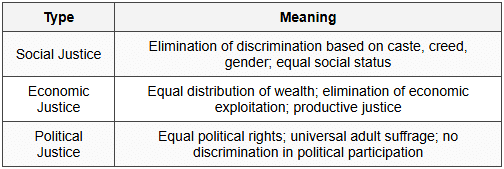
JUSTICE, social, economic and political;
LIBERTY of thought, expression, belief, faith and worship;
EQUALITY of status and of opportunity; and to promote among them all
FRATERNITY assuring the dignity of the individual and the unity and integrity of the Nation;
IN OUR CONSTITUENT ASSEMBLY this twenty-sixth day of November, 1949, do HEREBY ADOPT, ENACT AND GIVE TO OURSELVES THIS CONSTITUTION."
1.2 Source and Adoption
2. Key Terms
2.1 Sovereign

- Supreme power resides with the people
- Parliament can make laws subject to constitutional limitations
- No foreign power can dictate to Indian government
2.2 Socialist

- Added by 42nd Amendment, 1976
- Not doctrinaire socialism or state ownership of means of production
- Democratic socialism - mixed economy with public and private sectors
- Directive Principles reflect socialist goals
2.3 Secular

- Added by 42nd Amendment, 1976
- State maintains equal distance from all religions
- Articles 25-28 guarantee religious freedom
- Positive concept: state protects all religions (S.R. Bommai v. Union of India, 1994)
2.4 Democratic

- Representative democracy with universal adult suffrage
- Political democracy: one person, one vote, one value
- Social and economic democracy through Directive Principles
- Parliamentary form of government with executive accountable to legislature
2.5 Republic

- President elected indirectly for fixed term
- Contrasts with monarchy where headship is hereditary
- No privileged class; equality of opportunity for public office
3. Objectives in Preamble
3.1 Justice
3.2 Liberty
- Liberty of thought - freedom to form opinions and beliefs
- Liberty of expression - freedom to express views through speech, writing, etc.
- Liberty of belief - freedom to hold any religious or philosophical belief
- Liberty of faith - freedom to practice and profess any religion
- Liberty of worship - freedom of religious worship and ritual
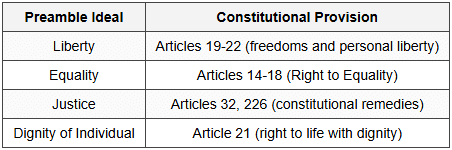
- Subject to reasonable restrictions under Fundamental Rights (Articles 19-22)
3.3 Equality
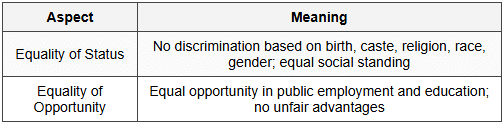
- Reflected in Articles 14-18 (Right to Equality)
- Permits affirmative action for disadvantaged groups
3.4 Fraternity

- Assures dignity of the individual - recognition of intrinsic worth of every person
- Ensures unity and integrity of the nation - national integration and solidarity
- "Integrity" added by 42nd Amendment, 1976
- Single citizenship promotes fraternity
4. Legal Status and Effect
4.1 Nature
4.2 Judicial Interpretation
4.3 Functions
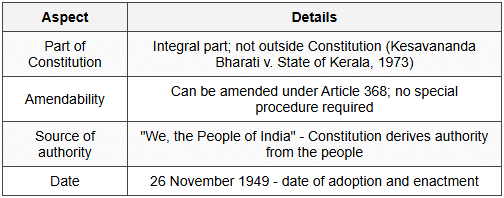
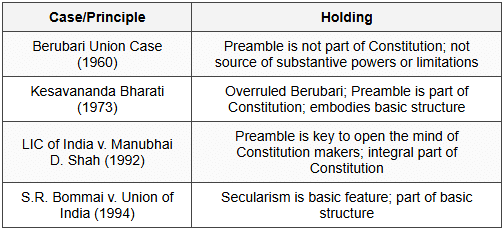
- Declares source of Constitution - the people of India
- States objectives of Constitution - justice, liberty, equality, fraternity
- Indicates date of adoption - 26 November 1949
- Guide for interpretation of provisions in case of ambiguity
- Embodies basic structure; cannot be destroyed by amendment
- Not enforceable in court but aids constitutional interpretation
4.4 Not Source of Limitations
- Does not confer powers or impose restrictions by itself
- Cannot override express provisions of Constitution
- Used as interpretative tool, not independent source of rights or duties
- Parliament's legislative power comes from specific Articles, not Preamble
5. Basic Structure Doctrine
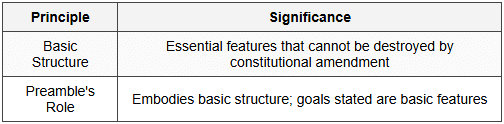
5.1 Preamble and Basic Structure
5.2 Basic Features from Preamble
- Sovereignty of India
- Democratic character of polity
- Secular character of Constitution
- Socialist character (economic justice)
- Republican form of government
- Justice - social, economic, political
- Liberty of thought, expression, belief, faith, worship
- Equality of status and opportunity
- Dignity of individual
- Unity and integrity of nation
6. Amendment History
6.1 42nd Amendment Act, 1976
6.2 Validity of Amendment
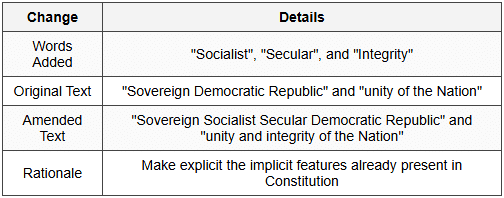
- 42nd Amendment not struck down; additions held valid
- Challenged in Kesavananda Bharati but amendment came later
- Socialist and secular principles already reflected in Constitution provisions
- Amendment made implicit features explicit
7. Comparison with Other Constitutions
7.1 Influence
7.2 Unique Features
- Combination of all five terms: Sovereign, Socialist, Secular, Democratic, Republic
- Explicit reference to Justice in three dimensions: social, economic, political
- Five specific liberties enumerated
- Fraternity linked to dignity of individual and integrity of nation
8. Key Judicial Pronouncements
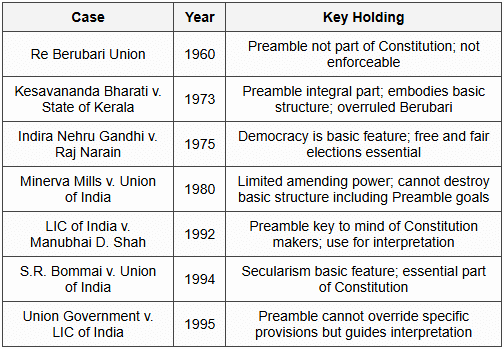
8.1 Important Cases
8.2 Interpretative Role
- Used to resolve ambiguity in constitutional provisions
- Assists in determining legislative competence in borderline cases
- Guides interpretation of Fundamental Rights and Directive Principles
- Cannot be used to expand or restrict express provisions
- Reflects philosophy and spirit of Constitution
9. Relationship with Other Parts
9.1 Fundamental Rights
9.2 Directive Principles
- Social justice - Articles 38, 39, 41-43, 46
- Economic justice - Articles 39, 39A, 43, 43A
- Political justice - Articles 326 (universal adult suffrage)
- Socialist goals - Articles 38, 39, 39A
- Secular principles - Article 44 (uniform civil code)
9.3 Fundamental Duties
- Article 51A(e) - promote harmony and fraternity
- Article 51A(a) - respect Constitution and ideals in Preamble
- Duties reflect Preamble's goals of unity, integrity, fraternity
10. Examination Points
10.1 Critical Facts
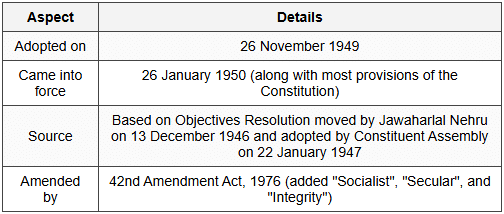
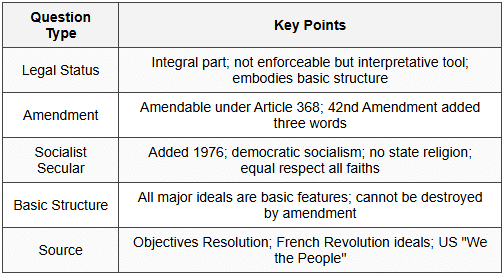
- Adopted: 26 November 1949; Came into force: 26 January 1950
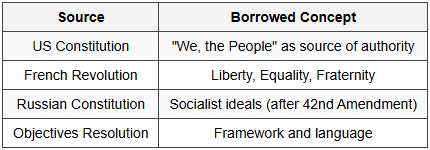
- Based on Objectives Resolution by Nehru (13 December 1946)
- 42nd Amendment (1976) added Socialist, Secular, Integrity
- Kesavananda Bharati (1973) made Preamble part of Constitution
- Berubari (1960) held Preamble not part of Constitution - overruled
- S.R. Bommai (1994) held secularism basic feature
10.2 Common Questions
10.3 Distinction Points
- Sovereign vs. Republic: sovereignty = independence; republic = elected head
- Democratic vs. Republic: democracy = rule by people; republic = no hereditary ruler
- Socialist (India) vs. Communist: mixed economy vs. state ownership
- Secular (India) vs. Western: equal respect all religions vs. separation church-state
- Justice vs. Equality: justice broader concept including fairness; equality specific aspect
- Liberty vs. License: liberty subject to reasonable restrictions; not absolute freedom
The document Cheat Sheet: Preamble is a part of the CLAT PG Course Constitutional Law.
All you need of CLAT PG at this link: CLAT PG
About this Document

4.97/5 Rating

Apr 20, 2026 Last updated
Related Exams
Document Description: Cheat Sheet: Preamble for CLAT PG 2026 is part of Constitutional Law preparation. The notes and questions for Cheat Sheet: Preamble have been prepared according to the CLAT PG exam syllabus. Information about Cheat Sheet: Preamble covers topics like and Cheat Sheet: Preamble Example, for CLAT PG 2026 Exam. Find important definitions, questions, notes, meanings, examples, exercises and tests below for Cheat Sheet: Preamble.
Introduction of Cheat Sheet: Preamble in English is available as part of our Constitutional Law for CLAT PG & Cheat Sheet: Preamble in Hindi for Constitutional Law course. Download more important topics related with notes, lectures and mock test series for CLAT PG Exam by signing up for free. CLAT PG: Cheat Sheet: Preamble
Description
Cheat Sheet: Preamble of Constitutional Law to help you remember important concepts with short tricks. Start learning for CLAT PG exam & improve retention with EduRev.
Information about Cheat Sheet: Preamble
In this doc you can find the meaning of Cheat Sheet: Preamble defined & explained in the simplest way possible. Besides explaining types of Cheat Sheet: Preamble theory, EduRev gives you an ample number of questions to practice Cheat Sheet: Preamble tests, examples and also practice CLAT PG tests



Related Searches
past year papers, Exam, Cheat Sheet: Preamble, Summary, Sample Paper, Free, Important questions, study material, Viva Questions, Semester Notes, MCQs, pdf , shortcuts and tricks, mock tests for examination, Cheat Sheet: Preamble, practice quizzes, video lectures, ppt, Extra Questions, Previous Year Questions with Solutions, Objective type Questions, Cheat Sheet: Preamble;