CLAT PG Exam > CLAT PG Notes > Family Law > Cheat Sheet: Hindu Law: Succession, Adoption, and Guardianship
Cheat Sheet: Hindu Law: Succession, Adoption, and Guardianship


1. Hindu Succession
1.1 Governing Legislation
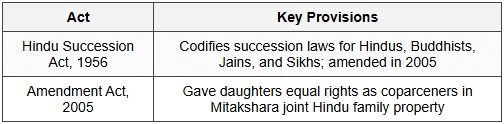
1.2 Application of the Act
- Applies to Hindus, Buddhists, Jains, and Sikhs by religion
- Does not apply to Scheduled Tribes unless Central Government notifies
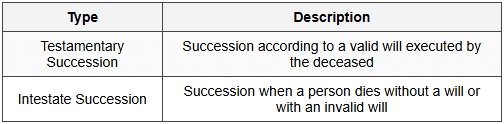
- Applies to intestate succession (dying without a will)
- Also applies to testamentary succession where provisions of the Act are relevant
1.3 Types of Succession
1.4 Coparcenary Property
1.4.1 Definition and Characteristics
- Coparcenary: A body of persons who acquire joint interest in ancestral property by birth
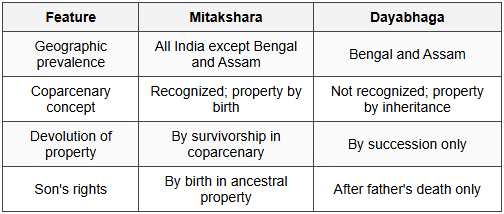
- Applies only to Mitakshara school of Hindu law
- Property devolves by survivorship, not succession
- Each coparcener has unity of ownership and possession
1.4.2 Coparceners (After 2005 Amendment)
- Son, daughter, grandson, great-grandson acquire interest by birth
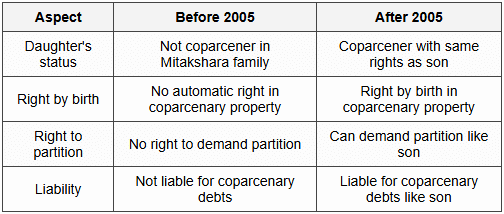
- Daughters are coparceners with same rights and liabilities as sons (Section 6)
- Daughters' rights are retrospective from 9 September 2005 regardless of father's death date
- Maximum 4 degrees from the last holder in lineal descent
1.4.3 Section 6 - Devolution of Interest in Coparcenary Property
- Interest devolves by survivorship among surviving coparceners
- If coparcener dies leaving female relatives or male relatives claiming through females, property devolves as per Act
- Daughter has same rights and liabilities as son in coparcenary property
- Section 6 applies to living daughters as on 9 September 2005 even if father died earlier (Prakash v. Phulavati, 2016)
1.5 Intestate Succession - Male Hindu Dying Intestate
1.5.1 General Rules of Succession (Section 8)
- Property devolves first upon heirs being Class I heirs
- If no Class I heirs, then upon Class II heirs
- If no Class I or Class II heirs, then upon agnates
- If no agnates, then upon cognates
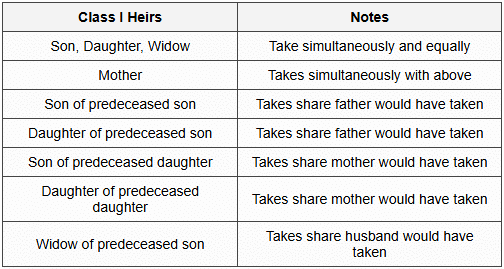
1.5.2 Class I Heirs (Section 8, Schedule)
1.5.3 Class II Heirs (Section 8, Schedule)
- Entry 1: Father
- Entry 2: Son's daughter's son, son's daughter's daughter, brother, sister
- Entry 3: Daughter's son's son, daughter's son's daughter, daughter's daughter's son, daughter's daughter's daughter
- Entry 4: Brother's son, sister's son, brother's daughter, sister's daughter
- Entry 5: Father's father, father's mother
- Entry 6: Father's widow, brother's widow
- Entry 7: Father's brother, father's sister
- Entry 8: Mother's father, mother's mother
- Entry 9: Mother's brother, mother's sister
1.5.4 Distribution Among Class I Heirs (Section 10)
- Heirs in Class I take simultaneously and to the exclusion of all other heirs
- They take per capita and not per stirpes except for certain categories
- Children of predeceased children take share parent would have taken
1.5.5 Distribution Among Class II Heirs (Section 11)
- Heirs in Entry 1 take to the exclusion of other entries
- If no heir in Entry 1, then Entry 2 heirs succeed, and so on
- Those in same entry take simultaneously
1.5.6 Agnates and Cognates (Section 12)

1.6 Intestate Succession - Female Hindu Dying Intestate
1.6.1 Order of Succession (Section 15)
- First: Upon sons and daughters (including children of predeceased son/daughter) and husband
- Second: Upon heirs of husband
- Third: Upon mother and father
- Fourth: Upon heirs of father
- Fifth: Upon heirs of mother
1.6.2 Special Rule for Property Inherited from Parents (Section 15(2)(a))
- If female dies without children, property inherited from father/mother devolves upon heirs of father
1.6.3 Special Rule for Property Inherited from Husband/Father-in-law (Section 15(2)(b))
- If female dies without children, property inherited from husband or father-in-law devolves upon heirs of husband
1.7 Rules of Succession
1.7.1 General Principles
- Heirs succeed to property per capita unless specified otherwise
- Child in womb at time of death capable of being born alive is deemed living person (Section 20)
- Heir disqualified if he/she murdered the deceased (Section 25)
- Convert to another religion loses inheritance rights (Section 26)
1.7.2 Rights of Female Heirs
- Female heirs have absolute ownership over property inherited (Section 14(1))
- Limited estate concept abolished for females
- Property possessed by female under any instrument prior to Act becomes her absolute property
1.8 Partition
1.8.1 Right to Partition
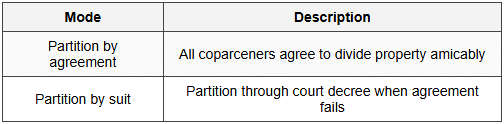
- Any coparcener can demand partition at any time
- Since 2005, daughters have right to demand partition like sons
- Partition can be total or partial
1.8.2 Modes of Partition
2. Hindu Adoption
2.1 Governing Legislation
- Hindu Adoptions and Maintenance Act, 1956
- Applies to Hindus, Buddhists, Jains, and Sikhs
- Codified and reformed customary adoption laws
2.2 Definition and Nature
- Adoption: Legal process by which a person takes another person as his/her child
- Creates permanent parent-child relationship
- Adopted child severs ties with biological family
- Adoption is irrevocable once validly made
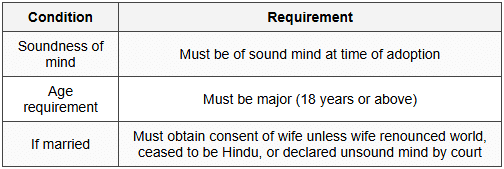
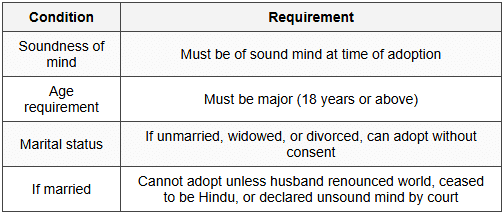
2.3 Capacity to Adopt (Section 7-8)
2.3.1 Male Hindu (Section 7)
2.3.2 Female Hindu (Section 8)
2.4 Capacity to Give in Adoption (Section 9)
2.4.1 Who Can Give Child in Adoption
- Father with consent of mother (unless mother renounced world, ceased to be Hindu, or declared unsound mind)
- Mother with consent of father (unless father renounced world, ceased to be Hindu, declared unsound mind, or completely unknown)
- Mother alone if father is dead
- Guardian with permission of court if both parents dead, unknown, or abandoned child
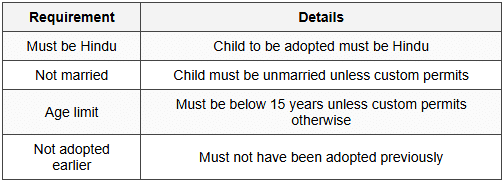
2.5 Who May Be Adopted (Section 10)
2.6 Other Conditions for Valid Adoption (Section 11)
- If adopting son, adoptive father/mother must not have Hindu son, son's son, or son's son's son living at time of adoption
- If adopting daughter, adoptive father/mother must not have Hindu daughter or son's daughter living at time of adoption
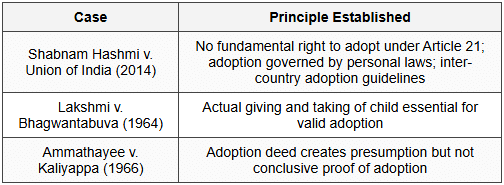
- Adopted child must be 21 years younger than adoptive father and 18 years younger than adoptive mother (Shabnam Hashmi v. Union of India, 2014)
- Same child cannot be adopted by two persons
2.7 Procedure and Ceremonies (Section 12)
- No specific ceremony required for valid adoption
- Actual giving and taking of child necessary
- Adoption deed advisable but not mandatory
- Registration of adoption not compulsory but recommended
2.8 Effects of Adoption (Section 12)
2.8.1 Rights in Adoptive Family
- Adopted child deemed to be child of adoptive parents from date of adoption
- All ties of adopted child with family of birth severed
- Acquires rights in adoptive family as if born in that family
- Can inherit property of adoptive family
2.8.2 Cessation of Rights in Birth Family
- Loses all rights in family of birth including coparcenary rights
- Exception: Property vested before adoption continues with adopted child (Section 12 proviso)
- Cannot marry within prohibited degrees of adoptive family
2.9 Valid and Invalid Adoptions
2.9.1 Presumption of Validity (Section 16)
- Registered adoption document raises presumption of genuineness
- Burden of proof on person challenging adoption
2.9.2 Invalid Adoptions
- Adoption not complying with Sections 6-11 is void
- Cannot be validated subsequently
- No legal relationship created between parties
2.10 Adopted Children and Succession Rights
- Adopted son/daughter entitled to inherit from adoptive father/mother
- Succession rights same as biological children after 1956 Act
- No discrimination between adopted and biological children in inheritance
3. Hindu Guardianship
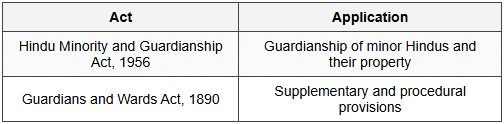
3.1 Governing Legislation
3.2 Definition of Terms (Section 4)
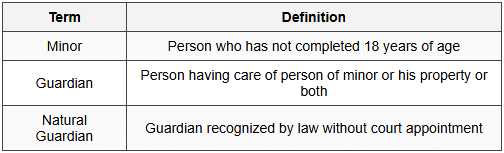
3.3 Types of Guardians
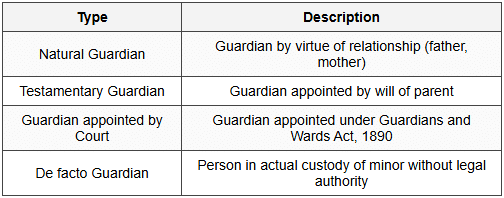
3.4 Natural Guardians (Section 6)
3.4.1 Of Minor's Person and Property
- For legitimate minor boy/girl: Father, then mother
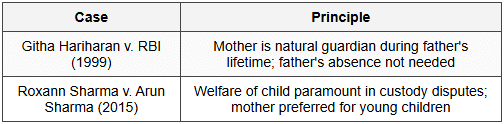
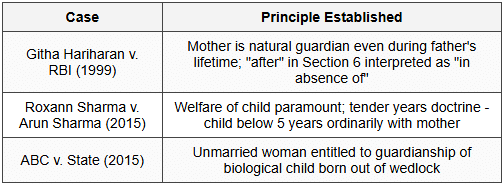
- Custody of minor below 5 years ordinarily with mother
- For illegitimate minor boy/girl: Mother, then father
- For adopted child: Adoptive father, then adoptive mother
- Husband is not natural guardian of wife even if she is minor
3.4.2 Priority Between Father and Mother
- Before amendment: Father was primary natural guardian
- After 2010 informal practice: Both parents recognized equally
- Welfare of child is paramount consideration (Githa Hariharan v. RBI, 1999)
3.5 Testamentary Guardian (Section 9)
3.5.1 Appointment by Will
- Father entitled to appoint guardian by will for legitimate minor
- Mother entitled to appoint guardian by will if father is dead
- Testamentary guardian acts after death of parent making appointment
- Can appoint guardian for person or property or both
3.5.2 Conditions for Validity
- Appointment must be by valid will
- Person appointed must consent to act as guardian
- Appointment continues during minority of child
3.6 Powers of Natural and Testamentary Guardians (Section 8)
3.6.1 General Powers
- Do all acts necessary for benefit and welfare of minor
- Protect and preserve minor's property
- Powers subject to restrictions in Section 8(2)
3.6.2 Restrictions on Guardian's Powers (Section 8(2))
- Cannot mortgage or charge immovable property without court permission
- Cannot transfer immovable property by sale, gift, or exchange without court permission
- Cannot transfer movable property by gift without court permission
- Exception: Lease up to 5 years or 1 year beyond minority permissible
3.6.3 Court Permission (Section 8(3))
- Court grants permission only if necessary or clearly for minor's benefit
- Guardian must demonstrate legal necessity or benefit
3.7 De Facto Guardian (Section 11)
- Person in actual charge of minor without legal authority
- Can do acts which natural/testamentary guardian is empowered to do (Section 11(1))
- Cannot bind minor by contract beyond reasonable personal needs (Section 11(3))
- Cannot dispose of immovable property of minor (Section 11(4))
3.8 Court-Appointed Guardian
- Appointed under Guardians and Wards Act, 1890
- Court considers welfare of minor as paramount (Section 13, G&W Act)
- Can be appointed for person, property, or both
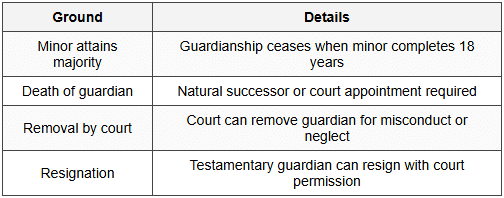
- Court has power to remove or replace guardian
3.9 Welfare of Minor - Paramount Consideration
- Welfare of minor is of paramount consideration in all guardianship matters
- Overrides statutory preferences in appropriate cases
- Courts have wide discretion to determine what constitutes welfare
- Includes physical, emotional, intellectual, and moral welfare
3.10 Termination of Guardianship
3.11 Key Case Laws
4. Important Statutory Provisions
4.1 Hindu Succession Act, 1956 - Key Sections
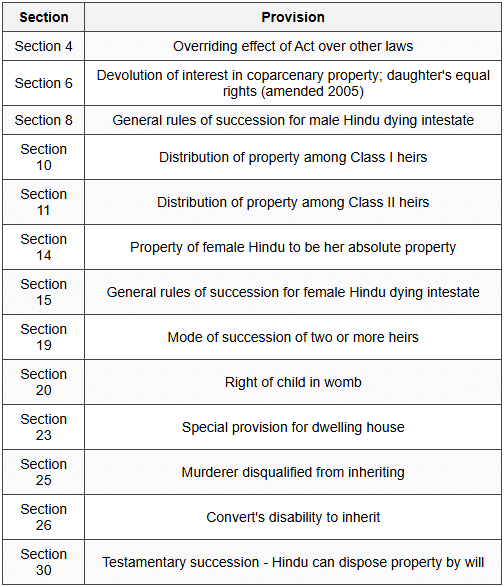
4.2 Hindu Adoptions and Maintenance Act, 1956 - Key Sections
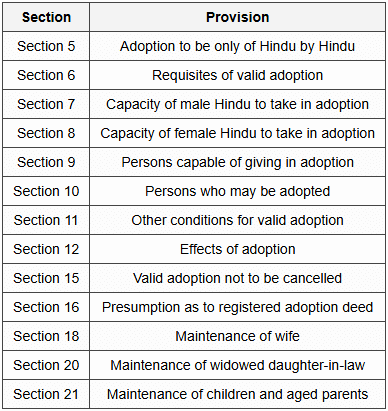
4.3 Hindu Minority and Guardianship Act, 1956 - Key Sections
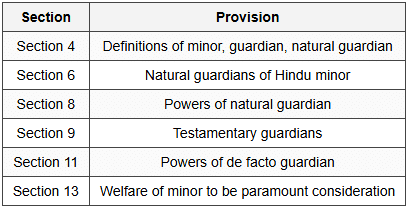
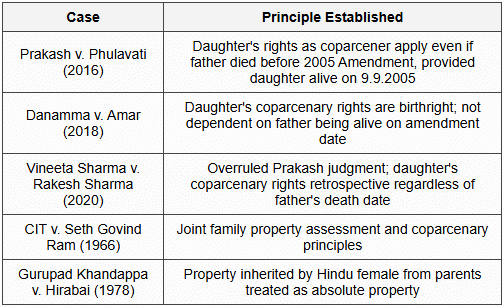
5. Important Case Laws
5.1 Succession
5.2 Adoption
5.3 Guardianship
6. Key Distinctions and Comparisons
6.1 Succession: Before and After 2005 Amendment
6.2 Mitakshara vs. Dayabhaga Schools
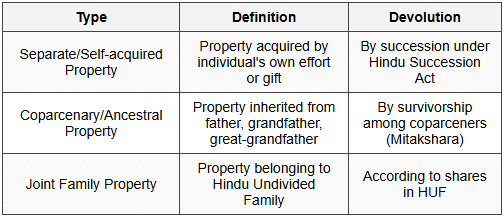
6.3 Types of Property for Succession
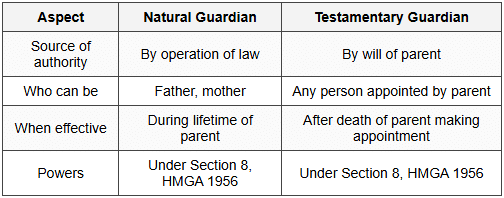
6.4 Natural Guardian vs. Testamentary Guardian
The document Cheat Sheet: Hindu Law: Succession, Adoption, and Guardianship is a part of the CLAT PG Course Family Law.
All you need of CLAT PG at this link: CLAT PG
About this Document

4.98/5 Rating

Apr 20, 2026 Last updated
Related Exams
Document Description: Cheat Sheet: Hindu Law: Succession, Adoption, and Guardianship for CLAT PG 2026 is part of Family Law preparation. The notes and questions for Cheat Sheet: Hindu Law: Succession, Adoption, and Guardianship have been prepared according to the CLAT PG exam syllabus. Information about Cheat Sheet: Hindu Law: Succession, Adoption, and Guardianship covers topics like and Cheat Sheet: Hindu Law: Succession, Adoption, and Guardianship Example, for CLAT PG 2026 Exam. Find important definitions, questions, notes, meanings, examples, exercises and tests below for Cheat Sheet: Hindu Law: Succession, Adoption, and Guardianship.
Introduction of Cheat Sheet: Hindu Law: Succession, Adoption, and Guardianship in English is available as part of our Family Law for CLAT PG & Cheat Sheet: Hindu Law: Succession, Adoption, and Guardianship in Hindi for Family Law course. Download more important topics related with notes, lectures and mock test series for CLAT PG Exam by signing up for free. CLAT PG: Cheat Sheet: Hindu Law: Succession, Adoption, and Guardianship
Description
Cheat Sheet: Hindu Law: Succession, Adoption, & Guardianship of Family Law to help you remember important concepts with short tricks. Start learning for CLAT PG exam & improve retention with EduRev.
Information about Cheat Sheet: Hindu Law: Succession, Adoption, and Guardianship
In this doc you can find the meaning of Cheat Sheet: Hindu Law: Succession, Adoption, and Guardianship defined & explained in the simplest way possible. Besides explaining types of Cheat Sheet: Hindu Law: Succession, Adoption, and Guardianship theory, EduRev gives you an ample number of questions to practice Cheat Sheet: Hindu Law: Succession, Adoption, and Guardianship tests, examples and also practice CLAT PG tests



Related Searches
study material, ppt, Objective type Questions, pdf , and Guardianship, Summary, Adoption, Cheat Sheet: Hindu Law: Succession, Extra Questions, Adoption, Previous Year Questions with Solutions, mock tests for examination, Adoption, Free, past year papers, Semester Notes, Important questions, Cheat Sheet: Hindu Law: Succession, practice quizzes, Cheat Sheet: Hindu Law: Succession, and Guardianship, shortcuts and tricks, MCQs, and Guardianship, Viva Questions, Exam, video lectures, Sample Paper;