CLAT PG Exam > CLAT PG Notes > Law of Torts > Cheat Sheet: Nuisance
Cheat Sheet: Nuisance


1. Definition and Nature of Nuisance
1.1 Concept
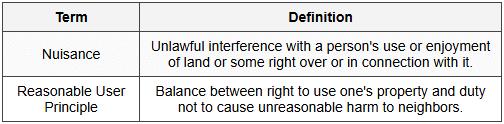
1.2 Essential Elements
- Unlawful interference
- With use or enjoyment of land
- Or interference with some right over or in connection with land
- Interference must be substantial and unreasonable
2. Types of Nuisance
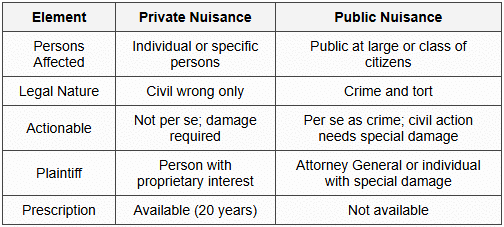
2.1 Public Nuisance
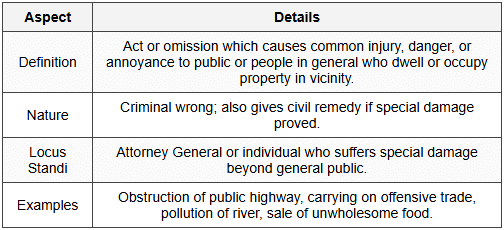
2.1.1 Special Damage Requirement
- Must be particular, direct, and substantial
- Must be different in kind (not merely degree) from that suffered by public at large
- Case: Rose v. Miles - obstruction of navigable creek causing plaintiff to use longer route held special damage
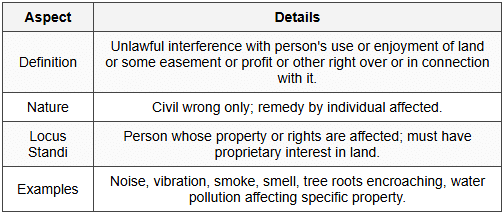
2.2 Private Nuisance
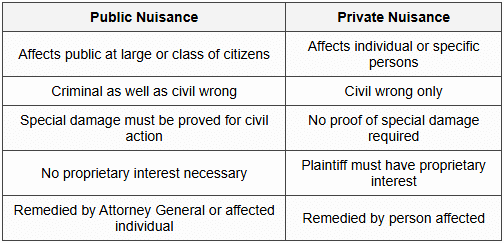
3. Distinction Between Public and Private Nuisance
4. Elements and Ingredients of Private Nuisance
4.1 Unreasonable Interference
- Test: Would ordinary person of normal sensibilities consider interference unreasonable?
- Factors: duration, frequency, intensity, nature of locality, time, utility of defendant's conduct
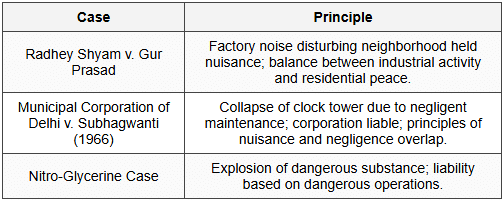
- Case: Radhey Shyam v. Gur Prasad - noise from defendant's factory held nuisance
4.2 Damage to Plaintiff
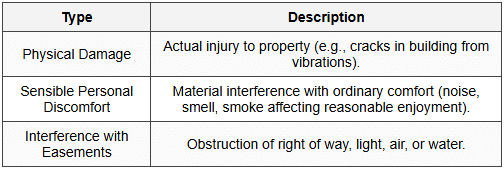
4.3 Continuous Activity
- Nuisance must be continuous or recurrent, not isolated incident
- Single isolated escape may be actionable under Rylands v. Fletcher but not nuisance
- However, state of affairs can constitute nuisance even without repeated acts
5. Actionable Per Se
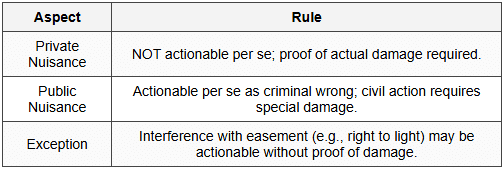
6. Who Can Sue
6.1 Locus Standi
- Person with proprietary interest in land affected
- Includes owner, tenant, lessee, licensee with exclusive possession
- Mere licensee without exclusive possession cannot sue
- Case: Malone v. Laskey - wife of tenant held no right to sue as she had no proprietary interest
6.2 Public Nuisance
- Attorney General on behalf of public
- Local authority
- Private individual who suffers special damage
7. Who Can Be Sued
7.1 Creator of Nuisance
- Person who creates or continues nuisance is liable
- Liability even after ceasing to occupy premises
7.2 Occupier of Premises
- Liable for nuisance created by himself, his servants, family members, or guests
- Liable for continuing nuisance created by predecessor if aware and failed to remedy
- Liable for nuisance arising from natural causes if failed to take reasonable steps after knowledge
7.3 Landlord
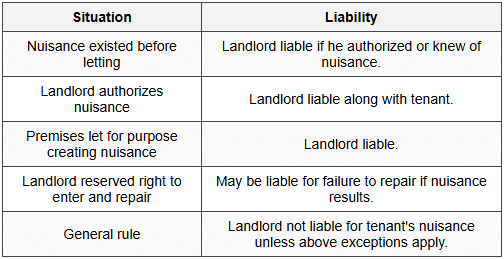
7.4 Independent Contractor
- General rule: employer not liable for torts of independent contractor
- Exception: employer liable if work is inherently hazardous or creates nuisance
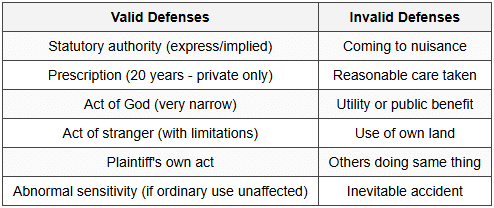
8. Defenses to Nuisance
8.1 Statutory Authority
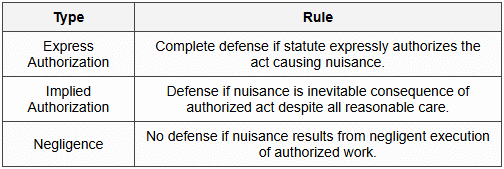
- Case: Hammersmith Railway Co. v. Brand - railway authorized by statute; inevitable noise not actionable
8.2 Prescription
- Continuous commission of private nuisance for 20 years without interruption may create right by prescription
- Time begins when nuisance becomes actionable
- Not available for public nuisance
- Must be of same character throughout; increase in intensity defeats defense
- Case: Sturges v. Bridgman - 20 years use not defense if nuisance only became actionable recently
8.3 Act of God (Vis Major)
- Defense if nuisance results from extraordinary act of nature which no human foresight could provide against
- Extremely narrow defense; natural events must be unprecedented and unforeseeable
8.4 Inevitable Accident
- Not a defense in nuisance; strict liability applies
- Defendant liable even if all reasonable care taken
8.5 Acts of Third Party or Stranger
- Generally a defense if nuisance created by trespasser or stranger over whom defendant has no control
- Exception: defendant liable if he knew or ought to have known of nuisance and failed to remedy it
- Occupier must take reasonable steps to abate nuisance once aware
8.6 Plaintiff's Own Act
- Defense if plaintiff by his own act brought himself within range of operation causing injury
- Case: Kiddle v. City Business Properties - plaintiff excavated causing subsidence; cannot sue for nuisance
9. Invalid Defenses
9.1 Defenses That Will NOT Succeed
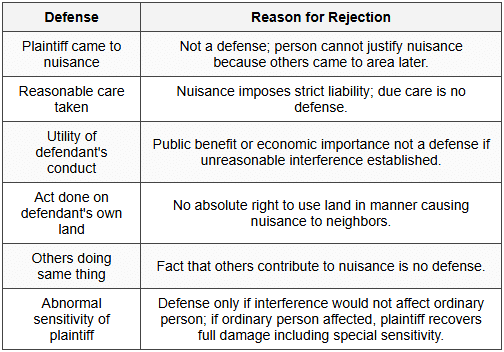
9.2 Coming to Nuisance
- Case: Sturges v. Bridgman - defendant's confectionery operated 20 years; when plaintiff built consulting room, held defendant liable for noise nuisance
- Case: Bliss v. Hall - defendant operating tallow factory; plaintiff built house nearby; defendant still liable
9.3 Abnormal Sensitivity
- Case: Robinson v. Kilvert - heat damaging special paper; no nuisance as ordinary paper unaffected
- Case: Heath v. Mayor of Brighton - vibrations damaging scientific instruments; no nuisance as ordinary structures unaffected
- If ordinary use affected, plaintiff can recover for all damage including to sensitive property
10. Factors Determining Nuisance
10.1 Tests of Reasonableness
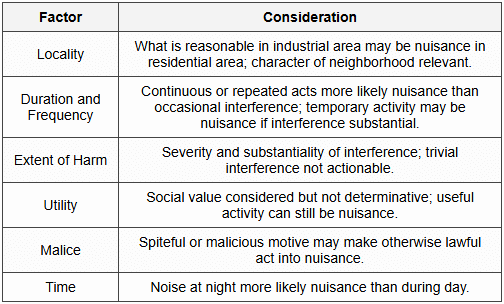
10.2 Principle of Locality
- Case: Sturges v. Bridgman - "what would be nuisance in Belgrave Square would not necessarily be so in Bermondsey"
- Standard: ordinary comfort according to notions of plain and sober people
- Does not apply to physical damage to property; locality irrelevant if actual damage caused
- Case: St. Helens Smelting Co. v. Tipping - locality relevant for personal discomfort, not material injury to property
10.3 Malice
- Case: Christie v. Davey - defendant made noise to annoy plaintiff's music lessons; malice made it nuisance
- Case: Hollywood Silver Fox Farm v. Emmett - defendant fired guns to harm plaintiff's foxes during breeding; malice established nuisance
- Malicious motive can convert otherwise reasonable act into unreasonable interference
11. Remedies for Nuisance
11.1 Abatement
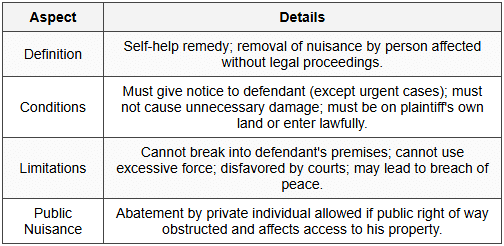
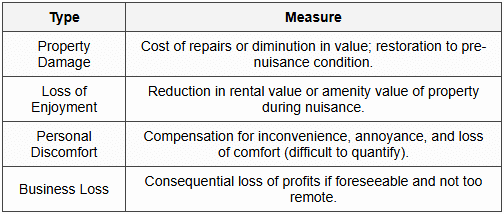
11.2 Damages
- Compensatory damages for actual loss suffered
- Includes diminution in property value, physical damage, personal discomfort
- Continuing nuisance: successive actions for damages allowed
- Measure: loss in value of use and enjoyment of property
11.3 Injunction
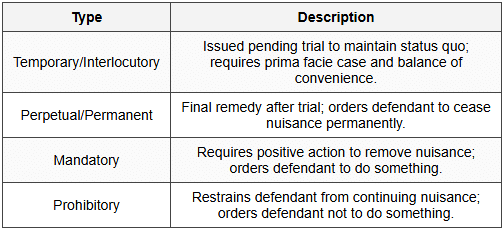
11.3.1 Principles for Grant of Injunction
- Equitable discretionary remedy
- Balance of convenience considered
- Granted where damages inadequate remedy
- May be refused if hardship to defendant disproportionate to benefit to plaintiff
- Public interest considered
- Court may award damages in lieu of injunction in appropriate cases
11.4 Action on Case
- Ordinary civil action for damages
- Proof of actual damage required in private nuisance
- Burden of proof on plaintiff to establish unreasonable interference
12. Nuisance Distinguished from Other Torts
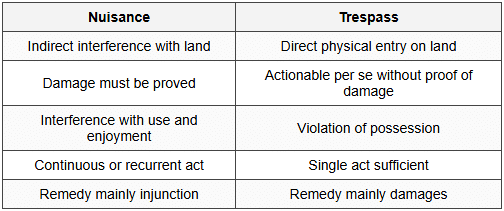
12.1 Nuisance vs. Trespass
12.2 Nuisance vs. Negligence
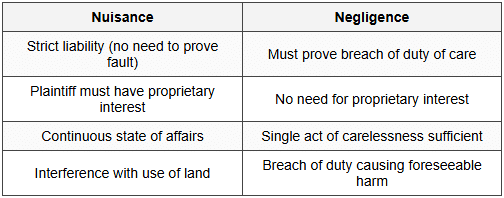
12.3 Nuisance vs. Rylands v. Fletcher
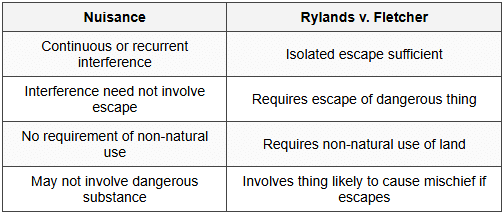
13. Important Cases
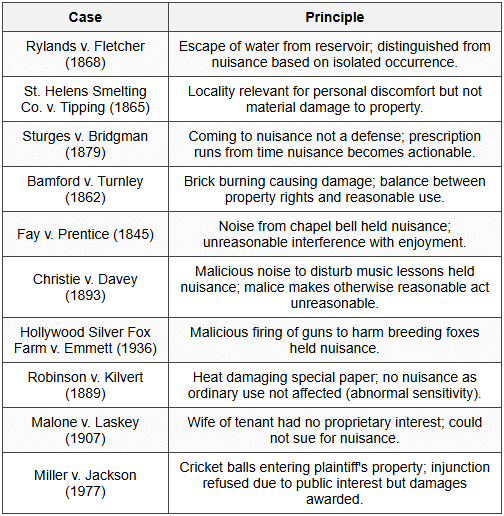
13.1 Landmark Judgments
13.2 Indian Cases
14. Special Types of Nuisance
14.1 Nuisance by Noise
- Excessive noise from industrial operations, construction, loudspeakers, musical instruments
- Reasonableness judged by time, duration, locality, intensity
- Night noise more readily actionable than daytime
14.2 Nuisance by Smell and Fumes
- Offensive smells from factories, trades, decomposing matter
- Emission of harmful fumes or gases
- Test: material interference with ordinary comfort of human existence
14.3 Nuisance by Vibration
- Vibrations from machinery, pile-driving, blasting causing physical damage or discomfort
- Physical damage actionable regardless of locality
- Mere discomfort judged by locality and reasonableness
14.4 Nuisance by Water, Smoke, and Pollution
- Discharge of polluted water affecting neighbor's land or water rights
- Excessive smoke from chimneys interfering with comfort
- Accumulation of water causing dampness or flooding
14.5 Nuisance by Tree Roots and Branches
- Encroachment of branches overhanging neighbor's land
- Tree roots penetrating and damaging neighbor's property
- Right to abate by cutting roots and branches on own land
- Must give notice before cutting unless urgent
14.6 Nuisance to Easements
- Obstruction of right of light by erecting building blocking windows
- Interference with right of way
- Diversion of water affecting riparian rights
- Interference with right of support
14.7 Nuisance to Highway
- Public nuisance: obstruction, danger, annoyance to highway users
- Projection of signs, goods, or structures onto highway
- Excavation near highway causing danger
- Allowing premises adjoining highway to fall into dangerous state
15. Burden of Proof
15.1 General Rule
- Burden on plaintiff to establish:
- Unlawful interference with his use or enjoyment of land
- Interference is unreasonable and substantial
- Actual damage suffered (except public nuisance where special damage must be proved)
- Proprietary interest in land affected
15.2 Defenses
- Once plaintiff establishes prima facie case, burden shifts to defendant to prove defense
- Defendant must establish statutory authority, prescription, act of God, etc.
16. Measure of Damages
16.1 Principles
16.2 Continuing Nuisance
- Separate cause of action arises each day nuisance continues
- Plaintiff can bring successive actions for damages
- Injunction preferred remedy to avoid multiplicity of suits
17. Exam-Relevant Distinctions
17.1 Key Differences Summary
17.2 Defenses Quick Reference
The document Cheat Sheet: Nuisance is a part of the CLAT PG Course Law of Torts.
All you need of CLAT PG at this link: CLAT PG
About this Document

4.64/5 Rating

Apr 20, 2026 Last updated
Related Exams
Document Description: Cheat Sheet: Nuisance for CLAT PG 2026 is part of Law of Torts preparation. The notes and questions for Cheat Sheet: Nuisance have been prepared according to the CLAT PG exam syllabus. Information about Cheat Sheet: Nuisance covers topics like and Cheat Sheet: Nuisance Example, for CLAT PG 2026 Exam. Find important definitions, questions, notes, meanings, examples, exercises and tests below for Cheat Sheet: Nuisance.
Introduction of Cheat Sheet: Nuisance in English is available as part of our Law of Torts for CLAT PG & Cheat Sheet: Nuisance in Hindi for Law of Torts course. Download more important topics related with notes, lectures and mock test series for CLAT PG Exam by signing up for free. CLAT PG: Cheat Sheet: Nuisance
Description
Cheat Sheet: Nuisance of Law of Torts to help you remember important concepts with short tricks. Start learning for CLAT PG exam & improve retention with EduRev.
Information about Cheat Sheet: Nuisance
In this doc you can find the meaning of Cheat Sheet: Nuisance defined & explained in the simplest way possible. Besides explaining types of Cheat Sheet: Nuisance theory, EduRev gives you an ample number of questions to practice Cheat Sheet: Nuisance tests, examples and also practice CLAT PG tests



Related Searches
mock tests for examination, Cheat Sheet: Nuisance, Semester Notes, Viva Questions, Sample Paper, Cheat Sheet: Nuisance, MCQs, past year papers, shortcuts and tricks, Extra Questions, Exam, Previous Year Questions with Solutions, ppt, Important questions, study material, Objective type Questions, Free, pdf , video lectures, practice quizzes, Summary, Cheat Sheet: Nuisance;