CLAT PG Exam > CLAT PG Notes > Criminal Law > Cheat Sheet: General Exceptions under IPC
Cheat Sheet: General Exceptions under IPC


1. Introduction to General Exceptions
1.1 Overview
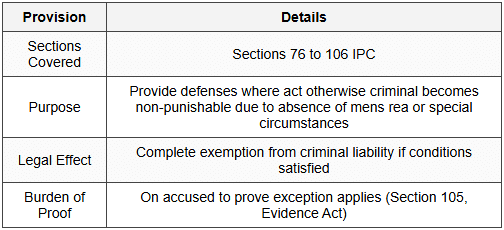
2. Acts of a Person Bound by Law
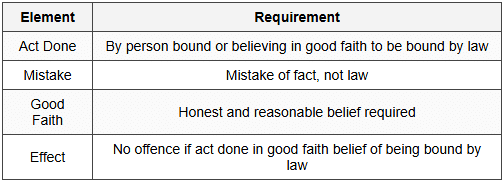
2.1 Section 76 - Mistake of Fact Believing Bound by Law
2.2 Section 77 - Act of Judge When Acting Judicially
- Judge acting judicially exempt from criminal liability
- Must be done in capacity as judge
- Covers judicial orders and acts within jurisdiction
- Protection absolute when acting judicially
2.3 Section 78 - Act Done Pursuant to Judgment or Order of Court
- Act done in pursuance of judgment/order of court
- No liability if court had jurisdiction over matter
- Protection even if judgment/order later set aside
2.4 Section 79 - Act Done by Person Justified or Excused by Law
- Act justified or excused by law not an offence
- Includes acts authorized by statute or legal provisions
- Must be within scope of justification/excuse
3. Mistake of Fact
3.1 Section 76 & 79 - Mistake of Fact Protection
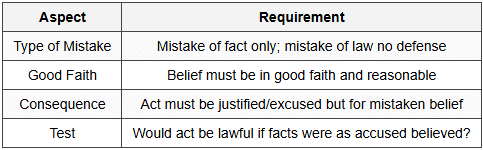
3.2 Key Cases
- Chirangi v. State: Mistake of fact defense requires reasonable and honest belief
- R v. Tolson: Mistake must be reasonable to person of ordinary prudence
4. Accident and Misfortune
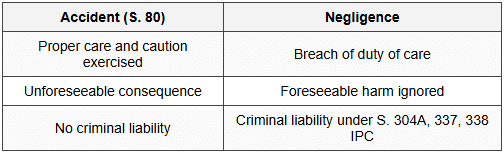
4.1 Section 80 - Accident in Doing Lawful Act
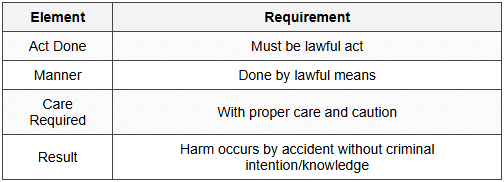
- All four conditions must be satisfied simultaneously
- Burden on accused to prove accident
- No negligence or recklessness permitted
4.2 Distinction from Negligence
5. Infancy
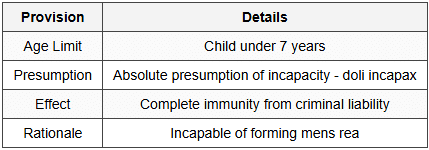
5.1 Section 82 - Act of Child Under Seven Years
5.2 Section 83 - Act of Child Above Seven and Under Twelve Years
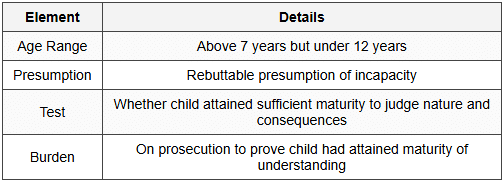
- Must show child understood act was wrong or contrary to law
- Assessment based on individual capacity, not age alone
6. Insanity
6.1 Section 84 - Act of Person of Unsound Mind
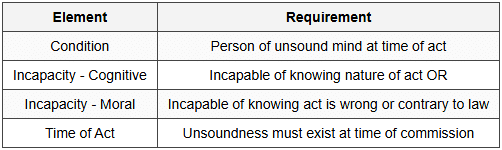
6.2 Legal Tests and Principles
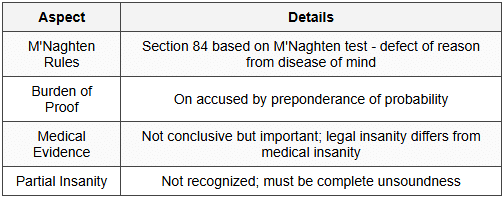
6.3 Key Exclusions
- Irresistible impulse alone not covered under Section 84
- Voluntary intoxication not insanity unless causes permanent insanity
- Emotional stress or provocation not unsoundness of mind
- Diminished responsibility not recognized as partial defense
6.4 Important Cases
- Dahyabhai v. State of Gujarat: Burden on accused to prove insanity
- Surendra Mishra v. State of Jharkhand: Legal insanity must affect cognitive or moral capacity
- Ratan Lal v. State of MP: Insanity at time of act, not before or after
7. Intoxication
7.1 Section 85 - Act of Person Incapable of Judgment by Intoxication
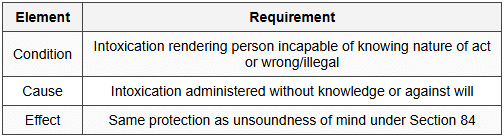
7.2 Section 86 - Offence Requiring Particular Knowledge or Intent
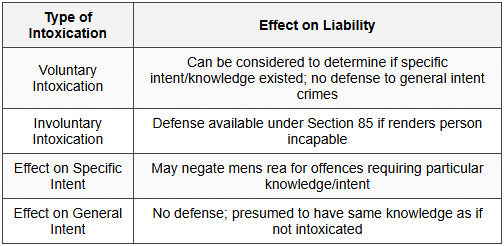
7.3 Voluntary vs Involuntary Intoxication
- Voluntary: Self-induced, no defense except to negate specific intent
- Involuntary: Without knowledge/against will, full defense under Section 85
- Pathological intoxication may qualify as involuntary
8. Consent
8.1 Section 87 - Act Not Intended and Not Known to Cause Death or GH
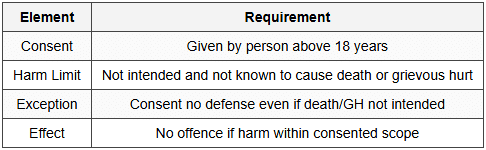
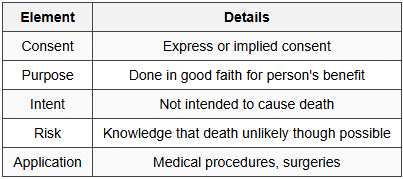
8.2 Section 88 - Act Not Intended to Cause Death, Done in Good Faith for Benefit
8.3 Section 89 - Act Done in Good Faith for Benefit of Child/Insane Person
- Guardian's consent valid for child under 12 years or person of unsound mind
- Act must be in good faith for benefit of person
- Not intended to cause death or grievous hurt
- Covers medical treatment with parental consent
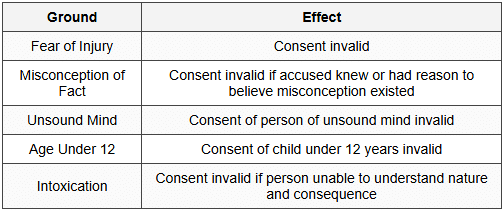
8.4 Section 90 - Consent Not Free
8.5 Section 91 - Exclusion of Acts Likely to Cause GH
- Sections 87, 88, 89 not applicable to acts known to cause/attempt/likely to cause grievous hurt or death
- Exception: Acts done in good faith for benefit not excepted
8.6 Section 92 - Act Done in Good Faith for Benefit Without Consent
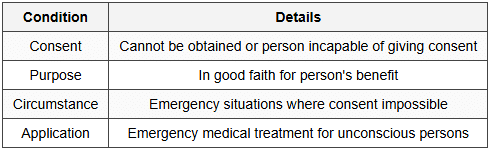
8.7 Section 92 Proviso - Harm to Third Party
- Exception does not extend to voluntary causing of grievous hurt or attempting to cause death
- Exception does not extend to abetment of offence
9. Communication Made in Good Faith
9.1 Section 93 - Communication Made in Good Faith
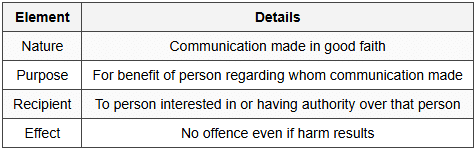
- Protects bona fide communications like medical advice, warnings
- Must be in good faith without malice
10. Necessity and Compulsion
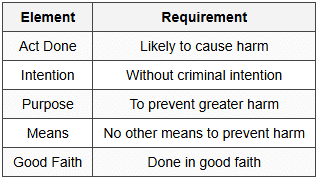
10.1 Section 81 - Act Likely to Cause Harm but Done to Prevent Greater Harm
10.1.1 Conditions for Section 81
- Act must be done without criminal intention
- Act done in good faith for purpose of preventing harm
- Harm prevented must be greater than harm caused
- Harm apprehended must be to person or property
10.1.2 Key Cases
- Emperor v. Omkar Ramji: Balancing of harms required
- Ram Lila's Case: Necessity must be genuine and imminent
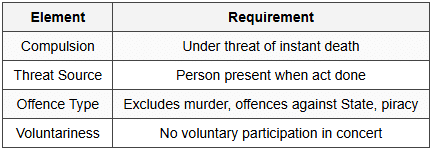
10.2 Section 94 - Act to Which Person is Compelled by Threats
10.2.1 Limitations of Section 94
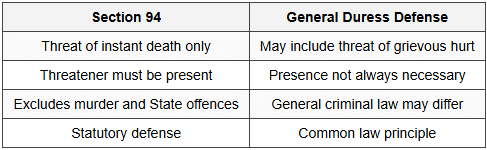
- Not available for murder or offences punishable with death
- Not available for offences against State
- Not available if person voluntarily placed himself in situation
- Threat must be of instant death, not future harm
- Person threatening must be present when act done
10.2.2 Comparison with Duress
11. Right of Private Defence
11.1 Section 96 - Things Done in Private Defence
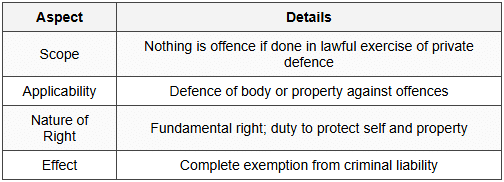
11.2 Section 97 - Right of Private Defence of Body and Property
- Every person has right to defend own and another's body
- Every person has right to defend own and another's property
- Right subject to restrictions in Sections 99
11.3 Section 99 - Limitations on Right of Private Defence
11.3.1 Acts Against Which No Right of Private Defence
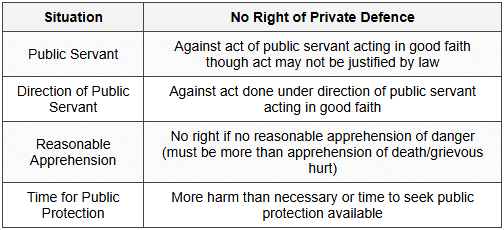
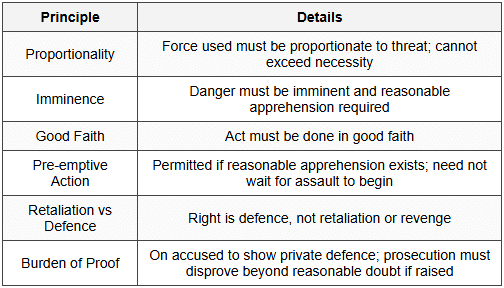
11.3.2 Conditions for Valid Exercise
- Must not inflict more harm than necessary
- Must be proportionate to threat
- Must commence when danger reasonably apprehended
- Must continue only while danger persists
- Cannot be exercised vindictively or as retaliation
11.4 Private Defence of Body
11.4.1 Section 100 - When Right Extends to Causing Death
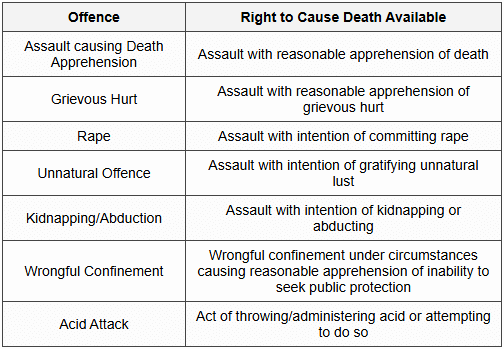
11.4.2 Section 101 - When Right Does Not Extend to Causing Death
- For offences not listed in Section 100, right limited to causing harm other than death
- Applies to simple hurt, assault, criminal force not endangering life
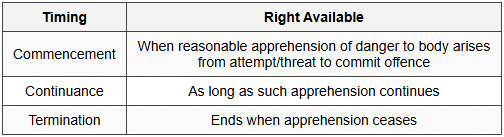
11.4.3 Section 102 - Commencement and Continuance
11.5 Private Defence of Property
11.5.1 Section 103 - When Right Extends to Causing Death
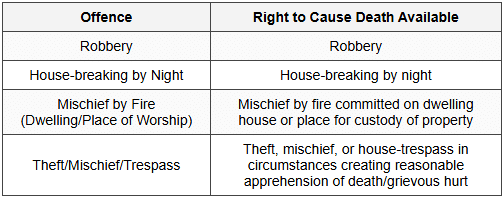
11.5.2 Section 104 - When Right Does Not Extend to Causing Death
- Property defence not extending to death for offences not covered in Section 103
- Applies to simple theft, trespass, mischief without aggravating circumstances
11.5.3 Section 105 - Commencement and Continuance
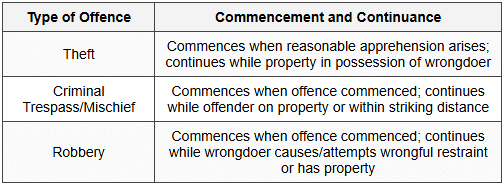
11.5.4 Section 106 - Right of Private Defence Against Deadly Assault
- Right available even if act does not amount to offence due to youth, unsoundness of mind, intoxication, or misconception
- Right extends to causing death if assault falls under Section 100 circumstances
- Innocence or incapacity of aggressor not bar to right of defence
11.6 Key Principles
11.7 Important Cases on Private Defence
- Darshan Singh v. State of Punjab: Right cannot be vindictive; must be proportionate
- Deo Narain v. State of UP: Reasonableness of apprehension judged from accused's perspective
- James Martin v. State of Kerala: Right available if circumstances create reasonable apprehension
- Munshi Ram v. Delhi Administration: Plea of private defence must be considered even if not specifically raised
12. Excluded Offences and Special Provisions
12.1 Offences Not Covered by General Exceptions
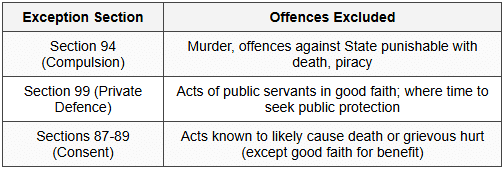
12.2 Burden of Proof
- Section 105 Evidence Act: Burden on accused to prove exception applies
- Standard: Preponderance of probability, not beyond reasonable doubt
- Once raised, prosecution must disprove beyond reasonable doubt
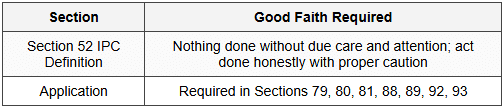
12.3 Good Faith Requirement
13. Comparative Analysis
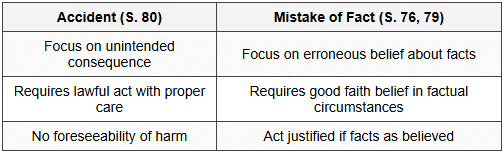
13.1 Accident vs Mistake of Fact
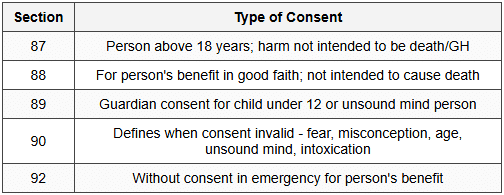
13.2 Consent Under Different Sections
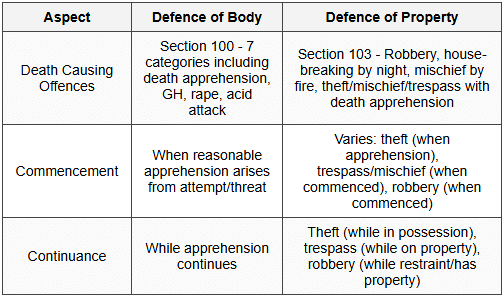
13.3 Private Defence: Body vs Property
14. Exam-Relevant Distinctions
14.1 Voluntary vs Involuntary Acts
- Voluntary intoxication: Limited defense under Section 86 for specific intent crimes only
- Involuntary intoxication: Full defense under Section 85 if incapacity established
- Act under compulsion (S. 94): Defense if threat of instant death, excludes murder
- Act in necessity (S. 81): Defense if done to prevent greater harm without other means
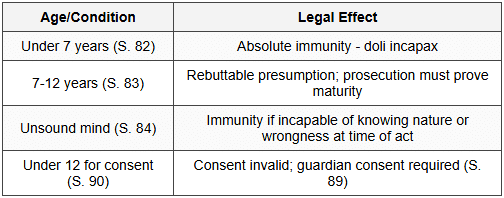
14.2 Capacity-Based Exceptions
14.3 Good Faith Standard
- Definition: Section 52 IPC - done honestly with due care and attention
- Not mere honesty; requires reasonable care
- Absence of malice or personal motive
- Judged objectively from circumstances
The document Cheat Sheet: General Exceptions under IPC is a part of the CLAT PG Course Criminal Law.
All you need of CLAT PG at this link: CLAT PG
About this Document

4.72/5 Rating

Apr 20, 2026 Last updated
Related Exams
Document Description: Cheat Sheet: General Exceptions under IPC for CLAT PG 2026 is part of Criminal Law preparation. The notes and questions for Cheat Sheet: General Exceptions under IPC have been prepared according to the CLAT PG exam syllabus. Information about Cheat Sheet: General Exceptions under IPC covers topics like and Cheat Sheet: General Exceptions under IPC Example, for CLAT PG 2026 Exam. Find important definitions, questions, notes, meanings, examples, exercises and tests below for Cheat Sheet: General Exceptions under IPC.
Introduction of Cheat Sheet: General Exceptions under IPC in English is available as part of our Criminal Law for CLAT PG & Cheat Sheet: General Exceptions under IPC in Hindi for Criminal Law course. Download more important topics related with notes, lectures and mock test series for CLAT PG Exam by signing up for free. CLAT PG: Cheat Sheet: General Exceptions under IPC
Description
Cheat Sheet: General Exceptions under IPC of Criminal Law to help you remember important concepts with short tricks. Start learning for CLAT PG exam & improve retention with EduRev.
Information about Cheat Sheet: General Exceptions under IPC
In this doc you can find the meaning of Cheat Sheet: General Exceptions under IPC defined & explained in the simplest way possible. Besides explaining types of Cheat Sheet: General Exceptions under IPC theory, EduRev gives you an ample number of questions to practice Cheat Sheet: General Exceptions under IPC tests, examples and also practice CLAT PG tests



Related Searches
Viva Questions, Objective type Questions, Cheat Sheet: General Exceptions under IPC, Sample Paper, Exam, mock tests for examination, shortcuts and tricks, ppt, Cheat Sheet: General Exceptions under IPC, Extra Questions, study material, pdf , Semester Notes, Cheat Sheet: General Exceptions under IPC, Free, video lectures, Important questions, Previous Year Questions with Solutions, Summary, past year papers, practice quizzes, MCQs;